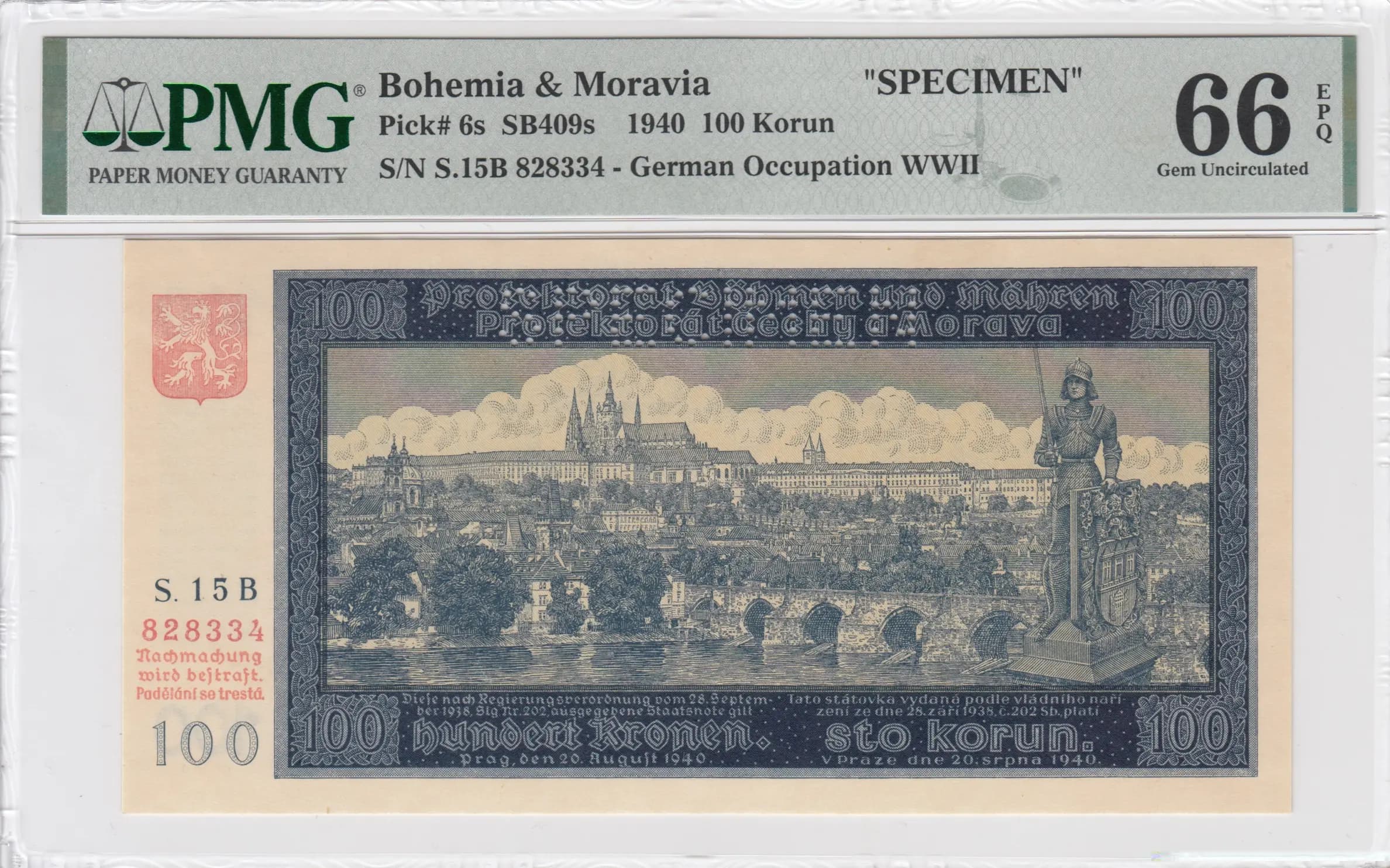
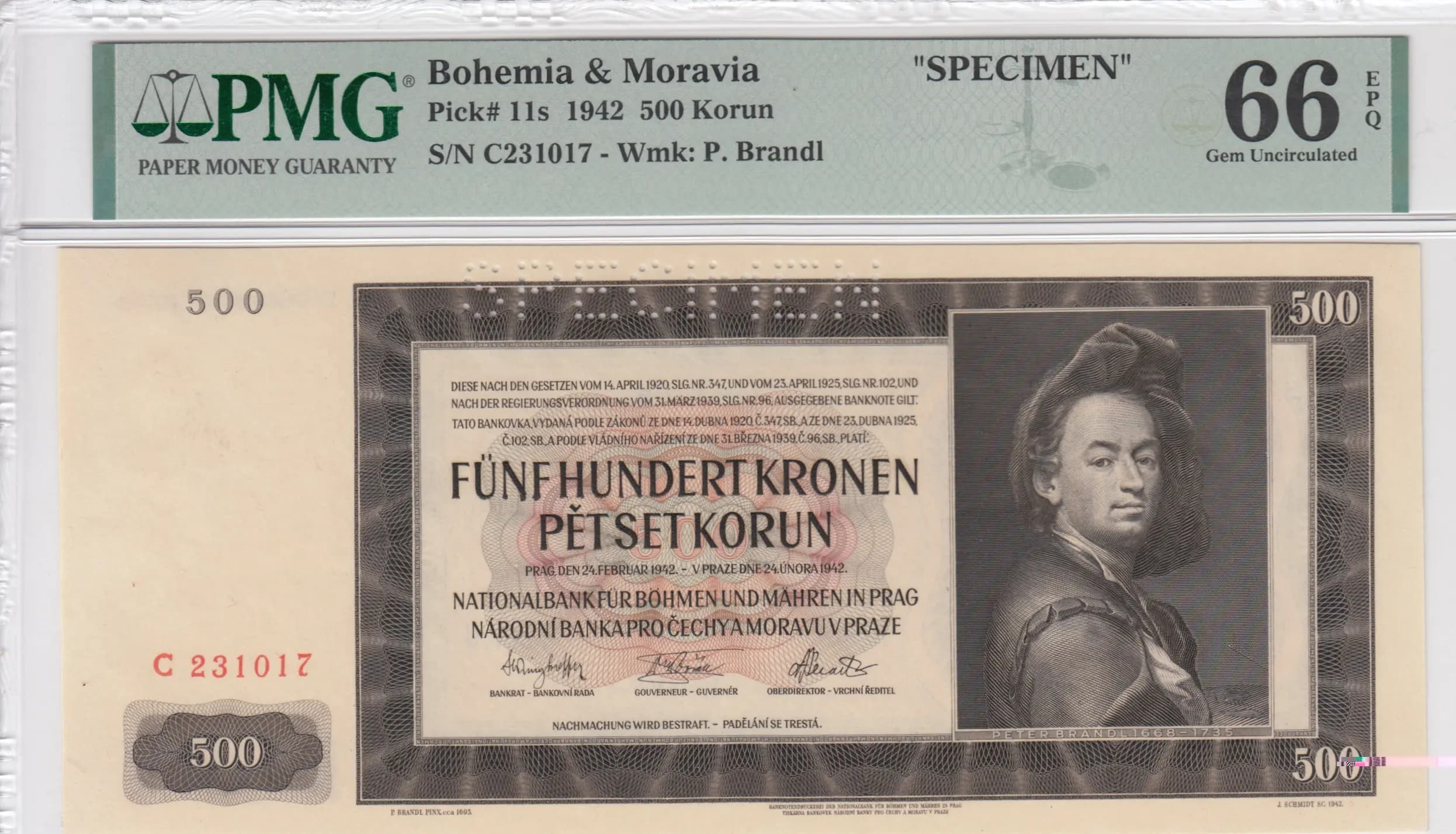
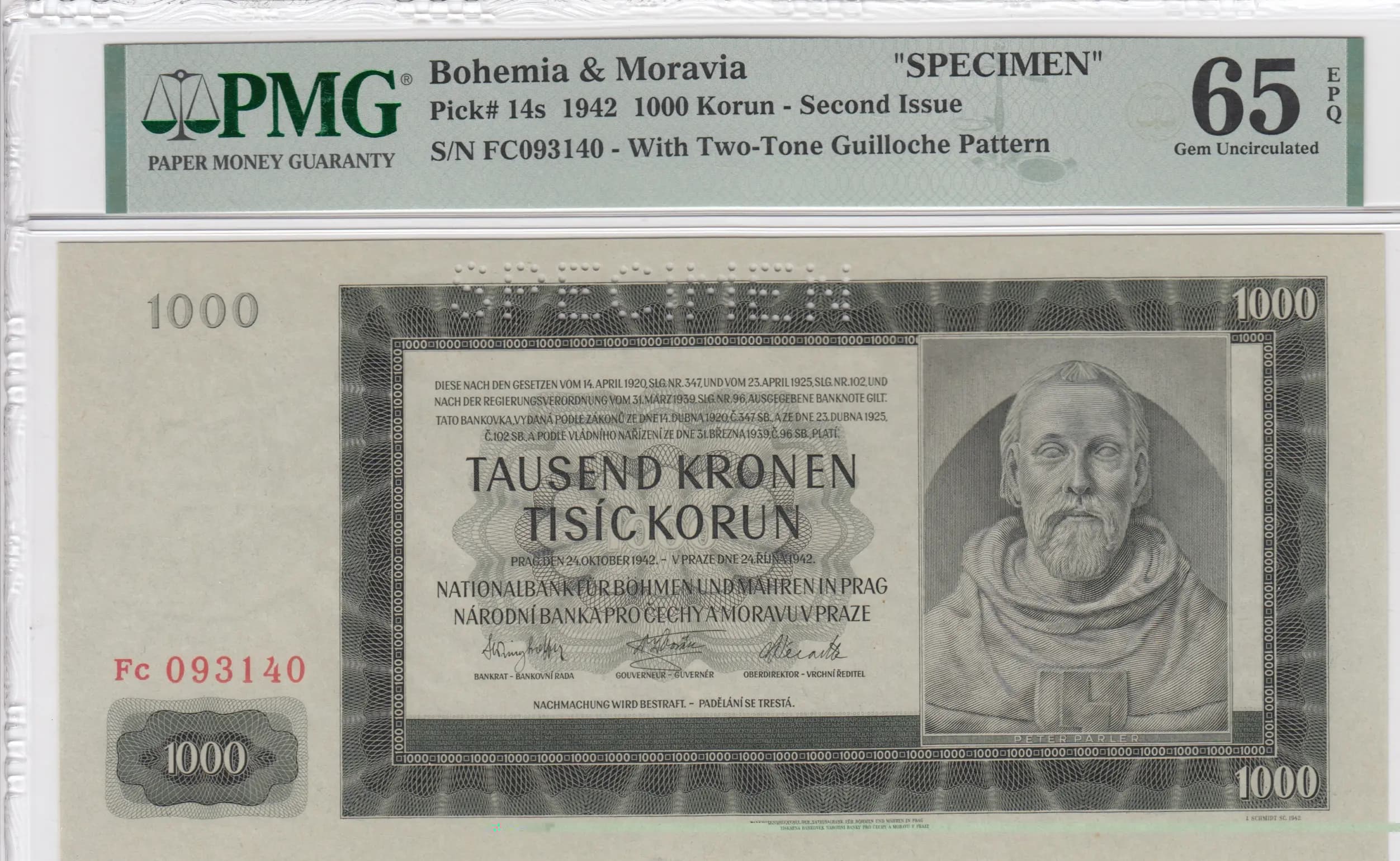
20 korun 1944 specimen
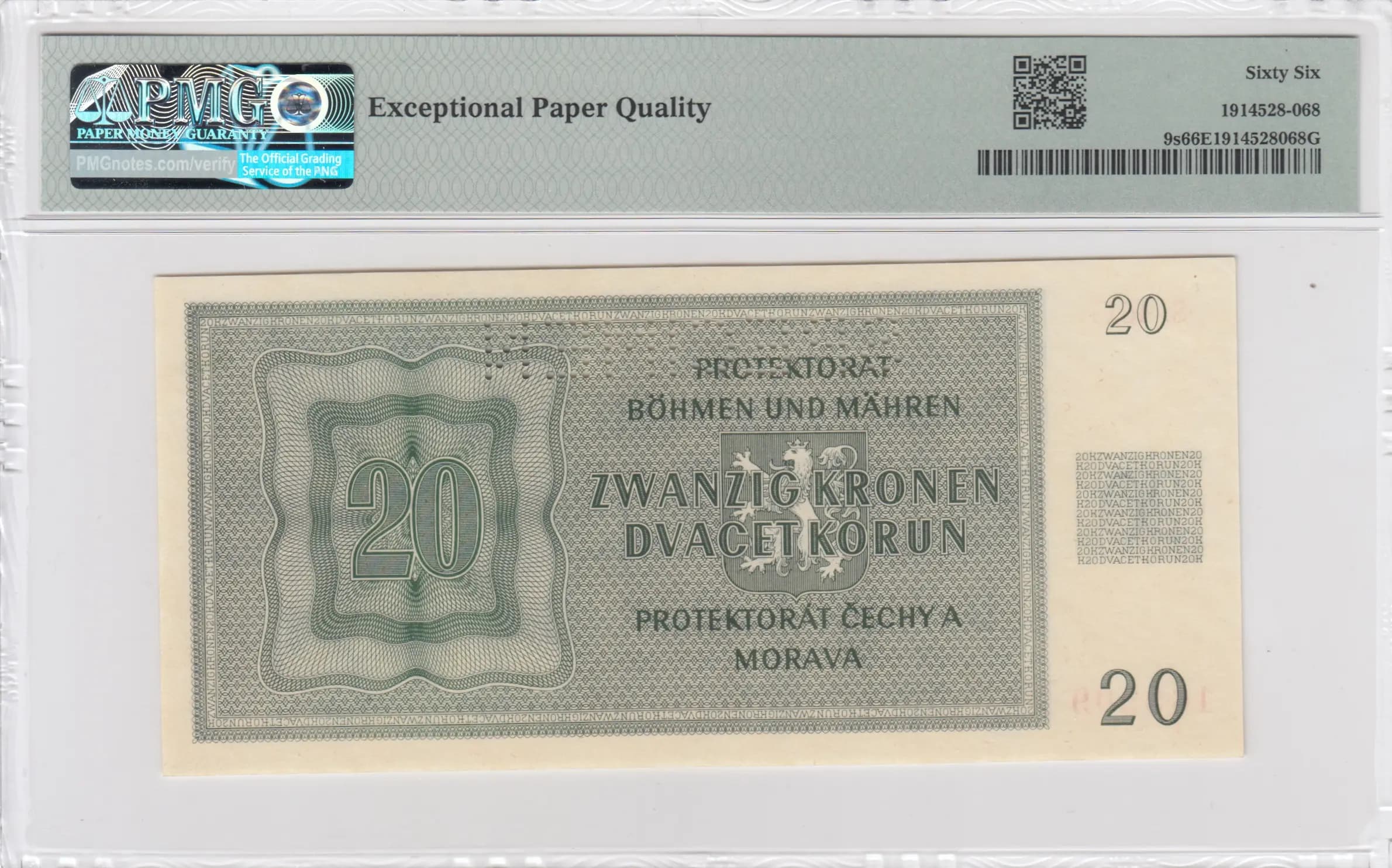
About This Note
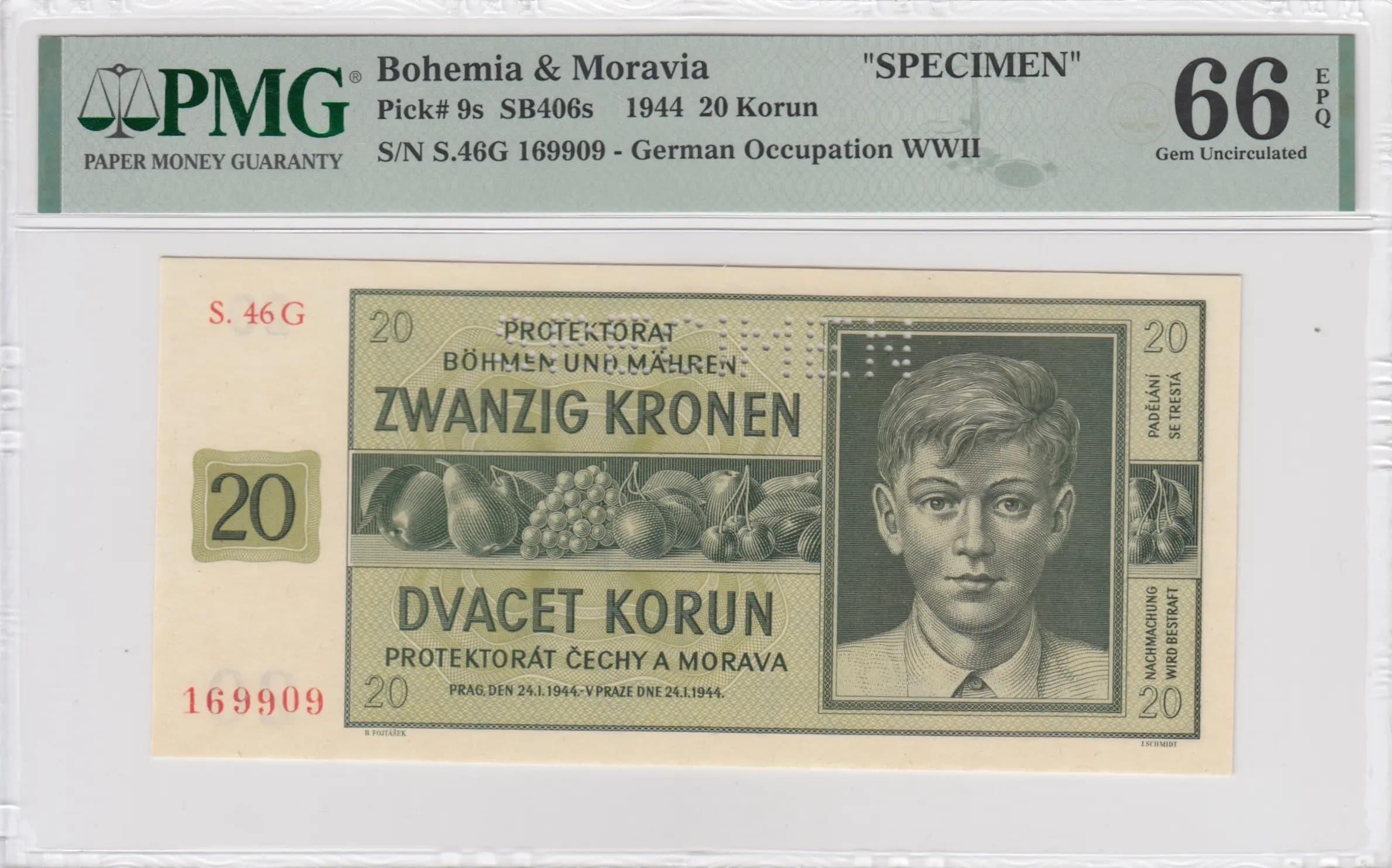
This is a PMG 66 EPQ specimen of the 1944 Bohemia & Moravia 20 Korun banknote, one of the final currency issues of the Protektorat Böhmen und Mähren before World War II's end. The obverse features a striking portrait of a young man in three-quarter view alongside an elaborate decorative motif of fruits and vegetables rendered in cream, green, and dark gray inks. As a specimen note marked 'S.46G' with red overprinting and serial number 169909, this represents an exceptional preservation example of wartime occupation currency with pristine paper and museum-quality presentation.
Uncommon. While the 1944 20 Korun denomination was issued in significant quantities during the final year of the Protectorate, specimen notes (marked 'S.46G') represent a fraction of total production and are considerably scarcer than circulation examples. The exceptional PMG 66 EPQ grade further elevates rarity, as most surviving specimens have experienced some handling or storage issues. The specific combination of specimen status, pristine condition, and documented provenance makes this a desirable acquisition for collectors of occupation currency and World War II-era numismatics, though not among the absolute rarest Bohemia & Moravia issues.
The Protektorat Böhmen und Mähren (Protectorate of Bohemia and Moravia) was established by Nazi Germany in 1939 following the occupation of the Czech lands, with this banknote issued near the end of the regime's control in January 1944. The bilingual German-Czech inscriptions ('PROTEKTORAT BÖHMEN UND MÄHREN' / 'PROTEKTORAT ČECHY A MORAVA') and dual denomination text reflect the nominal autonomy and Czech participation in the puppet state's administration. The decorative agricultural imagery symbolizes the economic resources of the protectorate, while the heraldic coat of arms on the reverse represents the formal governmental authority of the Nazi-controlled territory.
The obverse depicts an unidentified young man in formal three-quarter portrait view, rendered in high-quality steel engraving with fine grayscale linework characteristic of early 20th-century banknote portraiture. The portrait is flanked on the left by an allegorical agricultural still life featuring grapes, apples, pears, and other produce, symbolizing the Protectorate's economic productivity and agrarian resources under German administration. The denomination appears in multiple locations: as a large boxed numeral '20' on the left margin and as spelled-out text ('ZWANZIG KRONEN' / 'DVACET KORUN') across the upper center. The reverse features an ornamental heraldic composition centered on a coat of arms with eagle motifs, surrounded by intricate geometric guilloche patterns and decorative borders rendered in a single green-gray color. Both sides employ sophisticated multi-layered ornamental framing typical of high-security banknote design of the 1940s era.
FRONT SIDE: 'PROTEKTORAT BÖHMEN UND MÄHREN' = Protectorate of Bohemia and Moravia; 'ZWANZIG KRONEN' = Twenty Crowns (German); 'DVACET KORUN' = Twenty Crowns (Czech); 'PROTEKTORAT ČECHY A MORAVA' = Protectorate of Bohemia and Moravia (Czech); 'PRAG DEN 24.I.1944' = Prague, January 24, 1944; 'S.46G' = Specimen marking; '169909' = Serial number; 'VÝPRAŽ DNE 24.I.1944' = Printed January 24, 1944. REVERSE SIDE: '20' = Denomination numeral; 'PROTEKTORAT BÖHMEN UND MÄHREN' = Protectorate of Bohemia and Moravia; 'PROTEKTORAT ČECHY A MORAVA' = Protectorate of Bohemia and Moravia (Czech); 'ZWANZIG KRONEN' = Twenty Crowns (German); 'DVACET KORUN' = Twenty Crowns (Czech).
This note was produced using traditional intaglio (steel engraving) printing, the dominant security printing method for banknotes during the World War II period. The fine line engraving visible throughout both sides, the complex guilloche patterns on the reverse, and the precision of the portrait rendering are characteristic of intaglio production. The obverse exhibits two-color intaglio printing (green and dark gray/black inks), while the reverse is printed in a single green-gray color. The specimen overprinting ('S.46G') was applied as a secondary overprint in red ink, indicating this was a specimen note prepared for archival or demonstration purposes rather than circulation. The printer was the Reichsdruckerei (German State Printing Office) or affiliated security printing operations under Nazi administration.
This is a specimen variety (Pick P-9s designation confirms specimen status) marked 'S.46G' with red overprinting and bearing serial number 169909. The specimen overprint distinguishes it from circulation issues (Pick P-9). The date marking 'PRAG DEN 24.I.1944' / 'VÝPRAŽ DNE 24.I.1944' indicates this specimen was prepared on January 24, 1944, coinciding with the note's official release date. No significant printing varieties (such as signature variations, watermark differences, or serial number prefix changes) are evident in the visual analysis for this particular specimen.