50 francs 1966
About This Note
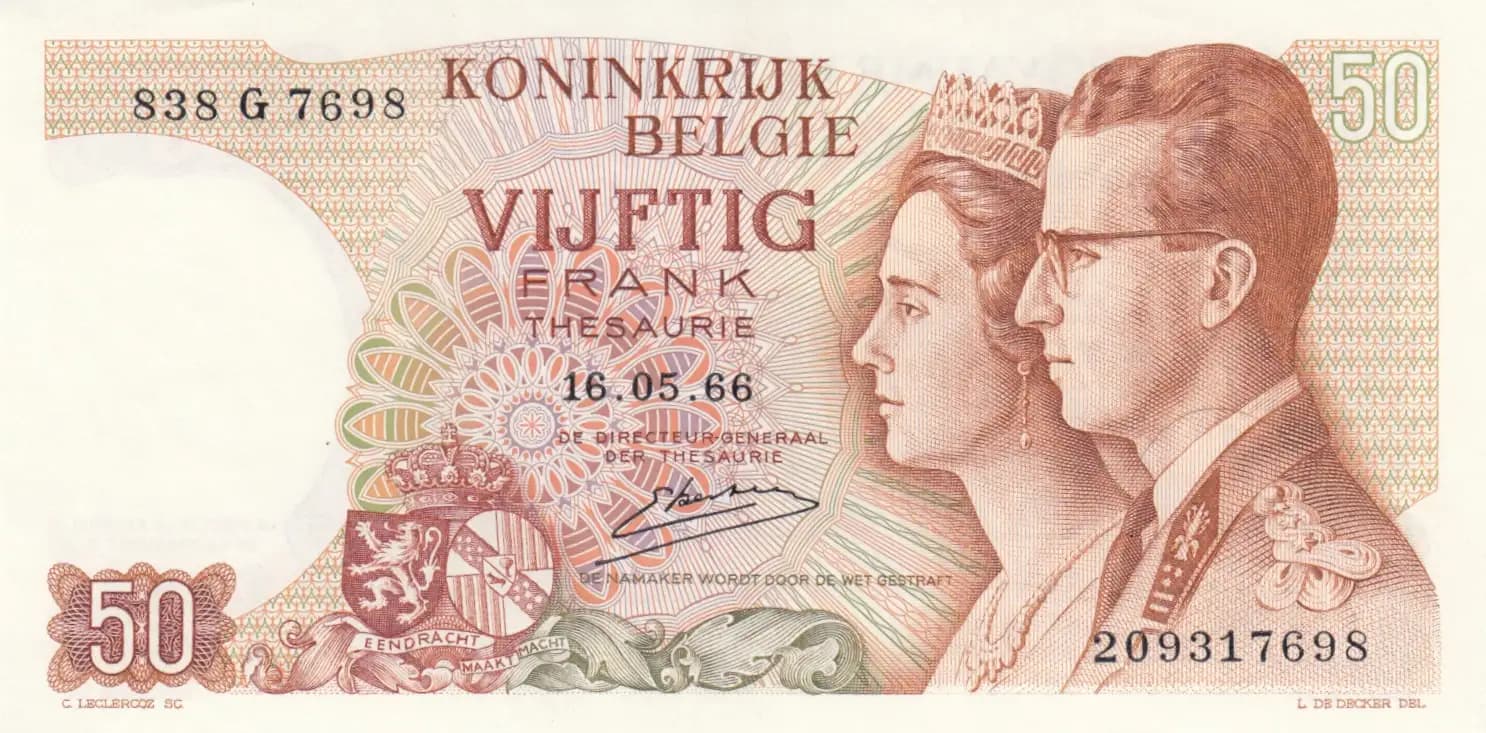
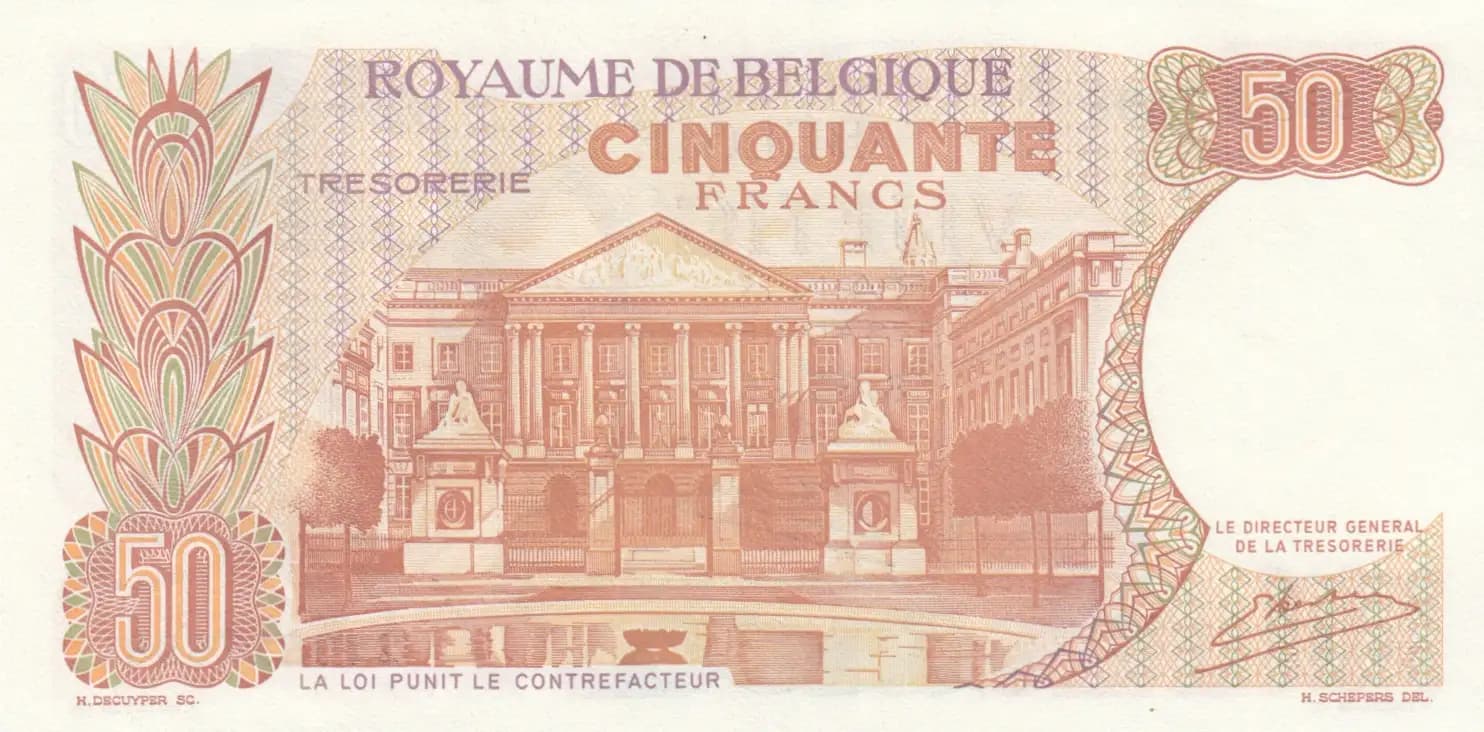
This is an uncirculated 1966 Belgian 50 franc banknote (Pick P-139(3)) in pristine condition, featuring elegant dual portraits of King Baudouin I and Queen Fabiola on the obverse within an ornate sunburst design frame. The reverse displays a classical parliamentary building with neoclassical columned architecture, reflecting Belgium's governmental heritage. The note exhibits exceptional clarity with crisp engraving throughout and no signs of wear, making it a desirable example of mid-20th century Belgian currency design.
Common. The 50 franc denomination from this 1966 series was part of standard circulation currency issues by the Belgian Treasury and saw substantial print runs. No evidence of limited production, early recall, or scarcity exists for this Pick number. Uncirculated examples are readily available in the numismatic market, with typical valuations well under $25 USD, consistent with common banknote pricing for this period and series.
Issued on May 16, 1966, this banknote reflects Belgium's post-war constitutional monarchy under King Baudouin I, who reigned from 1951-1993, and his queen consort Fabiola. The prominent depiction of the parliamentary building on the reverse symbolizes Belgium's democratic institutions during a period of economic recovery and political stability in Western Europe. The bilingual inscriptions in Dutch and French represent Belgium's linguistic duality, a defining characteristic of the nation's governance structure.
The obverse features dual facing portraits in right profile of King Baudouin I (right, in formal military dress) and Queen Fabiola (left, wearing an ornate crown and formal regalia), positioned center-right within elaborate decorative scrollwork. A prominent ornamental sunburst or radiating flower design frames the portraits, with a heraldic lion rampant coat of arms visible in the lower left. The reverse depicts the Belgian Parliament building (Palais de la Nation) in classical neoclassical style with a symmetrical columned facade, formal courtyard, and landscaped grounds with flanking trees. A large vertical lotus or ornamental flower design adorns the left side. Both sides feature denomination numerals (50) in outlined style at top right and bottom left corners. The color palette of brown, red-brown, cream, and tan provides the characteristic appearance of this series.
FRONT SIDE: 'KONINKRIJK BELGIE' (Kingdom of Belgium - Dutch), 'VIJFTIG FRANK' (Fifty Francs - Dutch), 'TRESORERIE' (Treasury - French), '16.05.66' (Date: May 16, 1966), 'DE DIRECTEUR GENERAAL DER THESAURIE' (The Director General of the Treasury - Dutch), 'C LECLEERCZ SC' (Engraver credit), 'L DE DECKER DEL' (Designer credit). BACK SIDE: 'ROYAUME DE BELGIQUE' (Kingdom of Belgium - French), 'CINQUANTE FRANCS' (Fifty Francs - French), 'TRESORERIE' (Treasury - French), 'LE DIRECTEUR GENERAL DE LA TRESORERIE' (The Director General of the Treasury - French), 'LA LOI PUNIT LE CONTREFACTEUR' (The law punishes the counterfeiter - French), 'K DSCUYPER SC' (Engraver credit), 'H SCHEPERS DEL' (Designer credit).
Steel engraving (intaglio) printing process, as evidenced by the fine line work, intricate guilloche patterns in borders and background, precise architectural detail rendering, and decorative scrollwork throughout. The crisp impression quality and sharp detail observable across all design elements are characteristic of high-quality engraved banknote production. The Belgian National Bank employed established security printers for this series, utilizing classical engraving techniques with multiple skilled engravers credited on the note (L. De Decker and C. Lecleercz on obverse; H. Schepers and K. Dscuyper on reverse).
Pick P-139(3) designation indicates this is the third variety/issue of the 50 franc 1966 type. Varieties in this series are distinguished by signature combinations of treasury officials and serial number prefixes. The observed note bears serial numbers including '838 G 7698' and '20931769 8', which would require cross-reference with comprehensive Belgian banknote catalogs to establish the specific signature variety. The bilingual inscription arrangement (Dutch on obverse, French on reverse) is standard for Belgian notes of this period reflecting the nation's constitutional bilingualism.