5 francs 1943
Market Prices
55 salesAbout This Note
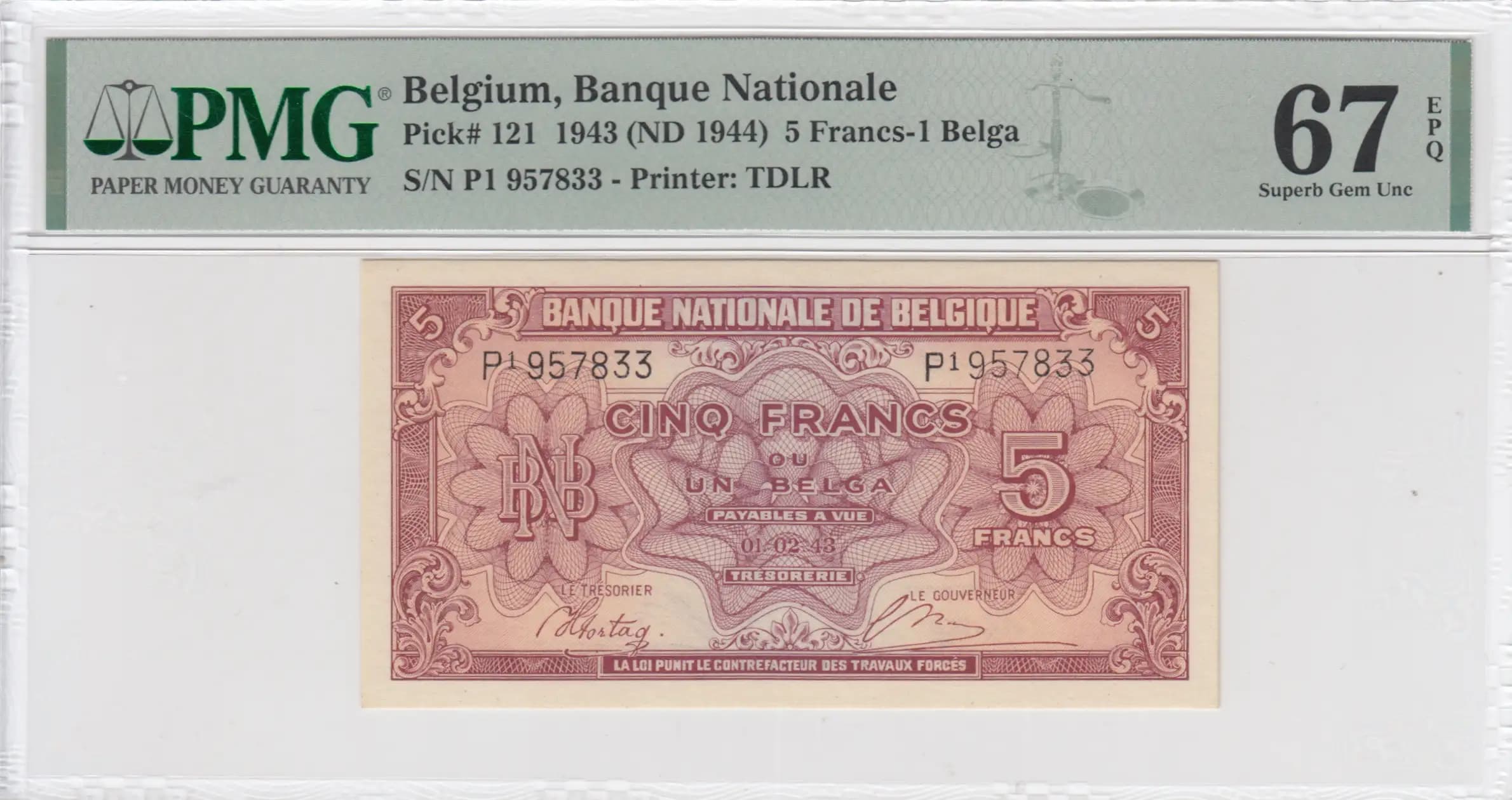
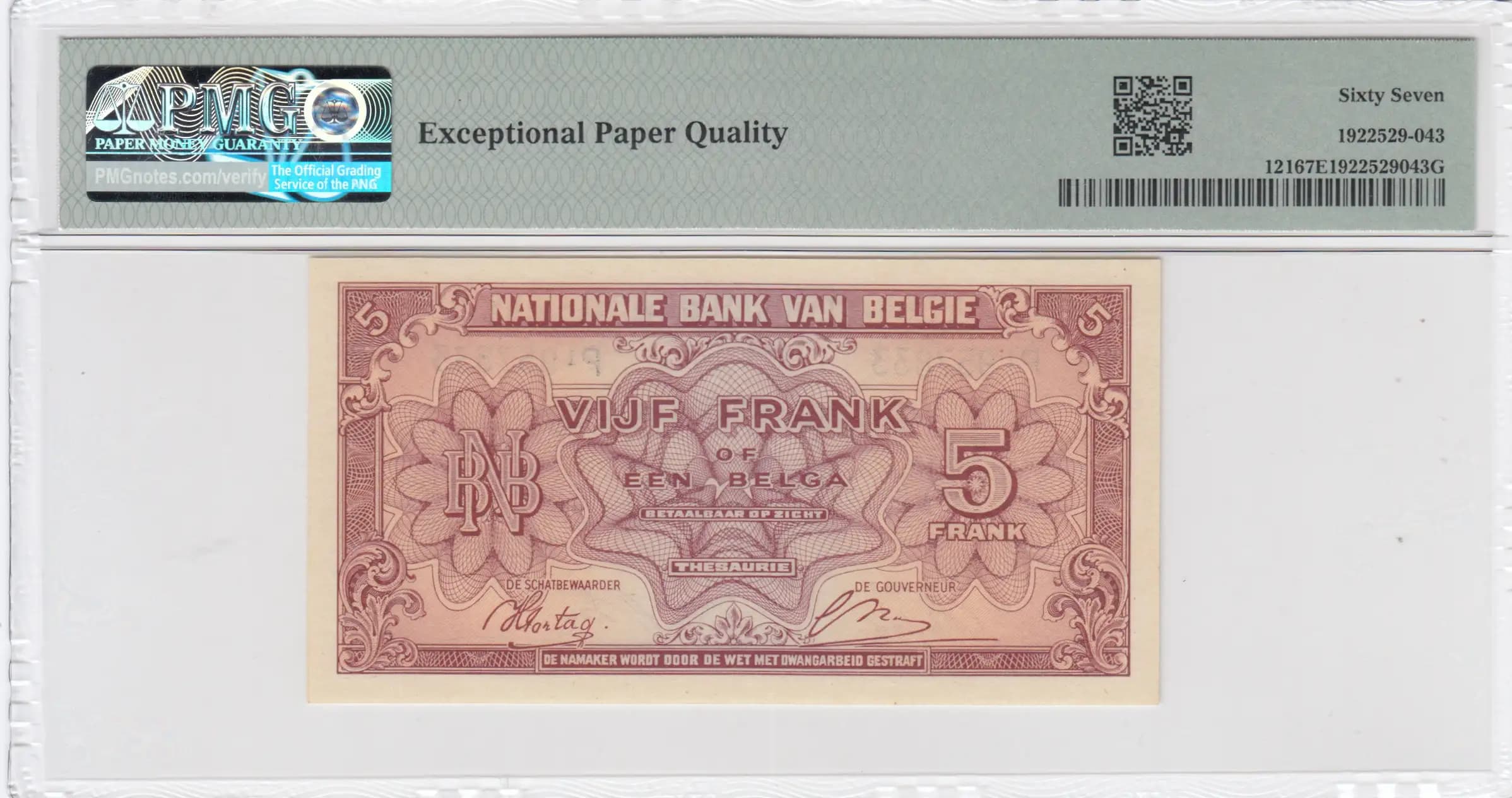
This exceptional PMG 67 EPQ example of the Belgian 5 Francs (1 Belga) from 1943 showcases the bilingual design characteristic of Belgium's currency during World War II. The note displays vibrant reddish-brown coloration with ornate decorative borders and exhibits exceptional paper quality with no visible wear, creases, or damage—truly uncirculated condition. This specimen represents a desirable mid-grade professionally certified example of an important wartime Belgian denomination.
Common. eBay market data demonstrates consistent availability with regular sales across all condition grades from F to AUNC, with typical VF specimens selling in the $2-5 range and even EF examples rarely exceeding $7. The PMG 66 example sold for $97.99 represents a premium for professional certification at that grade rather than intrinsic scarcity. The 1943 5 Francs issue had substantial print runs to serve Belgian occupation-era commerce, and significant quantities survive today. This denomination and date combination shows no evidence of rarity or strong collector demand.
Issued on February 1, 1943, during Nazi occupation of Belgium, this banknote represents the Banque Nationale de Belgique's continued monetary operations under wartime constraints. The bilingual French/Dutch design reflects Belgium's linguistic divide and institutional continuity, while the wartime date and Treasury issuer attribution (Trésorerie/Thesaurie) indicate the note's role in occupied Belgium's monetary system during the final years of World War II.
This bilingual Belgian note features a symmetrical design split between French (obverse) and Dutch/Flemish (reverse) language versions, both sharing identical architectural and ornamental framework. The dominant design elements include intricate engraved borders with classical scrollwork and floral patterns in all four corners, creating an ornate frame around the central BB monogram (Banque Nationale de Belgique). The denomination '5' and corresponding text appear prominently, flanked by dual signature lines for the Treasurer (Le Trésorier/De Schatbewaarder) and Governor (Le Gouverneur/De Gouverneur), indicating dual authorization required for note validity. The reddish-brown and mauve color scheme on a cream background provides excellent contrast and visual security. No portraits are depicted; instead, the design emphasizes institutional authority through textual and typographic elements consistent with early 20th-century Belgian currency design practices.
FRONT (French): Banque Nationale de Belgique (National Bank of Belgium), Cinq Francs (Five Francs), Ou Un Belga (Or One Belga), Payable à Vue (Payable on Demand), Trésorerie (Treasury), Le Trésorier (The Treasurer), Le Gouverneur (The Governor), La Loi Punit le Contrefacteur des Travaux Forcés (The Law Punishes Counterfeiters with Hard Labor), Date: 01-02-43, Serial: P1 957833. BACK (Dutch/Flemish): Nationale Bank van België (National Bank of Belgium), Vijf Frank (Five Francs), Of Een Belga (Or One Belga), Betaalbaar op Zicht (Payable on Demand), Thesaurie (Treasury), De Schatbewaarder (The Treasurer), De Gouverneur (The Governor), De Naamaker Wordt door de Wet met Dwangarbeid Gestraft (The Counterfeiter is Punished by Law with Forced Labor), Serial: P1 957833.
Intaglio engraving (deep impression printing) produced by Imprimerie Thiesset, Deschamps, Limousin & Renault (TDLR), the noted security printer for Belgian currency of this period. The fine line work visible throughout the borders, the precise serial number impressions (P1 957833 appearing twice), and the crisp signature lines confirm intaglio methodology. The absence of an imprint notation on the note itself is consistent with TDLR's standard practice during this production period.
This specimen is identified as Pick-121, the standard 1943 issue dated 01-02-43 with French/Dutch bilingual design. The serial number P1 957833 indicates the 'P1' prefix standard for this issue. PMG recognizes two variants for this base Pick number (P-121 and P-121s), suggesting possible specimen note varieties exist. No overprints, date variations, or signature variants are evident on this example. The standard Treasury (Trésorerie/Thesaurie) designation and dual-language format confirm this as the regular issue type rather than any specialized variant.