20 francs 1956
Market Prices
54 salesAbout This Note
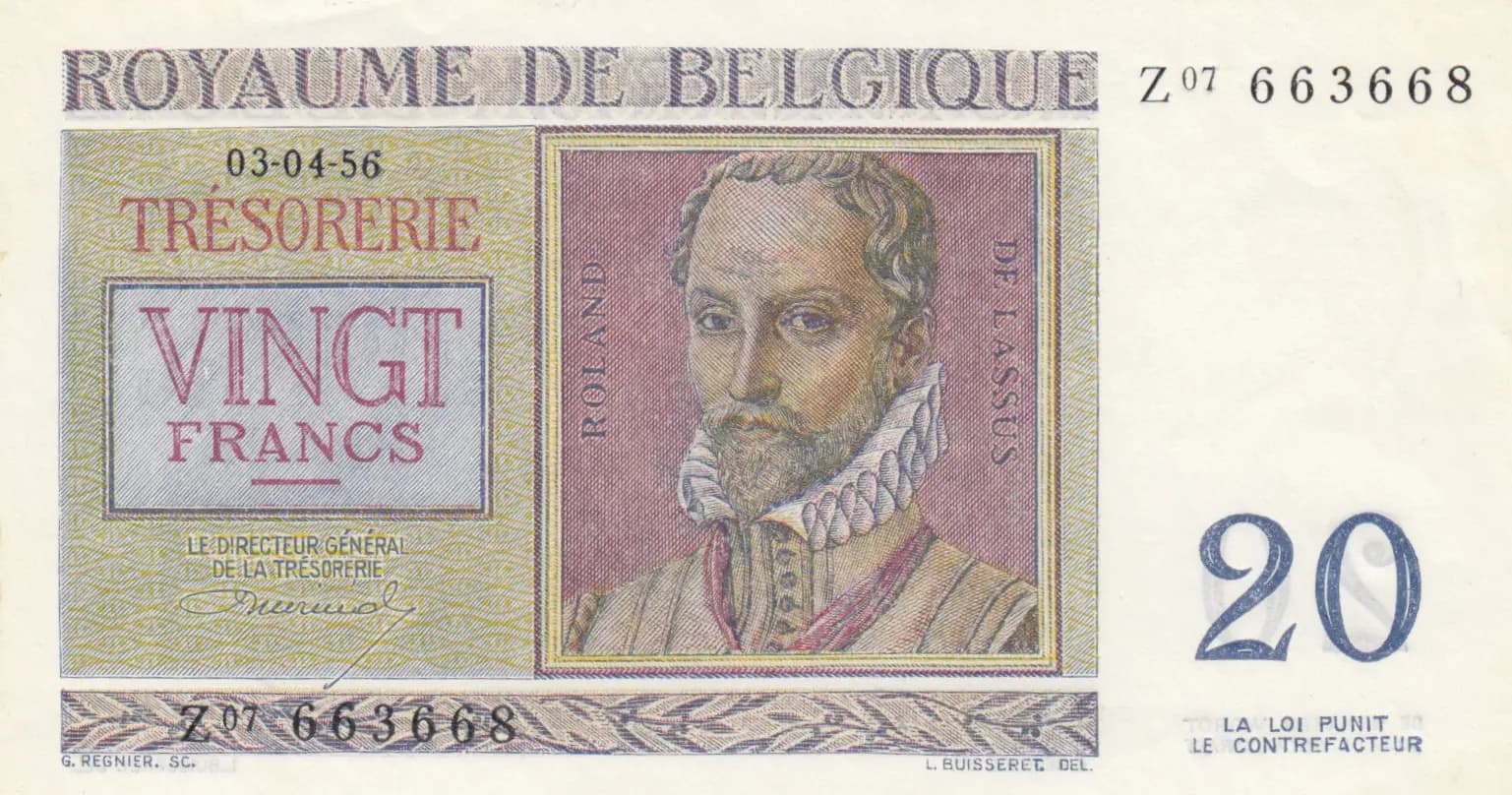
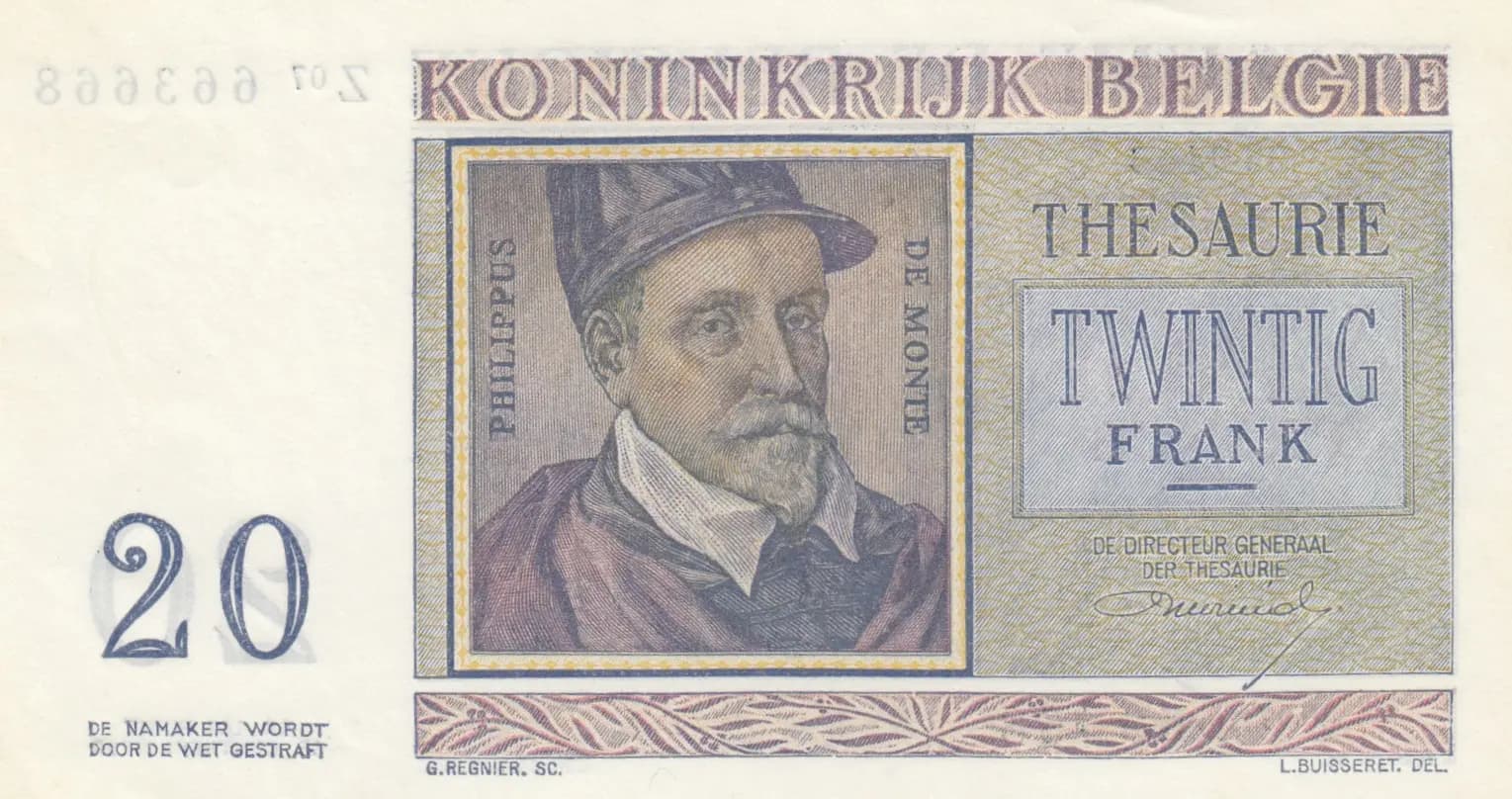
This is an AU-graded 1956 Belgian 20 Francs note (Pick P-132b) issued by the Banque Nationale de Belgique, featuring exceptional preservation with crisp, clean surfaces and no visible wear. The note displays dual-language inscriptions in French (obverse) and Dutch (reverse), reflecting Belgium's bilingual character, and is notable for its fine Renaissance-era portraiture of cultural figures rendered in purple, cream, and gold tones. At AU condition, this note represents a well-preserved example of mid-20th century Belgian currency that remains popular with collectors, with recent market activity supporting values in the $3-5 range for similar grades.
Common. This is a standard-issue circulation note from 1956, and the robust eBay market data confirms commonality across all condition grades. Sales records spanning 2009-2025 show consistent pricing well below $20 for VF and EF examples, with even UNC specimens rarely exceeding $20-$30. The AU-graded example, while well-preserved, commands only modest premiums ($3-5 range based on recent AUNC sales). The substantial print run of this denomination and the absence of any documented scarcity or recall status support a common classification.
Issued in 1956 during the post-World War II period of Belgian economic recovery, this banknote commemorates two significant Renaissance humanists: Roland de Lassus (Orlandus Lassus), the renowned 16th-century Flemish composer visible on the obverse with his characteristic ruff collar, and Philippus de Monte on the reverse, reflecting Belgium's cultural heritage during the Burgundian and Renaissance periods. The dual French and Dutch inscriptions ('Royaume de Belgique'/'Koninkrijk Belgie' and 'Tresorerie'/'Thesaurie') emphasize the note's role in a nation working to balance its linguistic communities in the mid-20th century. The official April 3, 1956 date confirms this as part of the standard circulation issue following Belgium's post-war currency stabilization.
This banknote features meticulously engraved Renaissance portraiture on both sides. The obverse displays Roland de Lassus (Orlandus Lassus, 1532-1594), the celebrated Flemish composer and musician, depicted as a bearded man in left profile wearing period-appropriate 16th-century clothing with an ornate white ruff collar characteristic of Renaissance nobility. The reverse presents Philippus de Monte (1521-1603), another illustrious Renaissance musician and composer from the Low Countries, shown in similar left-facing profile wearing a Renaissance cap and period garments. Both portraits are enclosed within rectangular ornamental frames with decorative guilloche borders in cream, purple, brown, and gold tones. The denomination '20' appears prominently on the right side of the reverse in large numerals. Ornamental corner designs and fine-line engraving throughout provide security and aesthetic sophistication typical of mid-20th century European currency design.
OBVERSE (French side): 'Royaume de Belgique' (Kingdom of Belgium); 'Tresorerie' (Treasury); 'Vingt Francs' (Twenty Francs); 'Le Directeur General de la Tresorerie' (The Director General of the Treasury); 'La Loi Punit le Contrefacteur' (The law punishes the counterfeiter); 'G. Regnier. Sc.' (G. Regnier, sculptor); Serial number: Z 07 663668; Date: 03-04-56 (April 3, 1956). REVERSE (Dutch side): 'Koninkrijk Belgie' (Kingdom of Belgium); 'Thesaurie' (Treasury); 'Twintig Frank' (Twenty Francs); 'De Directeur Generaal der Thesaurie' (The Director General of the Treasury); 'De Namaker Wordt door de Wet Gestraft' (The counterfeiter is punished by law); 'G. Regnier. Sc.' (G. Regnier, sculptor); 'L. Buisseret. Del.' (L. Buisseret, delineator/designer); Series number: 800800.
This note was produced using intaglio (engraved plate) printing, the standard security method for banknotes of this era. The fine-line engraving visible in the detailed portraiture, particularly the intricate facial features of both Roland de Lassus and Philippus de Monte, along with the ornamental guilloche patterns in borders and background, are hallmarks of this technique. The Belgian note would have been printed by the Banque Nationale de Belgique or a contracted security printer using copper or steel plates, with the characteristic crisp lines and depth of impression evident in AU examples such as this specimen.
This note is catalogued as Pick P-132b, indicating it represents one of two known varieties of the 1956 20 Francs issue (P-132a and P-132b variants exist). The specific variety distinction likely relates to signature variations or minor design changes between printings. The observed serial number prefix 'Z 07' and the issue date of 03-04-1956 are consistent with mid-run production of the P-132b variety. No overprints or significant anomalies are evident in this specimen, confirming it as a standard variety note from the regular 1956 circulation issue.