100 francs 1959
Market Prices
18 salesAbout This Note
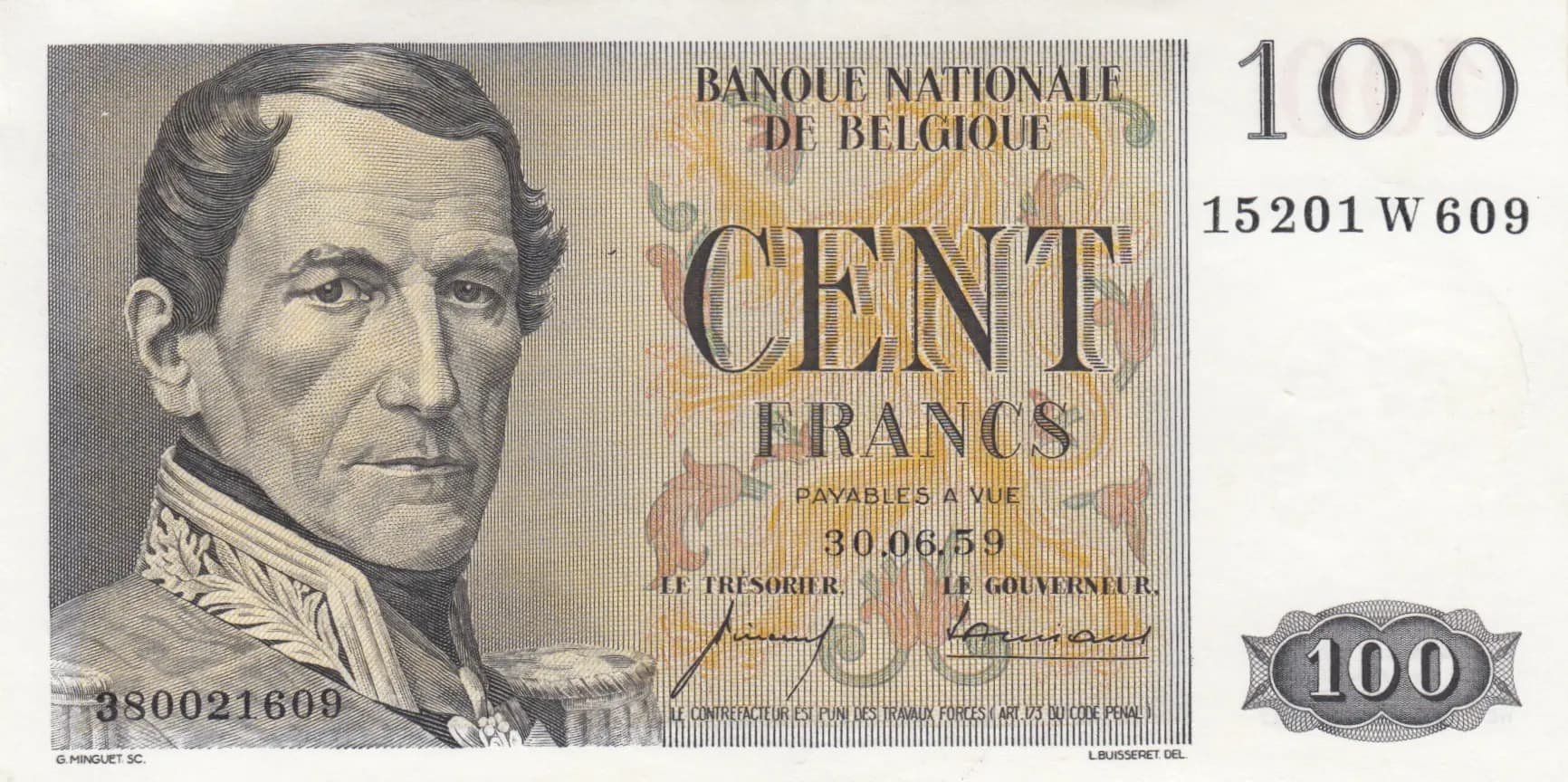
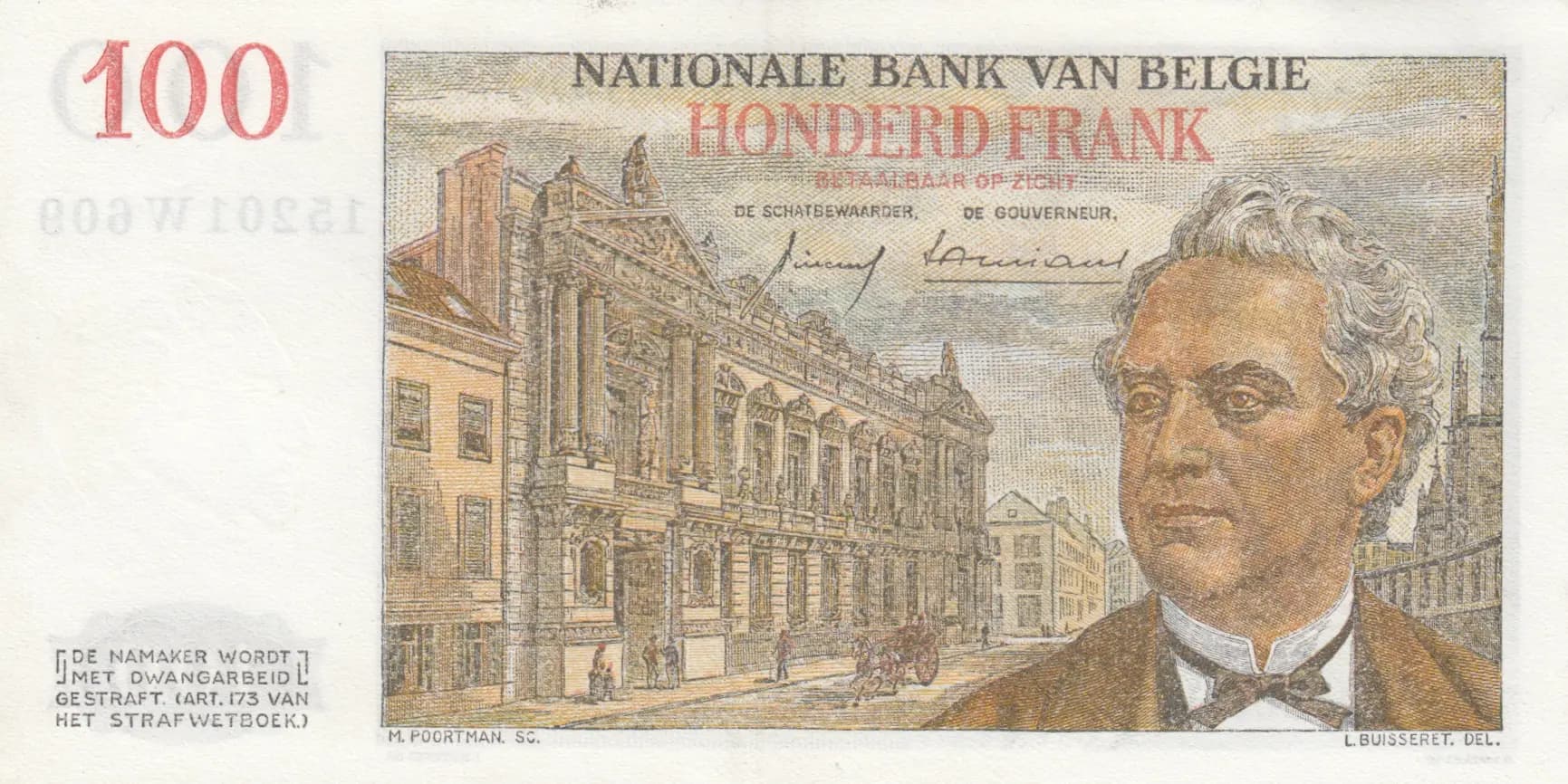
This is a well-preserved example of Belgium's 100 Francs note from 1959 (Pick P-129c), graded AU, displaying the iconic portrait of King Leopold I in formal military dress on the obverse. The reverse features the Banque Nationale de Belgique building with a portrait of Frédéric Orban, rendered in elegant earth-tone engraving with sharp, clear printing throughout. The note exhibits no visible wear, creases, or deterioration, representing the upper end of circulated condition or near-uncirculated state.
Common. This note was part of a regular issue with a substantial production run during 1957-1959. eBay market data shows consistent sales across multiple condition grades (Fine to EF), with prices ranging from approximately $3-$12 for circulated examples and $40 for uncirculated in 2016 catalog values. The AU condition grade observed here aligns with typical market pricing around $15-$25, confirming this is a frequently encountered note in the secondary market rather than a scarce or rare variety.
Issued in 1959 near the end of its production run (1957-1959), this note reflects Belgium's post-WWII economic recovery and modernization under the Banque Nationale de Belgique. The dual-language design (French and Dutch) reflects Belgium's linguistic divisions, while Leopold I's portrait honors Belgium's founding monarch, and the bank building imagery emphasizes the institution's role in national financial stability during the Cold War era.
The obverse features a three-quarter profile portrait of King Leopold I at left, depicted in nineteenth-century military formal dress with a high collar and decorative ruffled detail, characteristic of Belgian state portraiture of the era. The denomination 'Cent Francs' appears centrally with issuing bank information, while '100' in large serif font occupies the right side with an ornamental oval frame. The reverse presents the grand classical Banque Nationale de Belgique building as its focal point—a multi-story structure with columns, mansard roof, and ornate stonework, shown with period horse-drawn carriages and pedestrians in front, symbolizing the bank's prominence in Belgian civic life. To the right is a portrait in profile of Frédéric Orban (Fr. Orban), a significant figure in Belgian banking history. Both sides employ intricate line engraving with fine cross-hatching throughout, geometric patterns in backgrounds, and dual-language text reflecting Belgium's French and Dutch linguistic communities.
FRONT (French): 'Banque Nationale de Belgique' (National Bank of Belgium), 'Cent Francs' (One Hundred Francs), 'Payables à vue' (Payable on sight), dated '30.06.59' (30 June 1959), with signatures for 'Le Gouverneur' (The Governor) and 'Le Trésorier' (The Treasurer). Designer credit: 'L. Buisseret Del.' (Designed by L. Buisseret), Engraver: 'G. Minguet Sc.' (Engraved by G. Minguet). Serial numbers: 15201 W 609 and 3800216 09. BACK (Dutch): 'Nationale Bank van Belgie' (National Bank of Belgium), 'Honderd Frank' (One Hundred Francs), 'Nederlands van zicht' (Payable on sight - Dutch version), with signatures for 'De Gouverneur' (The Governor) and 'De Schatbewaarder' (The Treasurer). Anti-counterfeiting warning: 'De namaker wordt met dwangarbeid gestraft (Art. 173 van het Strafwetboek)' (The counterfeiter will be punished with forced labor - Article 173 of the Penal Code). Designer and engraver credits: 'L. Buisseret Del.' and 'M. Poortman Sc.'
Intaglio engraving (line engraving), the standard security printing method for Belgian banknotes of this period. The visual analysis confirms fine line work, detailed cross-hatching in portraits and backgrounds, and geometric patterns characteristic of steel-plate intaglio printing. Engravers credited include G. Minguet (front) and M. Poortman (back), with designer L. Buisseret. The Banque Nationale de Belgique commissioned this work from Belgium's official security printer, likely Imprimerie de Belgique or similar state-contracted facility.
This is cataloged as Pick P-129c, indicating it is the third identified variety within the 100 Francs 1959 series. PMG records show variants P-129a, P-129b, P-129c, and P-129s (specimen). Variety distinctions likely relate to signature combinations, serial number prefixes, or minor design modifications across the 1957-1959 production period. The observed specimen displays the date '30.06.59' (30 June 1959), serial number '15201 W 609', and additional reference '3800216 09', placing it among the final issues of this denomination before franc currency was eventually phased out.