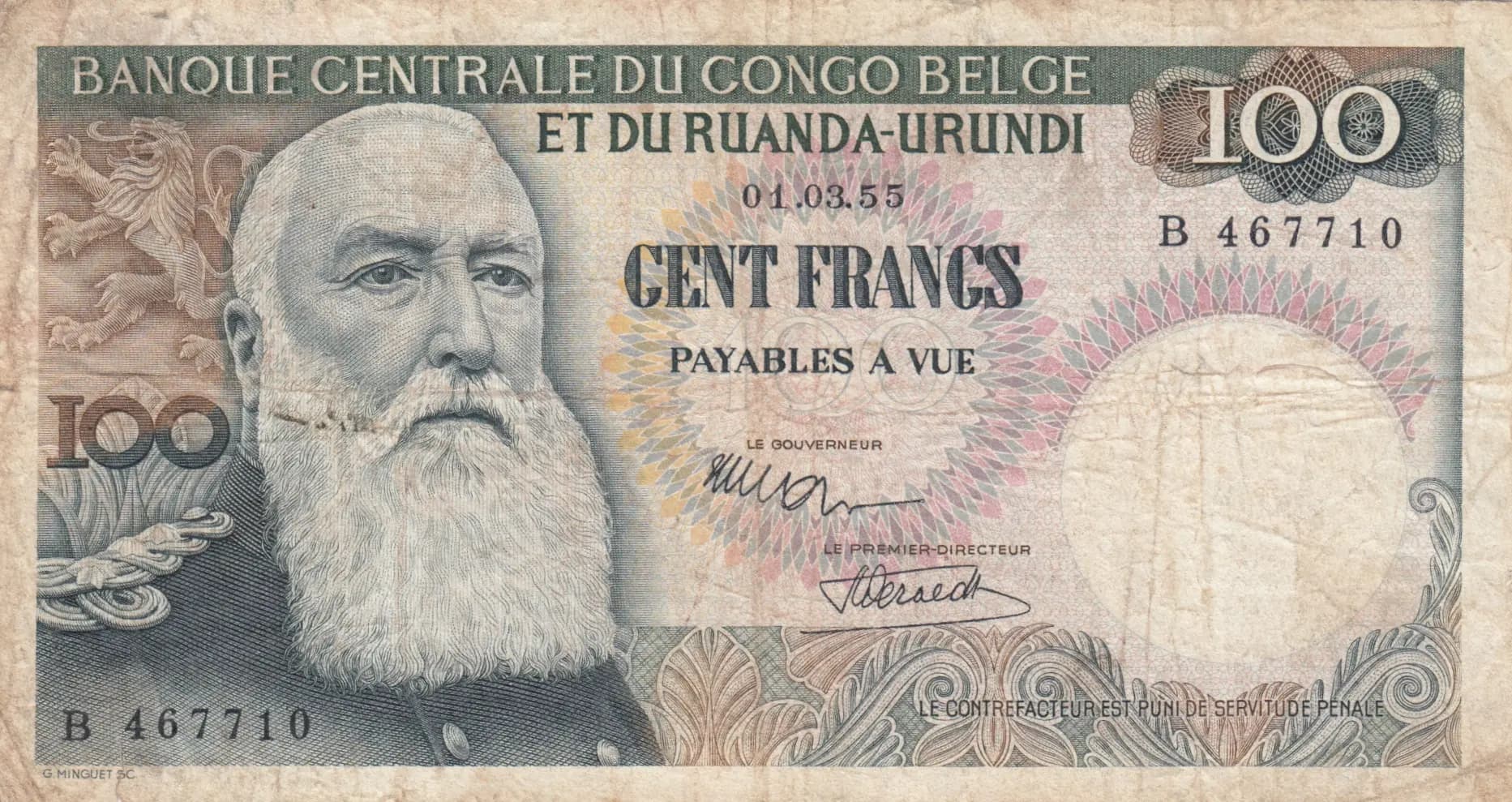
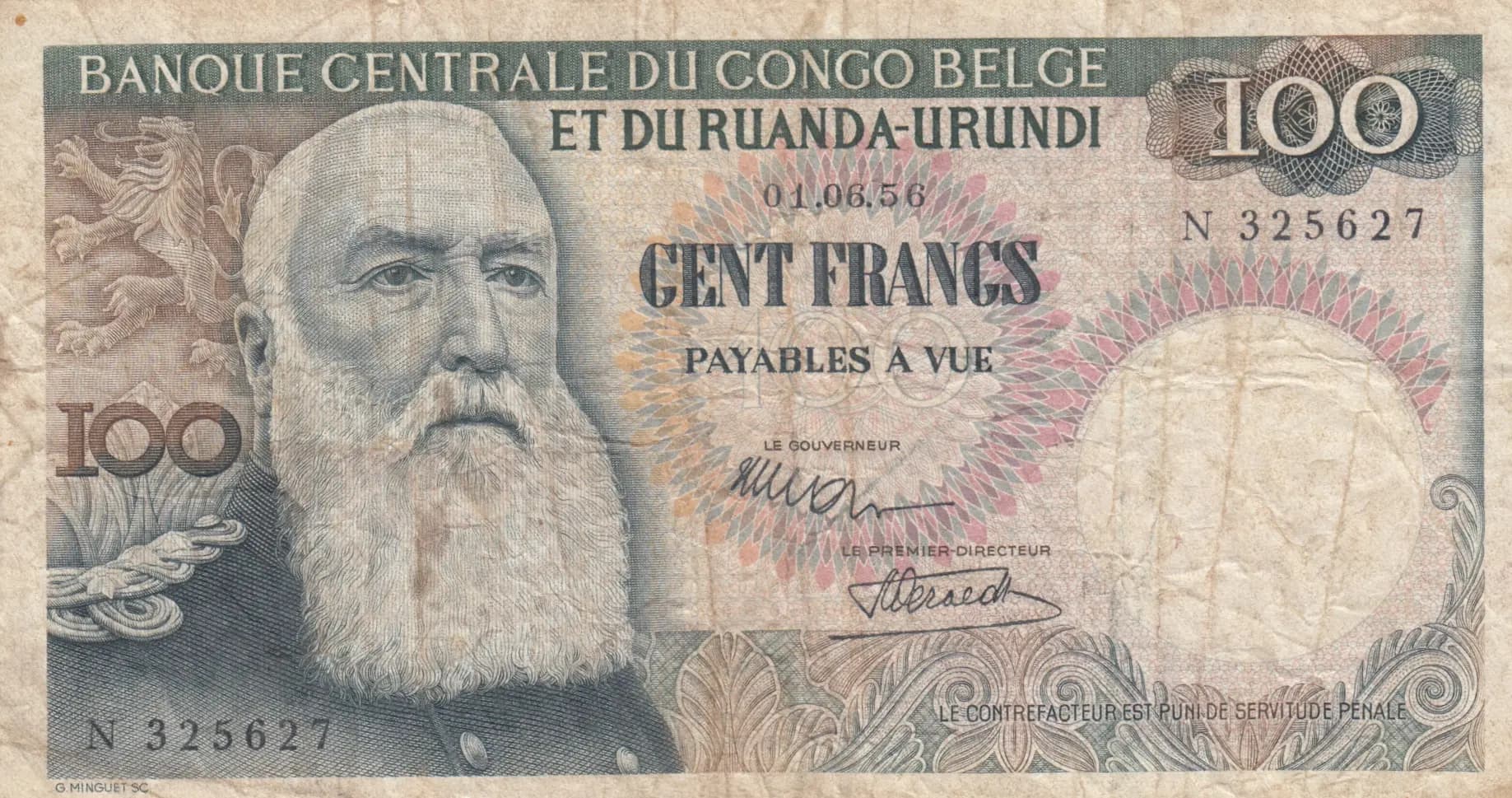
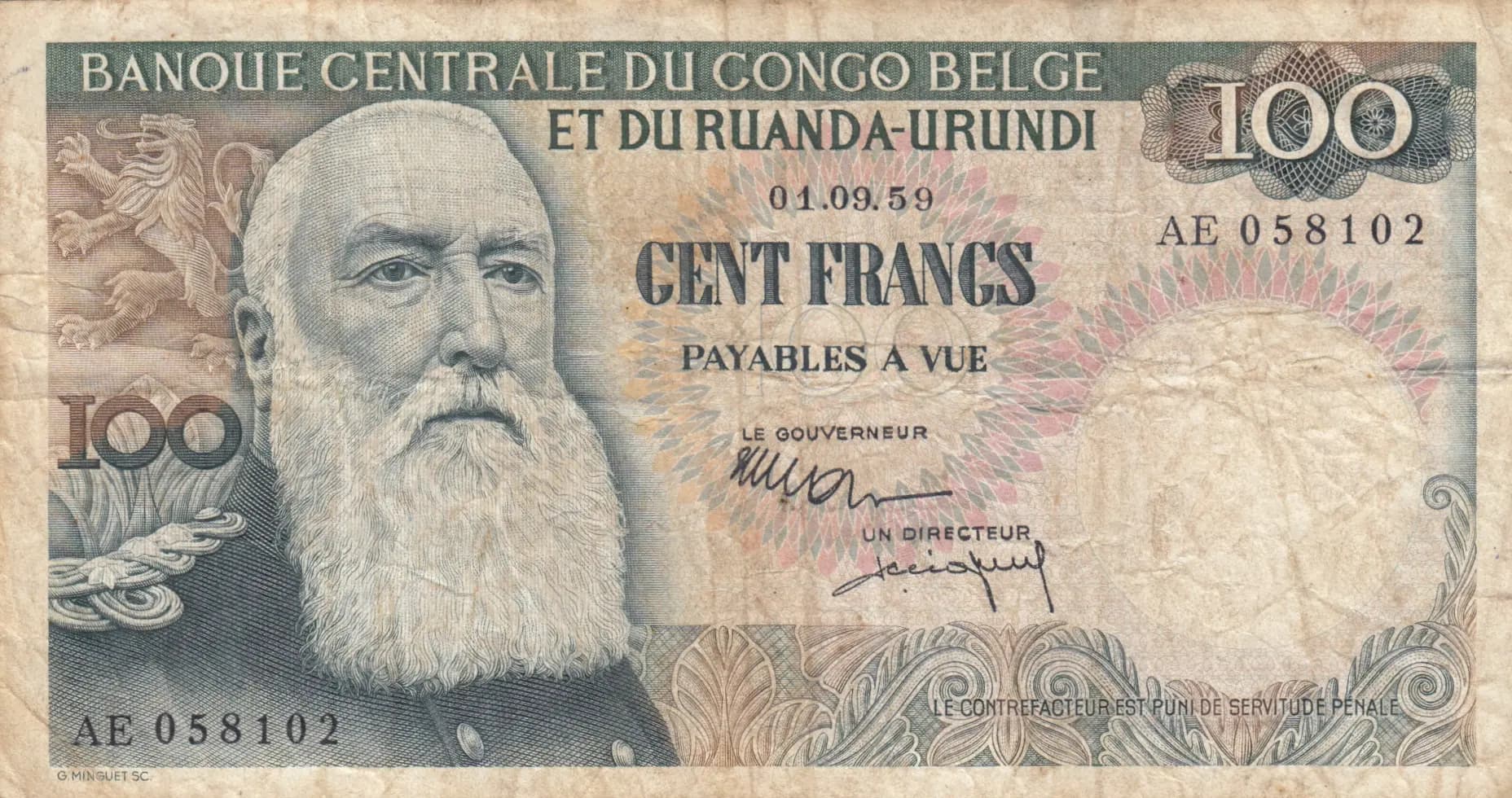
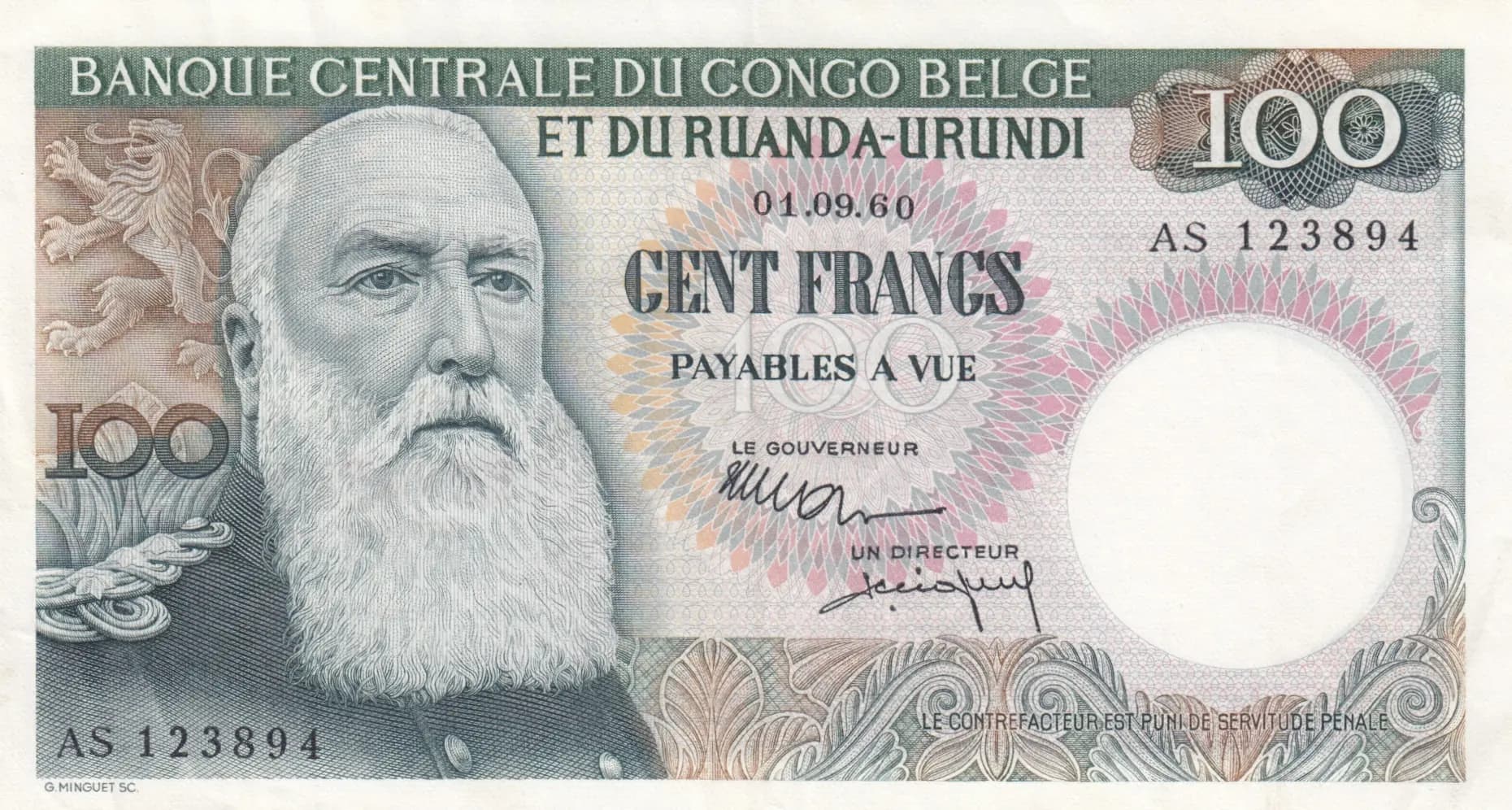
100 francs 1960
“1.04.60”
Market Prices
18 salesAbout This Note
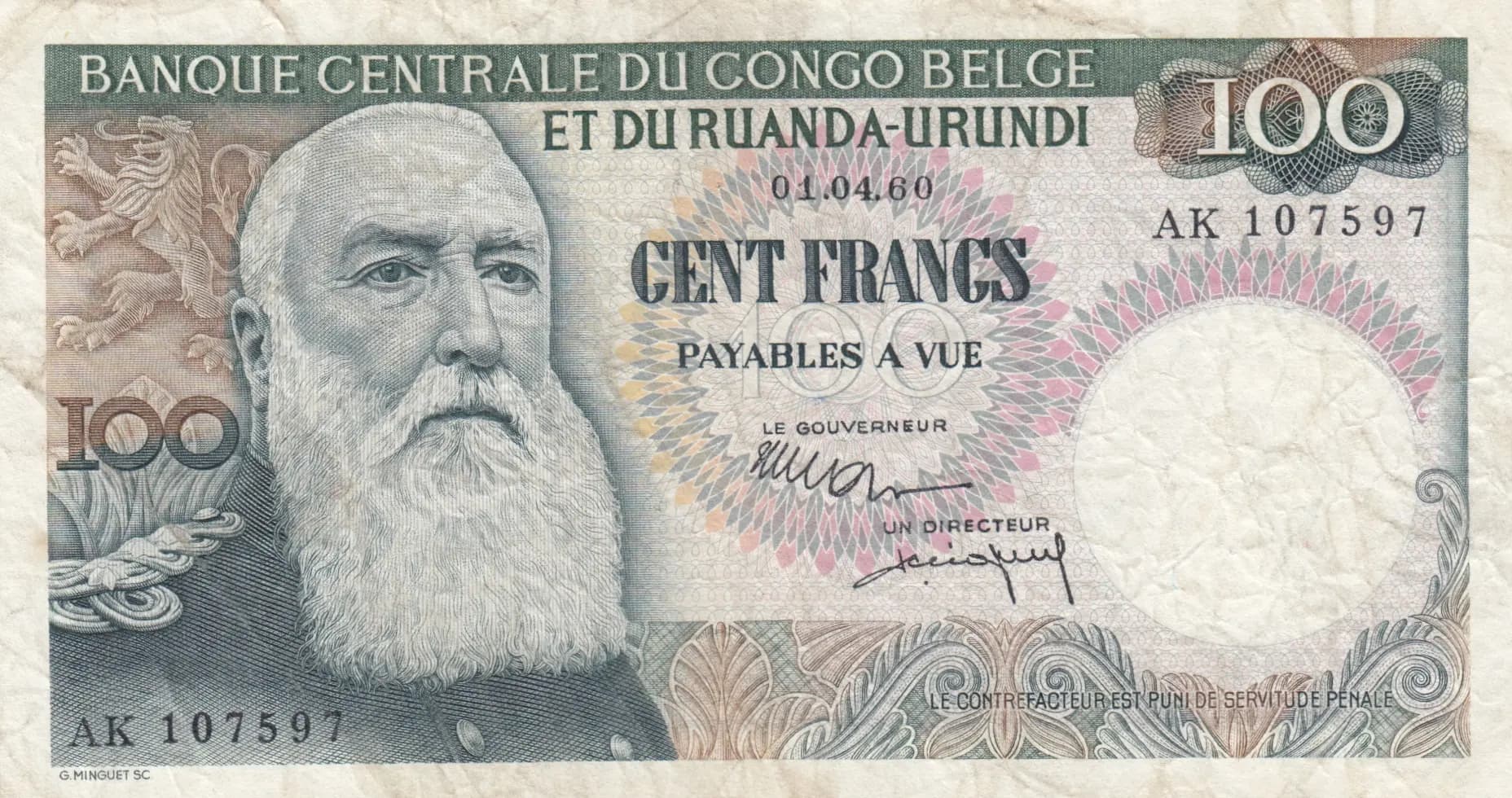
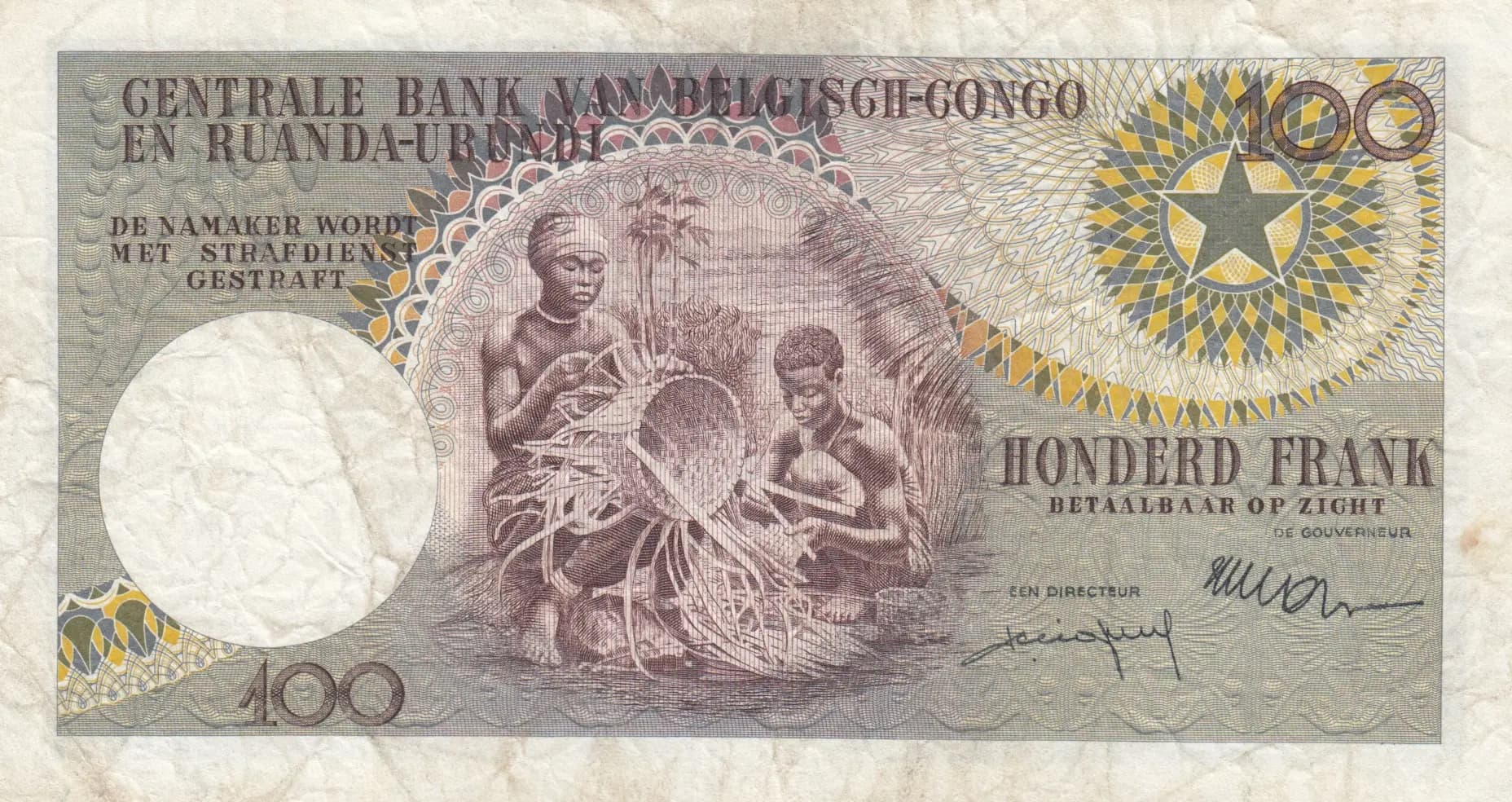
A Fine condition 100 Francs note from Belgian Congo dated April 1, 1960, issued by the Banque Centrale du Congo Belge et du Ruanda-Urundi during the final months before independence. The note displays moderate circulation wear with visible creases and age-related foxing, yet retains clear legibility of the portrait and ornate design elements. The bilingual (French/Dutch) inscriptions and ethnographic imagery of basket weavers on the reverse reflect the colonial administration's dual-language policy during this transitional period.
Common. This note was part of a regular issue (P-33b) with significant circulation during 1956-1960. eBay market data shows consistent sales activity with Fine condition examples typically selling in the $10-$30 range historically, with recent 2025 sales at $31 (VF) and lower. The catalog 2016 valuation for Fine condition was approximately $10-$15. The elephant's head watermark variant (P-33b) is not noted as scarce relative to other variants. Large print runs were standard for a central bank note of this denomination during a five-year issue period, and the moderate wear visible on this example is consistent with heavy circulation rather than survival rarity.
This note was issued during the final year of Belgian colonial rule in Congo, a period of rapid political change culminating in independence on June 30, 1960. The bilingual French and Dutch text reflects the administrative structure of Belgian Congo, where both languages held official status. The portrait of King Leopold II on the obverse and the depiction of indigenous basket weavers on the reverse represent the colonial perspective on the territory and its people during the terminal phase of colonial governance.
The obverse features a left-facing portrait of King Leopold II with a distinctive long beard, rendered in the formal neoclassical engraving style typical of early 20th-century colonial currency. The portrait is surrounded by ornamental rosette patterns, heraldic lion symbols, and elaborate scrollwork in green and brown tones. The reverse depicts two indigenous figures—an adult and child—engaged in traditional basket weaving activities, shown within an ornate circular medallion frame with geometric patterns. A prominent eight-pointed star with radiating sunburst design appears in the upper right corner of the reverse. The note employs a multicolor printing scheme with green, yellow, gray, and brown as dominant colors. The design reflects the ethnographic documentary style common in colonial-era currency, presenting indigenous crafts as emblematic of the colonial territory.
FRONT SIDE: 'Banque Centrale du Congo Belge et du Ruanda-Urundi' (Central Bank of Belgian Congo and Rwanda-Urundi); 'Cent Francs' (One Hundred Francs); 'Payables à vue' (Payable on Demand); 'Le Gouverneur' (The Governor); 'Un Directeur' (A Director); '01.04.60' (April 1, 1960); 'Le Contrefacteur est puni de Servitude Pénale' (The Counterfeiter is Punished by Penal Servitude); 'G Minguet Sc' (Artist credit). BACK SIDE: 'Generale Bank van Belgische-Congo en Ruanda-Urundi' (General Bank of Belgian Congo and Rwanda-Urundi); 'Honderd Frank' (One Hundred Francs); 'Betaalbaar op Zicht' (Payable on Sight); 'De Gouverneur' (The Governor); 'Een Directeur' (A Director); 'De Nmaaker wordt met Strafdiens gestraft' (The Counterfeiter is Punished with Penal Servitude).
Intaglio engraving (recess printing), the standard security printing method for banknotes of this era. The fine line work, intricate decorative patterns, and depth of detail visible throughout are characteristic of intaglio production. Printed by BNB (Banque Nationale de Belgique/Belgian National Bank) without manufacturer's imprint on the note itself, per the catalog reference. The multiple color layers suggest multi-pass intaglio printing to achieve the multicolor underprint effects.
This is catalog variety P-33b, distinguished by the elephant's head watermark. The visual analysis confirms the watermark is present (visible as blank circular spaces in the center areas of both sides). The date '01.04.60' (April 1, 1960) places this note in the final months of the issue period (catalog range 1956-1960). Serial number 'AK 107597' indicates standard serial numbering without special significance. The signatures are in the positions noted for this type ('LE GOUVERNEUR' and 'UN DIRECTEUR'), consistent with P-33b specifications. No overprints or special markings are evident. The two other known Pick catalog variants (P-33a and P-33c) differ in watermark configuration; this note clearly exhibits the P-33b elephant's head watermark characteristic.