100 francs 1956
Market Prices
10 salesAbout This Note
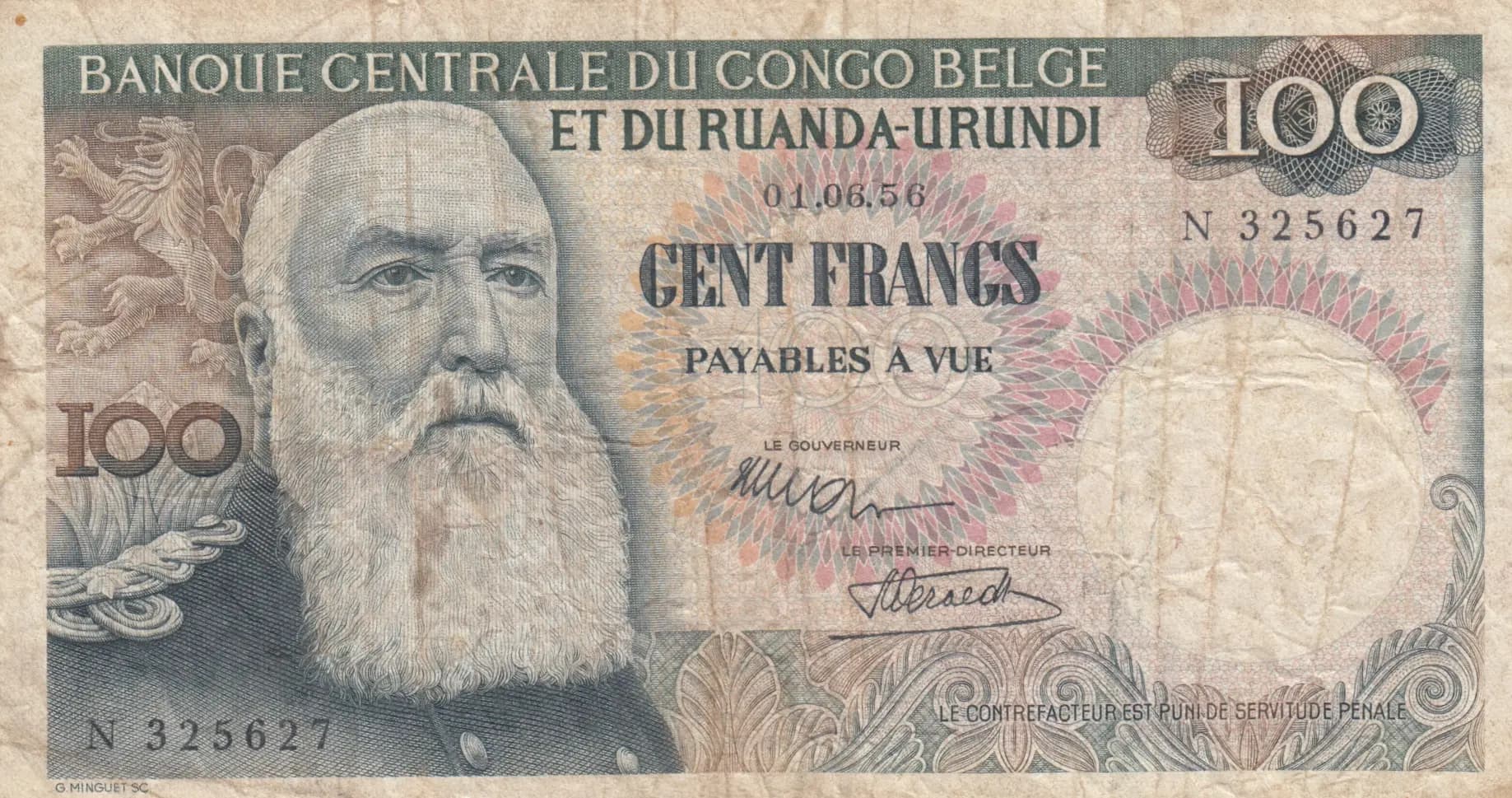
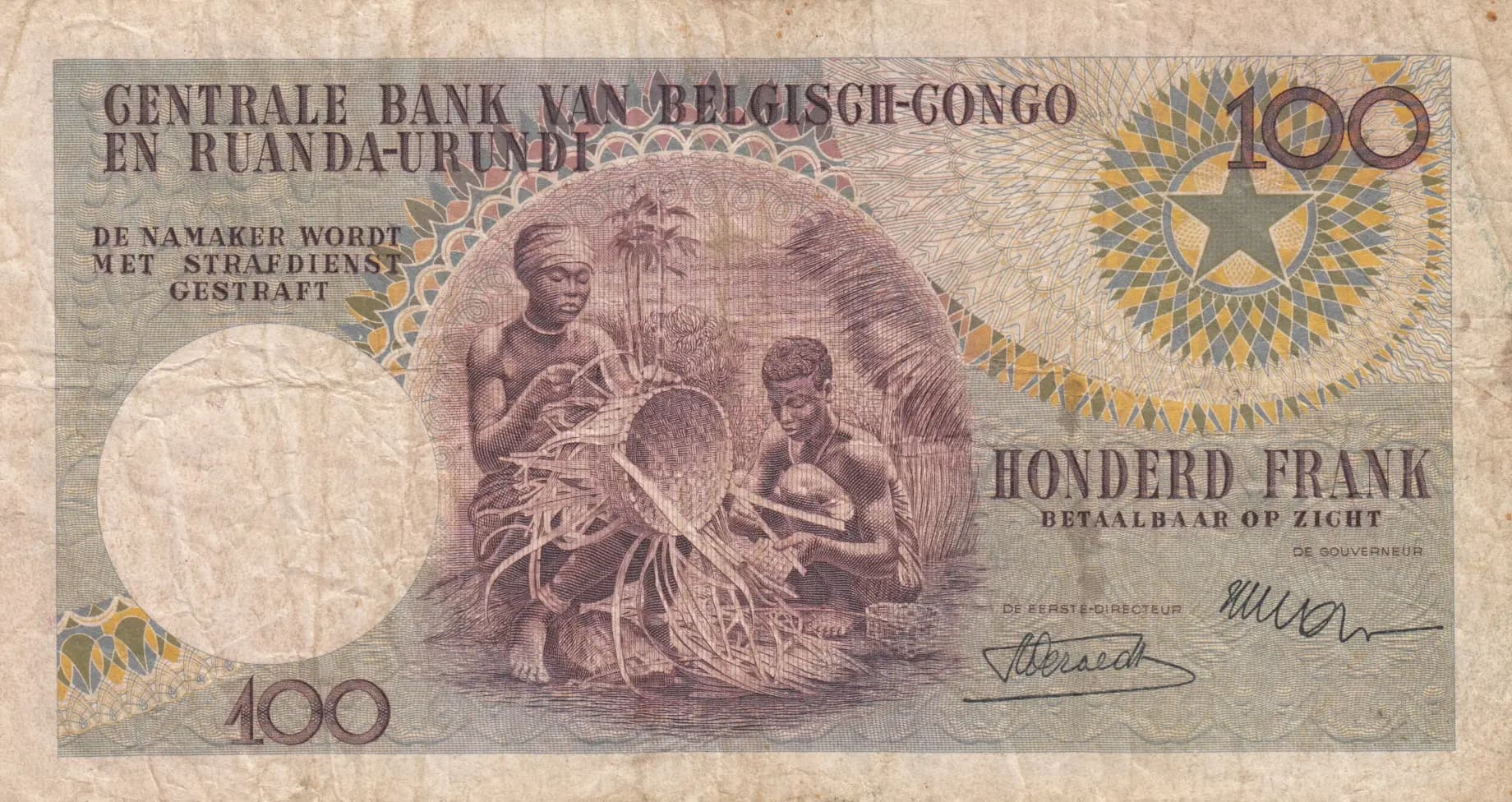
This Belgian Congo 100 francs note from 1956 presents a striking example of mid-20th century colonial African currency, featuring the portrait of King Leopold II on the obverse and a detailed engraved scene of basket weavers on the reverse. The note displays moderate to significant circulation wear with visible creasing, foxing, and discoloration throughout, consistent with its F (Fine) condition grade, yet all printed elements remain legible and the fine line engraving detail is well-preserved. The bilingual French-Dutch inscriptions and intricate security patterns reflect the dual administrative structure of the Belgian Congo during this transitional period, making it an interesting historical artifact from the final years before independence.
Common. This is a standard issue from a relatively long production period (1955-1960) of the Banque Centrale du Congo Belge et du Ruanda-Urundi. The eBay market data provided shows consistent sales in the $16-$53 range for F condition notes over a ten-year period (2015-2021), with catalogue values at $4 (VG), $15 (VF), and $60 (UNC) as of 2016—all indicators of steady, modest collector demand characteristic of common colonial issue banknotes. Print runs were substantial, and examples remain readily available in circulation grades, making this Pick number a staple of Belgian Congo collections rather than a scarce variety.
This note was issued during 1955-1960 by the Banque Centrale du Congo Belge et du Ruanda-Urundi, representing the colonial monetary authority during the final decade of Belgian rule in the Congo. The depicted portrait of King Leopold II on the obverse connects to Belgian sovereignty, while the reverse's engraved scene of African basket weavers and palm trees celebrates indigenous craftsmanship and the colony's material culture—imagery designed to project stability and legitimacy even as decolonization pressures mounted across Africa. The bilingual French-Dutch presentation underscores the dual-language administrative heritage of the Belgian Congo, soon to be disrupted by independence in 1960.
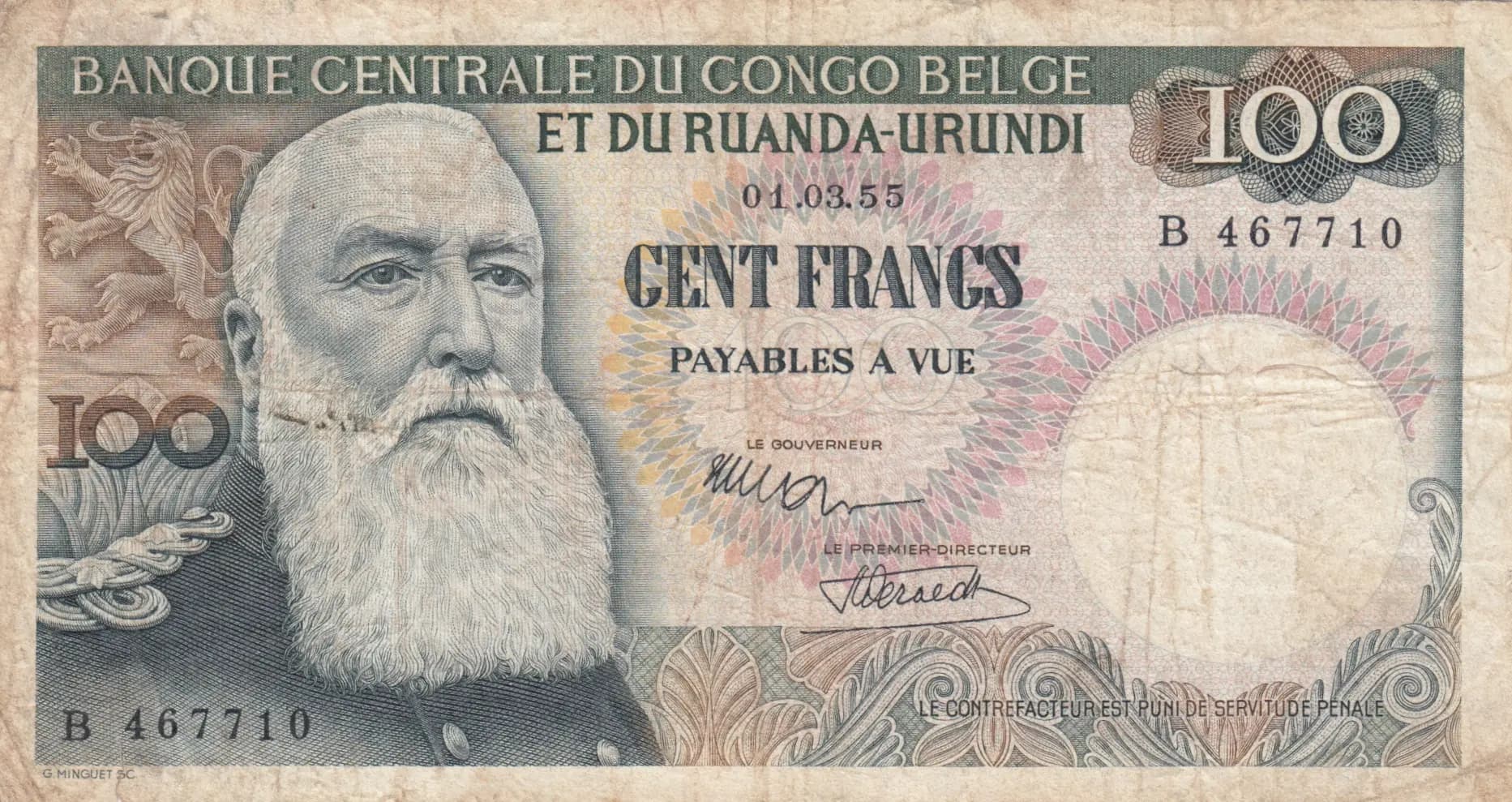
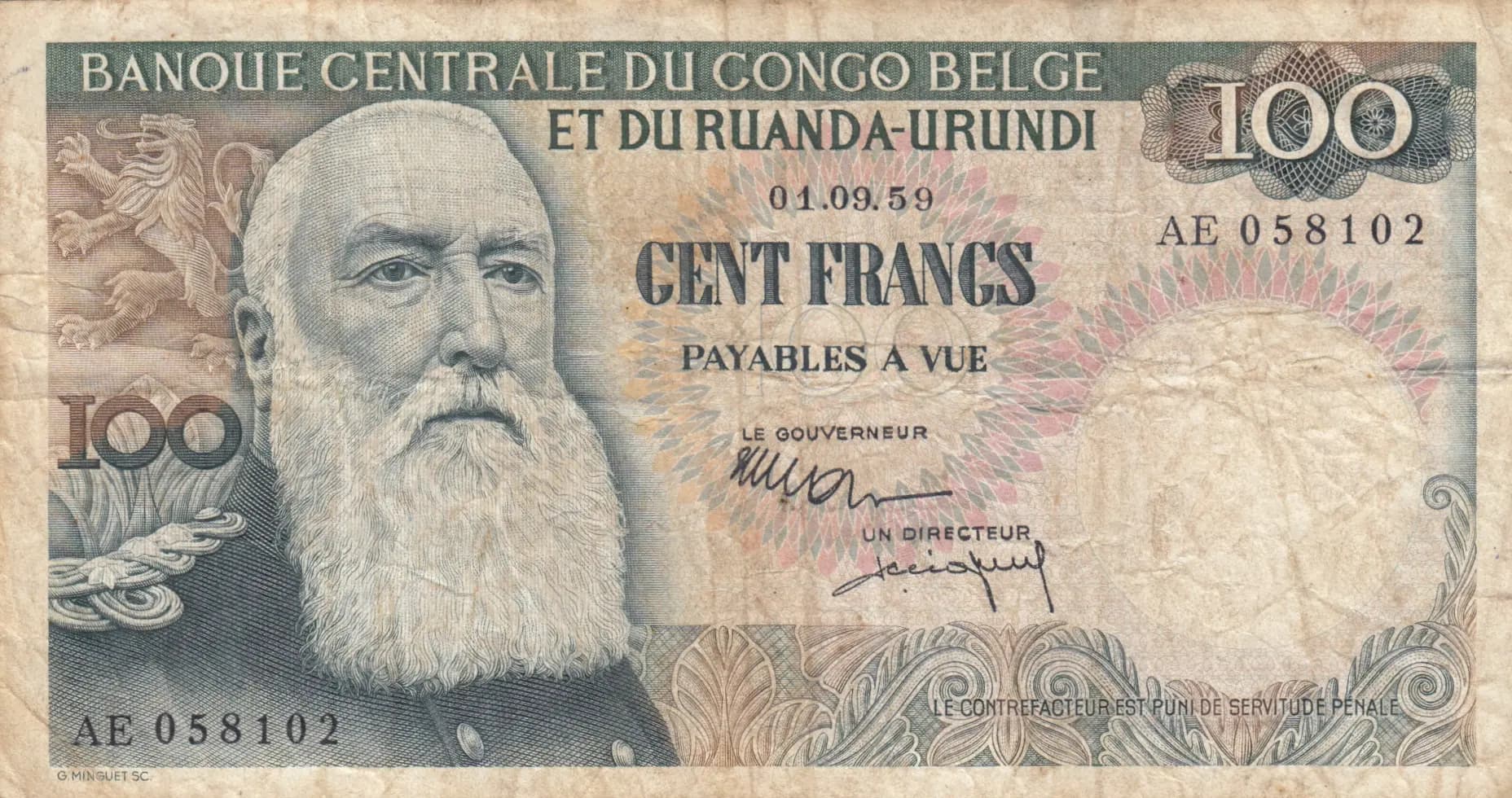
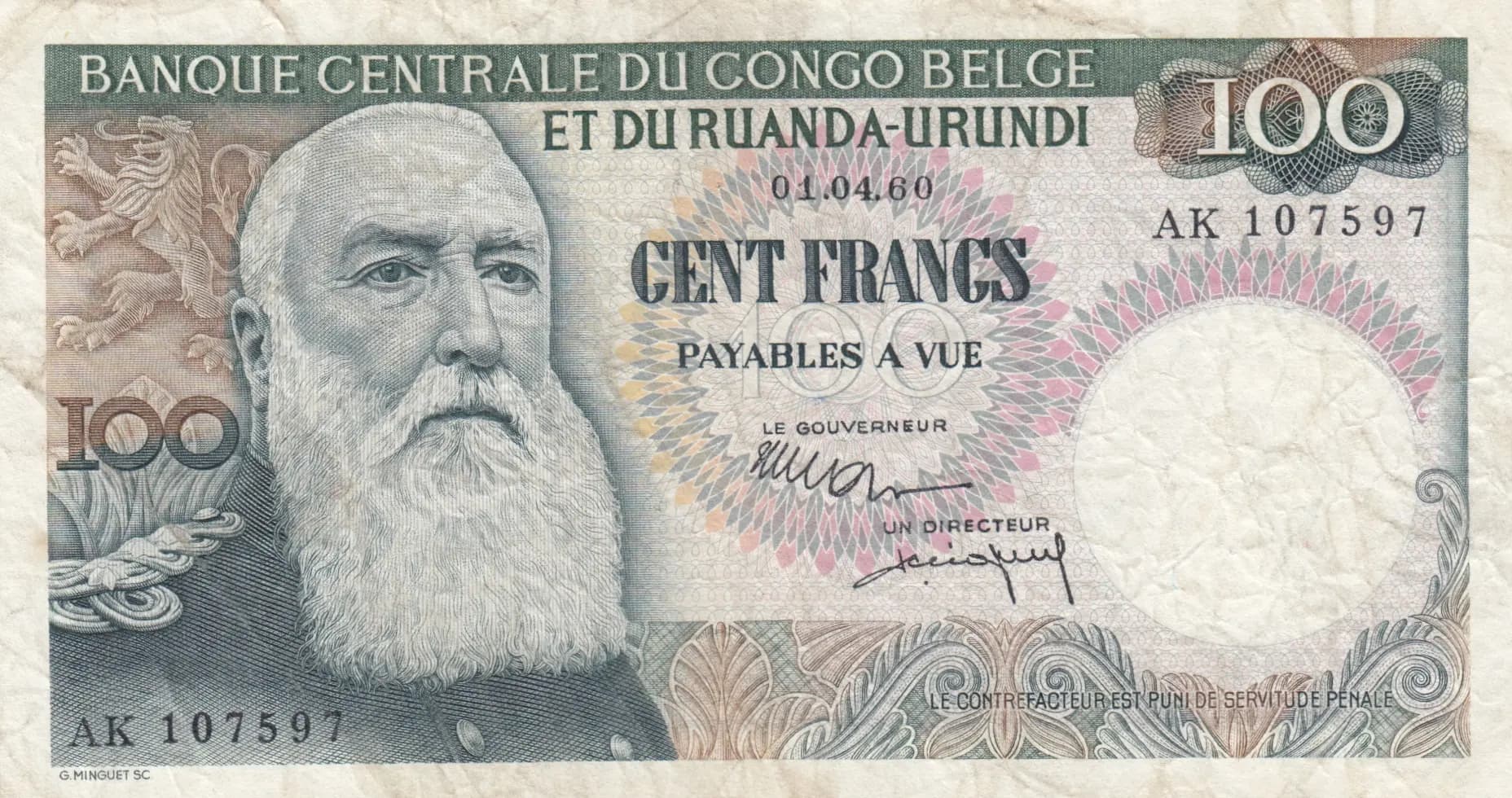
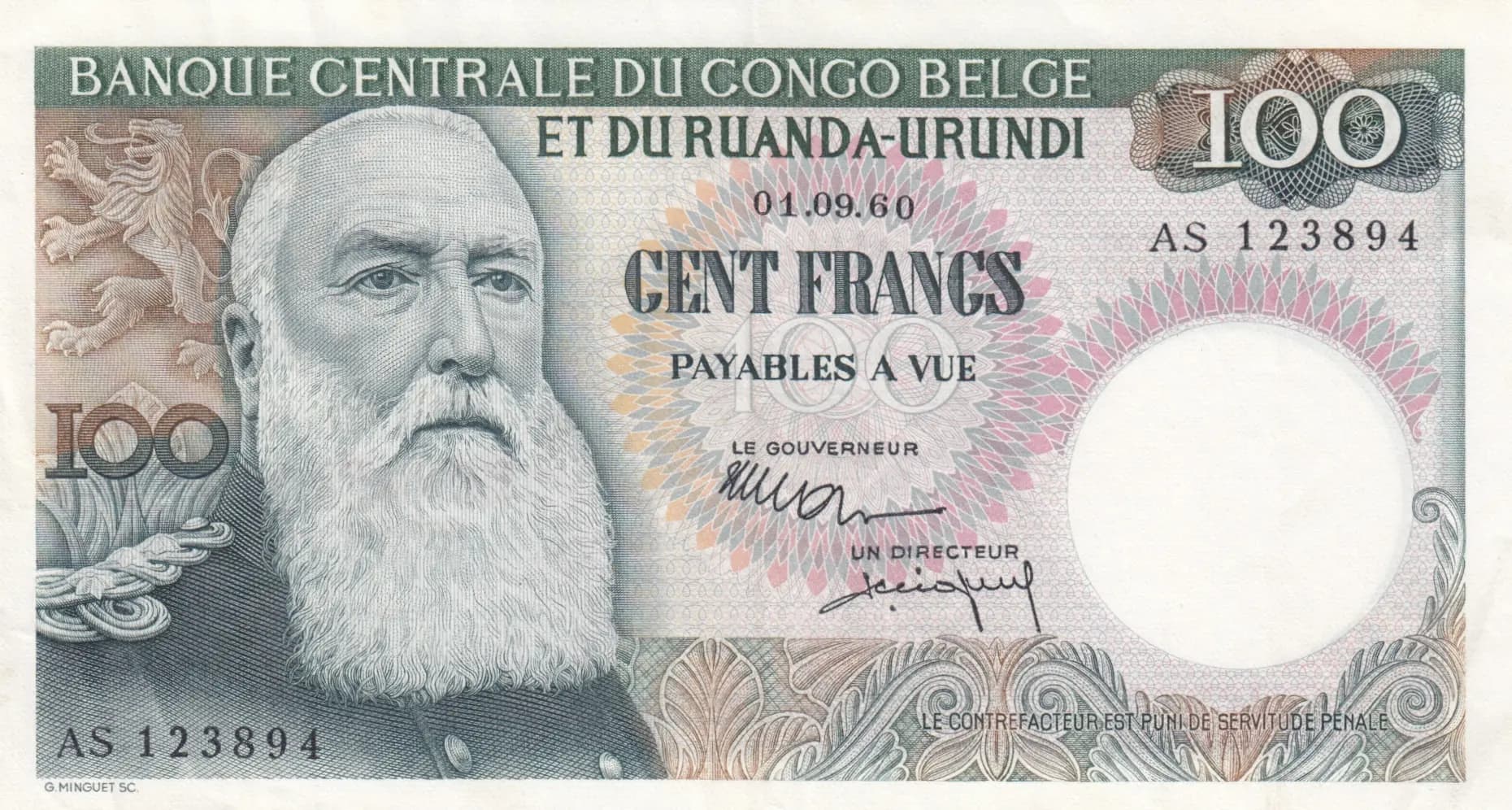
The obverse features a dignified left-facing profile portrait of King Leopold II, depicted with a long full beard, occupying the left portion of the note against a predominantly teal-green background with cream elements. A heraldic Belgian lion emblem appears in the upper left corner, while decorative floral and sunburst patterns in pink and orange tones accent the right side near the denomination numerals. The central band displays the issuer's name in French with ornamental scrollwork and geometric security patterns throughout. The reverse depicts a detailed engraved scene of African basket weavers—an adult and child—working with palm fronds and botanical materials in a central composition rendered in burgundy and brown tones against a cream background. Large five-pointed stars with radiating geometric patterns in yellow and blue frame the scene in the corners, while decorative borders in geometric designs complete the composition. Both sides employ bilingual text (French/Dutch) reflecting the colonial administrative duality.
{"front":{"issuer":{"french":"BANQUE CENTRALE DU CONGO BELGE ET DU RUANDA-URUNDI","english":"Central Bank of Belgian Congo and Ruanda-Urundi"},"denomination":{"french":"CENT FRANCS","english":"One Hundred Francs"},"payability":{"french":"PAYABLES À VUE","english":"Payable on Demand"},"signatures":{"french":"LE GOUVERNEUR / LE PREMIER-DIRECTEUR","english":"The Governor / The First Director"},"legal":{"french":"LE CONTREFACTEUR EST PUNI DE SERVITUDE PENALE","english":"The Counterfeiter is Punished with Penal Servitude"},"date":"04.06.56 (4 June 1956)","serialNumber":"N 325627","engraver":"G MINGUET SC (Sculptor/Engraver Mark)"},"back":{"issuer":{"dutch":"CENTRALE BANK VAN BELGISCH-CONGO EN RUANDA-URUNDI","english":"Central Bank of Belgian Congo and Ruanda-Urundi"},"denomination":{"dutch":"HONDERD FRANK","english":"One Hundred Francs"},"payability":{"dutch":"BETAALBAAR OP ZICHT","english":"Payable on Sight"},"signatures":{"dutch":"DE GOUVERNEUR / DE EERSTE-DIRECTEUR","english":"The Governor / The First Director"},"legal":{"dutch":"DE NAMAKER WORDT MET STRAFDIENST GESTRAFT","english":"The Counterfeiter is Punished with Penal Servitude"}}}
This note was produced using fine line engraving, evidenced by the intricate cross-hatching, detailed geometric patterns, and security design elements visible throughout both obverse and reverse. The printer is identified as BNB (Banque Nationale de Belgique/National Bank of Belgium) without imprint mark on the note itself. The engraver's mark 'G MINGUET SC' indicates the sculptor/engraver responsible for the plate design. The multicolor printing employs the traditional intaglio method characteristic of high-quality colonial-era banknote production, with distinct color separation for the base teal-green/cream on the obverse and burgundy-brown engraved elements on the reverse.
This example represents Pick-33a, identifiable by its watermark of an elephant's head, the most common variant of the 100 francs 1956 issue. The PMG population report identifies three catalogued variants for this base Pick number: P-33a (Wmk: Elephant's Head), P-33b (Wmk: Elephant's Head), and P-33c (Without Watermark). The distinction between P-33a and P-33b likely relates to subtle design or printing differences not readily apparent from visual inspection alone. The specific date of 04.06.56 (4 June 1956) and serial number N 325627 indicate this note falls within the standard circulation printing for this issue. Signature titles present ('LE GOUVERNEUR' and 'LE PREMIER-DIRECTEUR') are consistent with the standard P-33a variety.