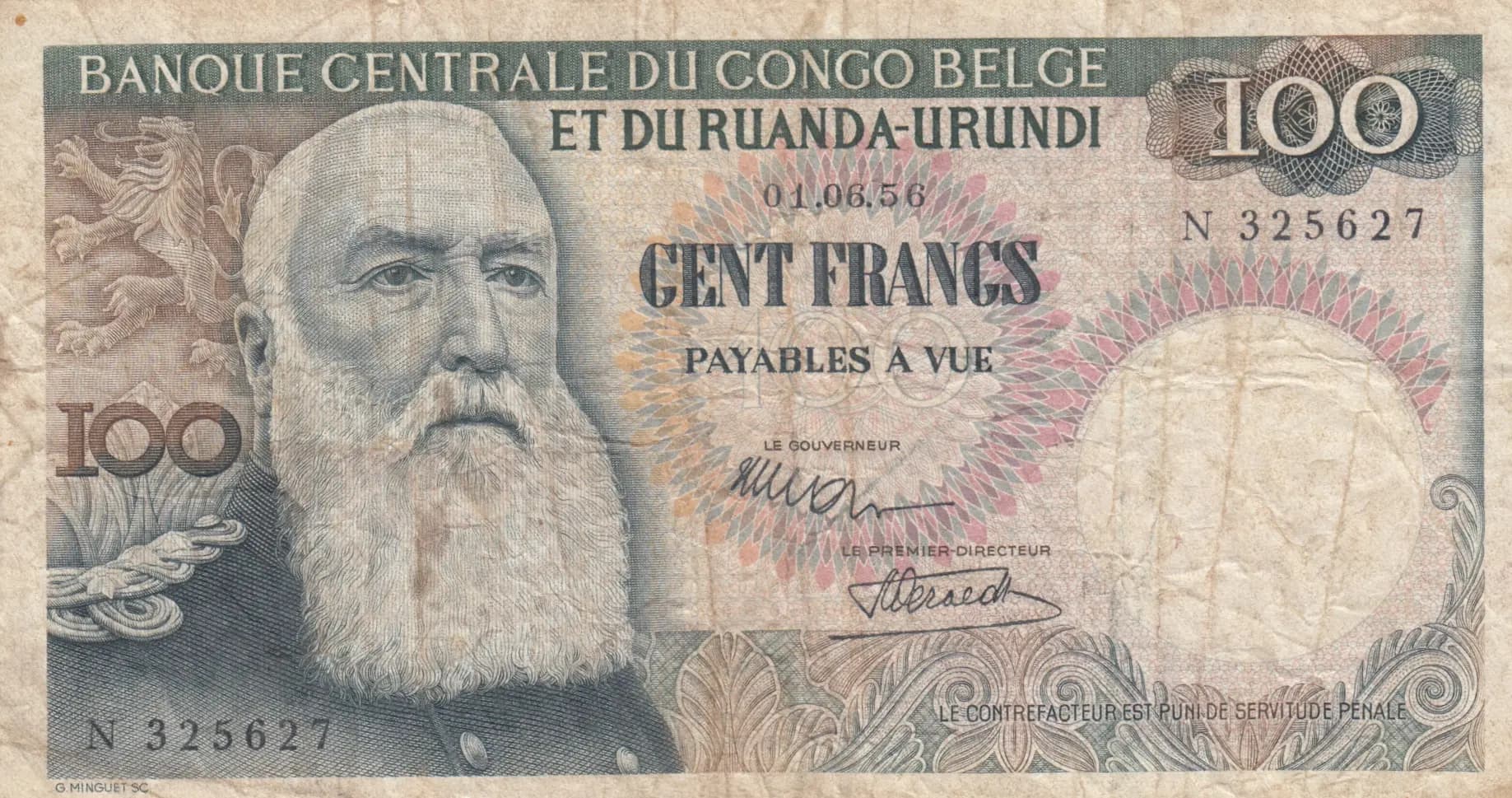
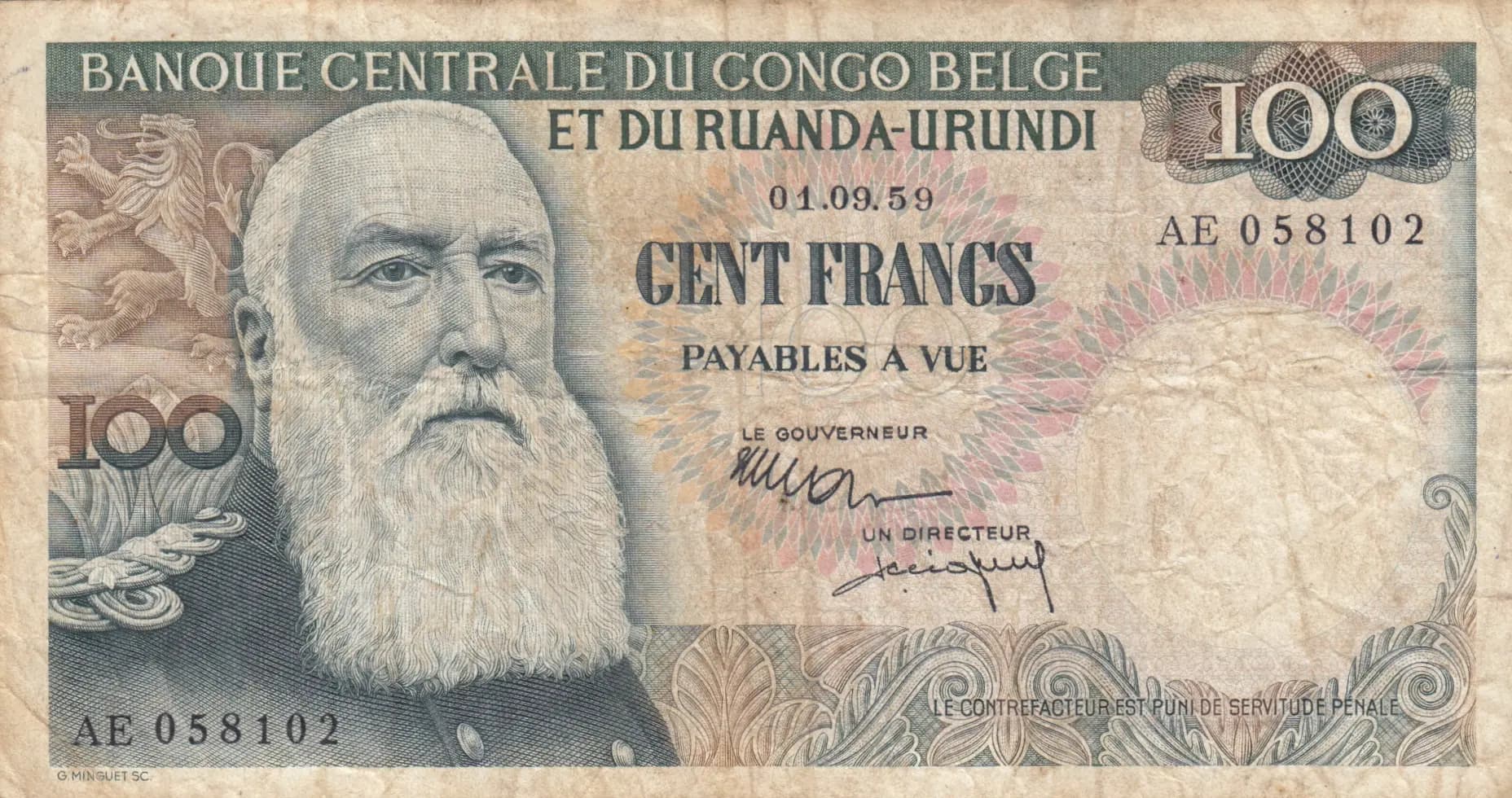
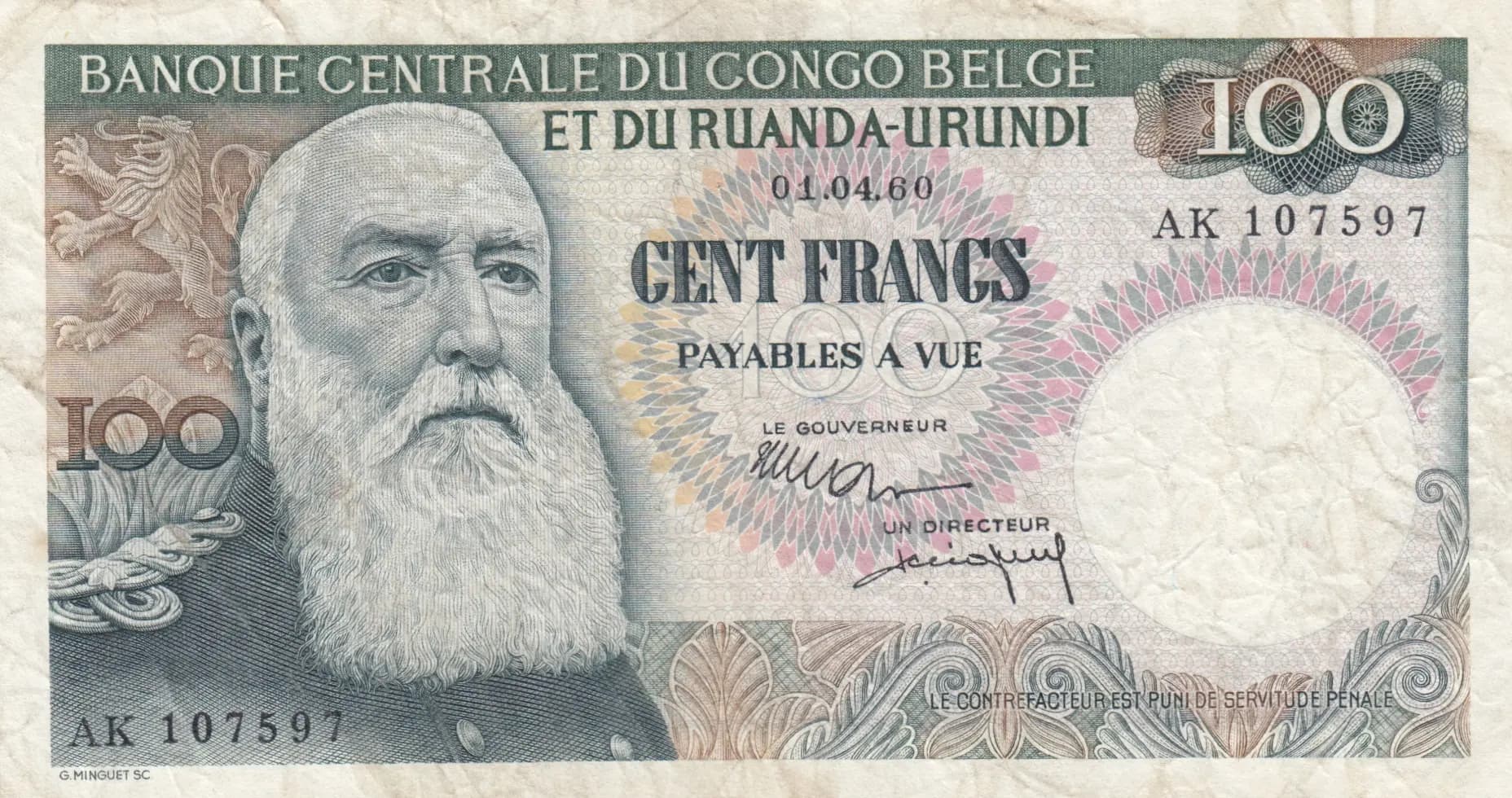
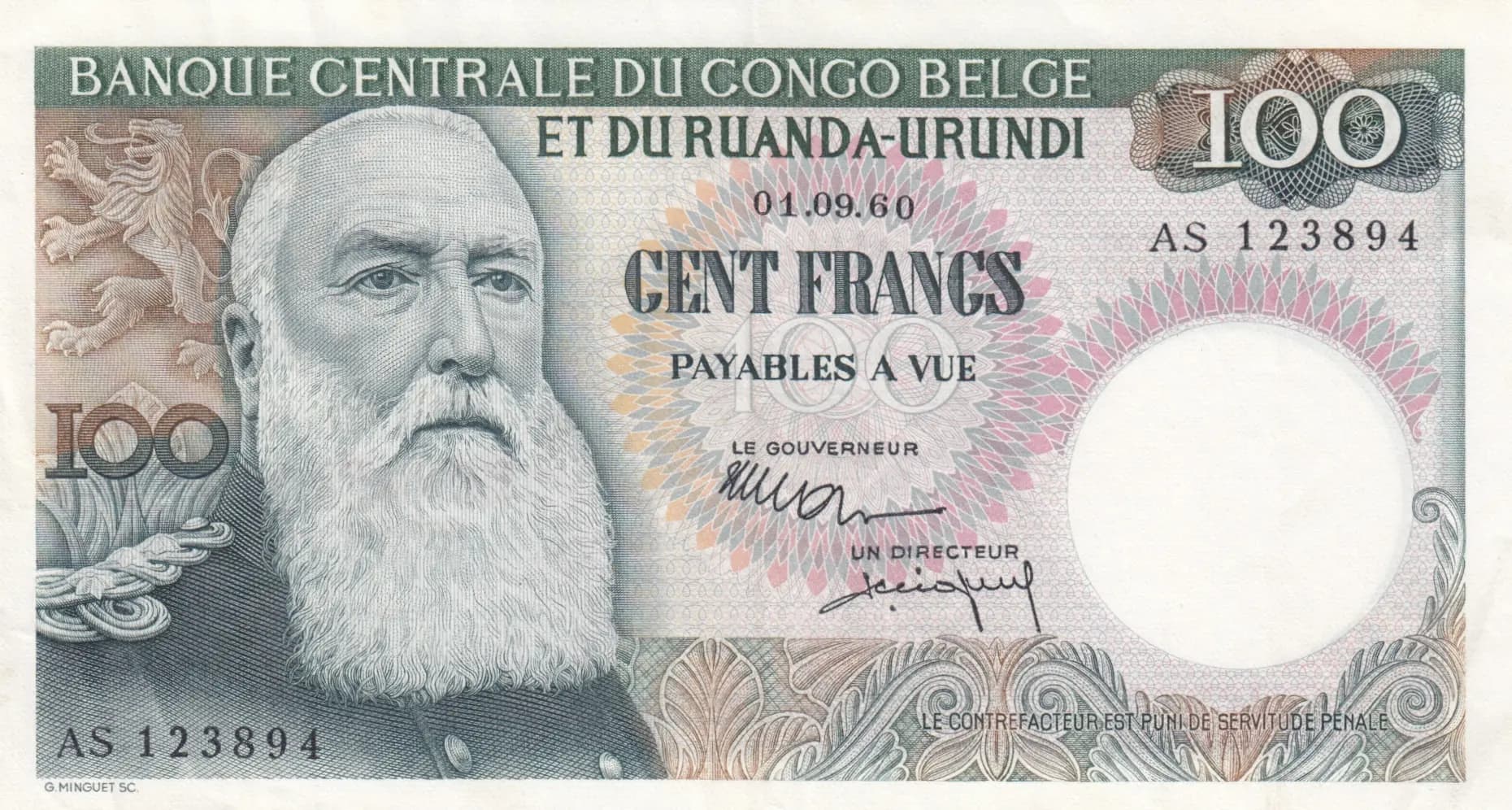
100 francs 1955
Market Prices
10 salesAbout This Note
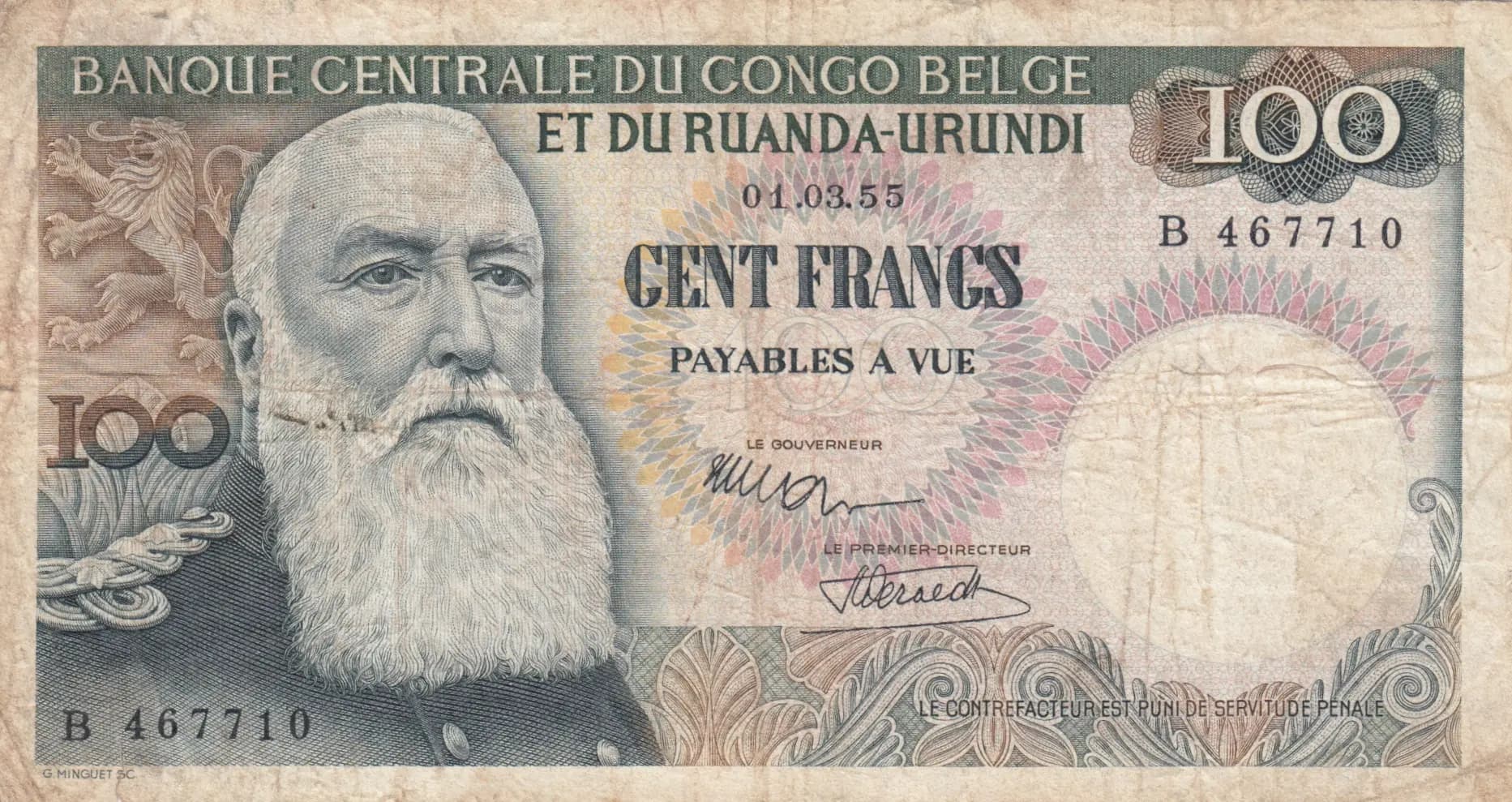
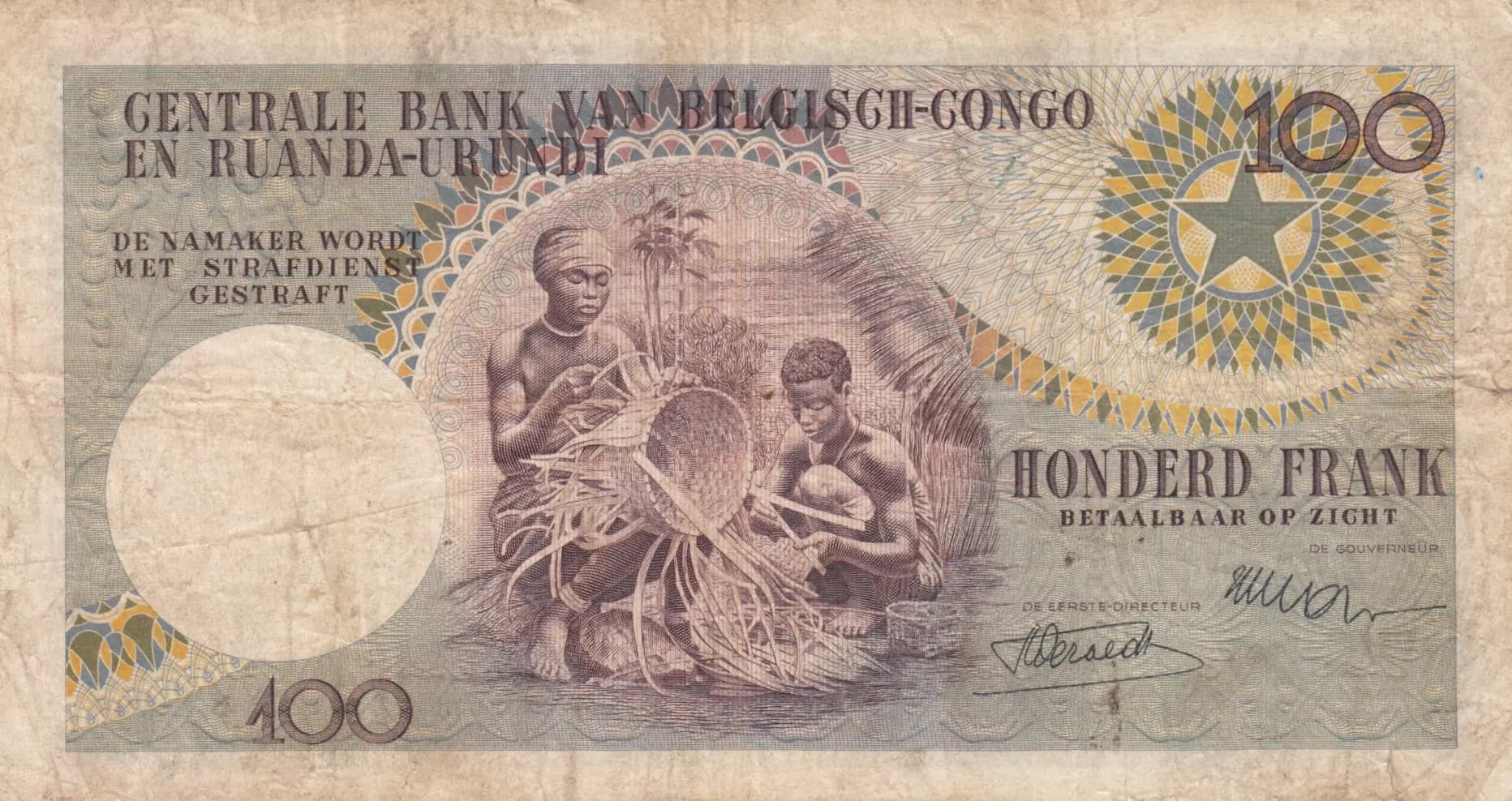
This Belgian Congo 100 Francs note from 1955 presents a beautiful example of mid-20th century colonial African currency design. The obverse features a striking portrait of King Leopold II in profile facing left, surrounded by ornate decorative patterns in green and multicolor, while the reverse depicts African basket weavers—a romanticized representation of traditional colonial-era labor and craftsmanship. In Fine condition, the note displays expected circulation wear including creasing and light foxing, with an intact structure and legible inscriptions; market data indicates this grade typically realizes $25-30 at auction, making it an affordable entry point for collectors of Belgian Congo currency.
Common. eBay price history demonstrates consistent sales in the $20-30 range for Fine condition examples, with no premiums commanding triple-digit prices in circulated grades. Professionally graded examples at higher grades (PMG 65) achieve substantially higher prices ($900+), but this indicates scarcity only in high grades, not in circulated grades. The 1955-1960 date range for this issue, combined with evidently substantial surviving populations reflected in steady auction market activity, confirms this as a standard circulation-era issue from a regular emission period. Print runs for this series were substantial, and the note was in regular circulation for five years across the Belgian Congo and Ruanda-Urundi territories.
Issued by the Banque Centrale du Congo Belge et du Ruanda-Urundi during the final decade of Belgian colonial rule (1955-1960), this note represents a transitional period in Central African monetary history. The imagery—Leopold II's portrait on the obverse and basket weavers on the reverse—reflects the colonial perspective of the era, presenting Belgian oversight of Congo's resources and labor while indigenous populations engaged in traditional crafts and production. This denomination and series predate Congo's independence in 1960 and the subsequent monetary reforms that followed decolonization.
The obverse features King Leopold II—the bearded Belgian monarch whose colonial administration controlled Congo—depicted in left-facing profile in the upper left quadrant. His portrait is framed by an ornate heraldic lion emblem (the Belgian heraldic symbol) positioned in the upper left corner, symbolizing Belgian sovereignty. The design employs intricate engraved floral and scroll work throughout, with pink/red and green tones creating a rich multicolor palette typical of mid-century banknote artistry. The reverse depicts a vignette of African basket weavers (identified in the visual analysis as two figures in traditional dress working with palm fronds and vegetation), centered within the design and surrounded by decorative sunburst patterns in gold and geometric motifs. Both sides employ bilingual text reflecting the colonial administration's use of both French and Dutch languages. The watermark, identified in PMG records as an elephant's head, appears in designated blank areas on both sides—a security feature common to this series and reflecting the Congo's wildlife heritage.
FRONT (French): 'BANQUE CENTRALE DU CONGO BELGE ET DU RUANDA-URUNDI' (Central Bank of Belgian Congo and Ruanda-Urundi); 'CENT FRANCS' (One Hundred Francs); 'PAYABLES A VUE' (Payable on Demand); 'LE GOUVERNEUR' (The Governor); 'LE PREMIER-DIRECTEUR' (The First Director); 'LE CONTREFACTEUR EST PUNI DE SERVITUDE PENALE' (The Counterfeiter is Punished with Penal Servitude); Date: 01.03.55 (March 1, 1955); Serial number: B 467710; 'G MINGUET 2C' (engraver/printer credit). BACK (Dutch): 'CENTRALE BANK VAN BELGISCH-CONGO EN RUANDA-URUNDI' (Central Bank of Belgian Congo and Ruanda-Urundi); 'HONDERD FRANK' (One Hundred Francs); 'BETAALBAAR OP ZICHT' (Payable on Sight); 'DE GOUVERNEUR' (The Governor); 'DE EERSTE-DIRECTEUR' (The First Director); 'DE NAMAKER WORDT MET STRAFDIENST GESTRAFT' (The Counterfeiter is Punished with Penal Servitude).
This note was produced using traditional intaglio engraving (copperplate printing), evidenced by the fine line work, intricate security patterns, and depth of impression visible throughout the design. The visual analysis confirms complex engraved patterns and ornamental flourishes characteristic of intaglio production. According to catalog references, the printer was the Banque Nationale de Belgique (BNB), Belgium's national bank, which handled printing for its colonial currency issues. The absence of a printer imprint on the note itself (as noted in realbanknotes.com reference) was typical of BNB's practice for certain colonial issues. The multi-color overprint and layered design elements suggest additional color separation printing layered atop the primary intaglio impression.
This note is cataloged as Pick-33a, which according to PMG population records is distinguished by a watermark featuring an elephant's head. Two related varieties exist: P-33b (also with elephant's head watermark, likely representing a signature or date variant) and P-33c (without watermark). The specific issue date observed on this specimen is 01.03.55 (March 1, 1955), within the broader 1955-1960 issue window. The serial number prefix 'B' and the presence of signature titles 'LE GOUVERNEUR' and 'LE PREMIER-DIRECTEUR' are consistent with the standard P-33a specification. The engraver mark 'G MINGUET 2C' represents the artisan responsible for engraving work on this plate. Collectors should note that date variants, signature variations, and serial number prefix changes may exist within the P-33a classification, though the visual evidence confirms standard characteristics of the primary variety.