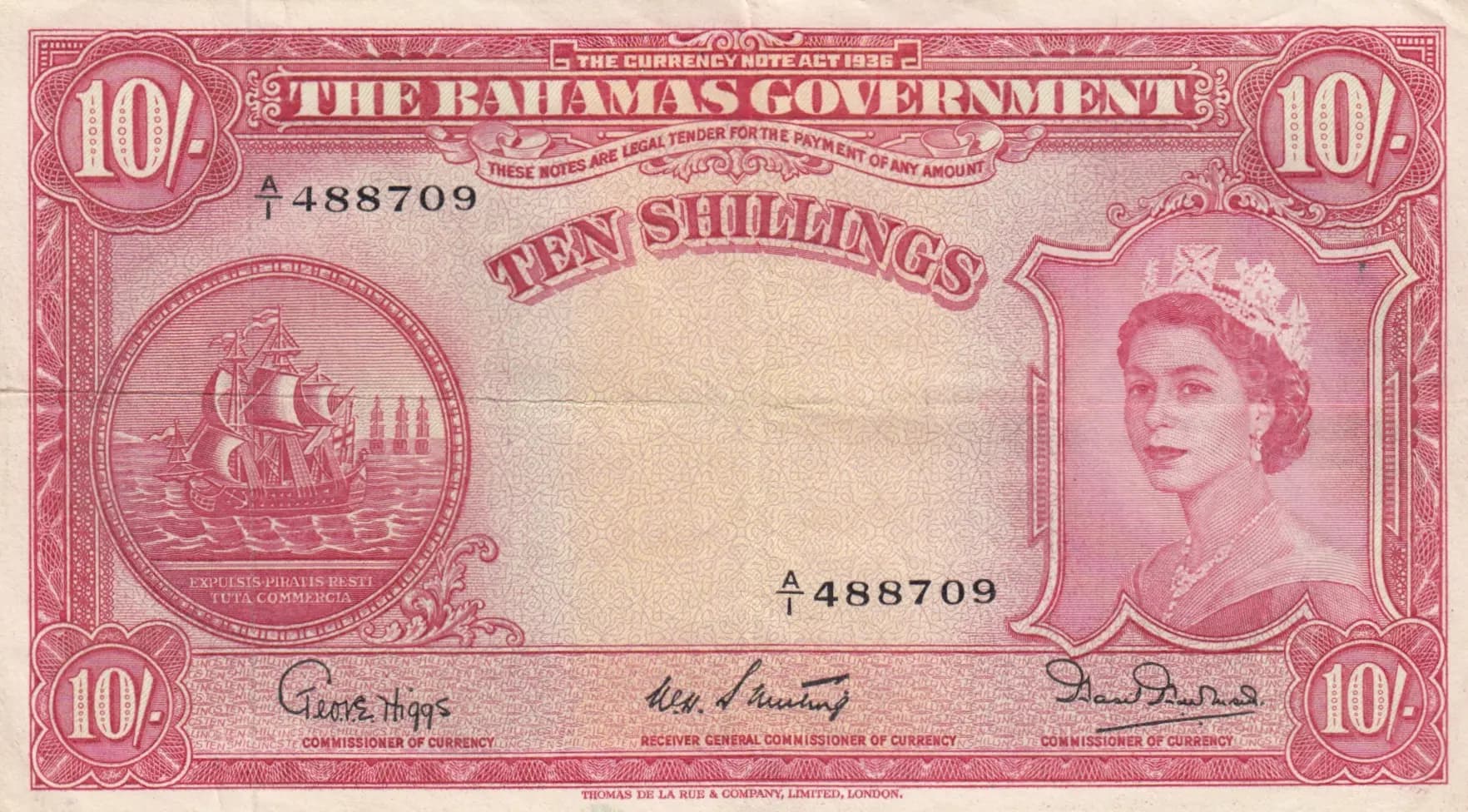
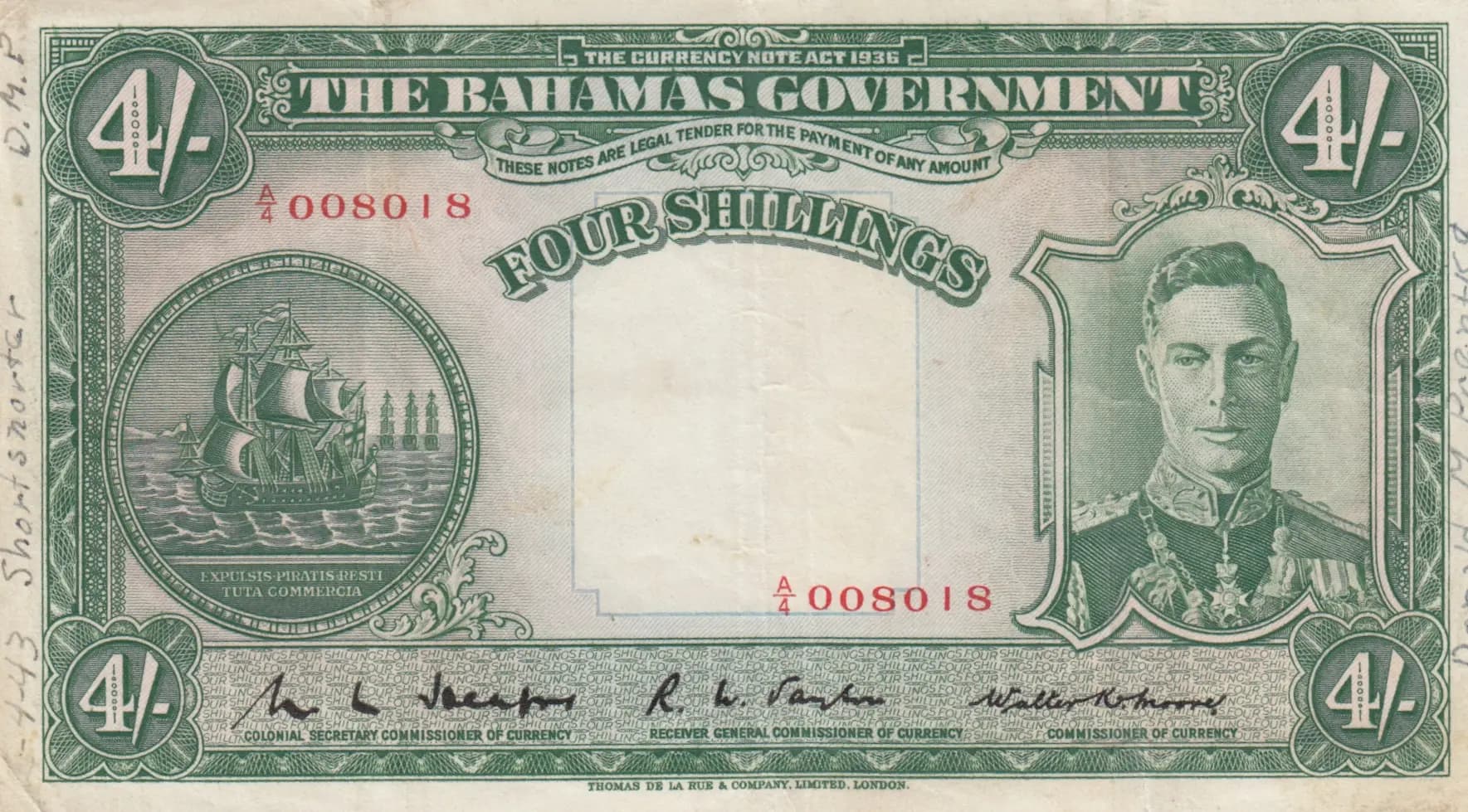
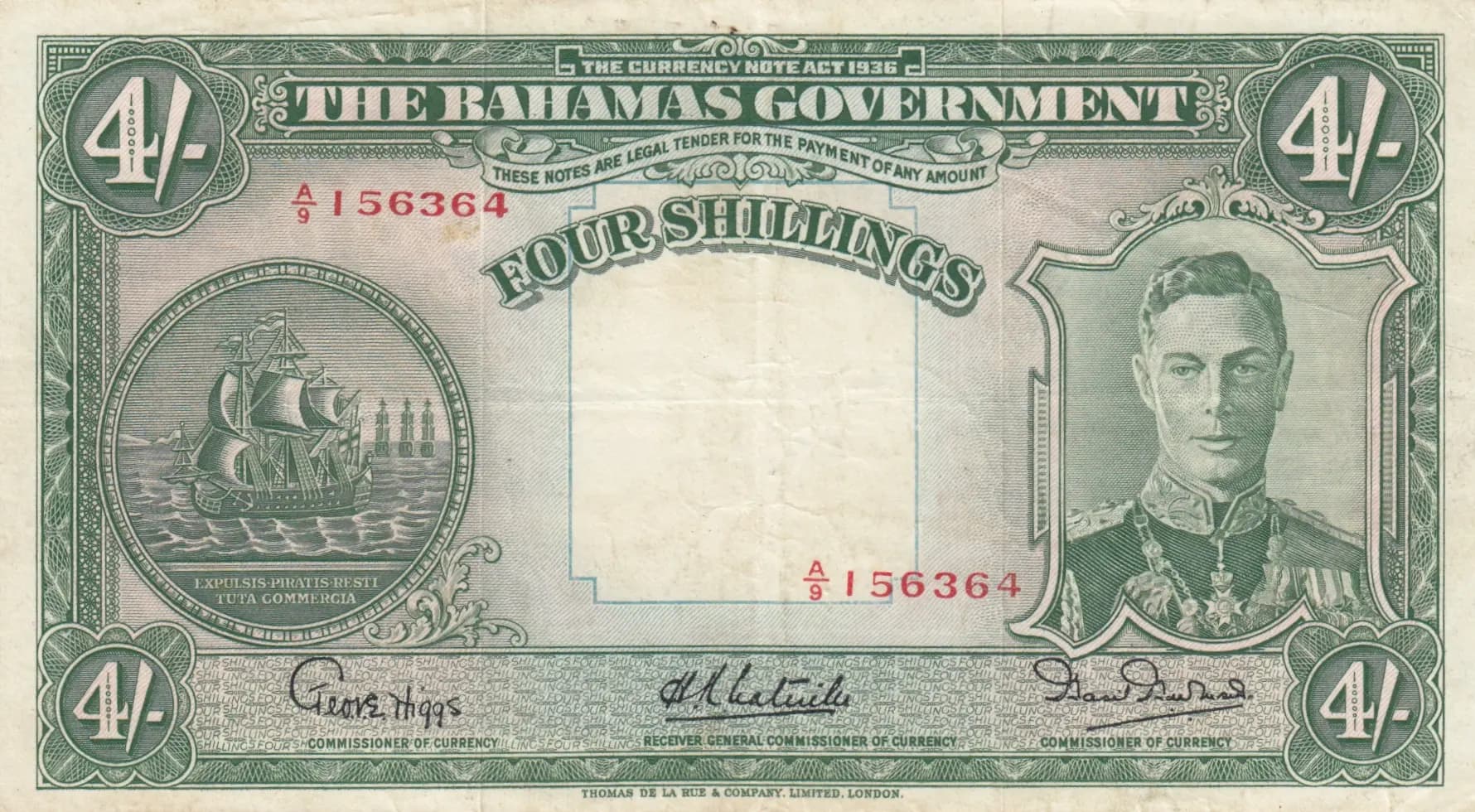
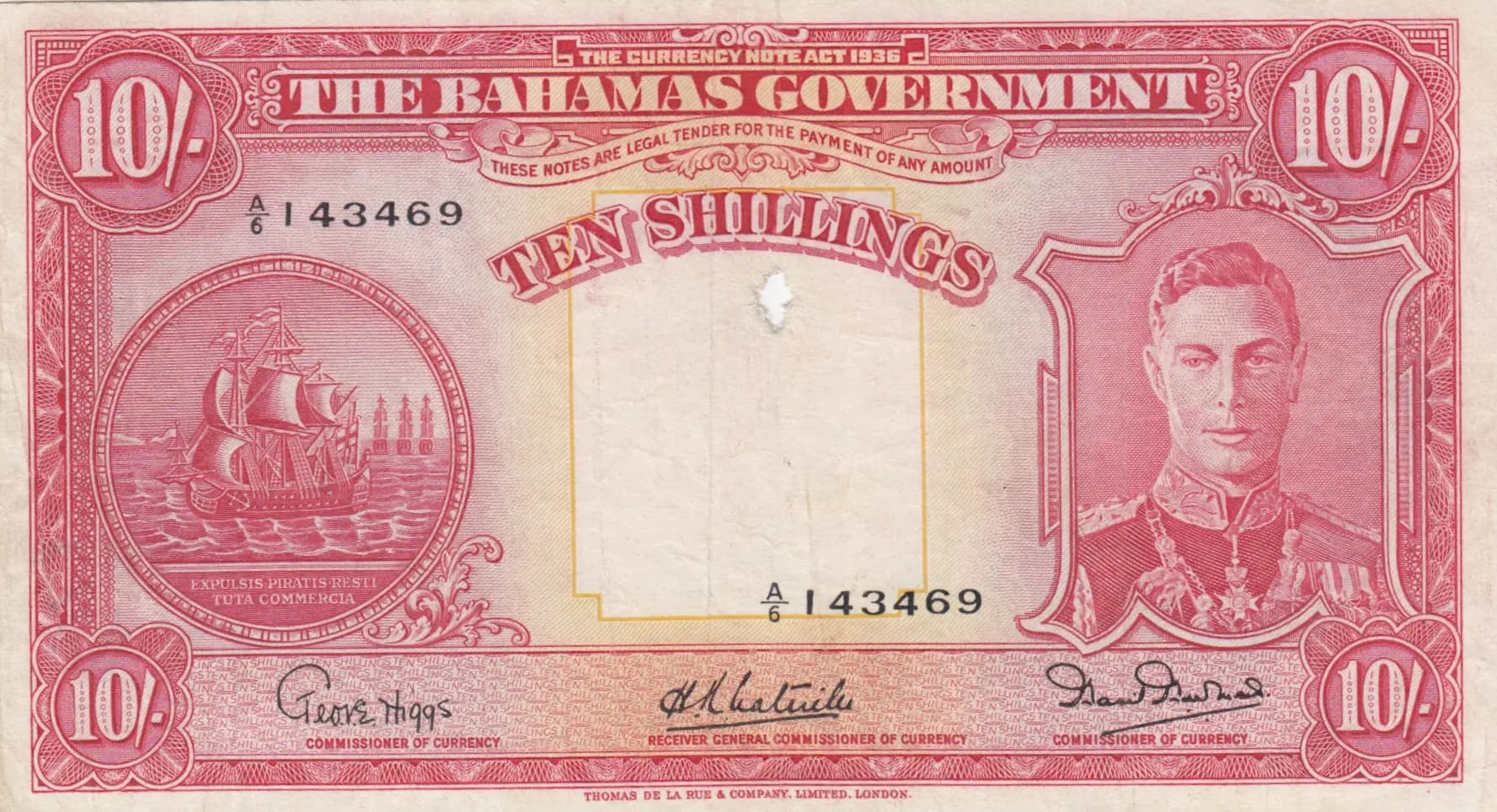
10 shillings 1953
Market Prices
13 salesAbout This Note
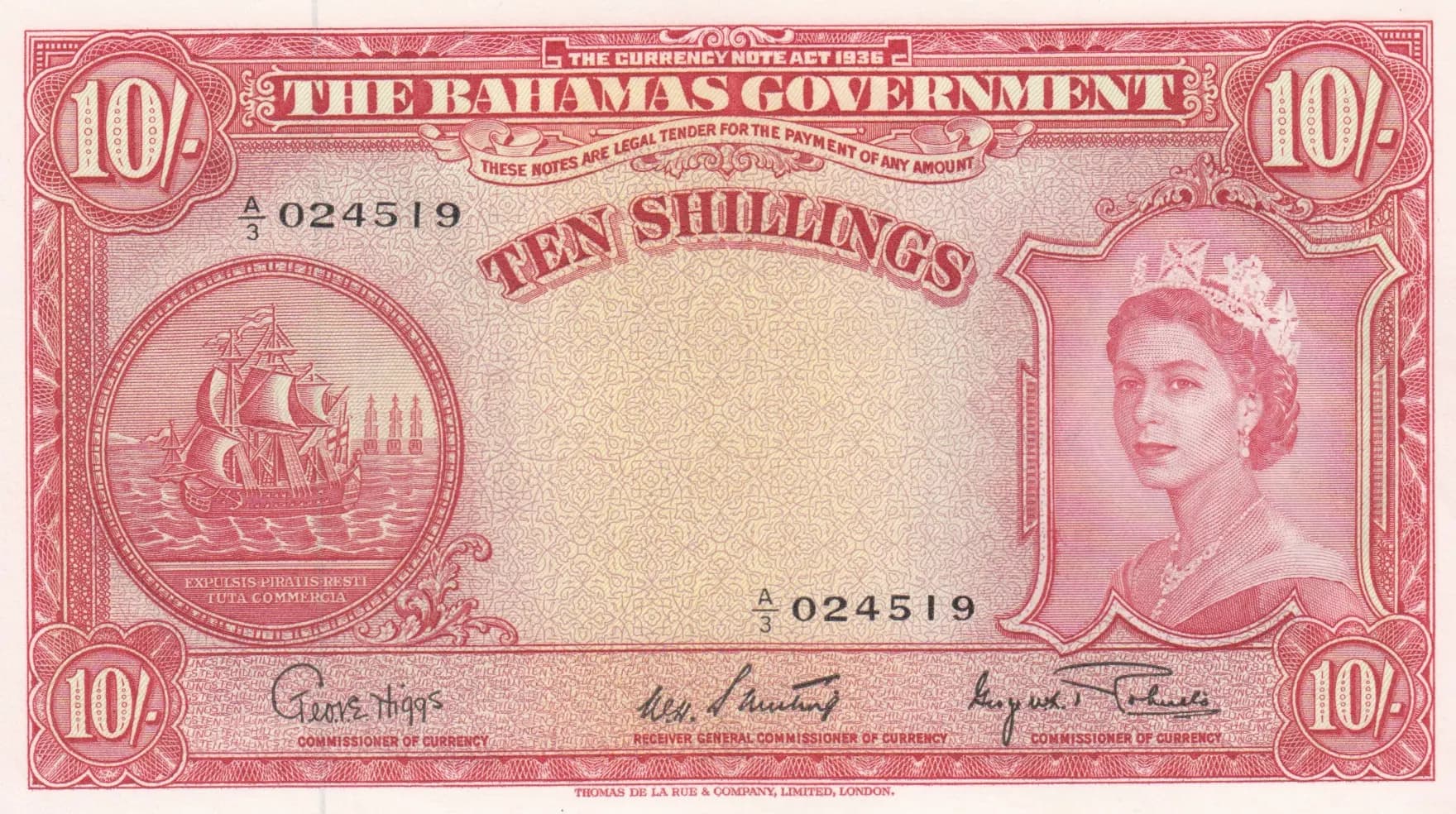
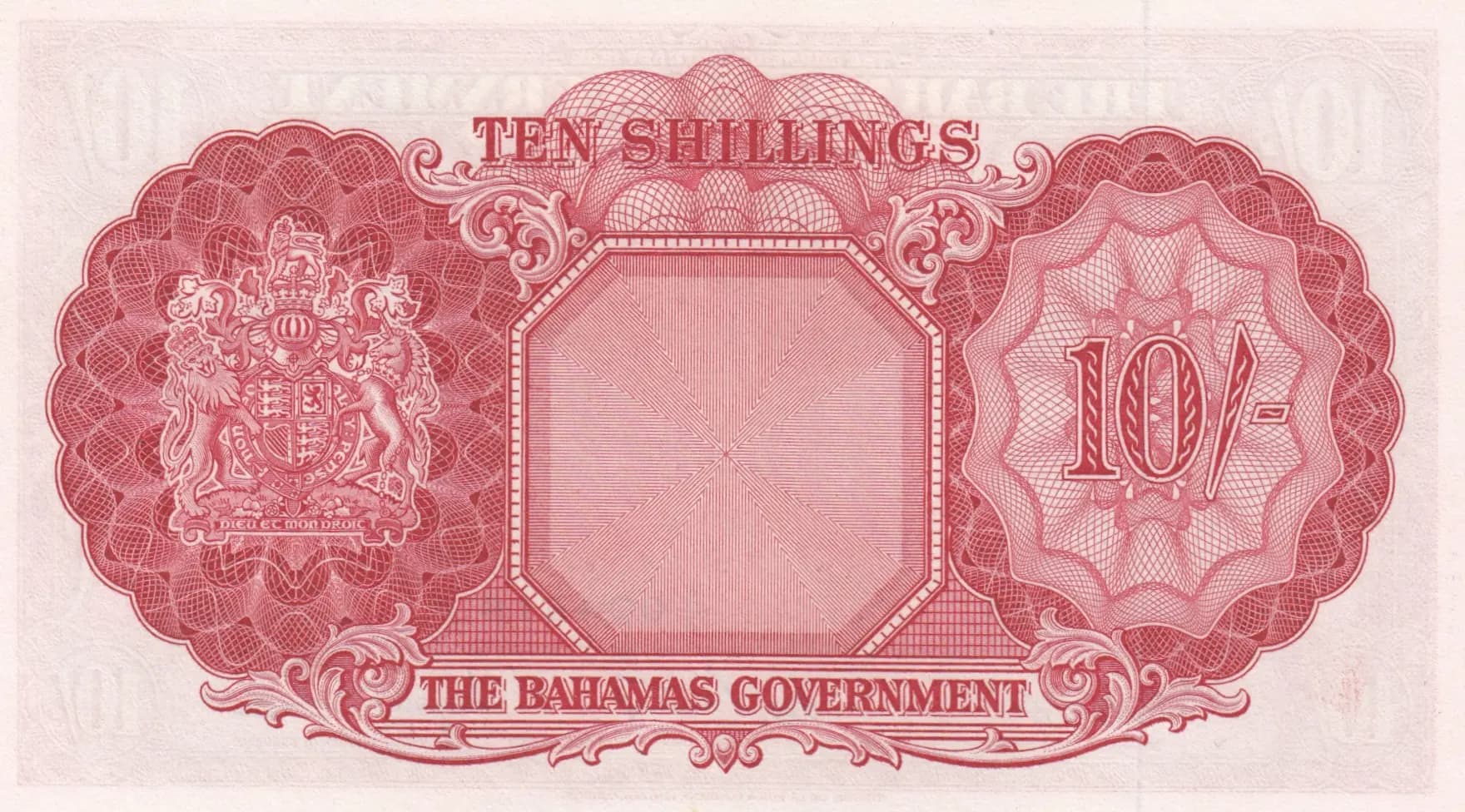
This is a stunning example of the Bahamas Government's 10 shillings note from 1953, printed by Thomas de la Rue in their characteristic pink/red color scheme. The note presents in uncirculated condition with crisp, vibrant printing, ornate engraved borders, and excellent eye appeal. The obverse features a portrait of Queen Elizabeth II in formal regalia alongside a beautifully detailed galleon in full sail, while the reverse displays the governmental coat of arms, making this an attractive specimen of early Commonwealth currency design.
Common. While this is an older Commonwealth currency note from 1953, the substantial eBay market history shows consistent trading activity across multiple grades and decades, with UNC examples having sold at $575 (2013), indicating reasonable availability in the collector market. The 2016 catalog valuation of $1,000 UNC reflects desirability rather than scarcity. Bahamas 10 shillings notes from this era were issued in sufficient quantities to support regular circulation and contemporary collecting, and they continue to appear regularly in international numismatic markets.
Issued under the Currency Note Act of 1936, this 1953 note represents the Bahamas' early post-war monetary period during Queen Elizabeth II's reign. The prominent sailing ship imagery reflects the nation's maritime heritage and colonial trading history, while the Latin motto 'Expulsis Piratis Restituta Commercia' (Pirates expelled, commerce restored) commemorates the historical suppression of piracy in the Caribbean and the establishment of legitimate commerce. The heraldic coat of arms on the reverse reinforces the colony's British governmental authority during this transitional period of Caribbean development.
The obverse features a left-aligned circular medallion containing a meticulously engraved multi-masted galleon (Spanish colonial sailing vessel) in full sail upon ocean waves, symbolizing the Bahamas' maritime commerce and naval heritage. To the right is a formal portrait of Queen Elizabeth II wearing a tiara and ceremonial dress, positioned within a decorative rectangular frame. The denomination '10/-' appears in ornamental circles at the upper corners, with 'TEN SHILLINGS' prominently displayed in the center. The reverse displays a symmetrical composition with the Bahamas coat of arms (featuring heraldic crown and lion imagery) positioned on the left within elaborate scrollwork, a large octagonal frame with diagonal line pattern in the center, and a decorative rosette containing '10/-' on the right. Throughout both sides, intricate ornamental borders with fine scrollwork and flourishes provide the characteristic Thomas de la Rue security aesthetic.
FRONT SIDE: 'THE BAHAMAS GOVERNMENT' (issuing authority); 'THE CURRENCY NOTE ACT 1936' (legislative authority); 'THESE NOTES ARE LEGAL TENDER FOR THE PAYMENT OF ANY AMOUNT' (legal tender declaration); 'TEN SHILLINGS' and '10/-' (denomination); 'EXPULSIS PIRATIS RESTITUTA COMMERCIA' (Latin: Pirates expelled, commerce restored); 'TUTA COMMERCIA' (Latin: Safe commerce); 'COMMISSIONER OF CURRENCY' and 'RECEIVER GENERAL COMMISSIONER OF CURRENCY' (official designations); 'THOMAS DE LA RUE & COMPANY, LIMITED, LONDON' (printer attribution); Serial number 'A 3 0245119'. BACK SIDE: 'TEN SHILLINGS' (denomination); '10/-' (denomination); 'THE BAHAMAS GOVERNMENT' (issuing authority).
This note employs steel engraving, the signature technique of Thomas de la Rue & Company, Limited, London. The visual analysis reveals characteristic fine line work, intricate parallel line patterns in background areas, complex ornamental borders, and detailed heraldic imagery typical of high-security engraved banknote production. The crisp definition of the galleon, portrait, and ornamental details confirms the use of traditional intaglio printing, which produces the tactile relief characteristic of quality period banknotes.
This note is cataloged as Pick 14d, one of four documented variants (P-14a through P-14d) for the base 10 shillings denomination. The distinguishing characteristics for P-14d include the specific signature combination (W. H. Sweeting as center signature and George W. K. Roberts at right), the Thomas de la Rue printer attribution, and the 1953 issue date. The serial number prefix 'A 3' and the condition details align with this variant classification. PMG population data confirms P-14d as a recognized variety within the series.