50 leke 1964
Market Prices
8 salesAbout This Note
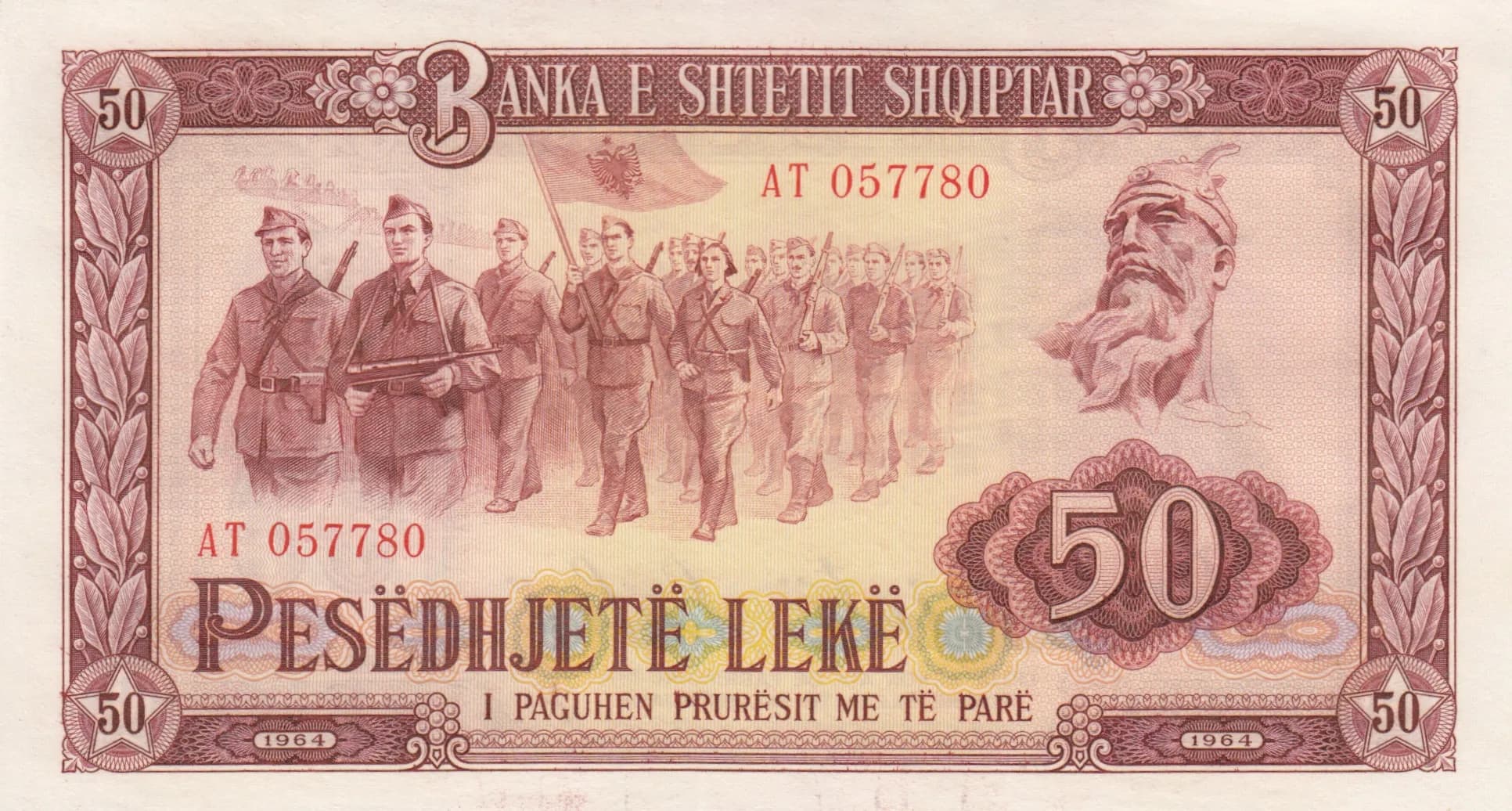
An exceptionally well-preserved example of Albania's 1964 50 leke note in uncirculated condition, featuring iconic Socialist-era imagery of military personnel on parade and the national hero Skanderbeg in profile. The reddish-brown multicolored design displays sharp engraving throughout with no wear, creasing, or staining, making this an attractive example for collectors of Eastern European or Socialist-period currency. The note's bold patriotic symbolism and fine decorative borders exemplify mid-20th century Albanian banknote design.
Common. This note exhibits standard circulation patterns with multiple eBay sales recorded over the past 15 years ranging from $6.70 to $66 depending on condition grade, indicating consistent collector availability. The 2019 catalog valuation of $25 UNC aligns with market reality showing typical UNC examples selling in the $15-20 range historically. The existence of multiple professional grading variants (P-38a and P-38s per PMG) and regular market appearance confirms this is a standard issue with no scarcity premium.
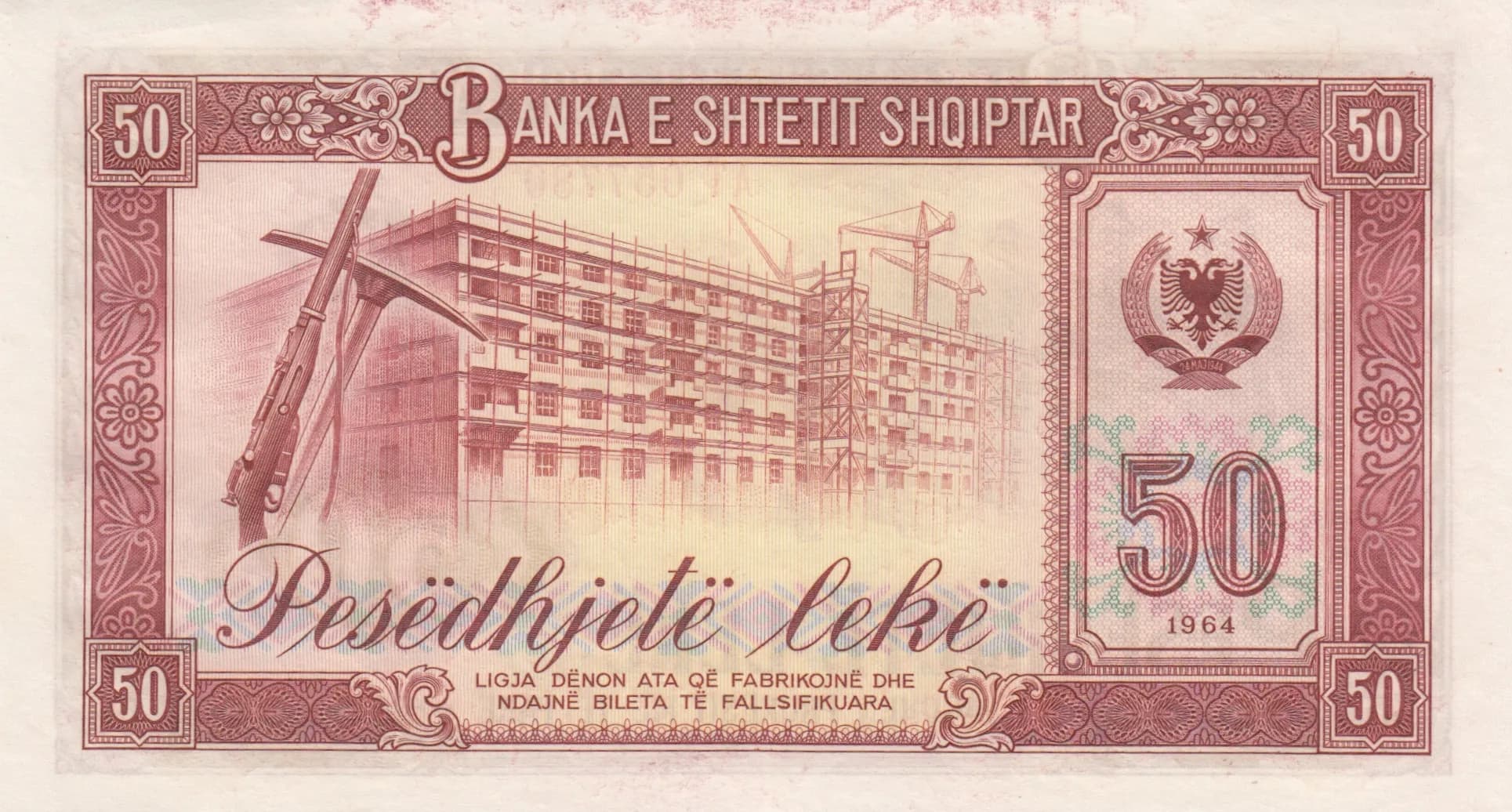
Issued by the Bank of the Albanian State in 1964, this note reflects Albania's post-war socialist period under Enver Hoxha, with the obverse prominently displaying soldiers on parade—symbolizing national strength and military readiness—and the profile of Skanderbeg, the 15th-century Albanian national hero and resistance fighter. The reverse's depiction of a modernist building under construction with crane imagery underscores the regime's emphasis on rapid industrialization and socialist development, themes central to Albanian state propaganda of the era.
The obverse features a left-center composition of armed soldiers on military parade holding rifles and a flag, with the distinctive bearded profile portrait of Skanderbeg (Gjergj Kastrioti, 1405-1468), the legendary Albanian military commander, positioned at upper right. The reverse displays a modernist multi-story building shown under active construction with visible crane on the left, symbolizing socialist progress, paired with the Albanian coat of arms—a double-headed eagle within a circular wreath topped with a star—positioned at upper right. Both sides are framed by ornate decorative borders featuring fine floral and geometric patterns typical of engraved banknote security design. The overall color palette of reddish-brown and mauve tones on cream background creates a cohesive, dignified aesthetic.
OBVERSE: 'BANKA E SHTETIT SHQIPTAR' (Bank of the Albanian State) | 'PESËDHJETË LEKË' (Fifty leke) | 'I PAGUEN PRURËSIT ME TË PARË' (Payable to the first holder) | Serial number: AT 057780 | Denomination numeral: 50 | Year: 1964. REVERSE: 'BANKA E SHTETIT SHQIPTAR' (Bank of the Albanian State) | 'Pesëdhjetë lekë' (Fifty leke) | Denomination numeral: 50 | Year: 1964 | 'LIGJA DËNON ATA QË FABRIKOJNË DHE NDAJNË BILETA TË FALLSIFIKUARA' (The law punishes those who manufacture and distribute counterfeit notes).
Intaglio (engraved) printing, evidenced by the fine line work, ornate decorative borders with detailed floral patterns, and the sharp, well-defined details visible throughout the obverse and reverse. The intricate rendering of the coat of arms, soldier uniforms, architectural details, and facial features characteristic of Skanderbeg's portrait all indicate high-quality engraved plate work typical of mid-20th century European central bank note production. The specific printer for this Albanian note is not definitively attributed in readily available references, though it may have been produced by a Swiss or Eastern European security printer contracted by Banka E Shtetit Shqiptar.
Visual analysis indicates this is the primary P-38 variety with the standard obverse design showing soldiers and Skanderbeg, reverse with construction scene and coat of arms. PMG has catalogued variants P-38a and P-38s, though the specific distinguishing characteristics of these variants are not detailed in available reference materials. The observed serial number AT 057780 appears consistent with standard sequential numbering. No overprints, security features beyond standard engraving, or unusual printing variations are evident in the images analyzed.