10 lek 1940
Market Prices
43 salesAbout This Note
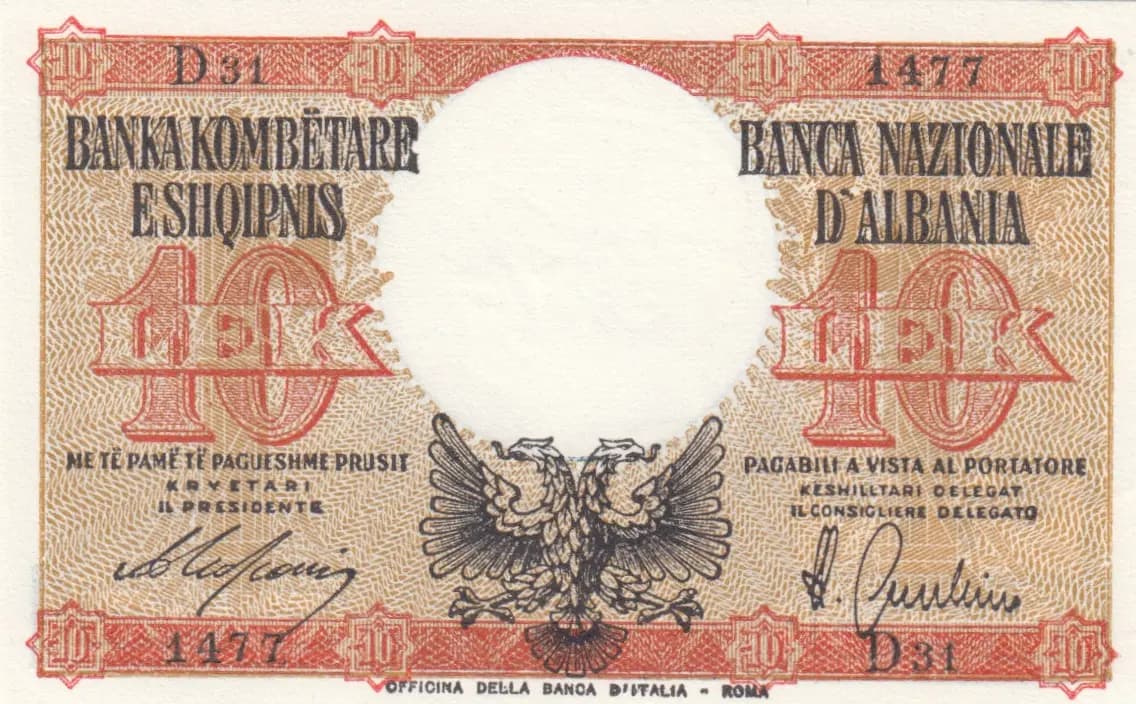
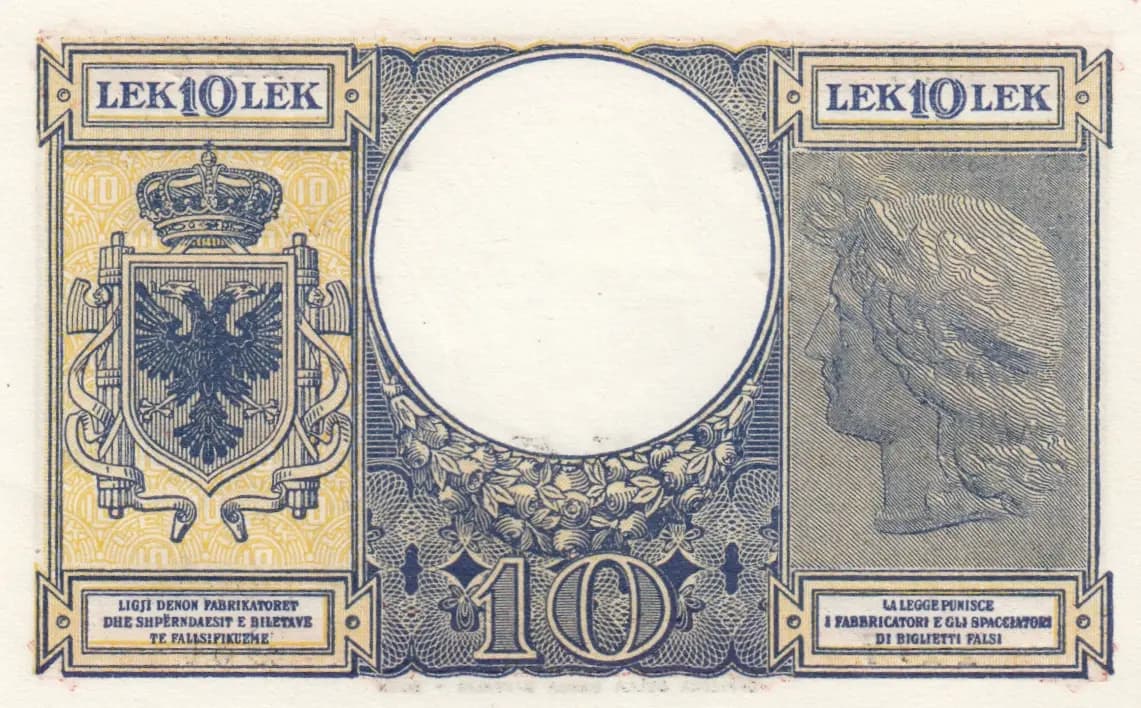
This is an exceptional example of Albania's 1940 10 Lek banknote (Pick P-11), graded UNC (Uncirculated) and printed by the Officina della Banca d'Italia in Rome. The note exhibits pristine condition with crisp, sharp printing throughout, featuring the distinctive Albanian double-headed eagle on the front in red and brown tones, and a crowned coat of arms with portrait on the reverse in dark blue and yellow. This bilingual issue (Albanian and Italian) represents a fascinating transitional period in Albanian monetary history and remains highly sought by collectors of Eastern European and Italian-printed currency.
Common. Despite its historical interest and the specific circumstances of wartime Italian-occupied Albania, this note remains common in the numismatic market. eBay historical price data shows consistent sales across all condition grades, with recent EF examples selling in the $5-$18 range and even PMG-graded specimens (PMG 67-68) typically fetching $100-$250. The 2016 catalog value for UNC is listed at $40, and the consistent availability of examples in various conditions indicates a substantial print run. The note's general accessibility in the secondary market, combined with moderate pricing even for high-grade examples, confirms its classification as common rather than scarce or rare.
Issued in 1940 during the Italian occupation of Albania (1939-1943), this banknote reflects the complex political situation where the Banca Nazionale d'Albania maintained nominal operations under Italian control, evidenced by the dual-language inscriptions and printing by Rome's Bank of Italy facility. The prominently displayed crowned coat of arms and the presence of what appears to be a portrait of a royal or state figure underscores Albania's status during this period, while the elaborate security features and anti-counterfeiting warnings demonstrate the issuer's efforts to maintain currency credibility amid wartime circumstances.
The obverse features a striking composition with red and brown coloring on a tan/cream underprint, dominated by ornate geometric and floral border patterns in the corners and margins. The Albanian double-headed eagle emblem is positioned prominently in the lower center, rendered in black with wings spread. A large circular white space occupies the central area, likely representing the watermark region or security feature area. The reverse displays dark blue printing on a yellow/cream underprint with equally elaborate ornamentation. A crowned coat of arms featuring the Albanian double-headed eagle within a shield is positioned on the left side, while a male figure in profile (likely a state or royal personage) is engraved on the right. The denomination '10' appears in large numerals at the lower center of the reverse. The entire design reflects high-quality engraved banknote production characteristic of Italian security printing from this era.
FRONT SIDE: 'BANKA KOMBËTARE E SHQIPNIS' / 'BANCA NAZIONALE D'ALBANIA' (National Bank of Albania); 'NË TE PAMJE TE PAGUESHME PRUSIT KËRVËTARI IL PRESIDENTE' / 'PAGABILI A VISTA AL PORTATORE, IL CONSIGLIERE DELEGATO' (Payable on sight to bearer, the delegate councillor); 'OFFICINA DELLA BANCA D'ITALIA - ROMA' (Printing office of the Bank of Italy - Rome); Serial number indicators: D41, D31, and reference numbers 1477, 1417; Denomination: '10'. BACK SIDE: 'LEK 10 LEK' (10 Lek); 'LIGJ DENON FABRIKATORET DHE SPËRNDAESIT E BILETAVE JT FALSIPIKUJEN' / 'LA LEGGE PUNISCE I FABBRICATORI E GLI SPACCIATORI DI BIGLIETTI FALSI' (The law punishes the manufacturers and distributors of counterfeit banknotes); Denomination: '10'.
This note was produced using traditional intaglio (engraved) printing methods, as evidenced by the fine line work, precise detail in the portraits and coat of arms, and the characteristic sharp, crisp impressions visible throughout both sides. The production was undertaken by the Officina della Banca d'Italia (ODBI) in Rome, one of Europe's premier security printing facilities. The multicolor printing (red/brown/tan on obverse; dark blue/yellow on reverse) was executed using separate plates for each color, a standard practice for high-security currency of this period. The intricate geometric patterns and ornamental borders served as visual anti-counterfeiting measures.
The observed specimen displays serial number prefix 'D' with component numbers visible (1477, 1417 and indicators D41, D31). The Pick catalog lists P-11 with one documented variant. No specific overprints, signature variations, or dated modifications are evident in this UNC example. The bilingual format (Albanian/Italian) and the Rome printing location are standard characteristics of this issue. Collectors should note that examples may vary by serial number range and color intensity, though these represent standard production variations rather than distinct catalog varieties.