10 leke 1964
Market Prices
7 salesAbout This Note
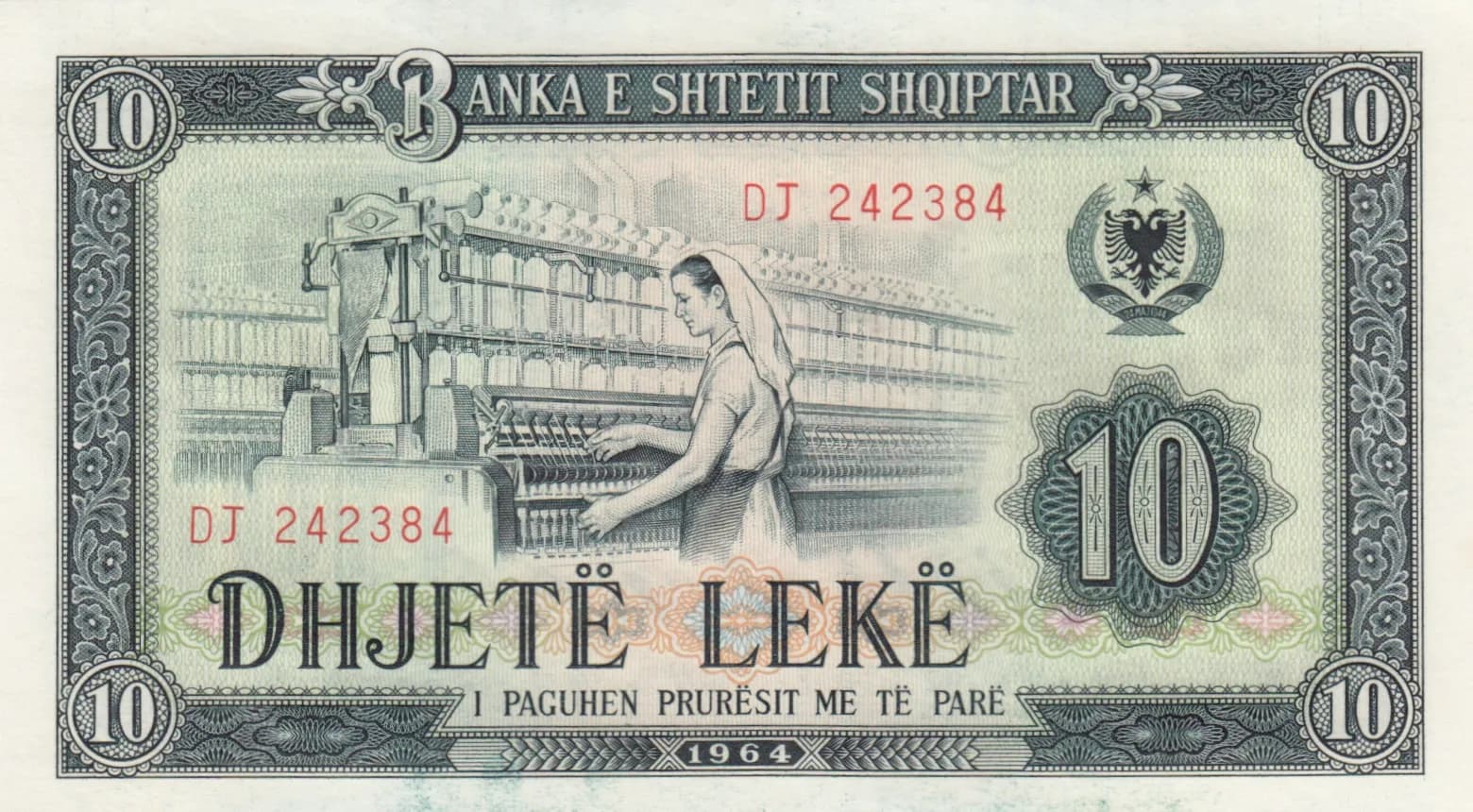
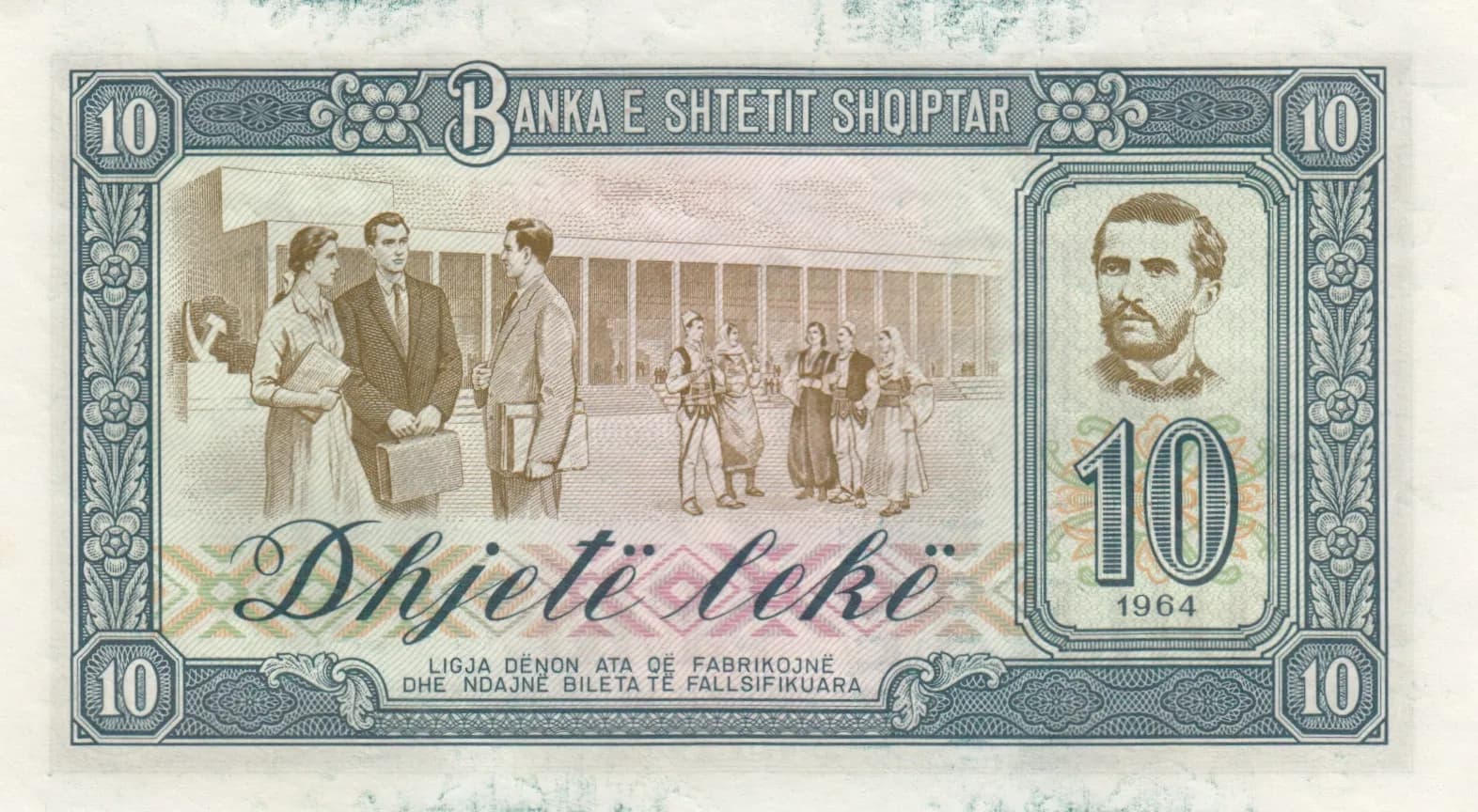
This is an uncirculated 1964 Albanian 10 leke note from the State Bank of Albania, showcasing the socialist-era aesthetic with crisp intaglio printing and excellent paper quality. The obverse depicts a woman operating a textile loom, symbolizing industrial progress, while the reverse features a modernist institutional scene and a portrait of a bearded dignitary, likely Naim Frasheri. The note exhibits no signs of circulation with intact margins and vivid color separation between the dark tones of the obverse and brown/sepia tones of the reverse.
Common. The 1964 10 leke (Pick-36) is a regular issue from a long-established state bank with substantial circulation. eBay market data from 2014-2019 shows UNC examples consistently selling for $7-10, with higher grades (PMG 67-68) averaging $30-70. These modest prices and regular appearance in the secondary market indicate wide availability. No evidence of limited print runs, recalls, or scarcity factors exists. This note is frequently encountered by collectors of Albanian currency and Eastern European banknotes.
This note was issued during Albania's isolationist period under Enver Hoxha's communist regime, a time when the country was emphasizing industrial development and labor as central themes of national identity. The textile worker depicted on the obverse reflects the socialist valorization of manual labor and industrial production, while the institutional architecture and formal portraiture on the reverse emphasize state authority and modernization. The high-quality intaglio printing demonstrates the technical capabilities of Albania's state printing facilities despite international isolation.
The obverse features a woman in profile wearing traditional head covering, operating an industrial textile loom with rows of machinery visible in the background—a visual representation of Albania's focus on industrial labor during the socialist period. A double-headed eagle emblem appears at upper right, representing the Albanian state. The reverse depicts a modernist institutional scene with columned architecture and large windows, showing a man in formal business attire on the left engaged with other figures, symbolizing state governance and public administration. The prominent oval-framed portrait on the right side is believed to represent Naim Frasheri, an important Albanian cultural and historical figure. Both sides feature ornate decorative borders with geometric and floral patterns, corner medallions displaying the denomination '10', and demonstrate the sophisticated engraving style characteristic of mid-20th century Eastern European currency.
Front side: 'BANKA E SHTETIT SHQIPTAR' (State Bank of Albania), 'DHJETE LEKE' (Ten Leke), 'I PAGUHEN PRUREST ME TE PARE' (Payable to the bearer on demand), '1964' (year of issue). Back side: 'BANKA E SHTETIT SHQIPTAR' (State Bank of Albania), 'Dhjete leke' (Ten leke), 'LIGJA DENON ATA OE FABRIKOJNE DHE NDAJNE BILETA TE FALLSIFIKUARA' (The law punishes those who manufacture and distribute counterfeit notes), '1964' (year of issue).
Intaglio (engraved) printing on bank note paper, evidenced by the fine line work, decorative border patterns, and crisp detail visible in both the industrial machinery background and portrait work. The color separation between obverse (black/dark gray on cream/beige) and reverse (brown/tan with green accents on cream/beige) indicates multi-plate intaglio production. The red serial number suggests additional flat printing or lithographic overlay. This was likely produced by a specialized state security printer, typical for Albanian banknotes of this era.
PMG has catalogued two variants for Pick-36: P-36a and P-36s (specimen). The note analyzed appears to be P-36a (regular issued note) based on the presence of a standard serial number (DJ 242384) and lack of 'SPECIMEN' overprinting. No signature varieties are evident from the visual analysis provided. The date '1964' on the note corresponds to the catalogued issue year. Additional varieties may exist based on serial number prefix changes or minor printing variations, but cannot be definitively determined from single-note imagery.