5 leke 1964
Market Prices
3 salesAbout This Note
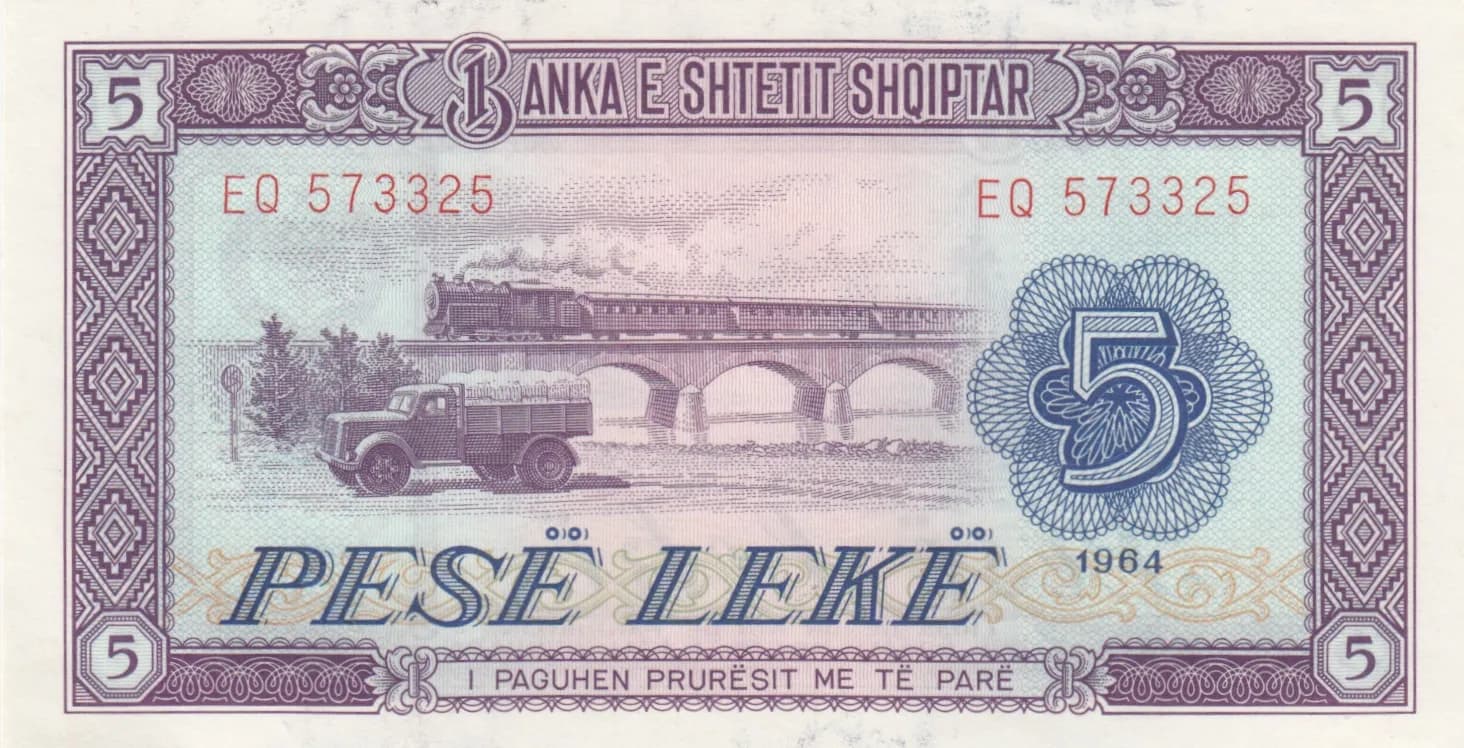
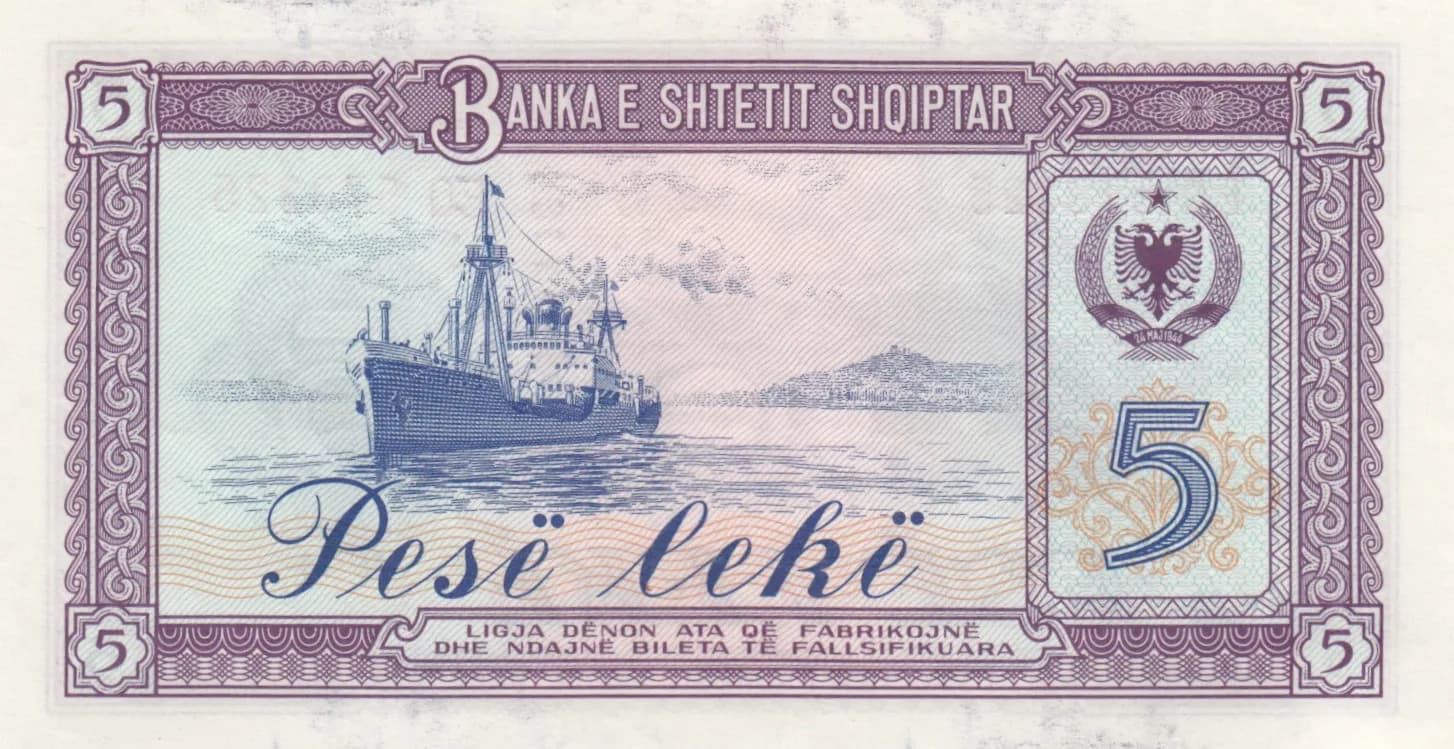
This 1964 Albanian 5 leke note (Pick P-35) presents an exceptional example of mid-20th century Eastern Bloc design aesthetics, showcasing industrial and maritime imagery that reflected post-war modernization themes. The obverse features a striking composition of a vintage truck and steam locomotive crossing a multi-arched viaduct, rendered in purple and mauve tones with intricate guilloché patterns, while the reverse depicts the steamship SS Daijti with the Albanian eagle emblem prominently displayed. In UNC condition with pristine paper quality and sharp engraving throughout, this note exhibits minimal aging and represents a well-preserved specimen of Albanian industrial-era currency design.
Common. The eBay market data provided shows this note trading in the $18.50–$31.69 range for standard UNC examples (2014–2018), with even higher-grade PMG specimens (67, 66) reaching only $54 at maximum. These modest market prices across all condition grades indicate substantial circulation and survival of this issue. While Albania's post-1944 banknotes command collector interest, the 1964 5 leke remains readily available in the secondary market. The catalog value for UNC listed as $8 further confirms this note is not scarce. No historical evidence suggests a limited print run or recall; this represents a standard regular-issue banknote with typical availability for its denomination and era.
Issued by Banka E Shtetit Shqiptar in 1964, this banknote exemplifies Albania's post-World War II reconstruction and modernization efforts during the early Communist period under Enver Hoxha. The deliberate choice of transportation imagery—a truck and steam locomotive crossing an engineered viaduct on the obverse, and a cargo vessel on the reverse—symbolized the regime's emphasis on infrastructure development, industrial capacity, and economic progress. These design elements reflected Albania's Soviet-aligned policies and aspirations for modern transportation networks, while the repetitive 'BSHSH' watermark and the eagle emblem reinforced national sovereignty and state authority.
The obverse depicts an industrial transportation viaduct scene featuring a vintage truck and a Polish-built steam locomotive (type TKt48, wheel arrangement 1-D-1) traversing a substantial multi-arched stone or concrete bridge structure, with stylized trees flanking the composition. The design is framed by an ornate geometric border in purple and mauve, with elaborate corner medallions containing the denomination numeral '5'. The reverse showcases the SS Daijti, a cargo/passenger steamship, positioned centrally on water with mountainous terrain in the background, similarly framed by decorative borders. The Albanian coat of arms—featuring an eagle within a circular emblem—appears prominently in the upper right of the reverse. Both sides employ fine line engraving with complex guilloché background patterns, creating depth and security through intricate linework. The color palette of purple, mauve, dark blue, light cyan, and pink provides visual distinction while maintaining the formal aesthetic typical of 1960s Socialist banknote production.
Front side: 'BANKA E SHTETIT SHQIPTAR' (State Bank of Albania); 'PESE LEKE' (Five leke); '1964' (Year of issue); 'I PAGUHEN PRURËSIT ME TË PARË' (Payable to bearer); Serial number 'EQ 573325'. Back side: 'BANKA E SHTETIT SHQIPTAR' (State Bank of Albania); 'Pësë lekë' (Five leke); 'LIGJA DËNON ATA QË FABRIKOJNË DHE NDAJNË BILETA TË FALLSIFIKUARA' (The law punishes those who manufacture and distribute counterfeit notes).
Intaglio (engraved) printing on banknote paper with security features including fine line engraving, complex guilloché patterns, and a repeated watermark (BSHSH). The note exhibits the characteristic crisp detail and tactile relief quality of high-quality intaglio production. The serial number appears in red ink, applied separately from the primary engraved design. This printing standard reflects the quality-control specifications of Eastern Bloc banknote production during this period, consistent with printers working under Soviet influence or direct Soviet technical supervision.
The visual analysis identifies this specimen as Pick-35a (the primary cataloged variant), with serial number EQ 573325. The letter prefix 'EQ' in the serial number is typical for this issue. PMG population data indicates one primary variant (P-35a) has been established. No overprints, date variations, or signature variants are evident on this specimen. The note exhibits consistent design characteristics with the standard 1964 emission; no identifying marks suggest this is a rare prefix, commemorative issue, or experimental variant.