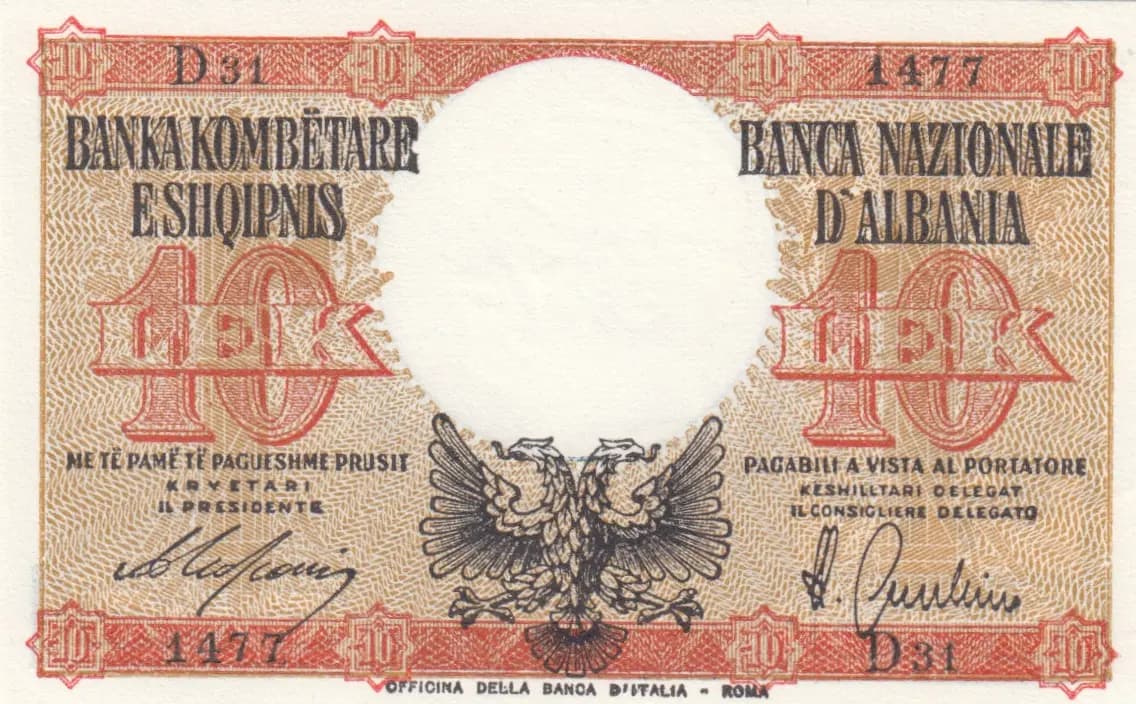
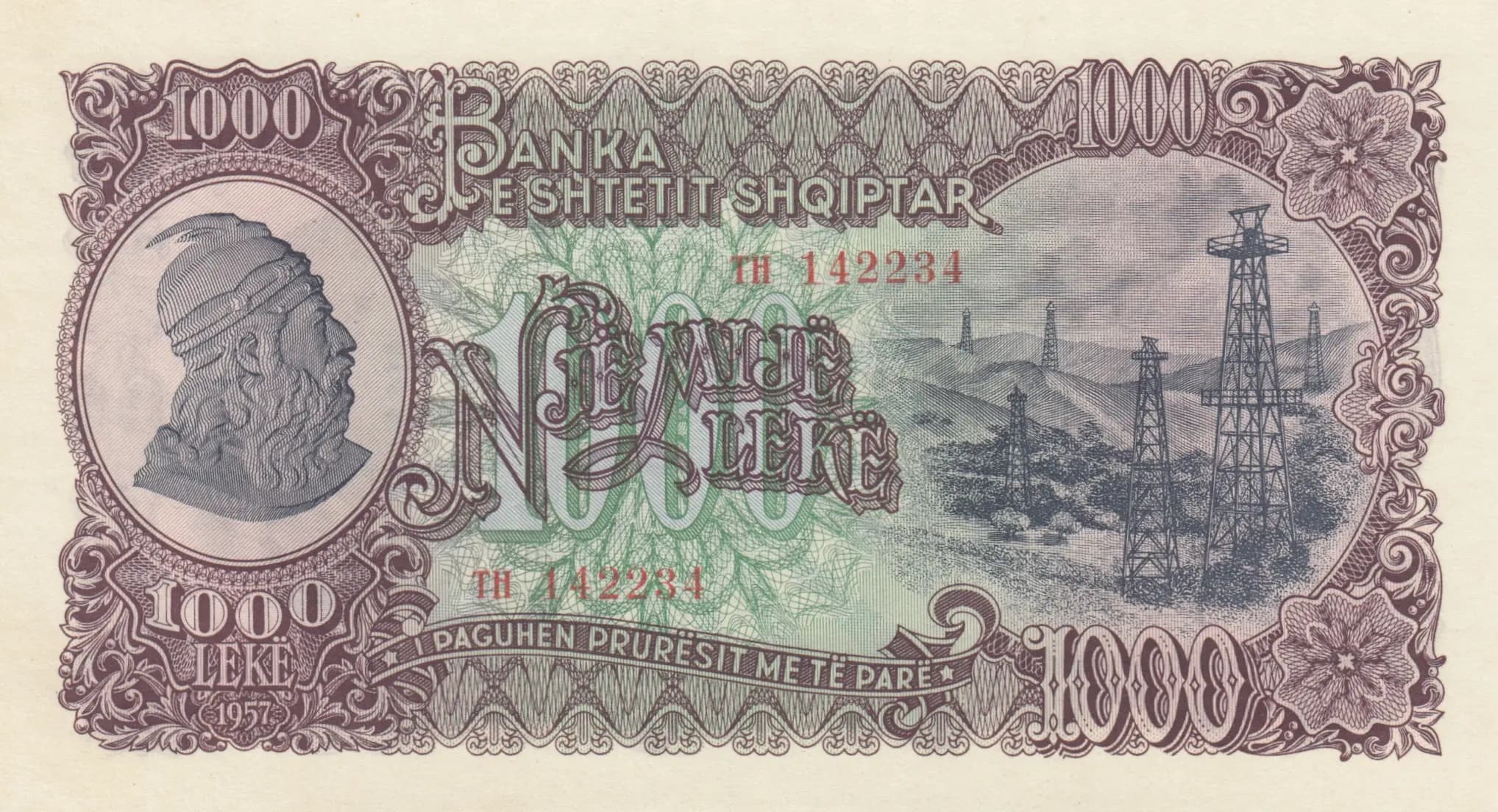
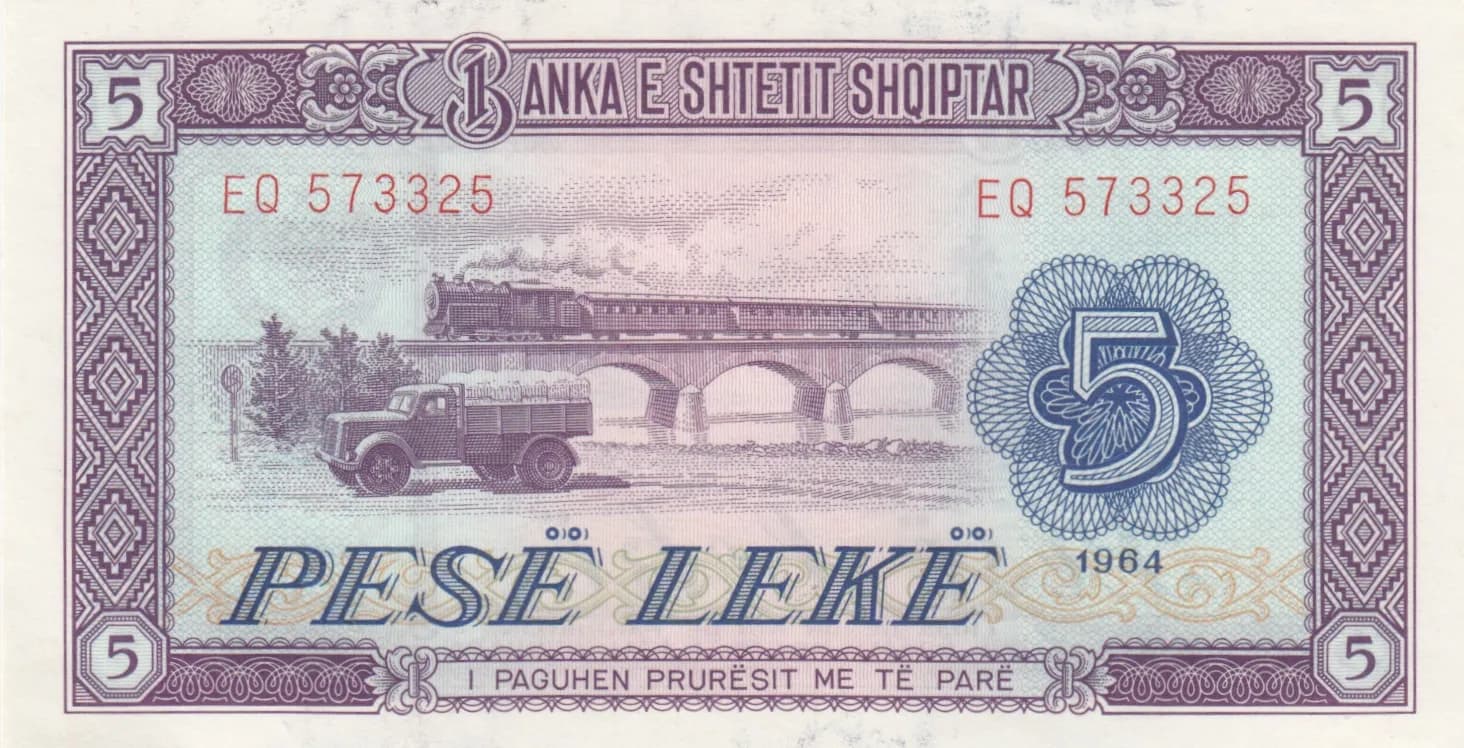
25 leke 1976
Market Prices
13 salesAbout This Note
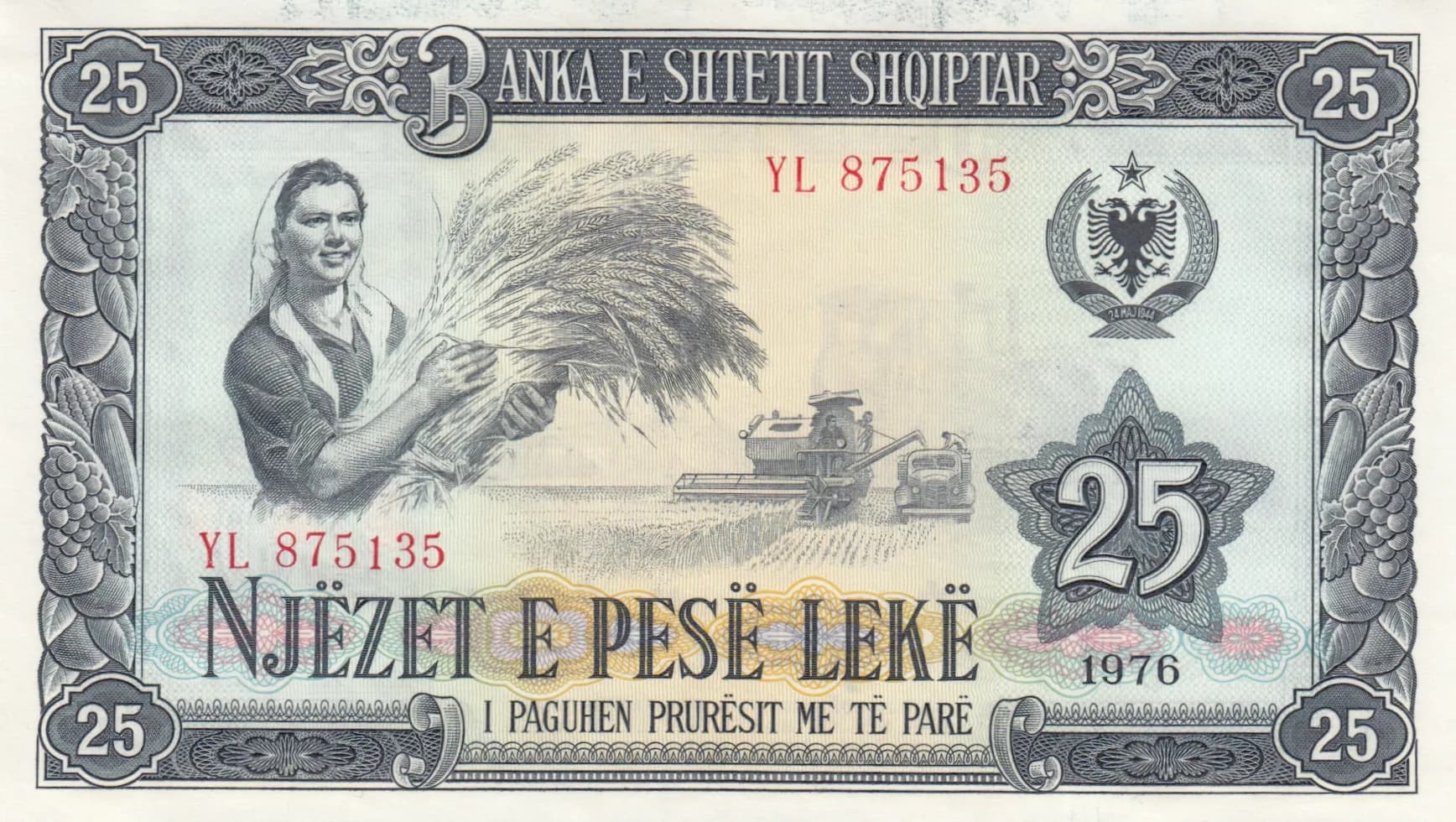
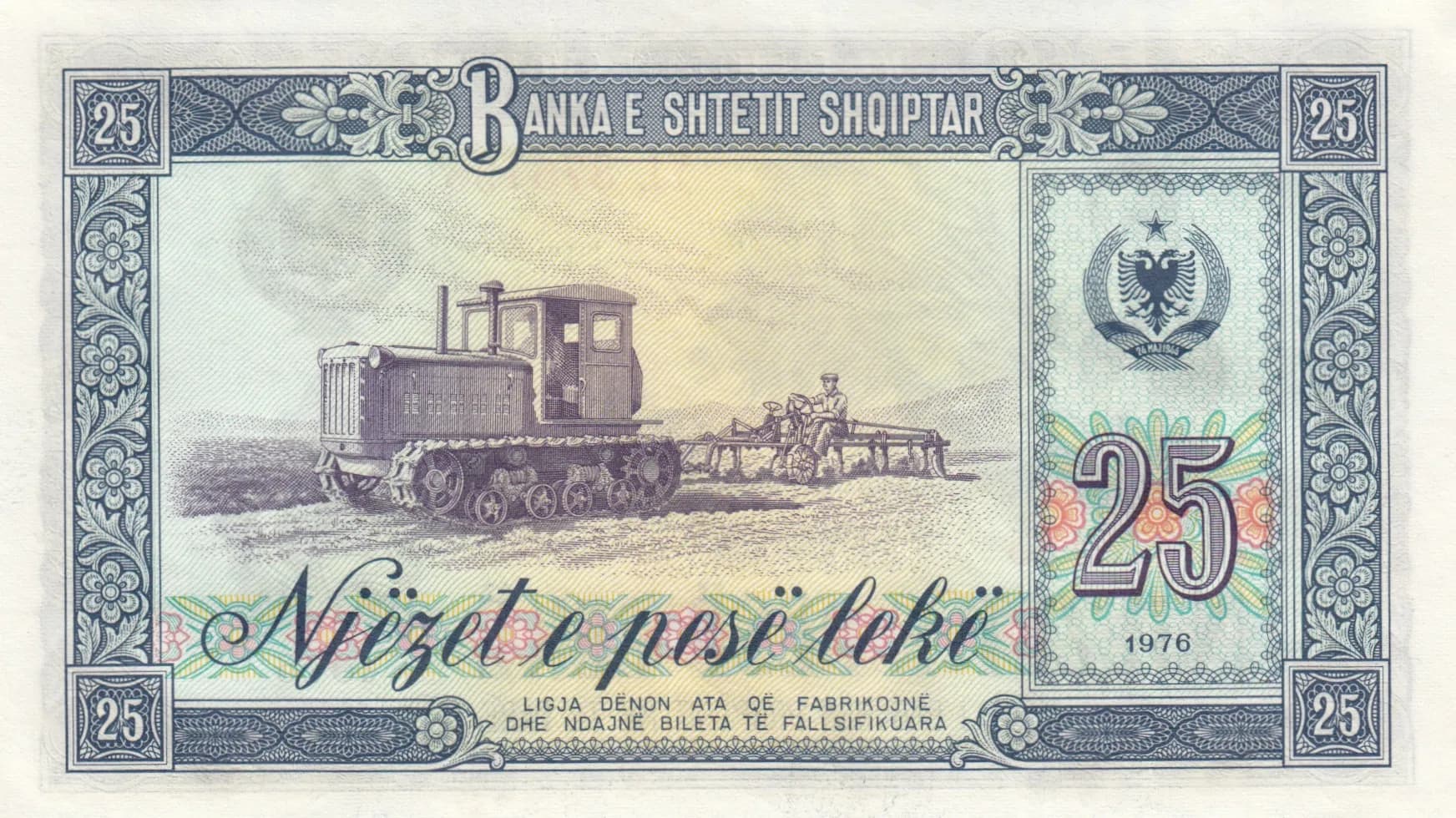
This is a well-preserved 1976 Albanian 25 leke note in uncirculated condition, featuring striking Socialist-era imagery depicting peasant labor and Soviet agricultural machinery. The note showcases excellent engraving quality with intricate floral borders, a portrait of a peasant woman with wheat on the obverse, and a prominent HTZ DT-54 tractor on the reverse, reflecting Albania's mid-1970s economic focus on collective agriculture and industrial development.
Common. eBay market data shows consistent sales in the $8-$16 range for UNC examples, with even PMG 67 graded specimens selling for $26-$67 historically. Catalogue values from 2019 list UNC at $7.50, consistent with abundant supply in the collector market. No evidence of limited print runs, special varieties, or recall issues. This is a standard regular-issue note with no scarcity factors.
Issued in 1976 by Banka e Shtetit Shqiptar during the Enver Hoxha era, this note exemplifies Socialist Albania's emphasis on agrarian and industrial progress. The depiction of mechanized harvesting with combine harvesters and Soviet-style tractors reflects the country's agricultural collectivization policies and close economic ties with Soviet technical assistance during this period, before Albania's later isolation following the Sino-Soviet split.
The obverse features a peasant woman in traditional Albanian dress with a head covering, holding wheat stalks, symbolizing rural labor and agricultural heritage. She is positioned on the left, with the central-right portion dominated by a mechanized harvest scene showing a combine harvester in operation among workers in a field. The reverse depicts the HTZ DT-54 tracked tractor (Kharkovskiy Traktorniy Zavod, Soviet Union) with an attached hopper or container on the left, flanked by rural workers with agricultural equipment. Both sides are framed by ornate decorative floral and geometric borders typical of 1970s Socialist currency design. The Albanian state arms—a double-headed eagle with a radiant star in a circular wreath—appear prominently on both sides, along with denomination emblems displaying '25' in all four corners of the obverse.
Front: 'BANKA E SHTETIT SHQIPTAR' (Bank of the State of Albania), 'NJEZET E PESE LEKE' (Twenty-five leke), 'I PAGUHEN PRUPESHT ME TE PARE' (Payable on demand at par), '1976' (year of issue), denomination '25', and serial number 'YL 875135'. Back: 'BANKA E SHTETIT SHQIPTAR' (Bank of the State of Albania), 'Njezet e pese leke' (Twenty-five leke), '25' and '1976', plus the legal warning 'LIGJA DENON ATA QE FABRIKOJNE DHE NDAJNE BILETA TE FALSIFIKUARA' (The law punishes those who manufacture and distribute counterfeit notes).
Intaglio (engraved) printing on multicolored underprint, characteristic of high-security banknote production. The note exhibits fine line work, intricate border patterns, and detailed machinery illustration typical of currency produced by specialized security printers. The blue-black primary color on multicolored base indicates advanced offset printing technology combined with engraving, standard for Eastern Bloc currency of this era.
PMG catalogues this as P-44s2 with watermark of bank initials around a radiant star, repeated pattern. The observed serial number prefix 'YL' and the 1976 date confirm this as the standard 1976 issue. No signature varieties, overprints, or distinguishing sub-varieties are evident in this example. This appears to be the primary variant for this Pick number.