500 afghanis 1979 specimen
Market Prices
6 salesAbout This Note
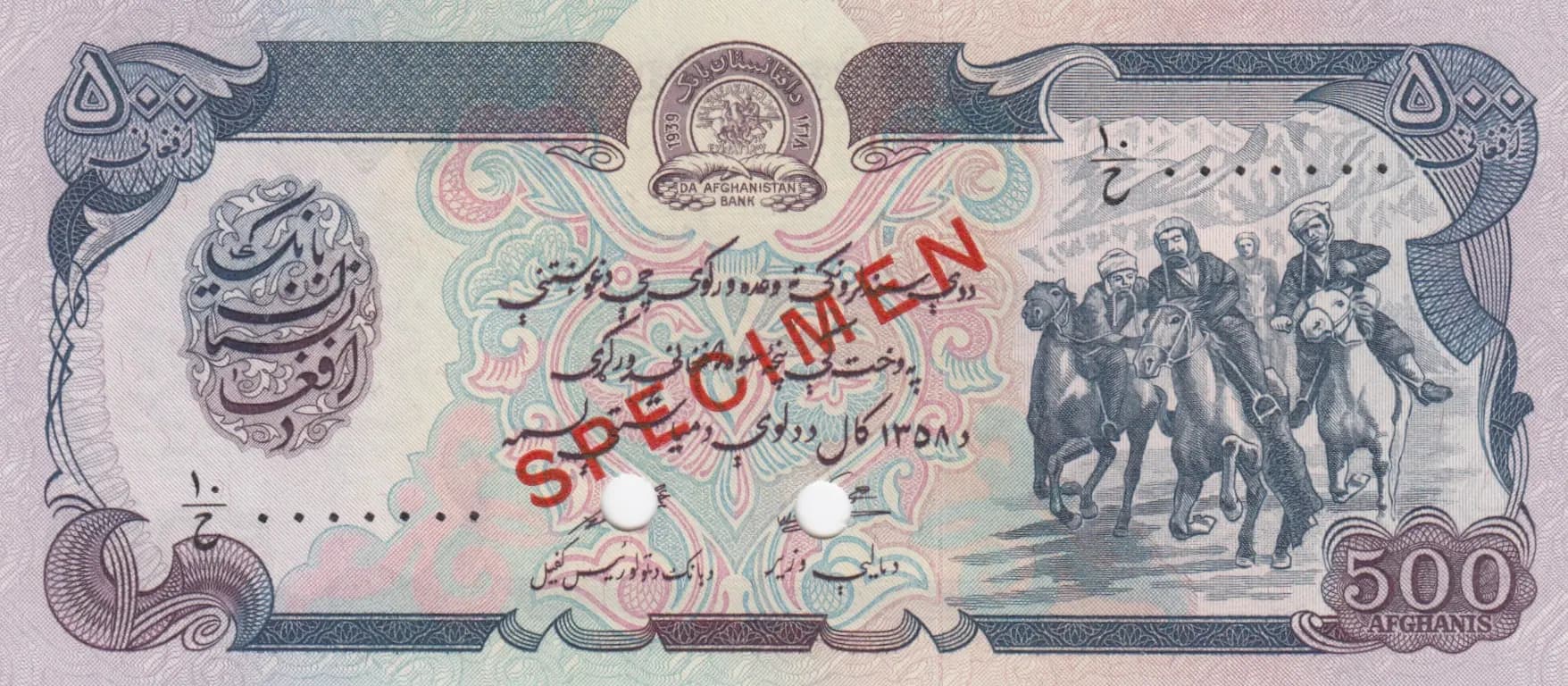
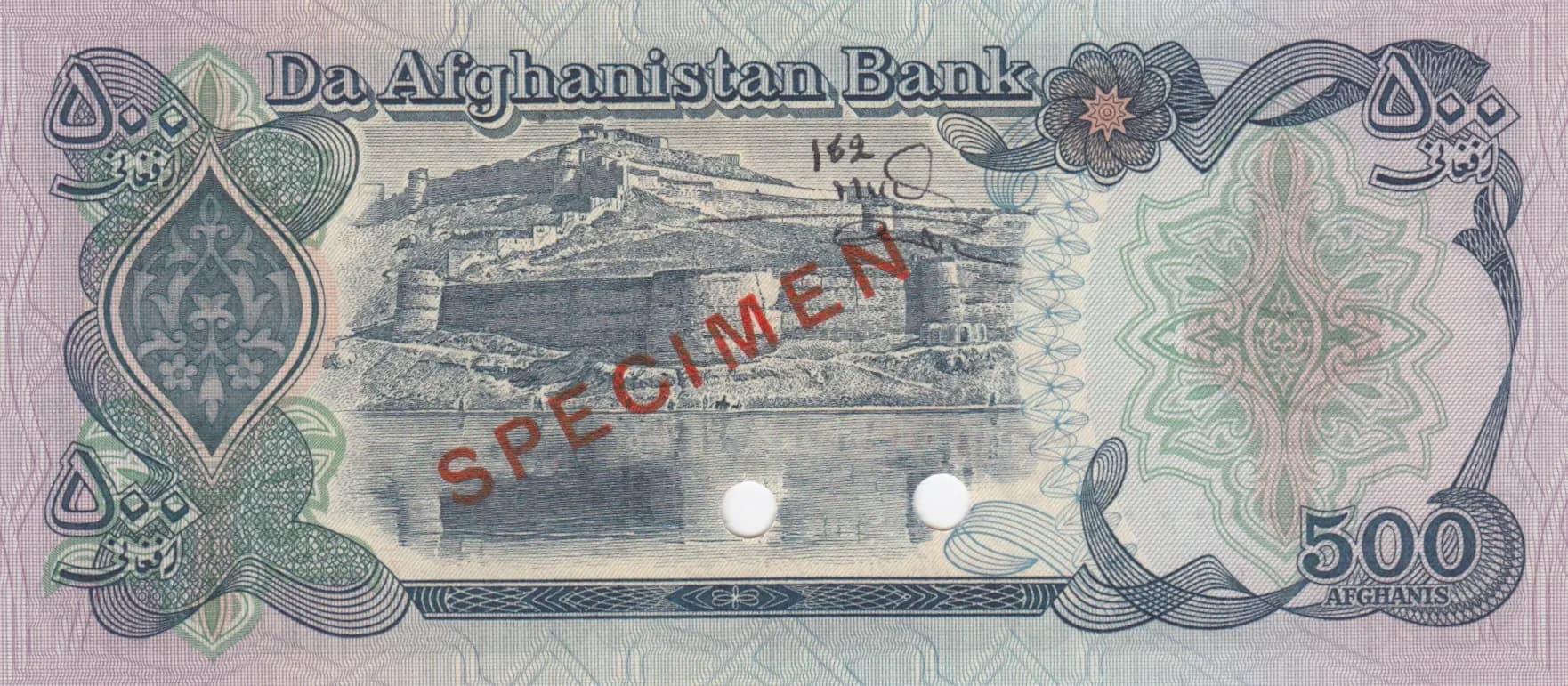
This is a 500 Afghanis specimen note from 1979 (SH 1358), issued by Da Afghanistan Bank and graded UNC. The note features vibrant multicolored printing with violet and dark blue dominating the palette, complemented by pink and green ornamental elements. As a specimen note, it bears the characteristic red 'SPECIMEN' overprint and two punch holes typical of bank specimen distribution, with no visible wear or circulation damage, making it an attractive example of this denomination from Afghanistan's pre-Soviet invasion period.
Common. The eBay price data provided shows consistent sales in the $6-$41 range over a decade, with UNC examples selling for $6-$12 according to 2019 catalog values. Regular circulation throughout the 1980s-2000s before most Afghan notes from this period were withdrawn or lost, combined with moderate catalog valuations well below $20, indicates this is a common note in the market. Specimen notes are somewhat less common than regular issues, but the abundance of supply and modest collector demand keep it in the 'common' category.
This banknote was issued in 1979, a pivotal year in Afghan history marking the beginning of the Soviet-Afghan War and the end of the Afghan monarchy's reign. The front design depicts the Buzkashi game, a traditional Central Asian horseback sport deeply embedded in Afghan culture and national identity, while the reverse features the Bala Hissar fortress south of Kabul, an iconic symbol of Afghan military heritage and sovereignty. The prominence of these cultural and military symbols reflects Afghanistan's attempt to assert national identity during a period of significant political upheaval.
The obverse features a dynamic engraved scene of multiple mounted horsemen competing in Buzkashi, the traditional Afghan sport where riders on horseback compete to control a headless goat carcass, depicted here on the right side of the note. The reverse showcases the Bala Hissar fortress, a historic military stronghold overlooking Kabul, rendered in detailed engraved black and white. Both sides are framed by ornate Islamic geometric and floral patterns in blue and green, with a circular seal of Da Afghanistan Bank positioned at the top center of the obverse. The note employs a sophisticated color scheme of purple, blue, pink, and green on a cream underprint, with fine-line decorative borders and calligraphic elements characteristic of Afghan Islamic design traditions.
Front side: 'DA AFGHANISTAN BANK' (English) and 'Afghanistan Bank' (Pashto/Dari script); '500 AFGHANIS' (English denomination); '۱۳۵۸' (Persian numerals representing SH 1358 or 1979 CE); 'SPECIMEN' (red overprint). Back side: 'Da Afghanistan Bank' (English); '500 AFGHANIS' (English denomination); 'SPECIMEN' (red overprint). The date 1358 in the Islamic calendar corresponds to March 1979 - March 1980 in the Gregorian calendar.
Intaglio engraving (letterpress/steel plate engraving) combined with lithographic color printing, evidenced by the fine detailed line work visible in the Buzkashi scene and fortress landscape, combined with the multi-color ornamental borders and backgrounds. The security features include intricate engraved patterns and fine-line decorative elements. The note was likely produced by the Austrian State Printing Office (Österreichische Staatsdruckerei) or a similar European security printer, which was common for Afghan banknotes of this era, though specific printer attribution for Pick P-59s would require additional documentation.
This is a specimen variety (Pick P-59s designation) distinguished by the red 'SPECIMEN' overprint and two punch holes typical of bank specimens distributed to central banks and international institutions rather than released into general circulation. Specimen notes of this type were produced in limited quantities relative to regular circulation issues but were produced in sufficient numbers that they remain readily available. No known signature or date varieties are apparent from the visual analysis, though Afghan banknotes of this era sometimes exist in varieties related to printer marks or slight design modifications.