50 afghanis 1928
Market Prices
7 salesAbout This Note
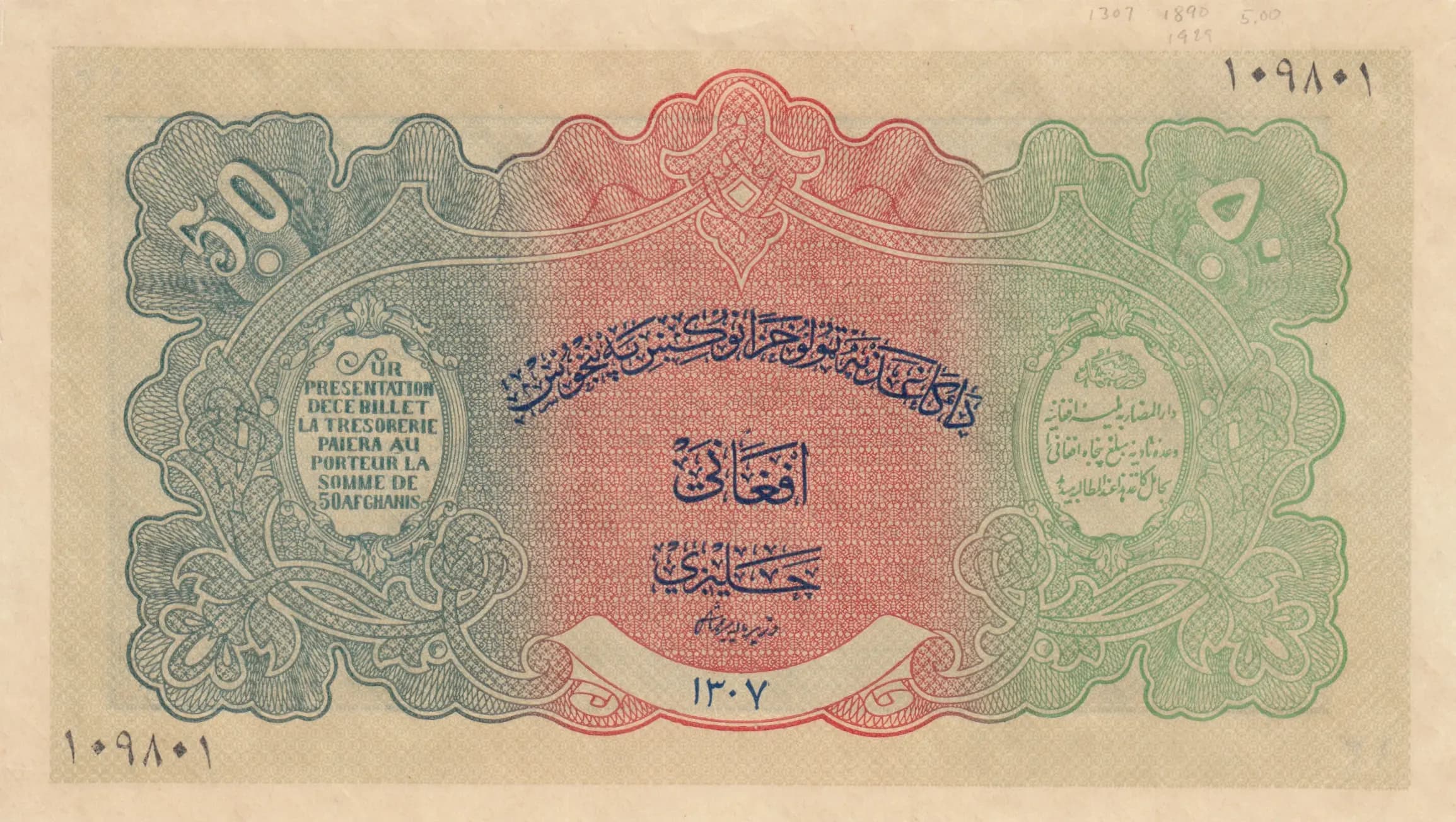
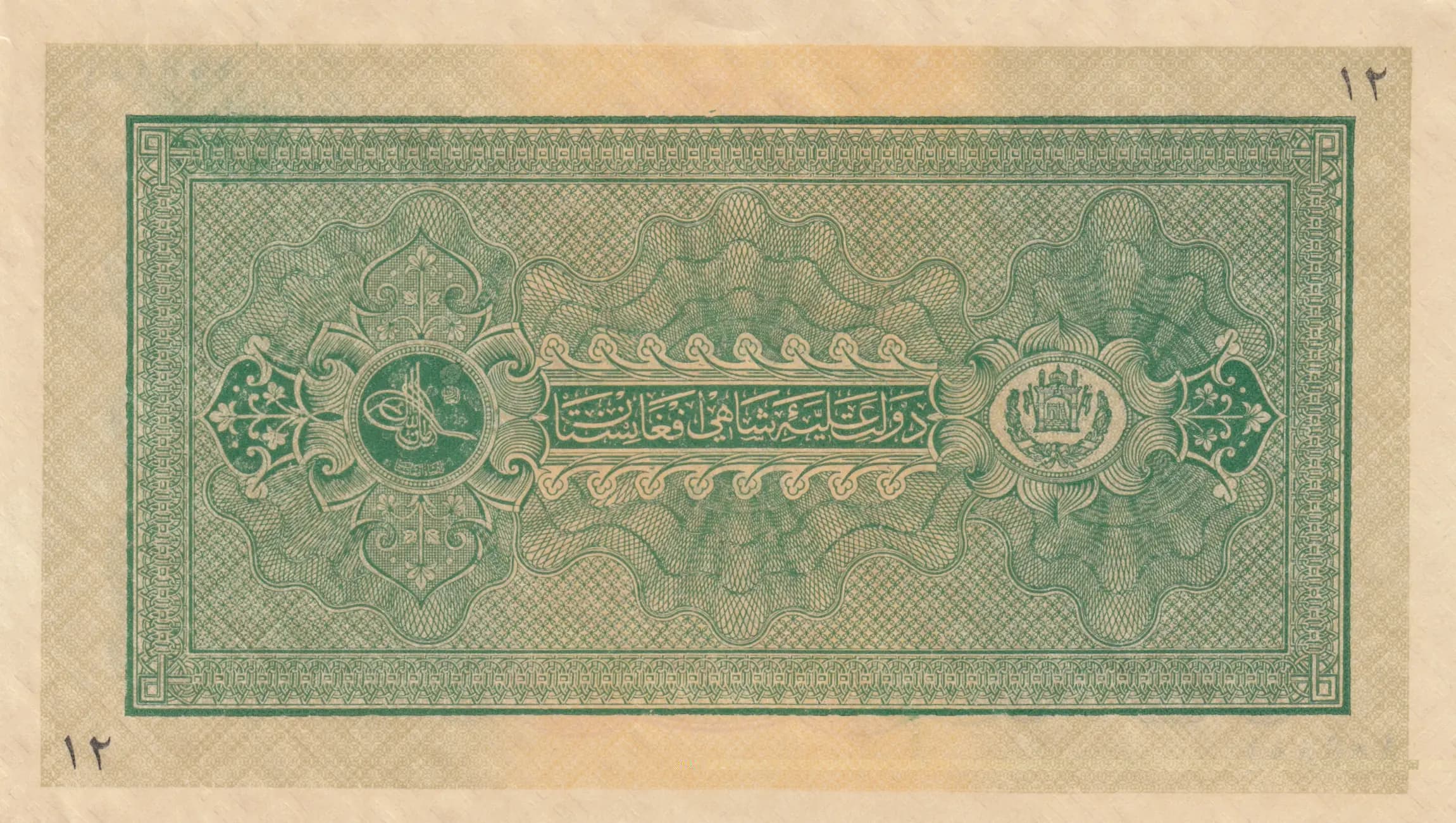
This is an Afghanistan 50 Afghanis note from 1928 (SH 1307), Pick P-10b, graded AU and displaying excellent preservation with minimal aging. The note features exceptional ornate engraving throughout both sides, with a striking red central panel on the obverse framed by blue-green and green decorative borders containing Islamic geometric patterns and calligraphy. The dual-language design (French and Persian/Dari) reflects Afghanistan's early 20th-century administrative style, making this an important example of Afghan monetary history from the reign of King Amanullah Khan.
Common. eBay market data shows consistent sales activity with prices ranging from $12.50 (2009) to $107.50 (2024) depending on condition grade, with multiple sales of VF-AU examples in the $40-107 range. The PMG Population Report confirms this is a standard catalogued variant (P-10b) with established market presence. Catalogue values of $7.50-$125 depending on condition reflect normal circulation for this issue. The regular issue status, absence of special handstamps or overprints noted in the Pick catalog, and steady eBay activity all indicate this was a standard production run without extreme rarity.
This note was issued during the reign of King Amanullah Khan (1919-1929), a period of significant modernization in Afghanistan following independence from British influence. The inscription 'State of His Majesty Ghazi Shah' (دولت علیه تعالیشاه غازی) on the reverse reflects the sovereign Afghan state's assertion of independence and national identity. The use of both French and Persian languages, along with the sophisticated engraved design featuring Islamic geometric patterns, demonstrates the Afghan Treasury's commitment to creating a modern monetary system during this transformative period in Afghan history.
The obverse features an elaborate ornamental frame with scalloped edges in blue-green and red, surrounding a large central red panel decorated with intricate Islamic geometric patterns and arabesque designs. The denomination '50' is displayed in both left (blue-green) and right (green) corner cartouches. A prominent left-side cartouche contains the French treasury payment obligation text within an ornamental frame. The note employs fine calligraphic Persian text on the right side identifying it as the Emirate of Afghanistan's currency. The reverse displays a unified green color scheme with an ornate rectangular frame containing geometric and floral patterns typical of Islamic artistic tradition. A large central cartouche frames the Persian text identifying the issuing authority. The entire composition relies on the complexity of engraved line work, cross-hatching patterns, and geometric detail as its primary security measure—there are no portraits or specific landmarks depicted, only abstract Islamic ornamentation throughout.
FRONT: French text in left cartouche reads 'POUR INITIATION DE CE BILLET LA TRESORERIE PAIERA AU PORTEUR LA SOMME DE 50AFGHANIS' (For presentation of this bill, the treasury will pay the bearer the sum of 50 Afghanis). Persian/Dari text includes 'نقد' (naqd - cash/currency) and 'امارت افغانستان' (Emirate of Afghanistan). Denomination '50' appears in Arabic numerals. Date shown as '1307' (Islamic Solar Calendar). BACK: Central inscription reads 'دولت علیه تعالیشاه غازی' (Dowlat-e Aliyyeh Taalishah Ghazi - State of His Majesty Ghazi Shah). Numeral '12' appears as a control number or sequence marker.
This note was produced using intaglio engraving, the standard security printing method of the era. The fine line work, cross-hatching patterns, and intricate geometric designs visible throughout both sides are characteristic of high-quality engraved banknote production. The precision of the scalloped borders, the depth of the Islamic geometric patterns, and the detailed calligraphic rendering indicate work by a skilled security printer, likely a European banknote firm contracted by the Afghan Treasury (specific printer attribution would require research into Afghan Treasury archives, but Swiss and German printers commonly produced notes for Central Asian governments during this period).
This is Pick P-10b, one of two known variants catalogued by PMG for the base 50 Afghanis 1928 type (P-10a also exists). The REALBANKNOTES.COM reference notes two varieties exist: 'light and dark green varieties' related to watermark coloring, and variants both 'with and without serial number.' This AU example should be examined for: (1) presence or absence of serial number, (2) watermark variety (light vs. dark green small squares), and (3) any handstamps. The catalog reference to P-13 notes that revolutionary handstamps appear on some 1928 notes; this example does not appear to display such overprints based on the visual analysis, confirming it as a standard P-10b variety without special markings.