100 afghanis 1939
Market Prices
7 salesAbout This Note
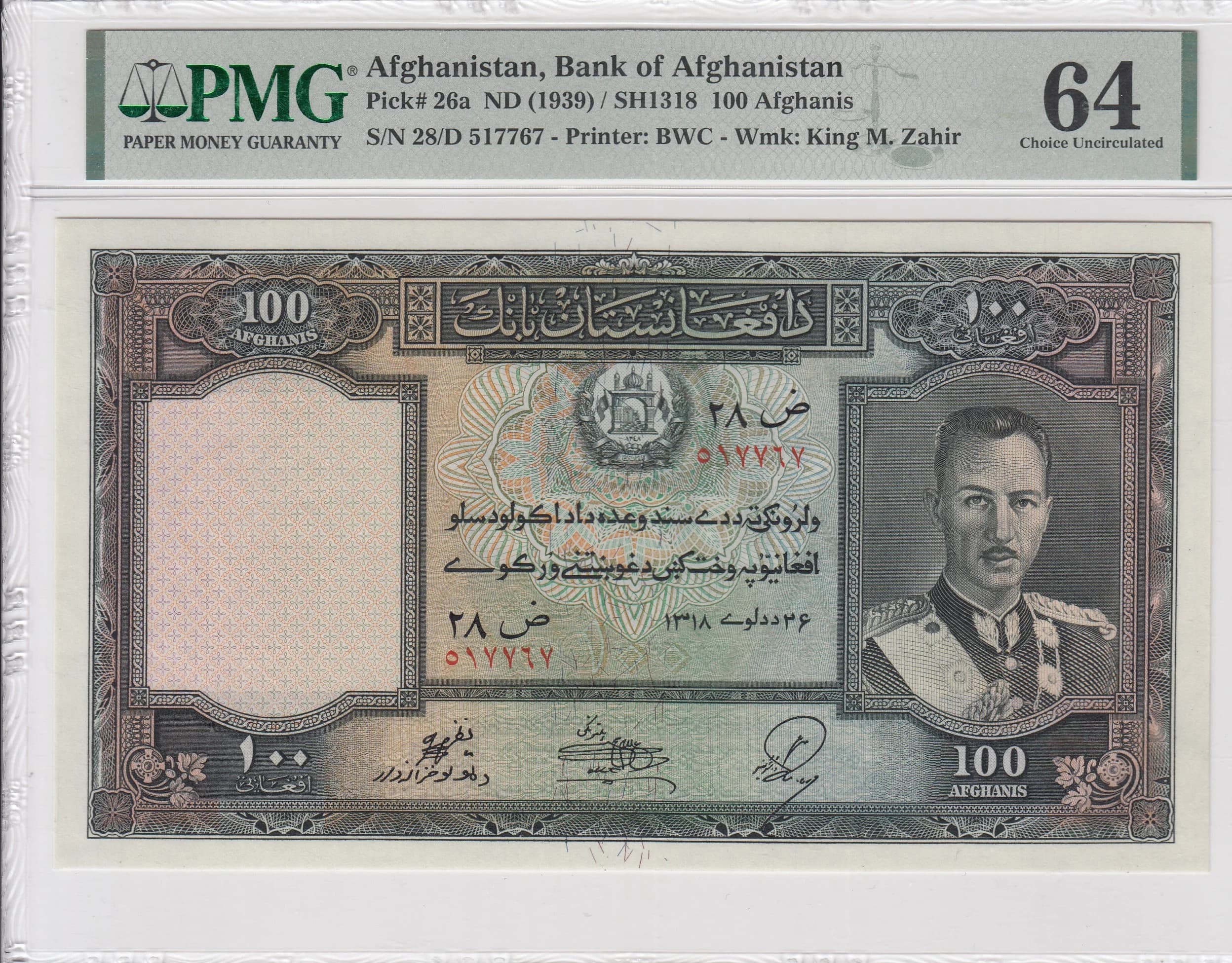
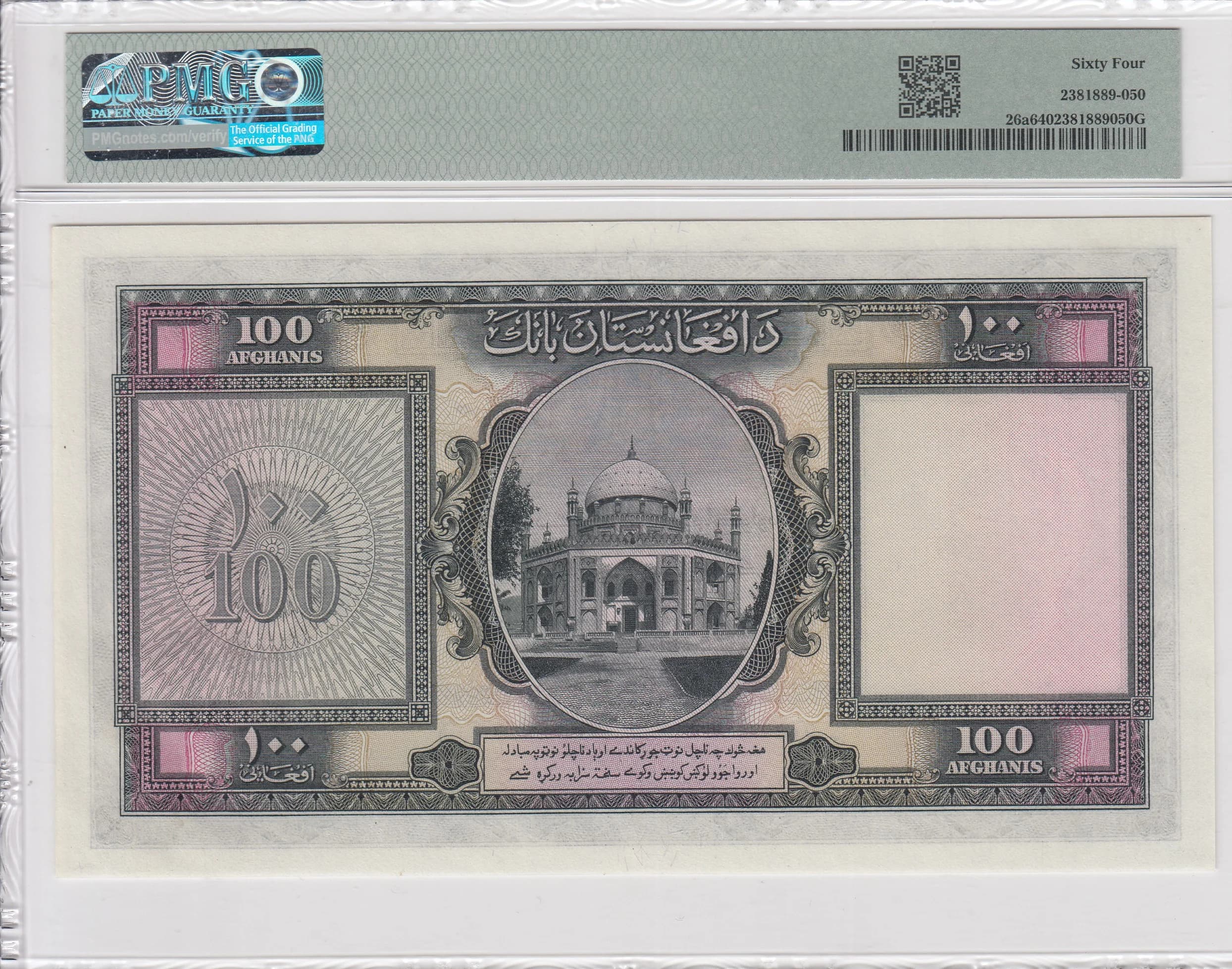
This is a PMG-64 graded 100 Afghanis banknote from 1939 (SH 1318), issued by Da Afghanistan Bank during the reign of King Muhammad Zahir Shah. The note displays exceptional eye appeal with crisp, well-defined printing across both sides, featuring ornate Art Deco-influenced borders in green and brown tones on the obverse and purple/mauve tones on the reverse. The obverse presents a formal military portrait of King Muhammad Zahir, while the reverse showcases a striking photograph of the Ahmad Shah Durrani Mausoleum in Kandahar, making this an iconic representation of early 20th-century Afghan numismatic artistry.
Common. This note represents a regular issue from a major print run spanning multiple years (1939-1946 based on dual dating visible in catalog references). Market data confirms common status: PMG 64 examples sold for $315 in 2019 and comparable uncirculated examples for under $200 in the 2013-2017 period. Catalog values from 2016 show UNC specimens valued at only $75, with VF at $30, consistent with typical pricing for common mid-20th century Afghan banknotes. The large number of eBay sales transactions across multiple years and grades indicates robust supply in the collector market.
This 100 Afghanis note was issued during the progressive reign of King Muhammad Zahir Shah (1933-1973), a period of modernization and attempted reforms in Afghanistan. The inclusion of Ahmad Shah Durrani's mausoleum on the reverse reflects the nation's emphasis on its founding heritage and Pashtun identity, as Ahmad Shah Durrani established the Durrani Empire in 1747. The dual dating system visible on the note (SH 1318 and 1325) indicates this design was used for multiple print runs across different Islamic calendar years, reflecting Afghanistan's currency needs during the mid-20th century.
The obverse features King Muhammad Zahir Shah in military dress uniform with decorative medals and a prominent mustache, positioned on the right side and rendered in fine black engraving against ornamental geometric and floral designs executed in green and gold tones. The center displays an elaborate national emblem featuring a mosque with radiating sun rays, surrounded by intricate Art Deco-style border work in brown and green. The reverse showcases a large central photograph of the Ahmad Shah Durrani Mausoleum—a domed Islamic structure with multiple minarets—framed in an ornate engraved border and flanked by radiating sun designs in the upper left corner, all rendered in purple/mauve and beige tones. Both sides feature large denomination numerals in the upper left and lower right corners.
Front side: '100' and 'AFGHANIS' (Arabic numerals and English); 'داافغانستان بانک' (Bank of Afghanistan in Dari); '۱۳۱۸' (1318 in Islamic calendar); Serial number '28/D 517767' with Dari equivalents '۲۸' (28) and '٥١٧٧٦٧' (517767). Back side: '100' and 'AFGHANIS' (denomination in English numerals); 'داافغانستان بانک' (Bank of Afghanistan); 'افغانستان' (Afghanistan). All text appears in both English/Latin and Dari/Persian script, reflecting the dual administrative language policy of the period.
Intaglio engraving combined with photographic integration on the reverse. The note exhibits characteristics of high-quality security printing typical of 1930s-1940s banknote production, with fine line work, detailed engraved borders, and intricate geometric patterns. The reverse's central photograph of the mausoleum is skillfully integrated into an engraved frame, demonstrating advanced multi-stage printing coordination. While specific printer attribution for this Pick number requires archival verification, the quality suggests production by a major European security printer such as the British American Bank Note Company or similar firms that serviced Commonwealth nations and their allies during this era.
This note is cataloged as Pick-26a, with a variant P-26s also recognized by PMG (likely a specimen note). The observed example displays the standard obverse without special imprints or overprints, consistent with the regular P-26a classification. The serial number format '28/D 517767' suggests production batch designation, with the '28' prefix potentially indicating a specific print run or currency serial numbering sequence. The dual Islamic calendar dates (SH 1318 and 1325) on the face indicate this design remained in use for an extended period; notes from different press runs may exist with slight typographical variations, though all are consolidated under the P-26a designation.