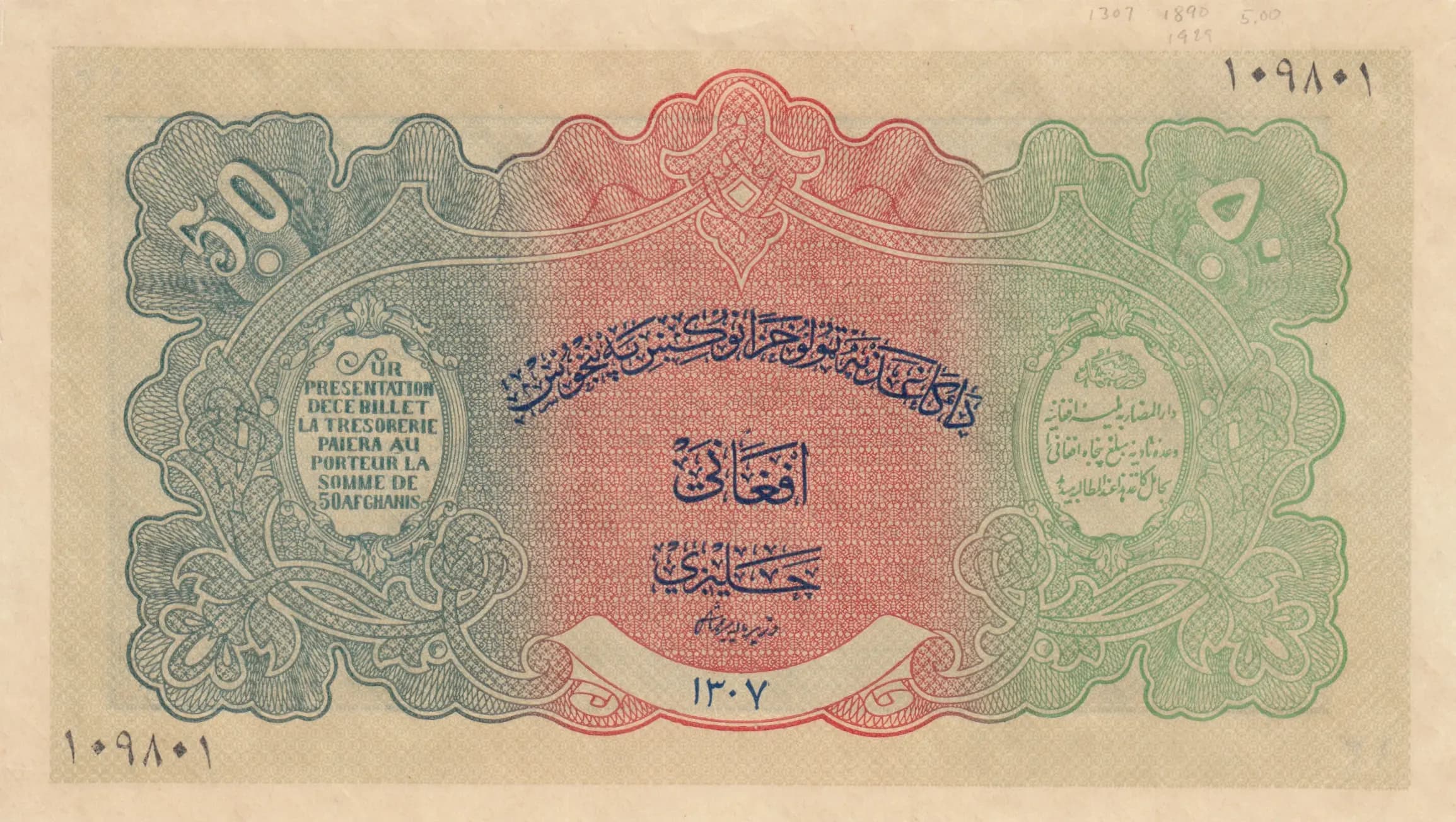
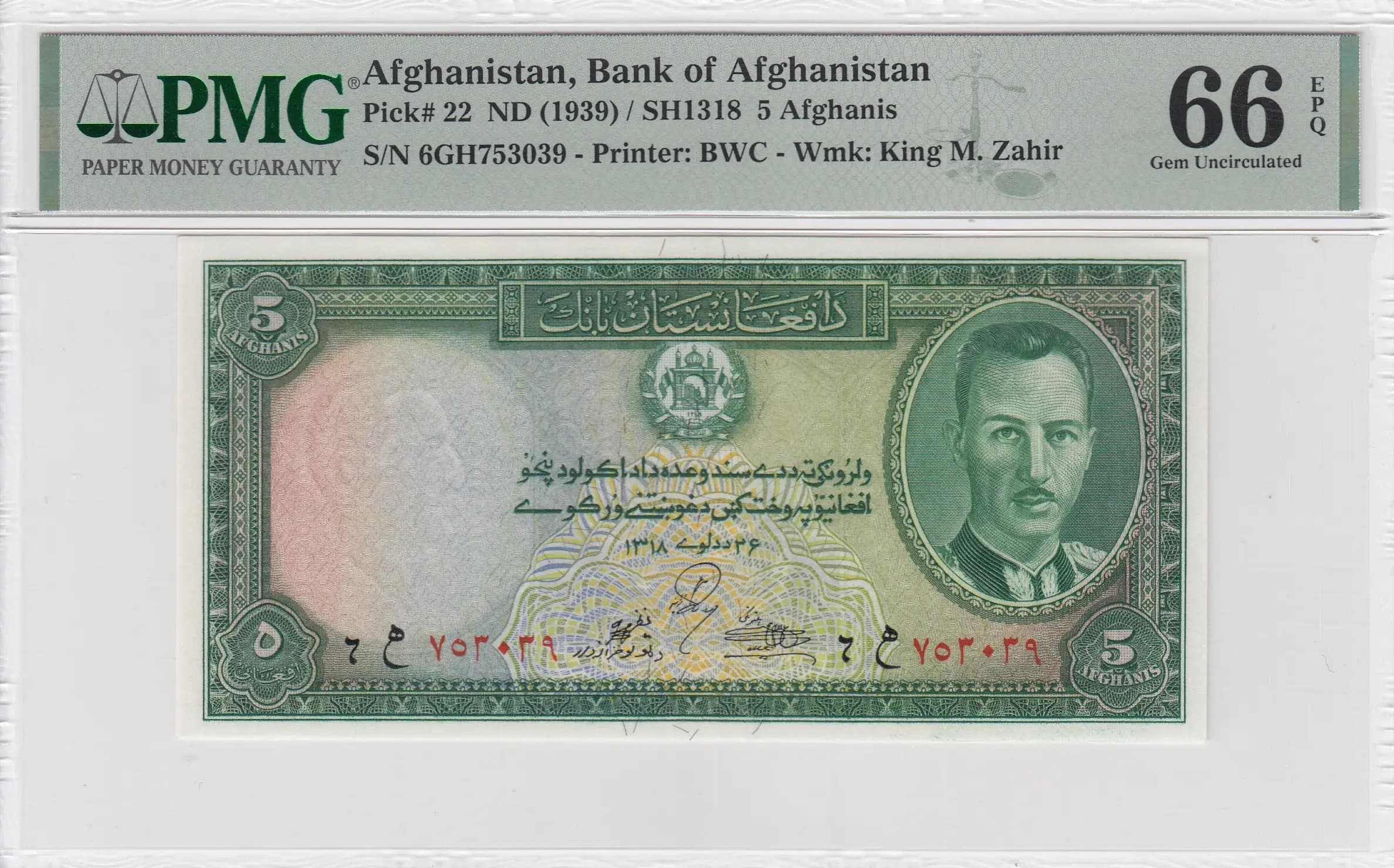
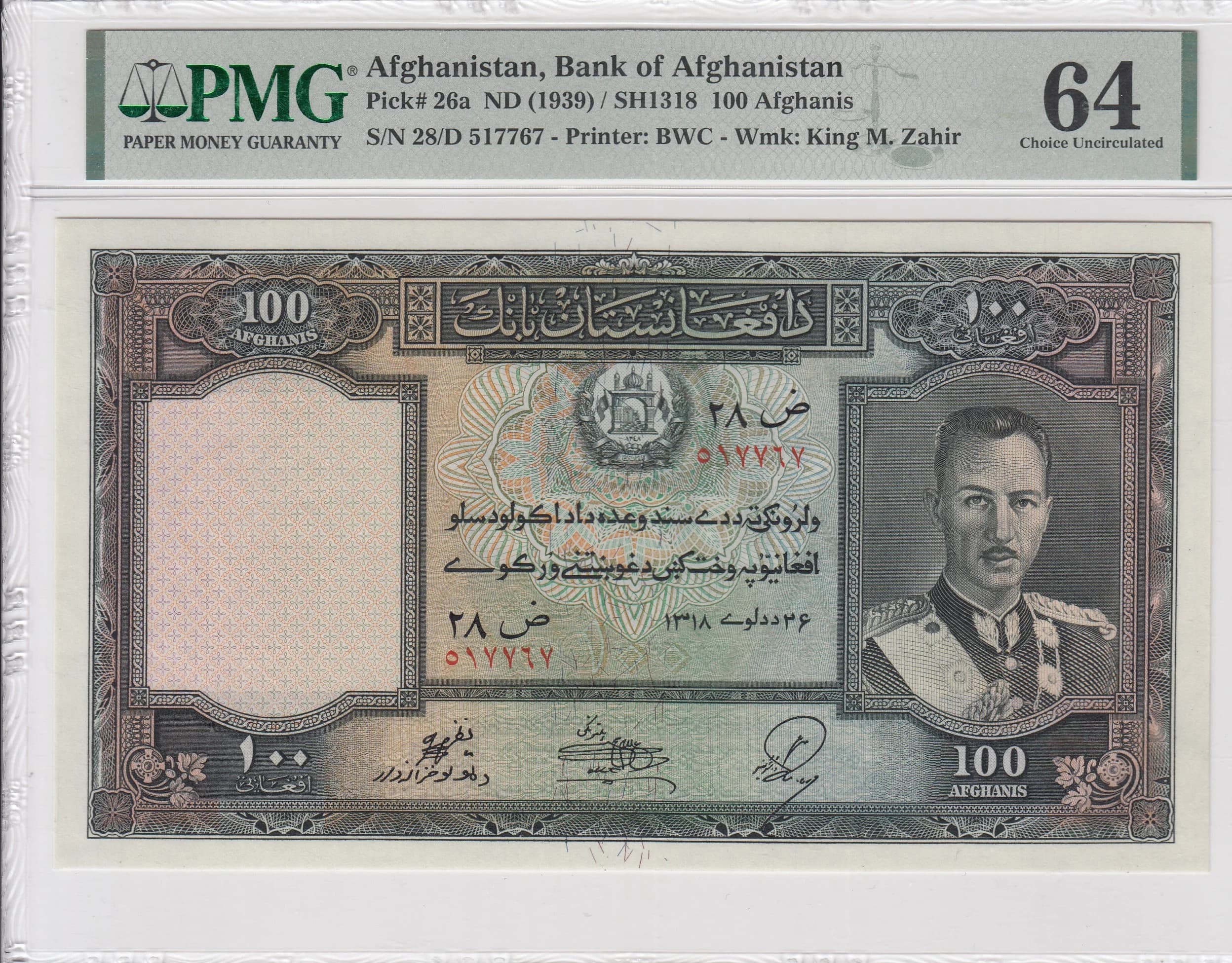
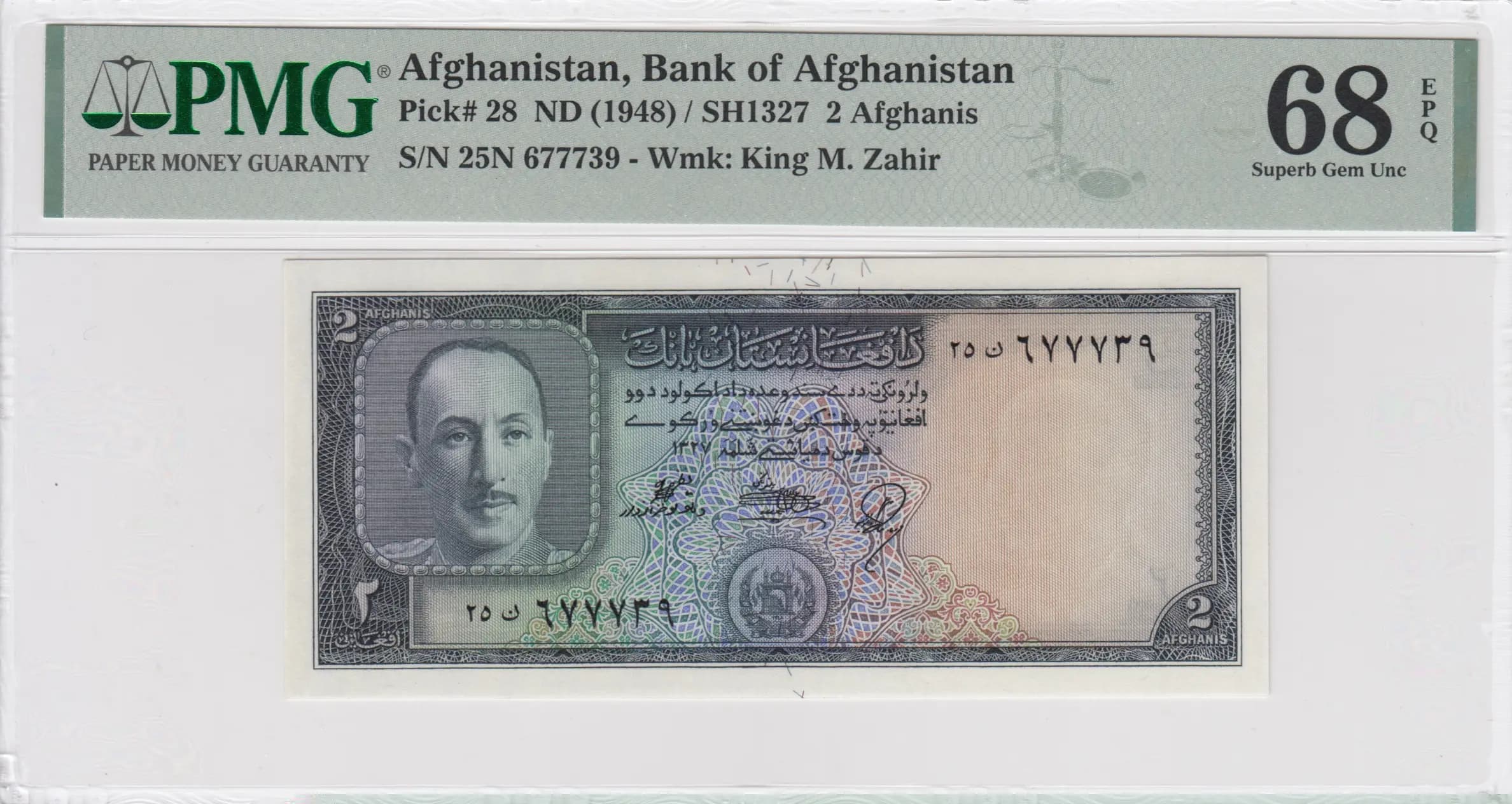
50 afghanis 1973 specimen
Market Prices
9 salesAbout This Note
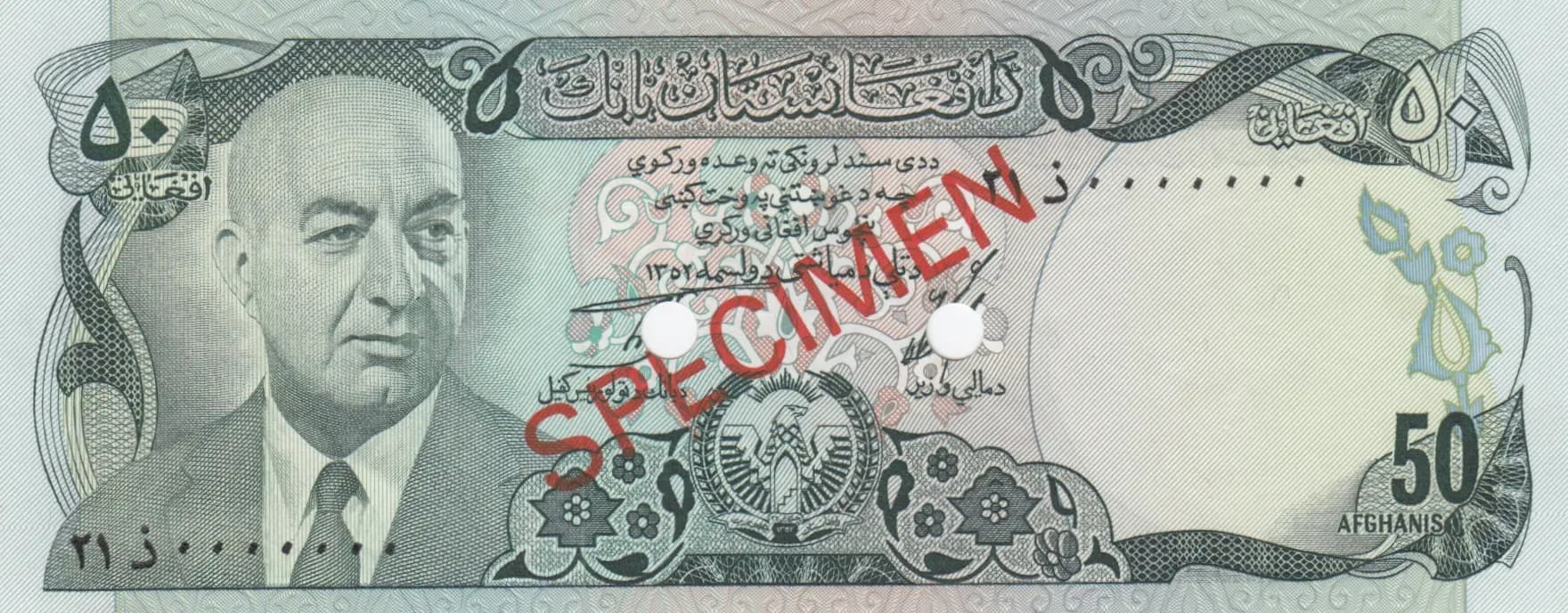
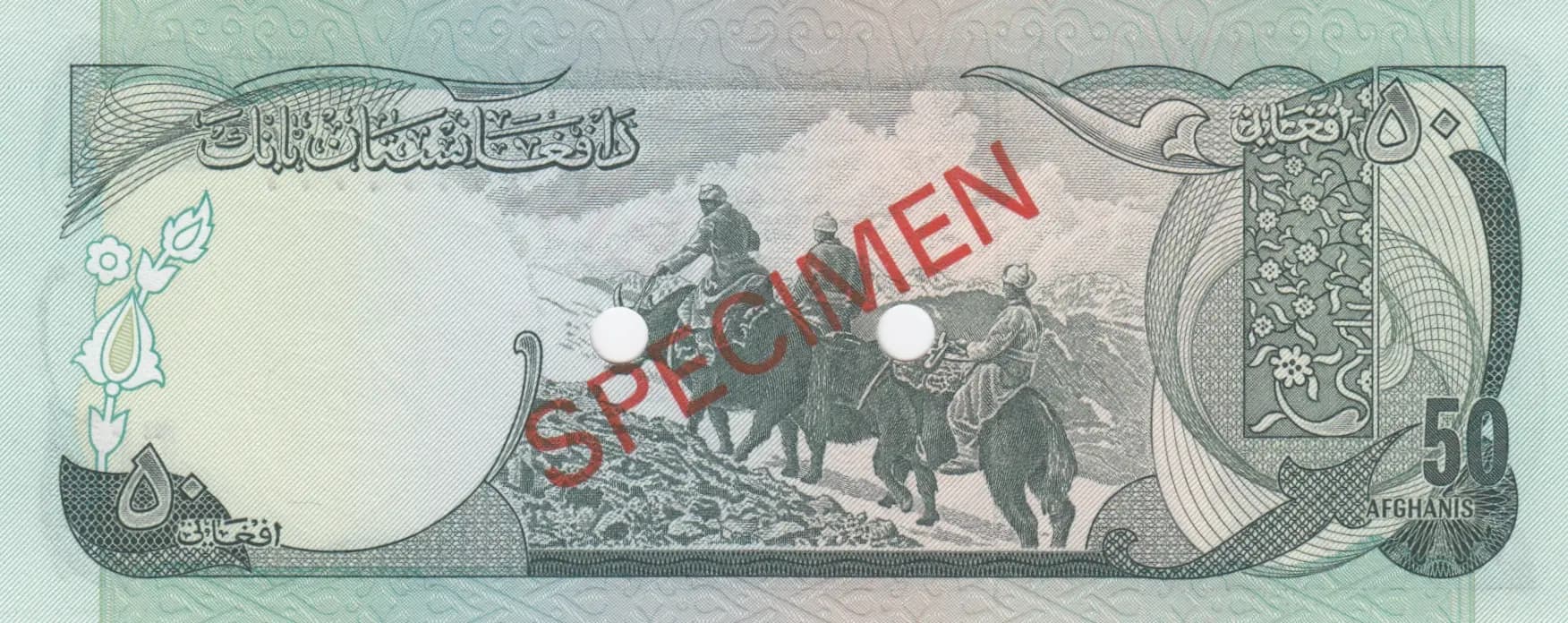
This is a 1973 50 Afghanis specimen note (Pick P-49as) issued by Da Afghanistan Bank, presented in uncirculated condition. The note features a formal portrait of President Muhammad Daud on the obverse and a historically significant scene of mounted figures in traditional dress on the reverse, both protected by red diagonal 'SPECIMEN' overprints and characteristic specimen punch holes. As a specimen note rather than a regular circulation issue, this piece represents an important numismatic artifact from Afghanistan's republican period under Daud's presidency (1973-1978).
Common. While specimen notes are less frequently encountered in the market than regular circulation issues, the 50 Afghanis 1973 is a straightforward regular issue from a well-known central bank with substantial print runs. eBay auction data shows UNC examples selling consistently in the $5-$30 range depending on grading, with 2019 catalogue values placing UNC at $5, indicating robust supply. Specimen overprints increase collector interest but do not create true rarity; the base Pick number P-49 was issued over multiple years (SH 1352-1356 / 1973-1977), further ensuring availability. This note is neither scarce nor rare in the numismatic market.
This banknote was issued during the reign of President Muhammad Daud Khan, who seized power in a bloodless coup in July 1973, ending the Afghan monarchy and establishing the Republic of Afghanistan. The reverse design depicting men on yaks in Badakhshan reflects Afghanistan's mountainous terrain and cultural heritage, specifically referencing the northeastern Badakhshan region known for its challenging geography and traditional trade routes. The specimen notes represent the central bank's archival documentation of currency designs during this formative period, which would end with the 1978 Saur Revolution.
The obverse features a formal three-quarter portrait of President Muhammad Daud Khan positioned on the left side, depicted in Western business attire (suit and tie), reflecting his modernizing political agenda. The reverse portrays a historical narrative scene set in mountainous terrain depicting multiple figures in traditional Afghan military and civilian dress, some mounted on yaks—animals indigenous to Central Asian high-altitude regions—representing Badakhshan's cultural and geographic character. Both sides are framed by intricate Islamic geometric and floral decorative borders in the traditional Persian/Afghan aesthetic. The national emblem (an eagle with spread wings) appears in the center-lower portion of the obverse. The color scheme employs green as the dominant hue with multicolored underprinting, gray, black, and white accents, creating visual depth and security through the complex engraving. Specimen designation is emphasized through red diagonal overprints and two circular punch holes positioned through the note.
Front side: د افغانستان بانک (Pashto/Dari: Da Afghanistan Bank / Bank of Afghanistan); '50' (numeric denomination); 'AFGHANISA' (English, variant spelling of Afghanis); '۵۰' (Pashto/Dari numerals: fifty); 'SPECIMEN' (English overprint). Back side: د افغانستان بانک (Pashto/Dari: Da Afghanistan Bank / Bank of Afghanistan); '50' (numeric denomination); 'AFGHANIS' (English); 'افغانستان' (Pashto/Dari: Afghanistan); 'SPECIMEN' (English overprint).
Intaglio engraving (line engraving), the standard security printing technique for this era of Afghan banknotes. The detailed guilloche patterns, fine line work in the portraits and historical scene, and the complexity of the decorative borders all indicate professional security-grade intaglio production. The specimen punch holes and overprints were applied as post-production security measures to prevent specimen notes from entering circulation. The printer for Afghan banknotes of this period was typically a European security printer, though specific attribution would require additional documentation.
This note is catalogued as P-49as (specimen variety). Per PMG population data, Pick P-49 has two recognized variants: P-49a (regular issue) and P-49s (specimen). This example is the specimen variant, identifiable by the 'SPECIMEN' overprints in red and the two circular punch holes characteristic of specimen notes distributed to foreign central banks and numismatic institutions rather than for circulation. The SH 1352 (1973) date stamp on the obverse indicates the first year of issue under the Daud regime. No signature varieties or serial number characteristics are discernible from the visual analysis provided.