20 afghanis 1961
Market Prices
32 salesAbout This Note
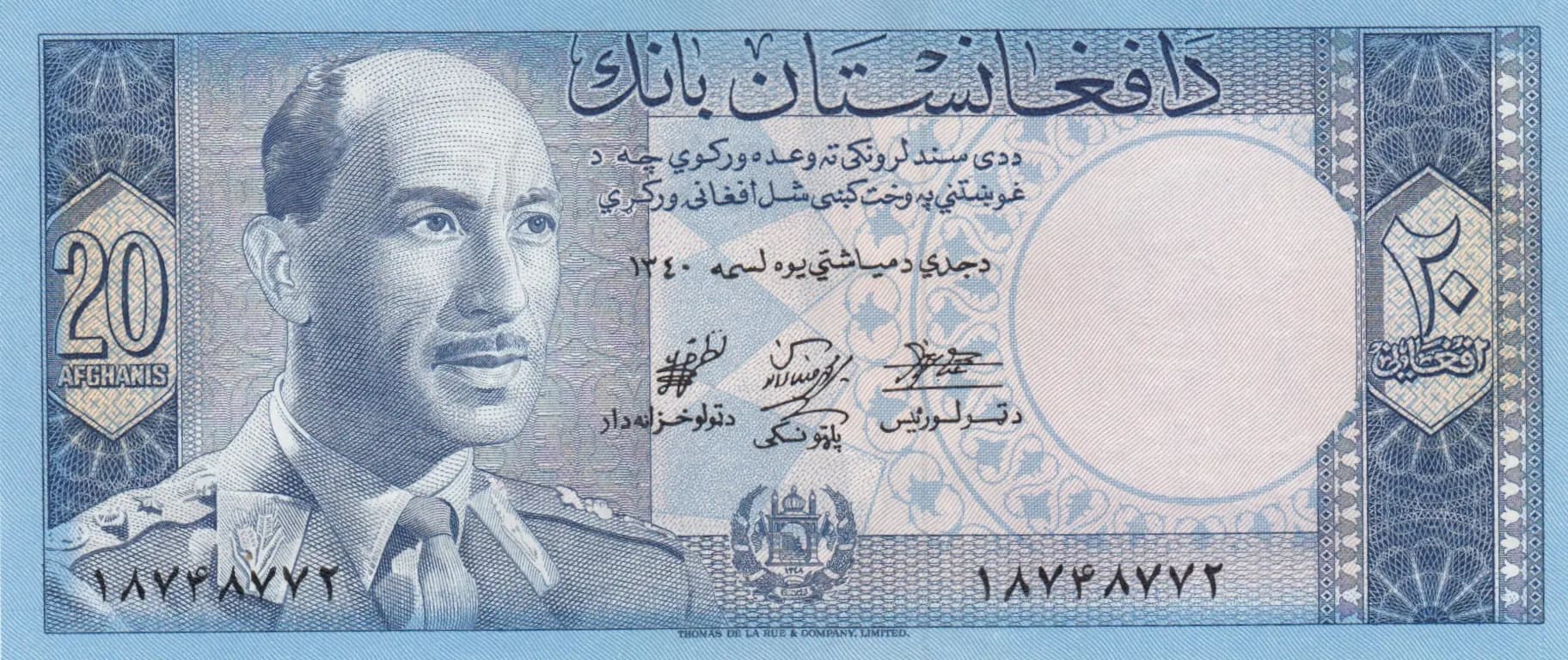
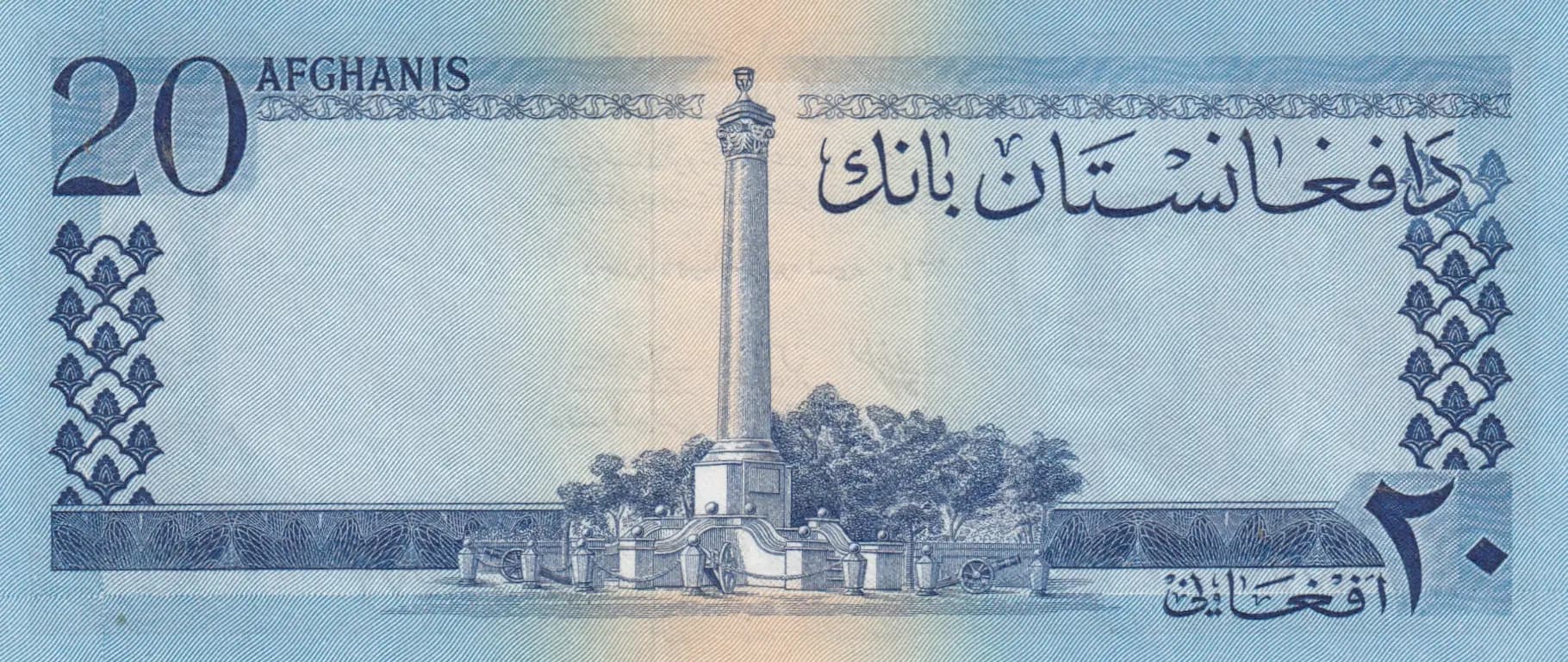
This is an uncirculated example of Afghanistan's 20 Afghanis from 1961 (SH 1340), printed by the prestigious Thomas de la Rue of London. The note features King Muhammad Zahir Shah in formal military dress on the obverse and the Independence Monument of Kabul on the reverse, both rendered in fine line engraving with a distinctive light blue color scheme. In UNC condition, this note displays crisp, sharp detail throughout with no visible wear, creases, or foxing, making it a desirable example of mid-20th century Afghan currency.
Common. This note circulated widely as a regular issue denomination during the 1960s. eBay market data shows consistent sales across all condition grades from 2013-2023, with UNC examples typically selling in the $2-$15 range and lower grades commanding only $1-$6. The existence of multiple PMG-graded examples and the steady supply on secondary markets indicate adequate printing quantities. No evidence of rarity or scarcity factors applies to this Pick number.
This banknote was issued during the reign of King Muhammad Zahir Shah, Afghanistan's last reigning monarch before the 1973 coup. The Independence Monument depicted on the reverse commemorates Afghanistan's independence and national sovereignty, reflecting the nation's pride during a period of relative stability and modernization in the early 1960s. The use of Thomas de la Rue—a world-leading security printer—for this denomination underscores Da Afghanistan Bank's commitment to producing modern, internationally-standard currency.
The obverse features a formal portrait of King Muhammad Zahir Shah positioned at the left, depicted in three-quarter profile wearing military dress uniform with collar insignia and decorative medals. The portrait serves simultaneously as the primary watermark element. The background consists of light blue tones with intricate geometric ornamental patterns and fine line engraving. The reverse showcases the Monument to Independence (Kabul), a tall commemorative structure with a central column topped by a dome, flanked by symmetrical architectural elements, formal gardens, and decorative urns or pillars. The background transitions from light blue to cream/tan tones. Both sides feature elaborate geometric corner panels with repeated ornamental designs and floral borders characteristic of high-security banknote design.
Front side: '20' (English numerals), 'AFGHANIS' (English), 'دافغانستان بانک' (Dari/Persian: 'Da Afghanistan Bank' or 'Bank of Afghanistan'), 'THOMAS DE LA RUE & COMPANY, LIMITED.' (English printer attribution). Back side: '20' (English numerals), 'AFGHANIS' (English), 'دافغانستان بانک' (Dari/Persian: 'Da Afghanistan Bank'), 'افغانستان' (Dari/Persian: 'Afghanistan').
Intaglio engraving (line engraving) throughout, as evidenced by the fine detail, sharp line work, and dimensional quality visible in both the portrait and architectural elements. The multi-color printing technique employs a light blue primary color with subtle gradations, gray toning, and cream/tan background elements. Thomas de la Rue employed their standard security printing methods including complex geometric patterns, fine line backgrounds, and integrated watermark design—all hallmarks of their mid-20th century banknote production.
The visual analysis does not reveal specific signature varieties, date overprints, or serial number prefixes that would distinguish sub-varieties. PMG's population report indicates only one catalogued variant for Pick-38. Without visible signatures or distinguishing marks in the inspection images, this appears to be the standard variety of the 1961 issue. Collectors should note that Afghan banknotes of this era may have minor signature variations between printings, but such distinctions are not apparent in this specimen.