10 afghanis 1979 specimen
Market Prices
About This Note
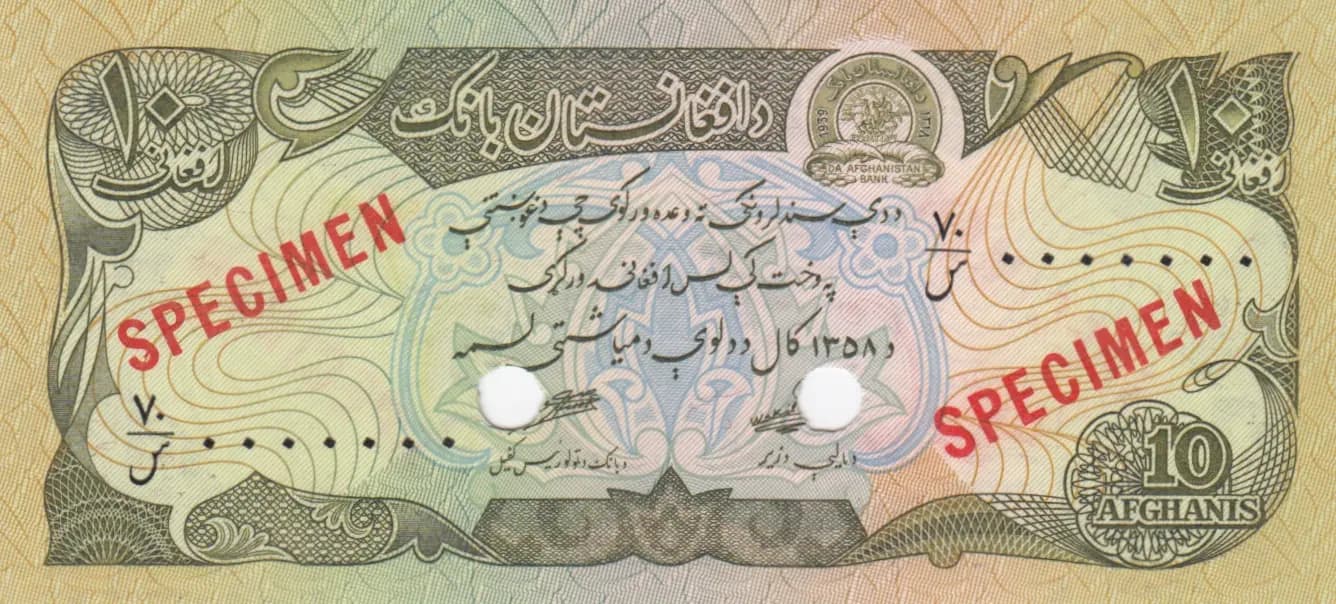
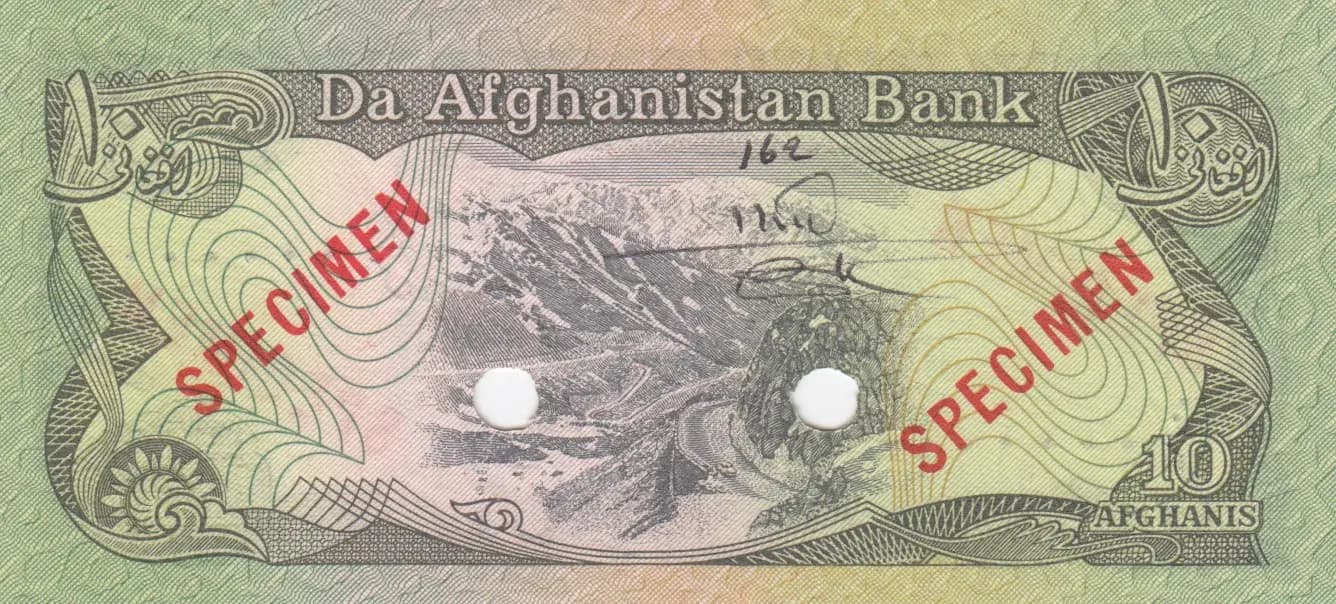
This is a specimen note of the 10 Afghanis from 1979 (SH 1358), issued by Da Afghanistan Bank during the Democratic Republic period. The note displays excellent uncirculated condition with crisp, clean surfaces and precise specimen punch holes through the center. It features ornate geometric and floral borders in green, tan, and orange tones, with the prominent state seal on the obverse and a detailed mountainous landscape vignette on the reverse, making it a visually striking example of Afghan numismatic design.
Common. The eBay market data provided shows specimen notes of this denomination and year trading consistently in the $2–$8 range, with most UNC examples selling below $5. Specimen notes, while not in general circulation, were produced in sufficient quantities for distribution to banks, international collectors, and institutions. The 10 Afghanis denomination from this period was a standard issue, and the specimen variant, though more limited than circulation notes, does not command premium prices. This pricing pattern strongly indicates common availability in the current collector market.
This banknote was issued during 1979, corresponding to Ramadan 1358 in the Islamic calendar, a pivotal period for Afghanistan following the April 1978 Saur Revolution that established the Democratic Republic of Afghanistan. The imagery—featuring the national seal and mountain landscapes—reflects the republic's identity during this transformative era. As a specimen note, it represents the bank's distribution to international collectors and institutions, serving as an official example of the currency design during a historically significant yet turbulent period in Afghan history.
The obverse features the seal of the Democratic Republic of Afghanistan as a prominent circular emblem in the upper center, surrounded by ornate decorative borders composed of geometric patterns and floral motifs in green, tan, orange, and gray. Calligraphic Dari/Persian script dominates the center with the issuing authority and state designation. The reverse depicts an engraved landscape vignette of mountainous Afghan terrain rendered in black and gray line engraving, showcasing the country's characteristic rocky mountain formations and varied topography. Both sides are framed by matching ornate borders, and both bear red diagonal 'SPECIMEN' overprints and two precisely punched circular holes through the center, standard specimen note indicators.
FRONT SIDE: 'Da Afghanistan Bank' (داافغانستان بانک - The Afghanistan Bank), 'Democratic Republic of Afghanistan' (دولت جمهوری دموکراتی افغانستان), 'Ramadan 1358' (رمضان 1358 - the date in Islamic calendar), '10' (denomination), 'AFGHANIS' (currency name), 'SPECIMEN' (English specimen marking, printed diagonally in red). BACK SIDE: 'Da Afghanistan Bank' (English text at top), '10' and 'AFGHANIS' (denomination markings), 'SPECIMEN' (English specimen marking, printed diagonally in red).
This note was produced using intaglio (engraved line) printing techniques, evident from the fine detail work visible in both the decorative border patterns and the mountainous landscape vignette. The crisp, precise rendering of geometric patterns, floral motifs, and terrain features demonstrates high-quality steel engraving. The specimen punch holes appear to have been applied after printing as a mechanical specimen designation. For the 1979 Afghan banknotes of this period, production was typically handled by established security printers, likely including involvement from international banknote printing firms, though specific printer attribution for this Pick number requires verification against Bank of Afghanistan archives.
This is a specimen note variant of Pick 55, indicated by the red diagonal 'SPECIMEN' overprints and two specimen punch holes through the center. The specific variety designation is P-55s (the 's' suffix denoting specimen status). Known signature varieties exist for this issue, though the specific signatures are not clearly legible in the visual analysis provided. The date shown is SH 1358 (Ramadan 1358 in the Islamic calendar, corresponding to 1979 CE). Without access to detailed signature plates or serial number information, further sub-variety classification cannot be determined from the images alone.