5 tala 1985
About This Note
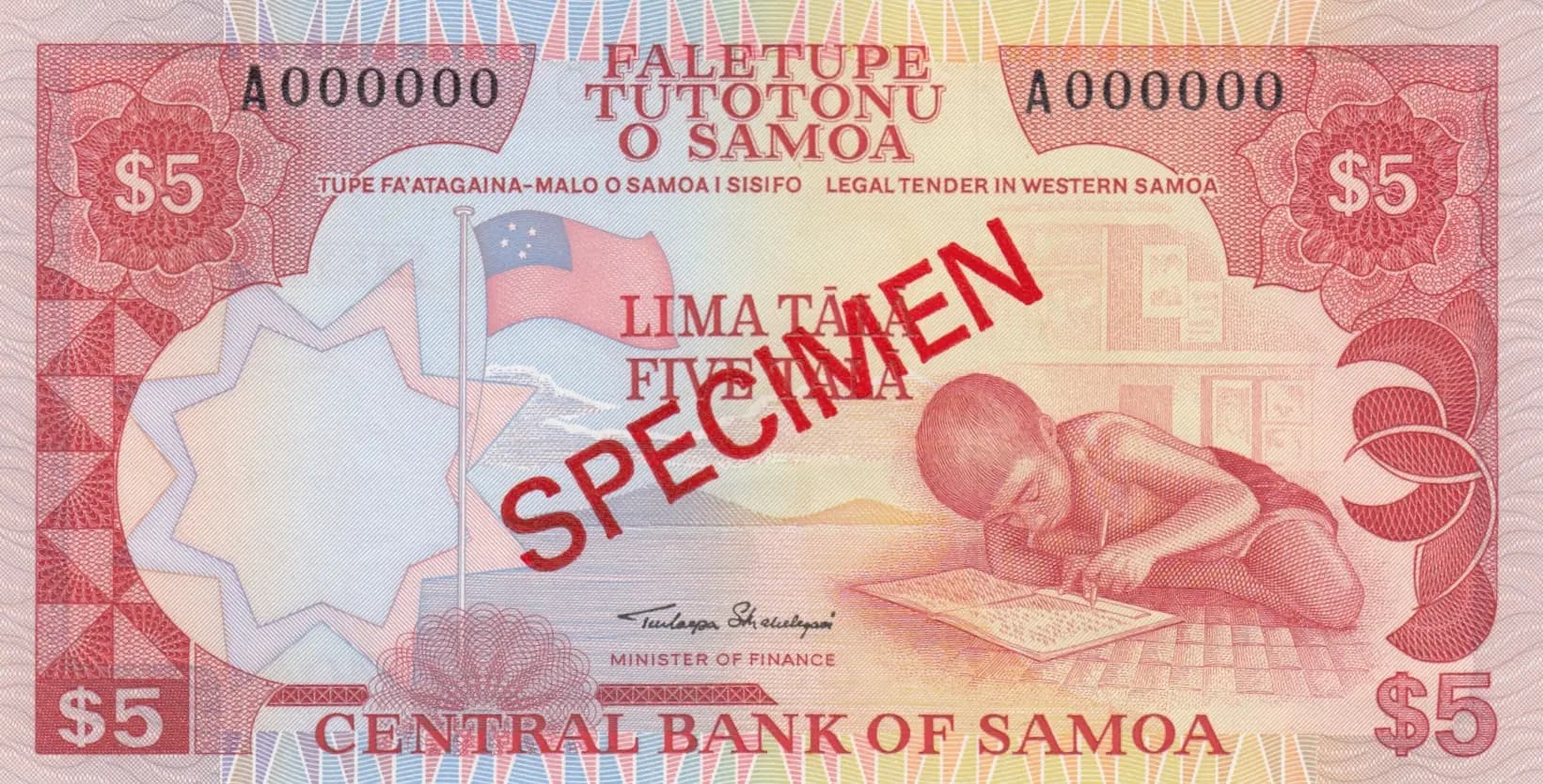
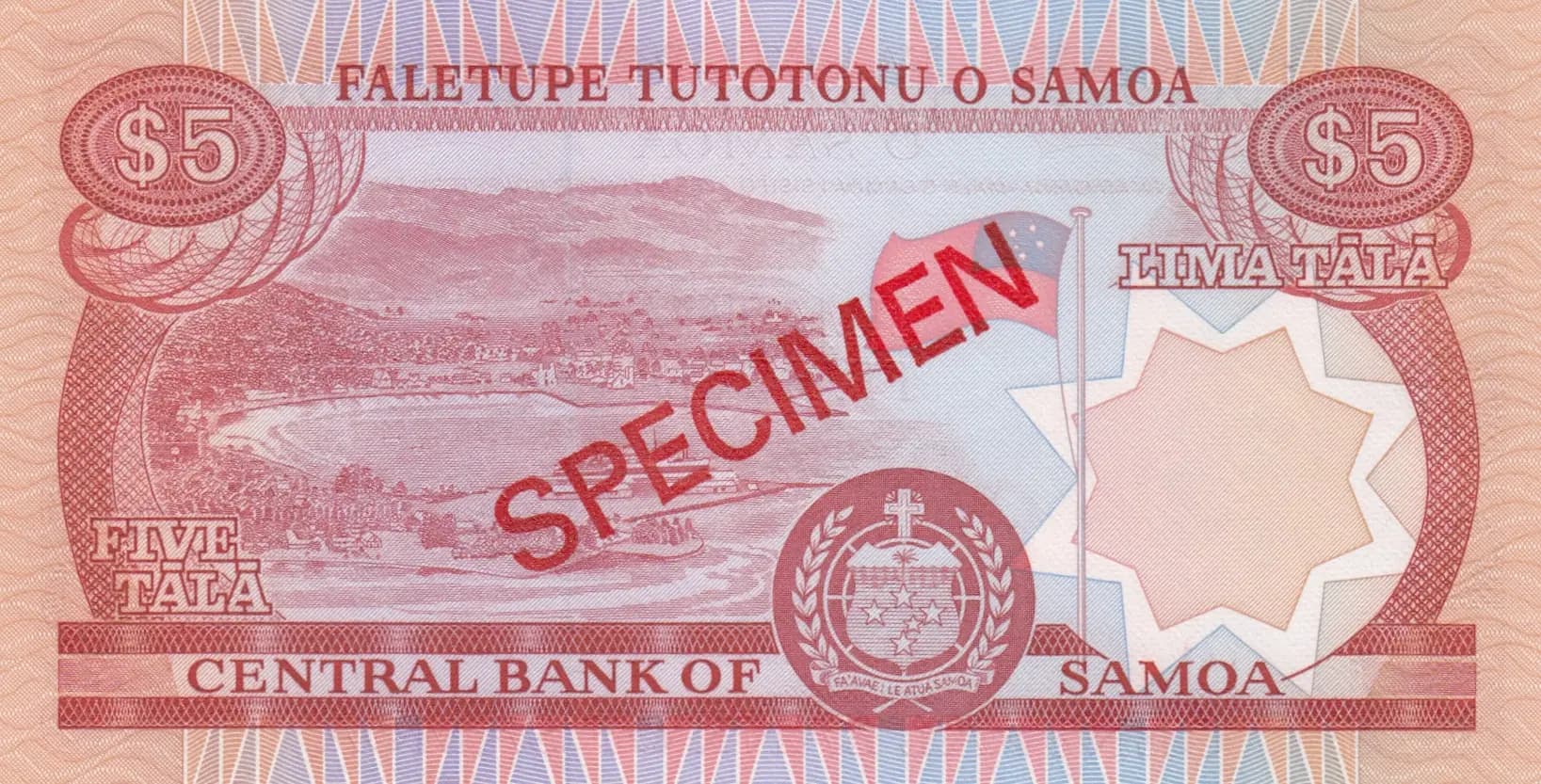
This is an uncirculated specimen note of the Western Samoa 5 tala from 1985 (Pick P-26), featuring a striking red/pink color scheme with blue and cream accents. The front depicts a young person engaged in traditional craftwork alongside the Samoan flag, while the reverse showcases a scenic coastal or valley landscape characteristic of Samoa. The prominent red 'SPECIMEN' overprint and serial number A000000 identify this as a specimen/sample note issued by the Central Bank of Samoa, making it a desirable item for collectors of Pacific island currency and specimens.
Common. The 1985 Western Samoa 5 tala (Pick P-26) was part of a standard currency series issued by a stable central bank and circulated throughout the nation for several decades. While specimen notes command slightly higher collector interest than circulated examples, specimen overprints were regularly issued for distribution to banks and collectors, resulting in relatively available quantities in the secondary market. No evidence suggests a restricted print run, recall, or short circulation period. Current market values for uncirculated specimens typically range from $10–25 USD, well within the common range for twentieth-century Pacific island currency.
This note was issued during Western Samoa's post-independence period, when the Central Bank of Samoa (Faletupe Tututonu o Samoa) was establishing its currency identity following the nation's 1962 independence from New Zealand. The imagery reflects the nation's cultural values, with the front depicting traditional Samoan craftsmanship and the reverse featuring the island's distinctive geography, while the bilingual inscriptions (Samoan and English) underscore the country's dual linguistic heritage during this transitional era. The 1985 series represented an important phase of Central Bank consolidation and national monetary sovereignty in the South Pacific.
The obverse presents a composition dominated by the Samoan flag in the upper left corner, with the central motif depicting a young Samoan artisan or child engaged in traditional handicraft work, shown in profile. Ornamental rosette designs occupy all four corners, with intricate guilloche patterns forming the border framework. The reverse features a panoramic landscape scene representative of Apia harbor or similar Samoan coastal/valley geography, with mountains or hills defining the horizon. The Central Bank of Samoa coat of arms (circular emblem featuring a cross and laurel wreath design) is positioned at the bottom center. Large oval denomination frames containing '$5' appear symmetrically in the lower left and right corners. The Samoan flag reappears in the upper right of the reverse. The overall design emphasizes national identity through cultural imagery (traditional work) and geographical landmarks (the harbor/valley vista), employing a cohesive red/pink, cream, and blue color palette throughout.
FRONT: 'FALETUPE TUTUTONU O SAMOA' (Central Bank of Samoa); 'TUPE FA'ATAGAINA-MALO O SAMOA I SISIFO' (Legal tender in Western Samoa); 'LEGAL TENDER IN WESTERN SAMOA' (English equivalent); '$5' / 'LIMA TALA' / 'LIMA TA'E' / 'FIVEMALA' (all meaning Five tala in various forms); 'SPECIMEN' (indicating specimen status); 'MINISTER OF FINANCE' and 'CENTRAL BANK OF SAMOA' (authority signatures/titles); Serial number 'A000000'. BACK: 'FALETUPE TUTUTONU O SAMOA' (Central Bank of Samoa); '$5' (denomination markers); 'SPECIMEN' (overprint); 'CENTRAL BANK OF SAMOA' (issuer); Samoan inscriptions referring to the depicted landscape. Both sides feature bilingual text reflecting official use of Samoan and English.
This note employs traditional intaglio engraving combined with offset lithography, characteristic of banknote production in the mid-1980s. The fine guilloche patterns, intricate security line work visible throughout the design, and the depth of color gradation evident in the landscape scene indicate high-quality security printing. The printer for Western Samoa's 1985 issues was typically De La Rue or similar Commonwealth-standard security printers; the level of technical sophistication visible in the specimen's execution is consistent with De La Rue's Pacific island currency work of this period. Security features include fine-line engraving, complex background pattern work, and color-shifting areas visible in the composition.
This specimen note exhibits the standard A series serial number prefix (A000000), consistent with the first printing run of the 1985 series. Specimen notes may exist with different serial number prefixes (B, C, etc.) from subsequent printings. The red 'SPECIMEN' overprint is the primary variety distinguishing this from regular circulation notes, which would bear standard serial numbers without overprint. No significant varieties in signature, date, or design elements are documented for Pick P-26 beyond the standard specimen/circulation distinction.