10 shillings 1963
About This Note
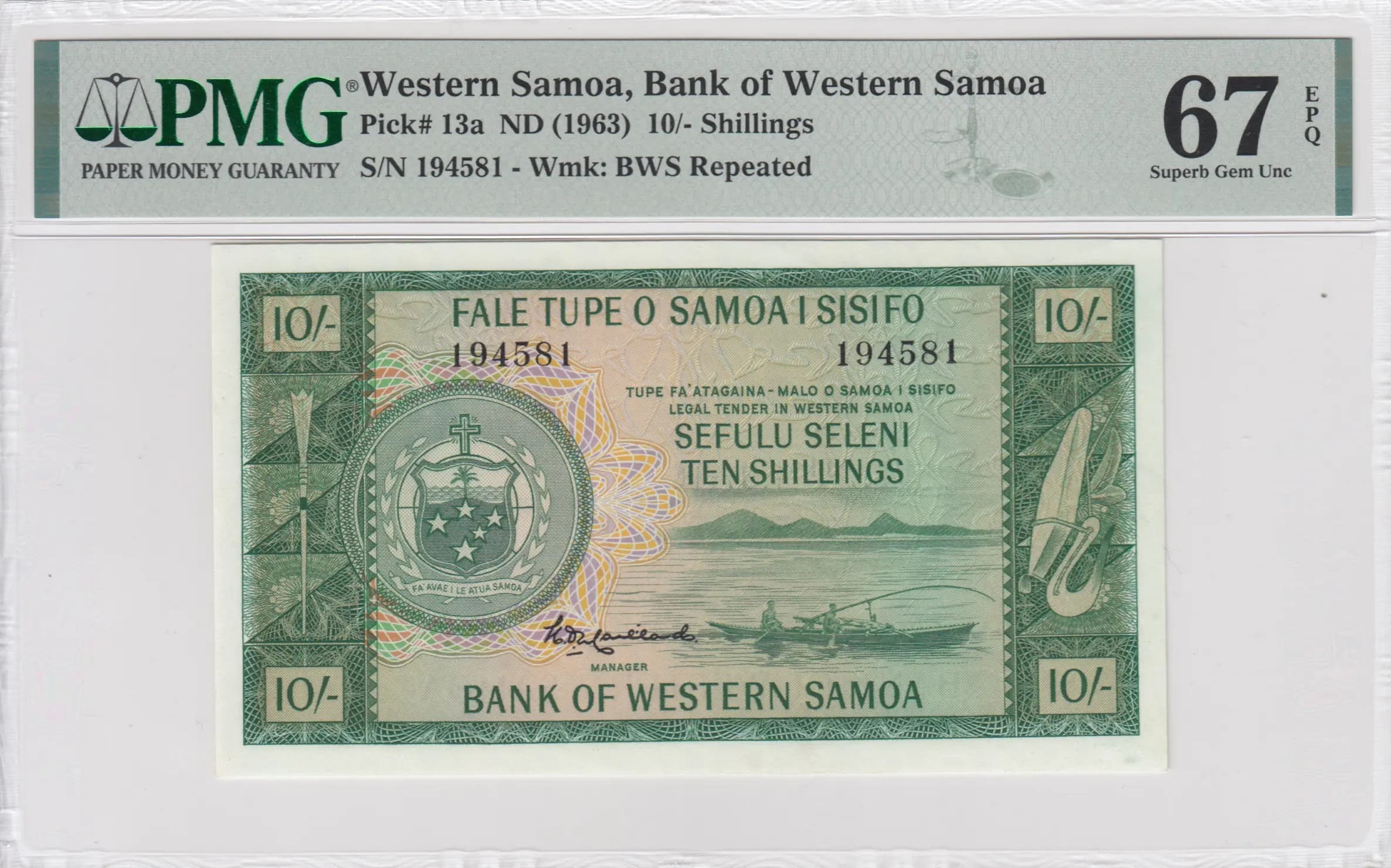
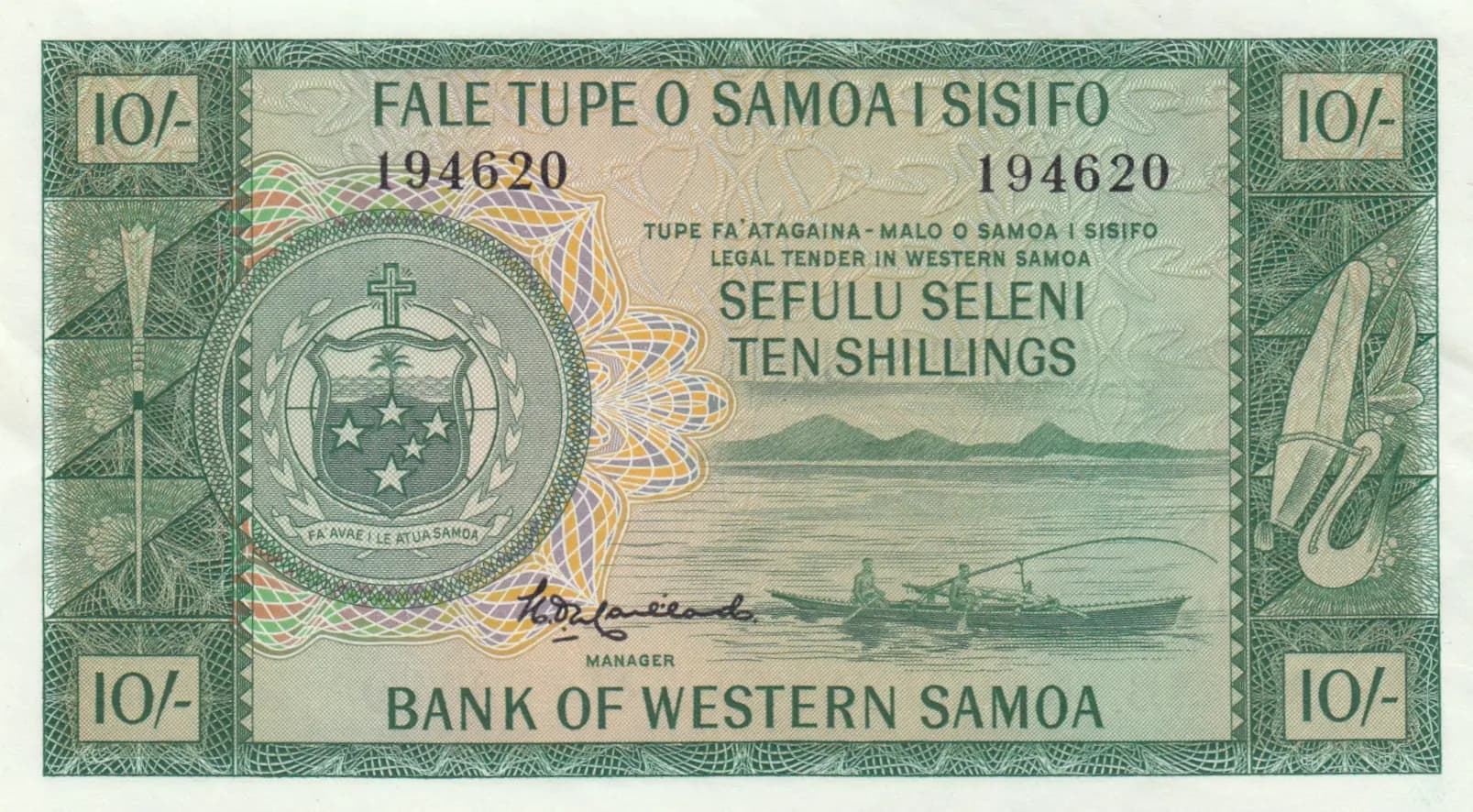
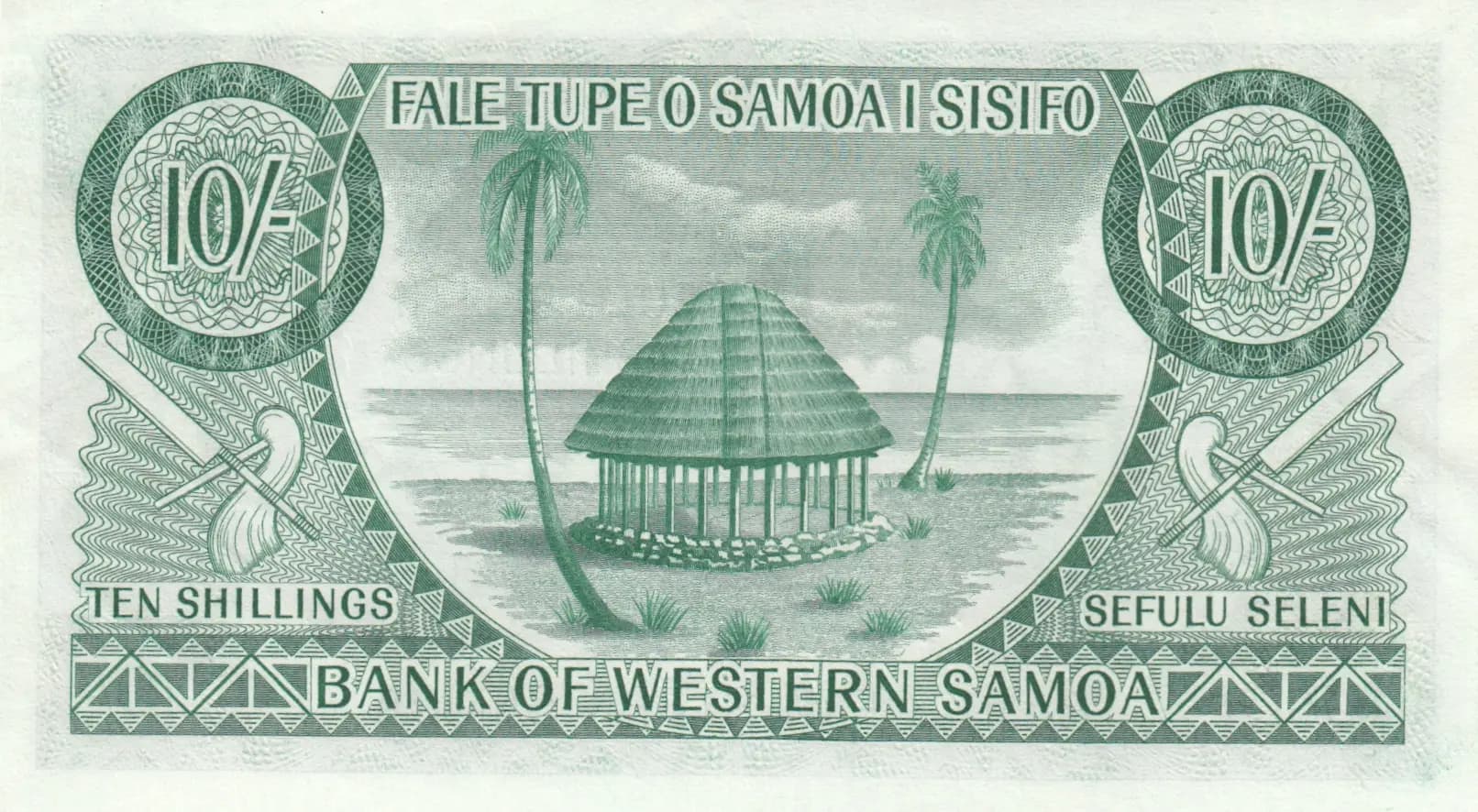
This Western Samoa 10 Shillings banknote from 1963 (Pick 13a) presents in uncirculated condition with crisp, sharp printing throughout and no visible wear or damage. The note showcases a distinctive green color scheme with bilingual English-Samoan inscriptions and features the Bank of Western Samoa's coat of arms on the obverse alongside a traditional outrigger canoe, while the reverse depicts an iconic Samoan fale (thatched house) in its tropical island setting. As an early emission from the newly independent Bank of Western Samoa, this note represents an important piece of Pacific island monetary history.
common
This note was issued in 1963 by the Bank of Western Samoa, established shortly after Western Samoa's independence in 1962. The imagery deliberately celebrates Samoan cultural heritage—the coat of arms with its cross symbolizes Christian influence, while the depicted outrigger canoe and traditional fale represent the maritime and architectural traditions central to Samoan society. The bilingual presentation in English and Samoan reflects the post-colonial transition and the nation's commitment to preserving indigenous language and identity alongside its new international statehood.
The obverse features the Bank of Western Samoa's coat of arms centered on the left within an ornate circular wreath, topped with a cross and containing four stars representing the Southern Cross or regional significance. To the right is a landscape vignette depicting volcanic mountains or islands across a body of water, symbolizing Samoa's geography. Below this scene floats a traditional Samoan outrigger canoe (va'a), a culturally significant vessel representing the nation's seafaring heritage. The reverse showcases a detailed engraving of a traditional Samoan fale—the characteristic open-sided dwelling with a conical thatched roof supported by wooden poles—situated in a tropical coastal setting flanked by palm trees. Both sides feature ornate geometric border patterns with cross-hatching that serve dual purposes of aesthetic framing and security. The color palette of green with white/cream and yellow-orange accents creates a tropical yet formal presentation appropriate for a newly independent nation's currency.
FRONT SIDE: 'FALE TUPE O SAMOA I SISIFO' (Bank of Western Samoa) / 'BANK OF WESTERN SAMOA' (English equivalent) / 'TEN SHILLINGS' and 'SEFULU SELENI' (Ten shillings in English and Samoan) / '10/-' (denomination in both corners) / 'LEGAL TENDER IN WESTERN SAMOA' and 'TUPE FA'ATAGAINA - MALO O SAMOA I SISIFO' (legal tender declaration in English and Samoan) / 'FA'AVAI LE ATUA SAMOA' (God bless Samoa, inscribed within the coat of arms) / 'MANAGER' (signature designation). BACK SIDE: 'FALE TUPE O SAMOA I SISIFO' and 'BANK OF WESTERN SAMOA' (issuing authority) / '10/-' (denomination in circular medallions, upper left and right) / 'TEN SHILLINGS' and 'SEFULU SELENI' (denomination text in English and Samoan).
This banknote was produced using intaglio (engraved) printing, as evidenced by the sharp, crisp line work, fine cross-hatching patterns, and dimensional quality visible throughout the note. The detailed security borders, precise geometric patterns, and the fine rendering of the coat of arms, landscape vignette, and architectural details are characteristic of high-quality intaglio engraving. The note was likely produced by a British security printer, as was common for Commonwealth-associated Pacific island nations in this period, though specific printer attribution requires additional documentation.
This note is cataloged as Pick 13a, indicating it is the first (primary) variety of the 10 Shillings denomination from the 1963 issue. The observed serial number prefix '194620' is consistent with early production runs. No overprints, signature variations, or other distinguishing varieties are apparent from the visual analysis. The uncirculated condition suggests this is a well-preserved example from the initial print run, though such early Western Samoa issues remain readily available in the collector market.