5 pounds 1963
About This Note
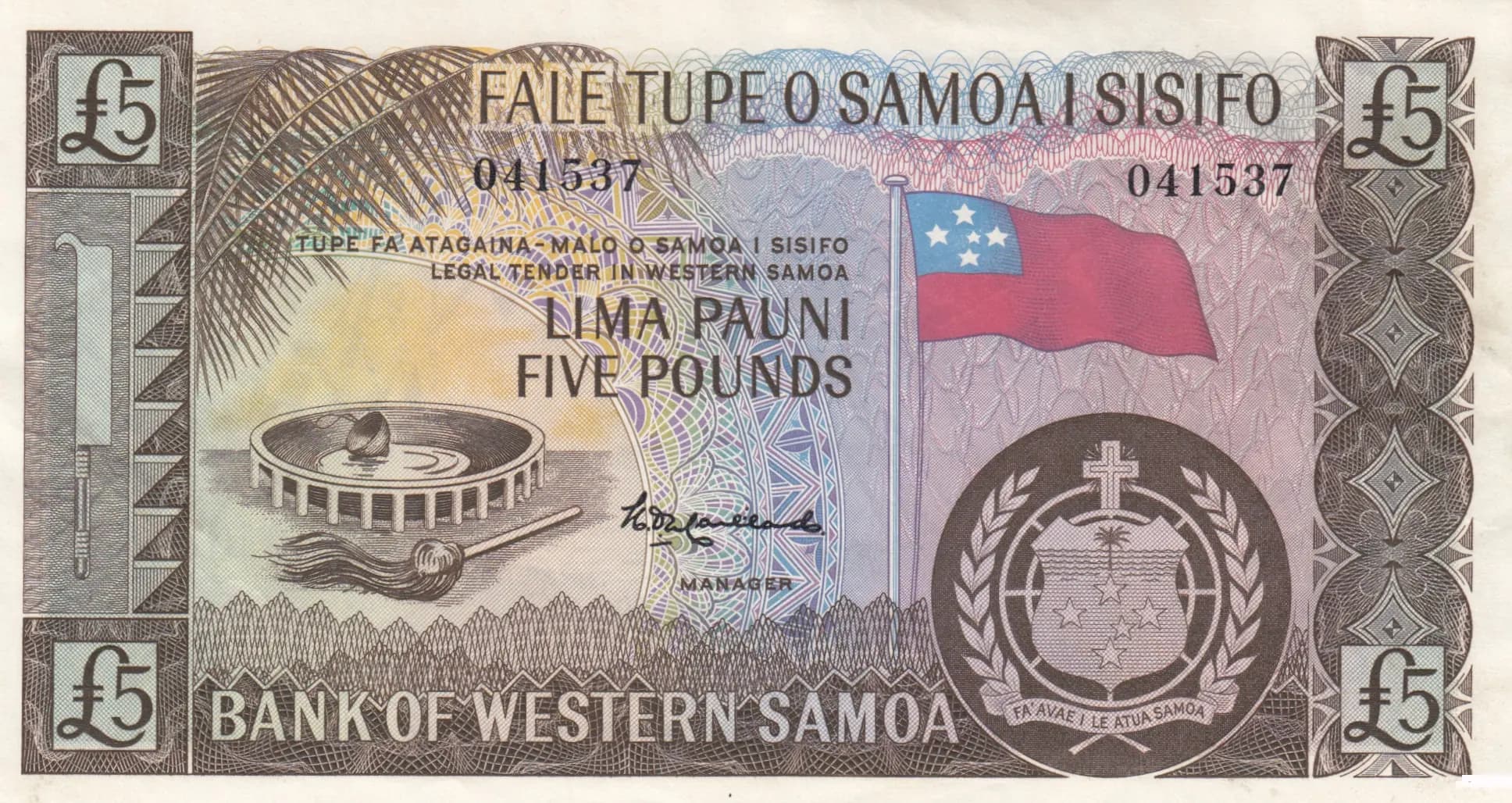
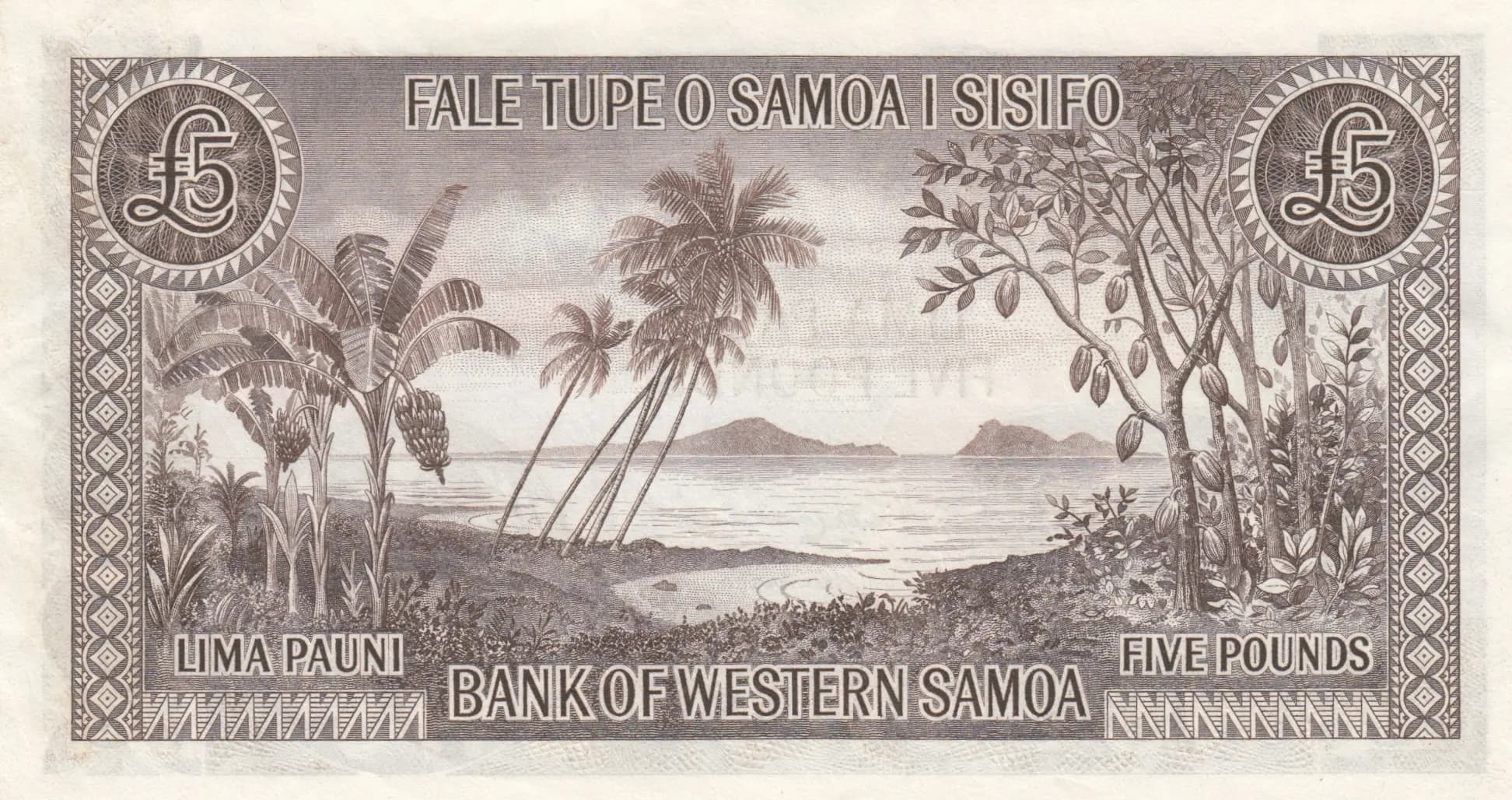
This is an attractive AU-grade example of the 1963 Western Samoa £5 note (Pick 15a), featuring well-preserved color printing and sharp engraving throughout. The note displays the characteristic bilingual design with traditional Samoan cultural elements including a woven kava bowl on the obverse and a scenic tropical landscape on the reverse, with no visible wear or creasing. The crisp printing quality and minimal aging make this a desirable example of this early post-independence currency issue.
Common. The 1963 Western Samoa £5 note (Pick 15a) was part of the Bank of Western Samoa's initial currency series and was issued in quantities typical for a new nation's foundational currency circulation. No documented print run restrictions, early recalls, or exceptional scarcity indicators exist for this denomination. While notes in AU condition command modest collector premiums over circulated examples, the issue itself remains readily available in the numismatic market.
Issued in 1963 by the newly established Bank of Western Samoa, this note reflects the nation's recent independence and pride in its cultural heritage, evident in the deliberate inclusion of traditional Samoan imagery such as the kava bowl and the official national seal. The bilingual Samoan-English text and national motto 'FA'AVAE I LE ATUA SAMOA' (God is the foundation of Samoa) underscore the nation's commitment to preserving its language and values during the early years of sovereignty. The tropical landscape on the reverse romanticizes Samoa's natural beauty and geographic identity during a formative period for the young nation.
The obverse features a carefully composed central design incorporating three primary symbolic elements: a traditional woven Samoan kava (or 'ava) bowl depicted with fine engraved detail on the center-left, representing Samoan ceremonial culture; the national flag of Western Samoa (red field with blue canton containing white stars) positioned center-right; and the official national seal featuring a cross within a circular emblem adorned with laurel wreaths, symbolizing Christian values and sovereignty. The reverse presents an idyllic tropical landscape engraving showing a serene beach scene with coconut palms leaning over calm waters, banana plants on the left, flowering tropical vegetation on the right, and distant islands visible on the horizon—a romanticized vision of Samoa's natural environment. Both sides are framed by intricate geometric border patterns with repeating decorative elements characteristic of Commonwealth-era banknote design. The color scheme employs brown, tan, red, blue, purple, and gray inks to create visual hierarchy and security depth.
FRONT SIDE: '£5' / 'LIMA PAUNI' (Five Pounds in Samoan); 'FALE TUPE O SAMOA I SISIFO' (Bank of Western Samoa); 'BANK OF WESTERN SAMOA'; 'LEGAL TENDER IN WESTERN SAMOA' / 'TUPE FA'ATAGAINA-MALO O SAMOA I SISIFO' (Legal tender in Western Samoa); 'FIVE POUNDS' / 'LIMA PAUNI'; 'FA'AVAE I LE ATUA SAMOA' (God is the foundation of Samoa); Serial number '041537'. BACK SIDE: '£5' / 'LIMA PAUNI' (Five Pounds); 'FALE TUPE O SAMOA I SISIFO' (Bank of Western Samoa); 'BANK OF WESTERN SAMOA'; 'FIVE POUNDS' / 'LIMA PAUNI'.
The note exhibits classic intaglio engraving characteristic of 1960s Commonwealth currency production. The fine line work, geometric security patterns, and sharp botanical detailing visible throughout both sides, combined with the multi-color printing layers and the depth achieved in the landscape engraving, are consistent with steel plate intaglio printing. The intricate background patterns and security elements suggest production by a specialized security printer, likely a British Commonwealth-affiliated printer such as De La Rue or Waterlow & Sons, though specific attribution cannot be confirmed without archival records.
The observed serial number '041537' indicates standard sequential numbering. Pick 15a is the primary variety for the 1963 £5 issue; no documented significant varieties (such as signature variations, date changes, or color variants) are recorded for this specific denomination in the 1963 series. The note represents the standard printing from this issue period.