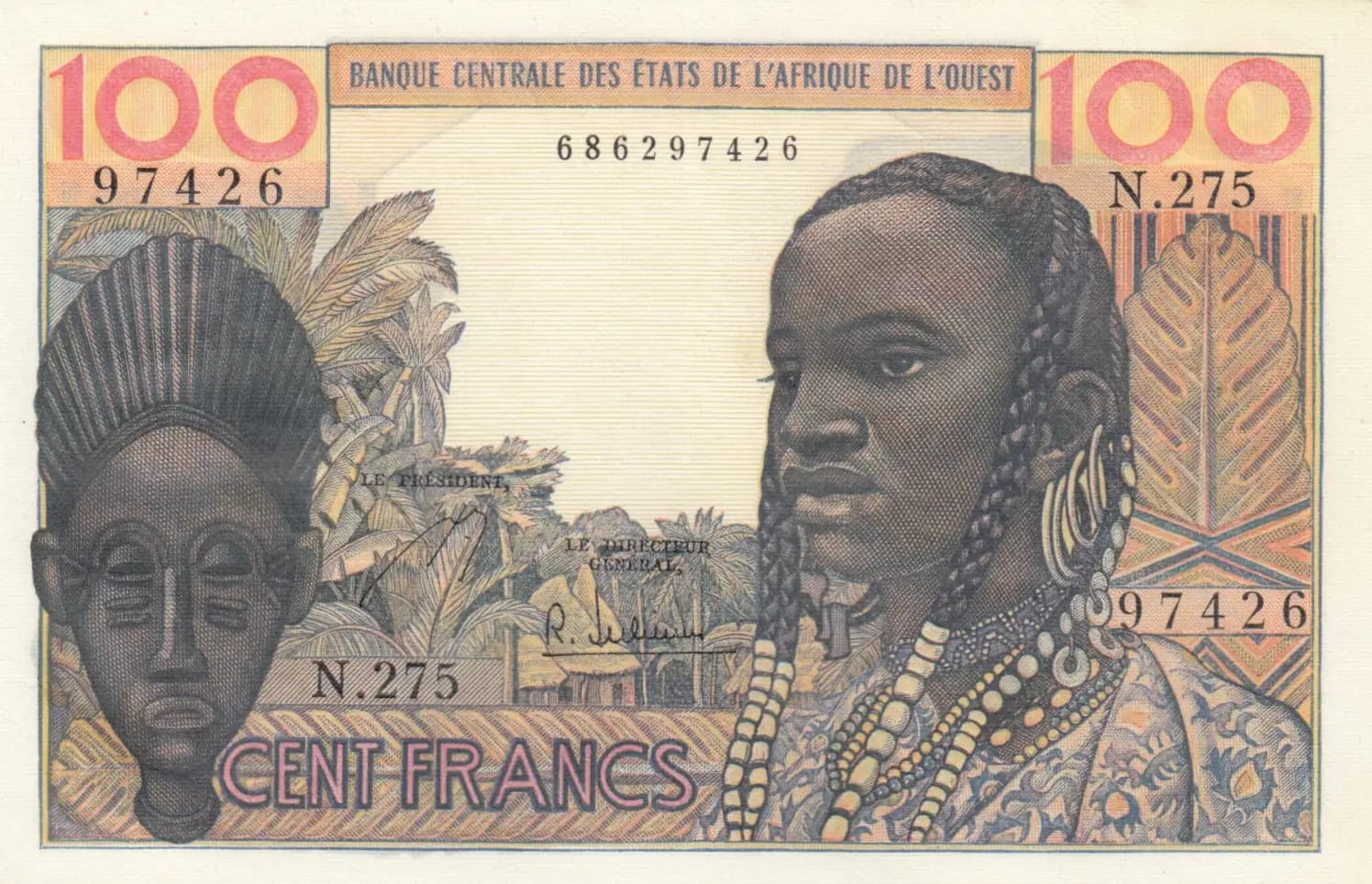
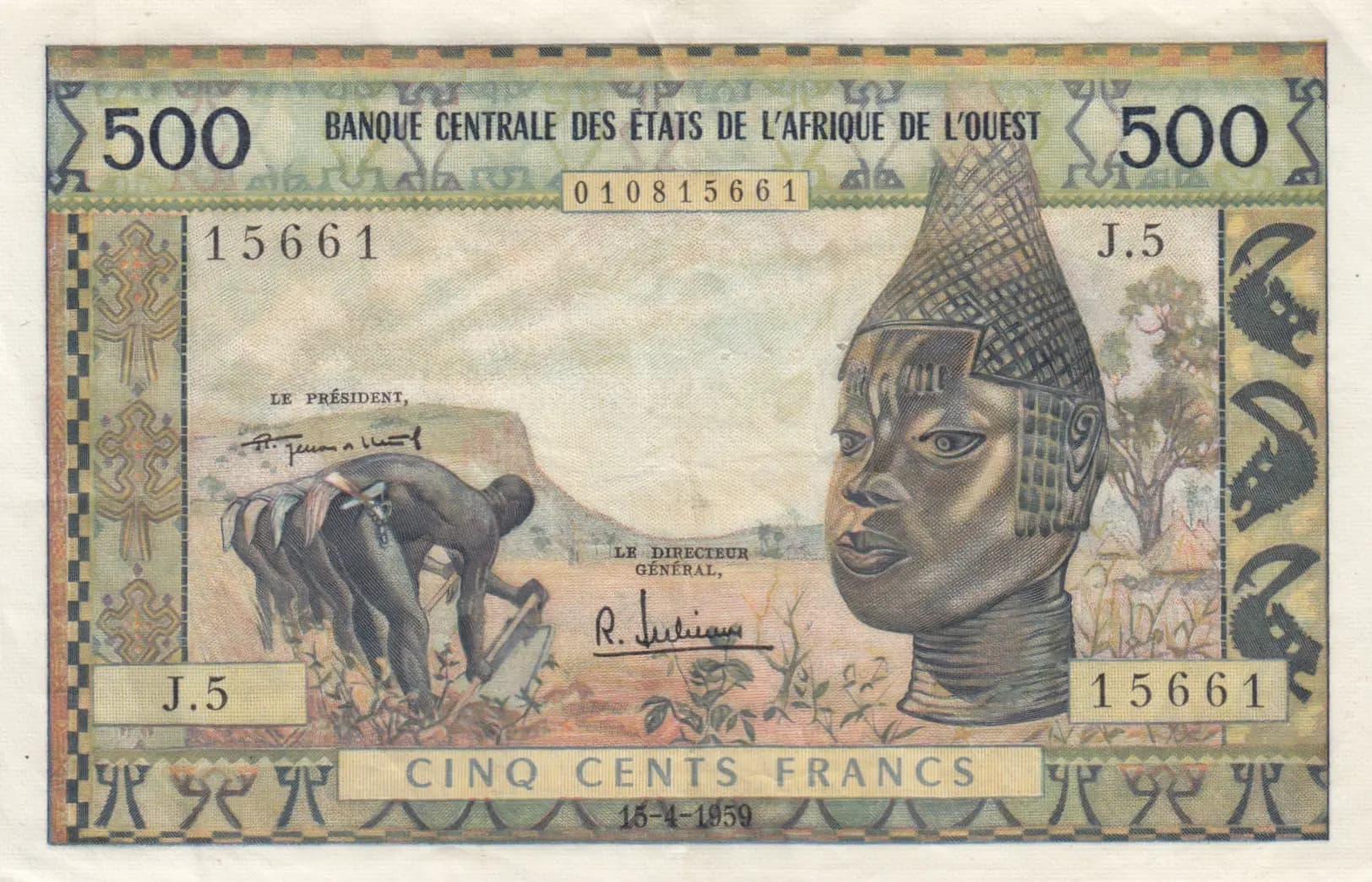
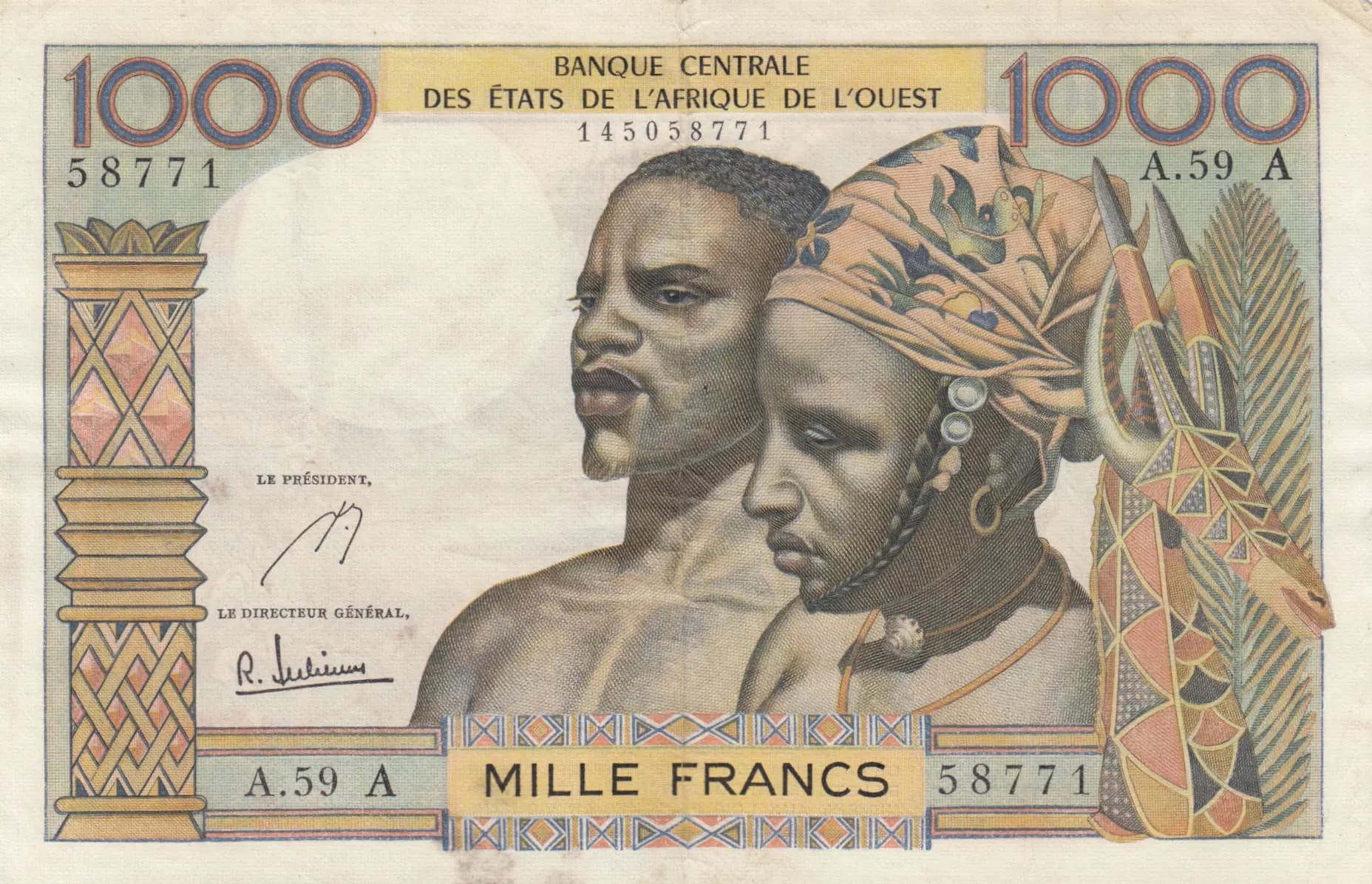
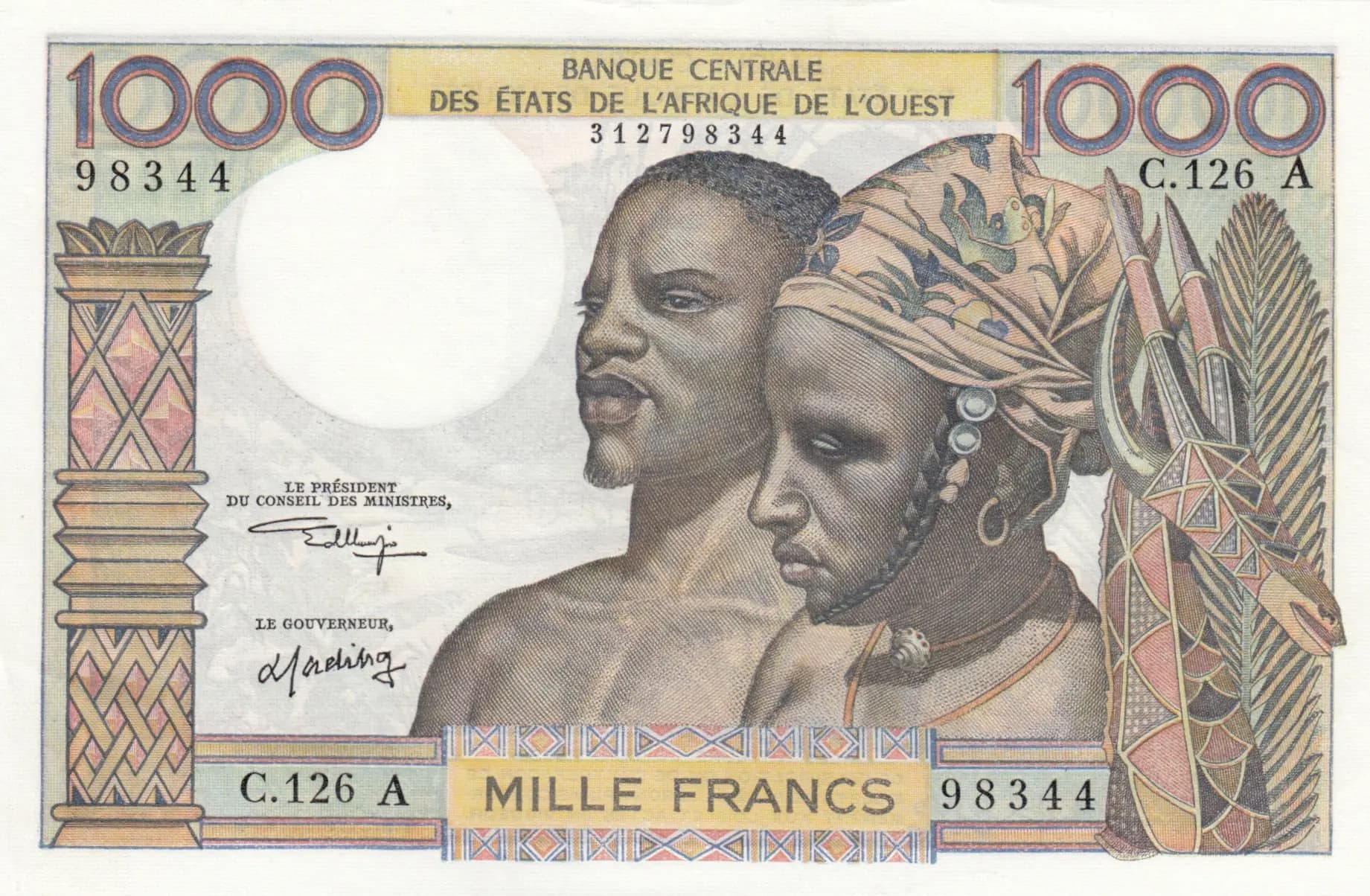
500 francs 1964
“Senegal”
About This Note
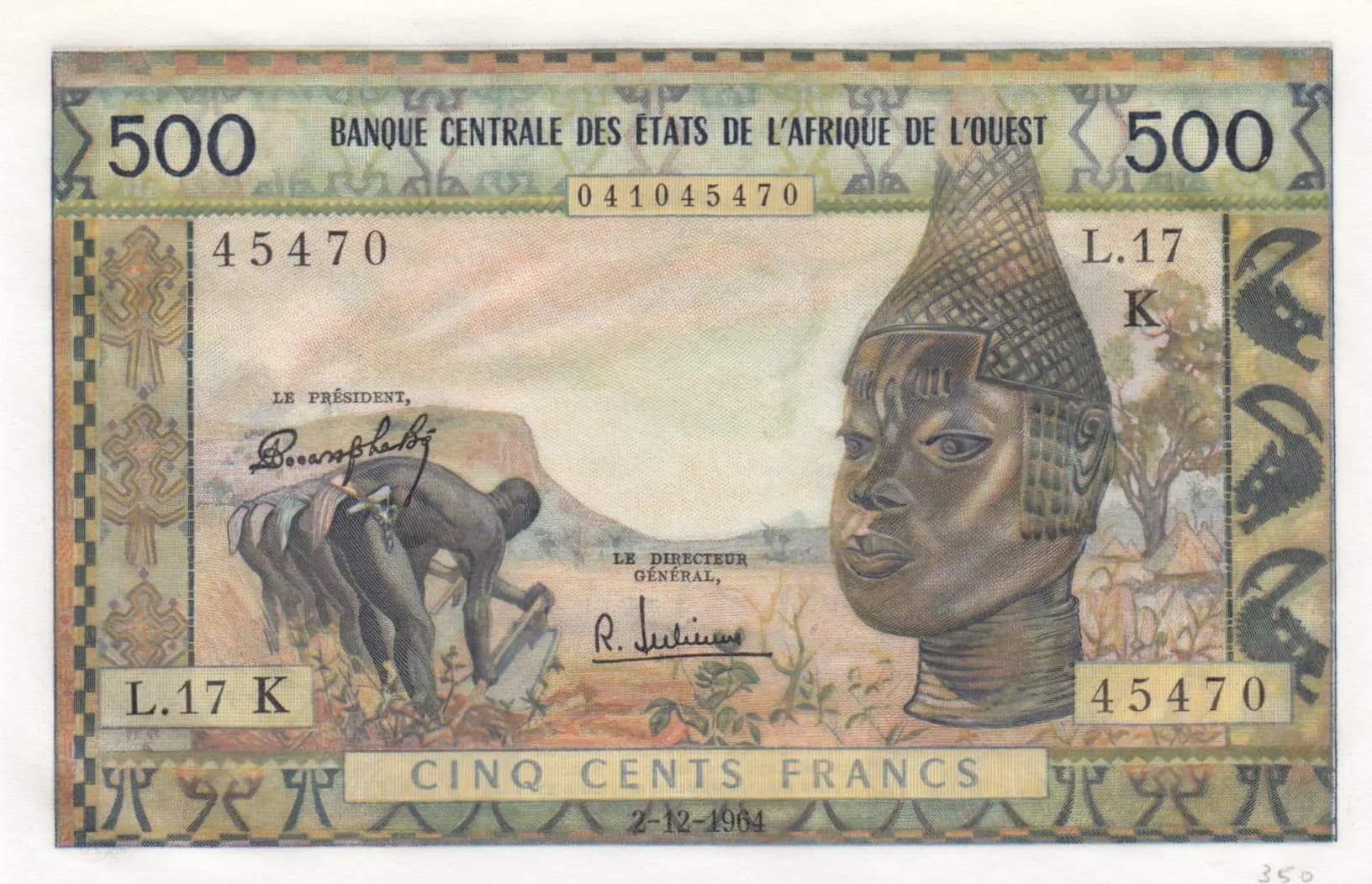
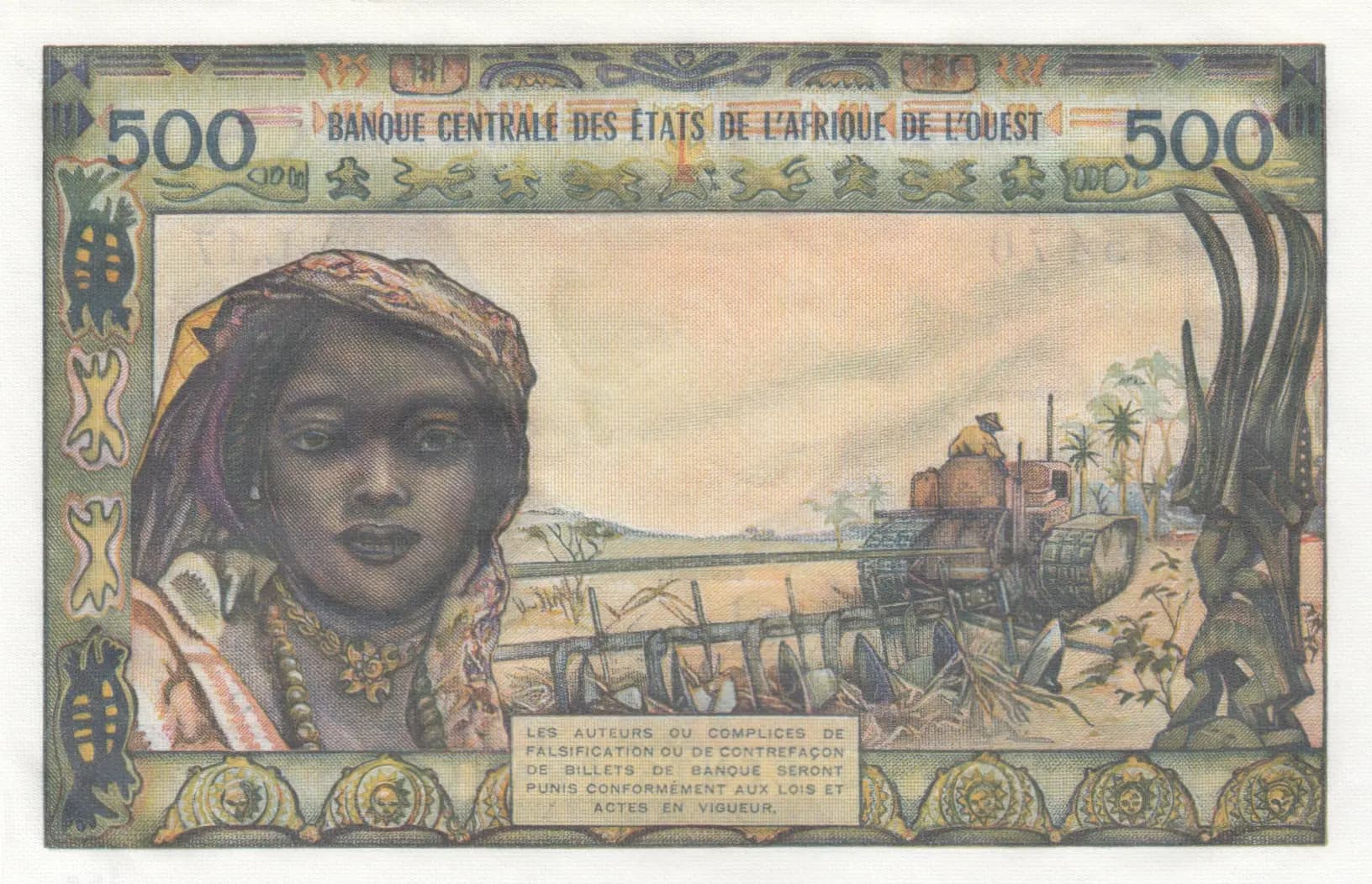
This is an uncirculated 500 francs banknote from 1964, issued by the Banque Centrale des États de l'Afrique de l'Ouest for the West African States, with Senegal as the issuing country per the catalog designation. The note features exceptional artistic composition with a carved African wooden mask on the obverse and a portrait of a woman in traditional dress on the reverse, accompanied by agricultural landscape imagery. In pristine UNC condition, this note exhibits sharp printing, clean margins, and no signs of circulation, making it an attractive example of early post-independence West African currency design.
Common. The 500 francs denomination from the 1964 BCEAO issue was produced in substantial quantities for circulation across the West African States member nations. While this specific variety (P-702Kd with code letter 'K' designation) may be one of several cataloged variants, the base denomination and issue year were not subject to limited production runs or early recall. The existence of multiple PMG-graded variants (P-702Kg, Km, Kn) for this same base Pick number indicates a broad printing run with various letter designations. Uncirculated examples are readily available to collectors at modest price points typical of common 1960s African banknotes.
Issued on December 2, 1964, this banknote reflects the early years of West African monetary integration through the BCEAO, established to serve the newly independent or recently autonomous states of French West Africa. The imagery celebrating African cultural heritage—through the prominent wooden mask sculpture and the depiction of traditional dress alongside agricultural activity—represents the post-colonial emphasis on African identity and economic development. The note's design documents a pivotal moment when these nations were establishing their own financial institutions and cultural narratives independent of colonial powers.
The obverse features a striking cultural composition combining two representations of African heritage: on the right, a meticulously rendered carved wooden mask or head sculpture (likely of Senegalese or West African origin) with elaborate facial features and ornate headdress, and on the left, an illustration of a dignified figure in traditional robes and ornamental headdress, rendered in black and white engraving style. The reverse showcases a portrait of a West African woman wearing traditional clothing with a decorative headwrap and beaded necklace on the left side, paired with a landscape scene depicting the region's agricultural and economic activity, including cultivated fields, palm trees, and what appears to be agricultural or light industrial infrastructure. Both sides are framed by geometric ornamental borders with African-style decorative motifs and patterns. The color palette of tan, beige, brown, green, and orange creates a warm, earthy aesthetic appropriate to the subject matter.
FRONT SIDE: '500' (denomination), 'BANQUE CENTRALE DES ÉTATS DE L'AFRIQUE DE L'OUEST' (Central Bank of the States of West Africa), 'CINQ CENTS FRANCS' (Five Hundred Francs), '2-12-1964' (Issue date: December 2, 1964), 'LE PRÉSIDENT' (The President), 'LE DIRECTEUR GÉNÉRAL' (The General Director), 'L.17 K' (Designation code), Serial number segment '041045470' and '45470'. BACK SIDE: '500' (denomination repeated), 'BANQUE CENTRALE DES ÉTATS DE L'AFRIQUE DE L'OUEST' (Central Bank of the States of West Africa), 'LES AUTEURS OU COMPLICES DE FALSIFICATION OU DE CONTREFAÇON DE BILLETS DE BANQUE SERONT PUNIS CONFORMÉMENT AUX LOIS ET ACTES EN VIGUEUR' (The authors or accomplices of counterfeiting or falsification of banknotes will be punished in accordance with applicable laws and acts in force).
The note exhibits characteristics of intaglio (engraved) printing, evidenced by the sharp detail in the portrait work, the fine line quality of the border patterns, and the crisp rendering of the landscape elements. This was the standard security printing technique employed by the BCEAO for its currency issues during this period. The multi-color printing suggests a combination of engraved plates with color layering, typical of European security printers contracted to produce African currency in the 1960s. The note was likely produced by one of the established security printing houses such as Banque de France's printing facilities or similar European contractors serving the BCEAO.
This note is identified as P-702Kd based on the code letter 'K' visible on the obverse (designated as 'L.17 K' in the inscription analysis). The PMG population report indicates that the BCEAO 500 francs 1964 issue includes at least three other cataloged variants with the same 'K' code letter (Kg, Km, Kn), suggesting that letter designations may have changed during the printing run. The specific serial number '041045470' and the L.17 designation provide additional variety information. Collectors should note that while these variants exist, the Pick catalog number P-702Kd specifically denotes this particular code letter and printing characteristic.