500 francs 1959
Market Prices
About This Note
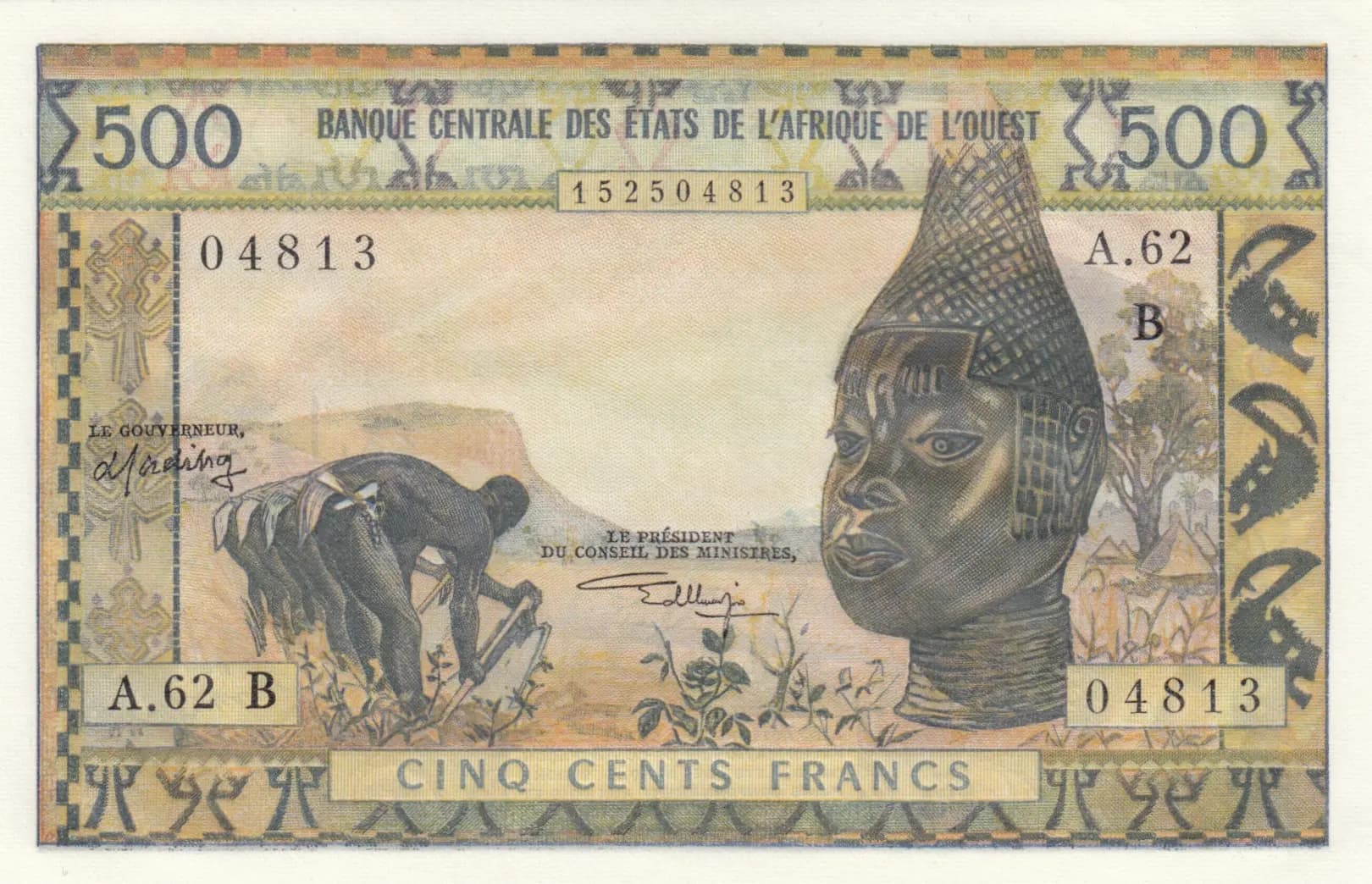
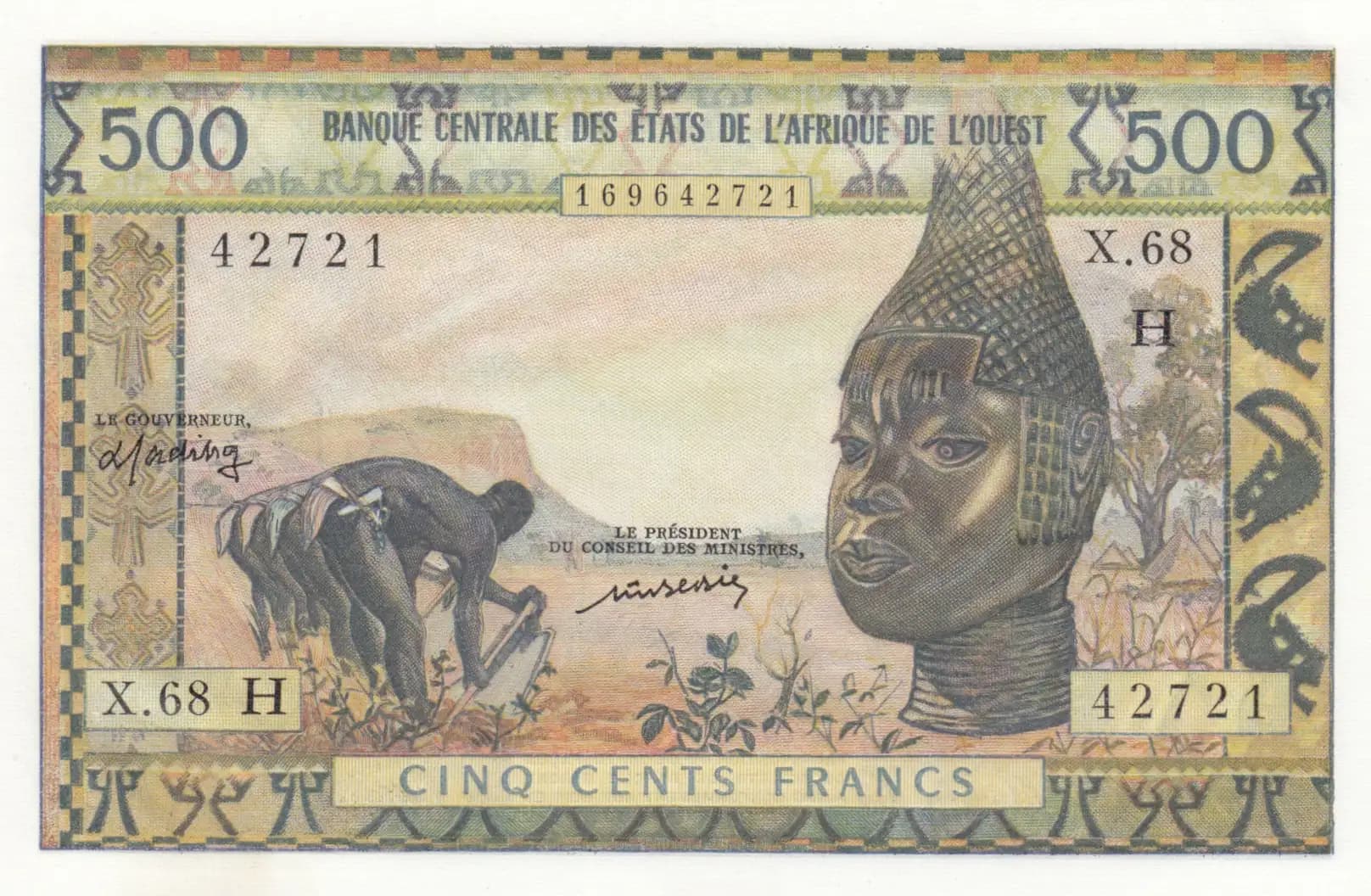
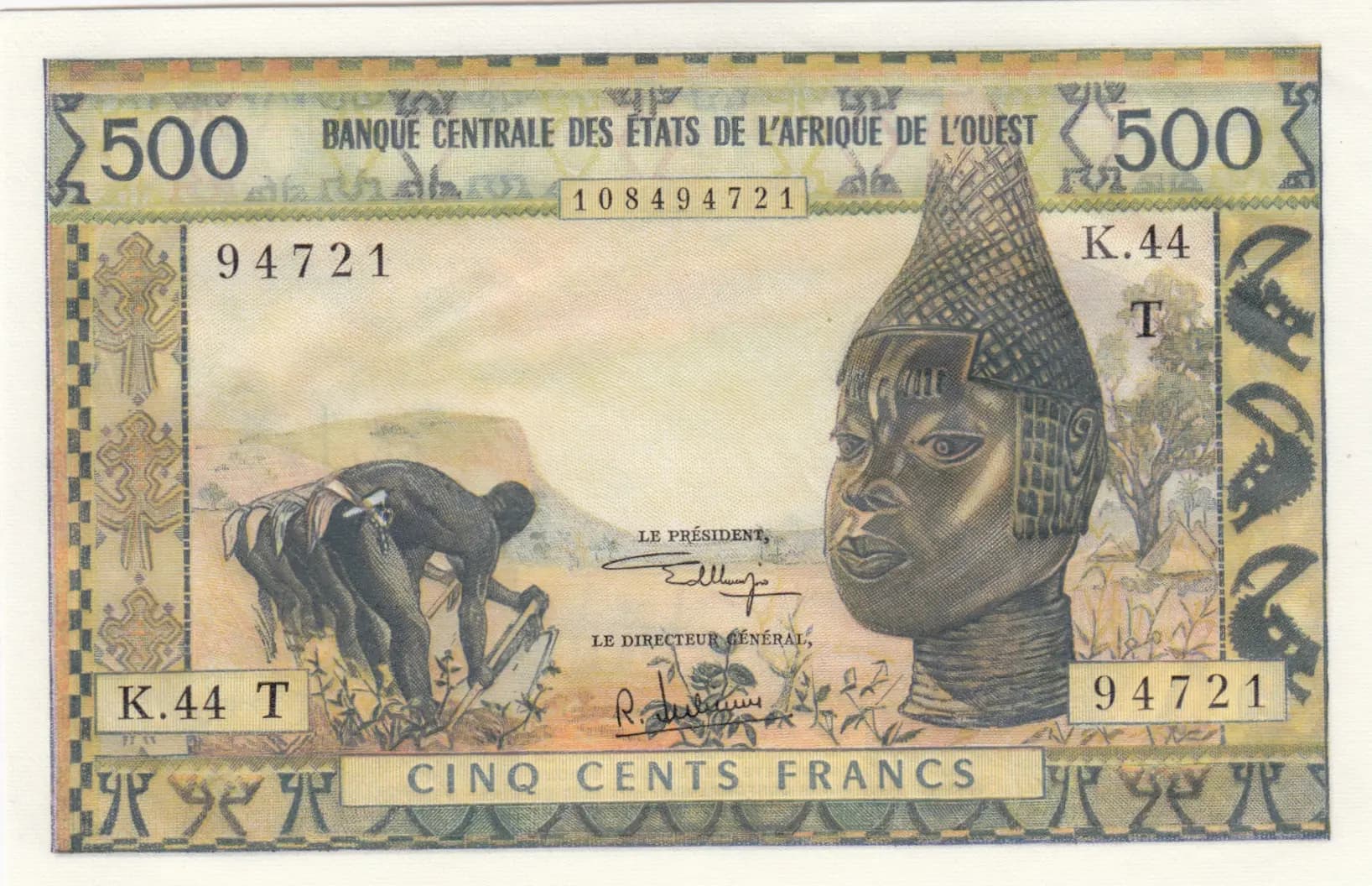
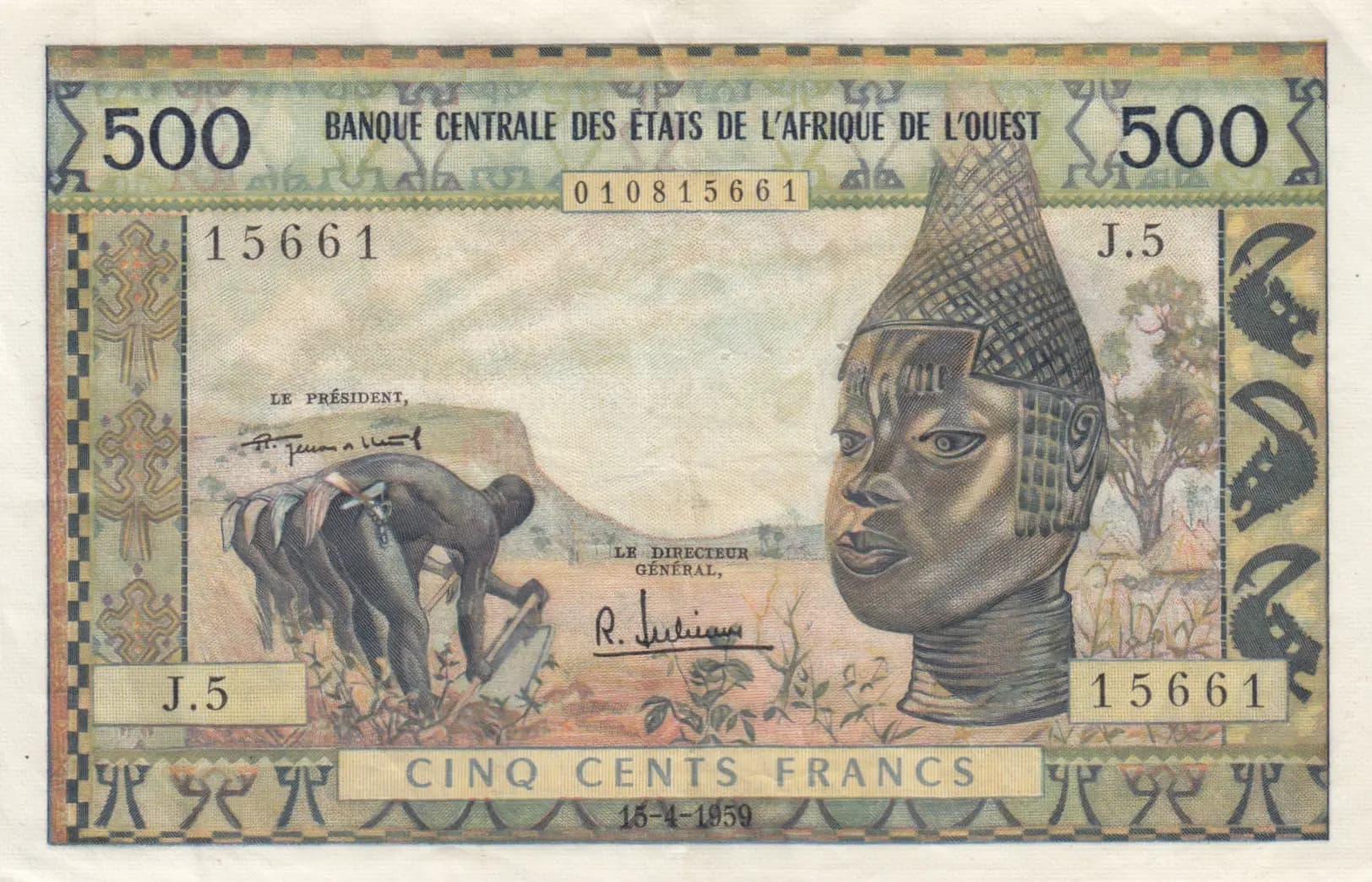
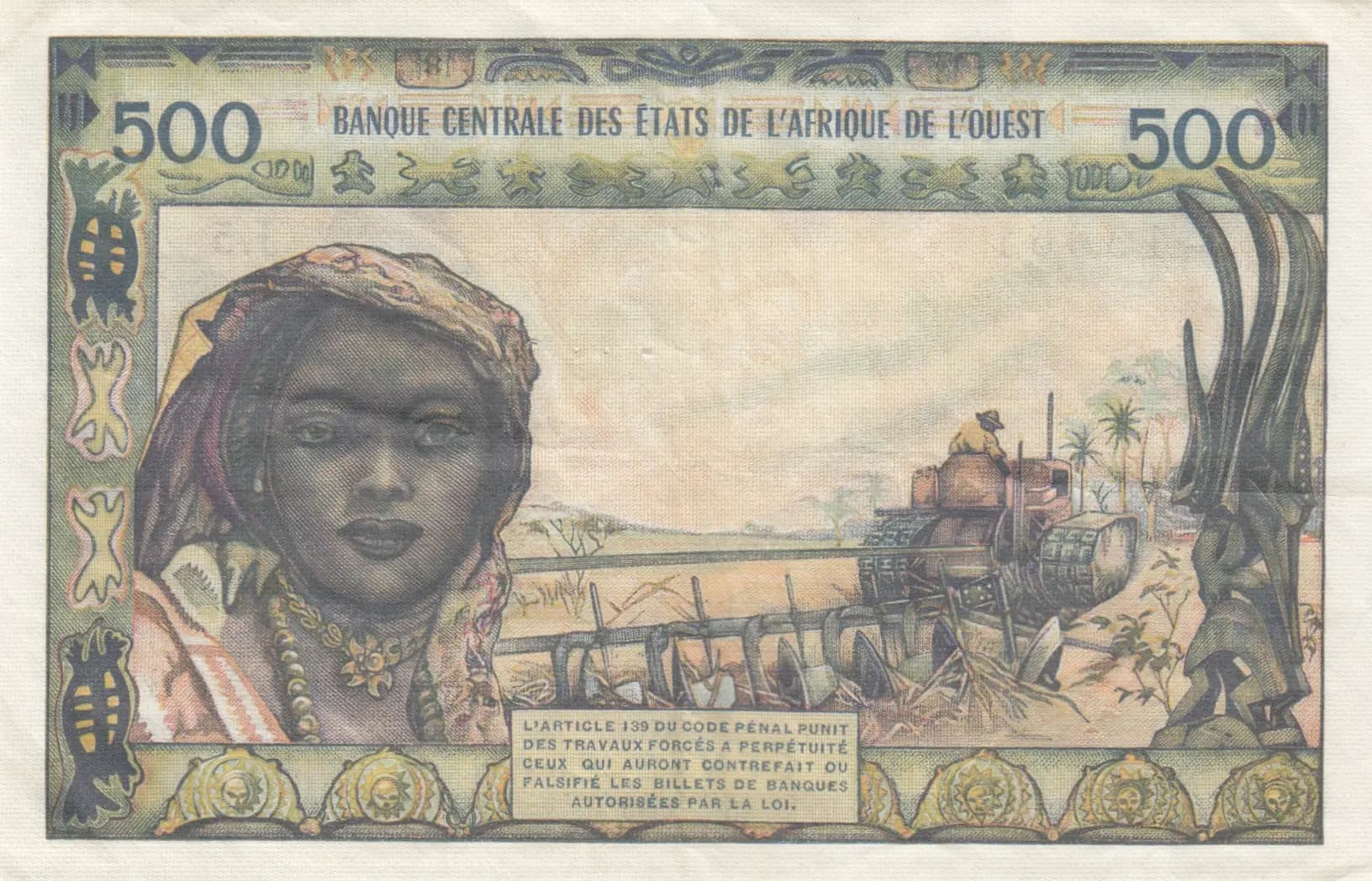
A 1959 West African States 500 Francs note (Pick P-3) in Very Fine condition, featuring distinctive colonial-era imagery reflecting the early post-independence period of the newly established Banque Centrale des Etats de l'Afrique de l'Ouest. The obverse displays a working figure and a sculptural African head (the cast bronze altar head of Iyoba, Queen Mother of Benin), while the reverse depicts an African woman in traditional dress alongside a steam locomotive in an agricultural landscape. Despite modest aging patina and minor creasing consistent with its age, the note retains good color registration and fine engraving details.
Common. The 500 Francs Pick P-3 from 1959 is a standard regular issue from the initial emission of the Banque Centrale des Etats de l'Afrique de l'Ouest. No evidence suggests a limited print run, early recall, or supply scarcity. The denomination, while not the lowest issued, was a standard circulation note. In VF condition, this note is readily available in the collector market and does not command premium pricing. PMG records show multiple varieties graded, including notes without code letters (P-3s), further indicating healthy supply levels across different variants.
Issued on April 15, 1959, this note represents a pivotal moment in West African monetary history, marking the creation of the Central Bank of the West African States following the political reorganization of French West Africa. The imagery deliberately celebrates African cultural heritage (the Benin bronze head of Iyoba) alongside symbols of colonial-era modernization (the locomotive and mechanized agriculture), reflecting the transitional ideology of the period. The note's design emphasizes both African identity and development narratives that dominated the immediate post-colonial narrative in the region.
The obverse features a laborer in a crouched working position on the left, symbolizing productive labor and agricultural development, paired on the right with a sculptural portrait head in profile—specifically the cast bronze altar head representing Iyoba (Queen Mother of Benin), a prominent historical African figure. Decorative geometric patterns frame both sides of the composition, with the issuer name and denomination prominently displayed. The reverse presents a portrait of an African woman in profile wearing traditional dress with a wrapped head covering and beaded necklaces, positioned on the left, while the right side depicts a colonial-era steam locomotive in a landscape with palm trees and cultivated fields, symbolizing technological progress and agricultural modernization. The note employs a cream/beige base with green and brown decorative borders, brown geometric margins, and accents of purple/mauve and gold tones, creating a warm, dignified aesthetic appropriate to the institutional and cultural significance of the issuing authority.
FRONT: '500' (denomination), 'BANQUE CENTRALE DES ETATS DE L'AFRIQUE DE L'OUEST' (Central Bank of the West African States), 'CINQ CENTS FRANCS' (Five Hundred Francs), 'LE PRÉSIDENT' (The President), 'LE DIRECTEUR GÉNÉRAL' (The Director General), '15-4-1959' (April 15, 1959 - issue date), serial numbers '01081561' and '15661', code designation 'J.5'. BACK: '500' (denomination repeated), 'BANQUE CENTRALE DES ÉTATS DE L'AFRIQUE DE L'OUEST' (Central Bank of the West African States), 'L'ARTICLE 139 DU CODE PÉNAL PUNIT DES TRAVAUX FORCÉS À PERPÉTUITÉ CEUX QUI AURAIENT CONTREFAIT OU FALSIFIÉ LES BILLETS DE BANQUES AUTORISÉES PAR LA LOI' (Article 139 of the Penal Code punishes with perpetual forced labor those who would have counterfeited or falsified banknotes authorized by law).
Intaglio (fine line engraving) combined with multi-color letterpress printing. The fine line engraving is evident in the detailed portraiture, the complex decorative guilloche patterns, and the ornamental borders. The security features include serial number printing in multiple locations and sophisticated color layering with gradation effects. These characteristics are consistent with high-security banknote production standards of the late 1950s, likely produced by a European security printer such as the Banque de France's printing facility or similar contract printer specializing in colonial African currency.
The observed specimen displays code designation 'J.5', indicating a specific printing lot or signature variety within the P-3 issue. The PMG population report documents P-3s (500 Francs without Code Letter) as a cataloged variety, suggesting that code letter variants exist. The note's serial number '01081561' and date of '15-4-1959' align with the stated issue date. No evidence of overprints or unusual varieties is apparent from the visual analysis; this appears to be a standard example of the base issue without the variants noted in PMG records (such as P-306Ca or P-310Cd which represent different code letter designations for the same denomination).