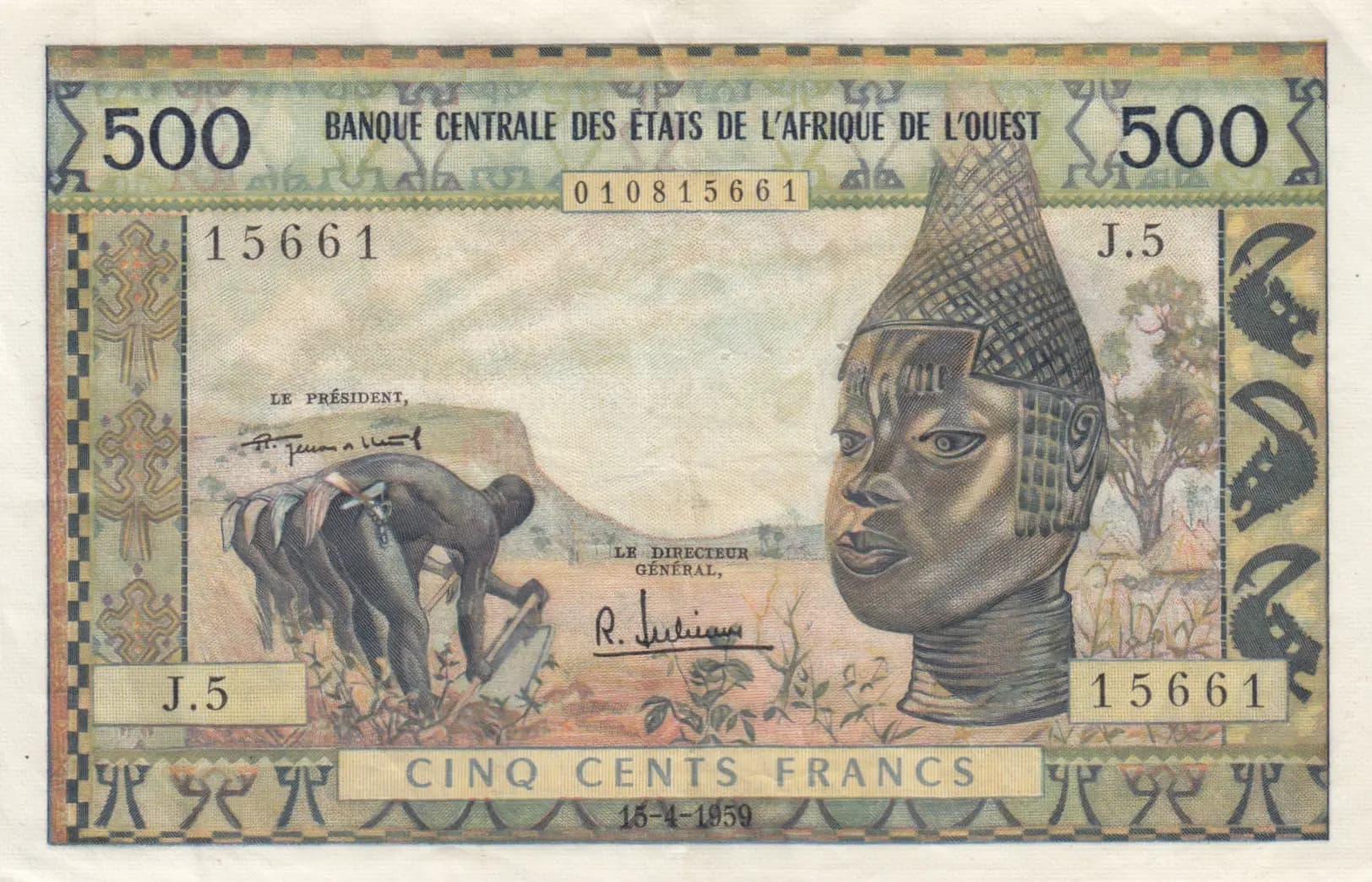
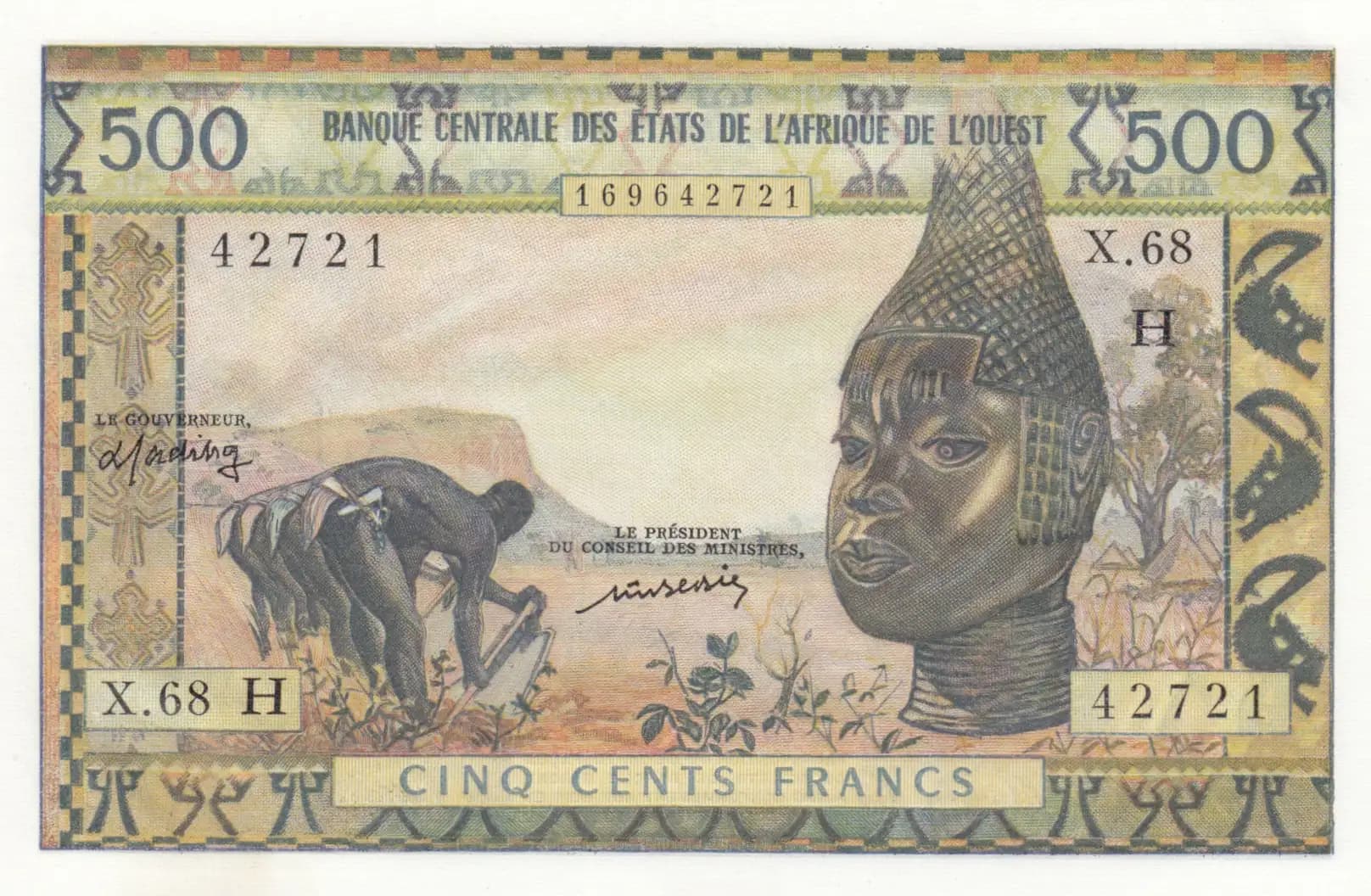
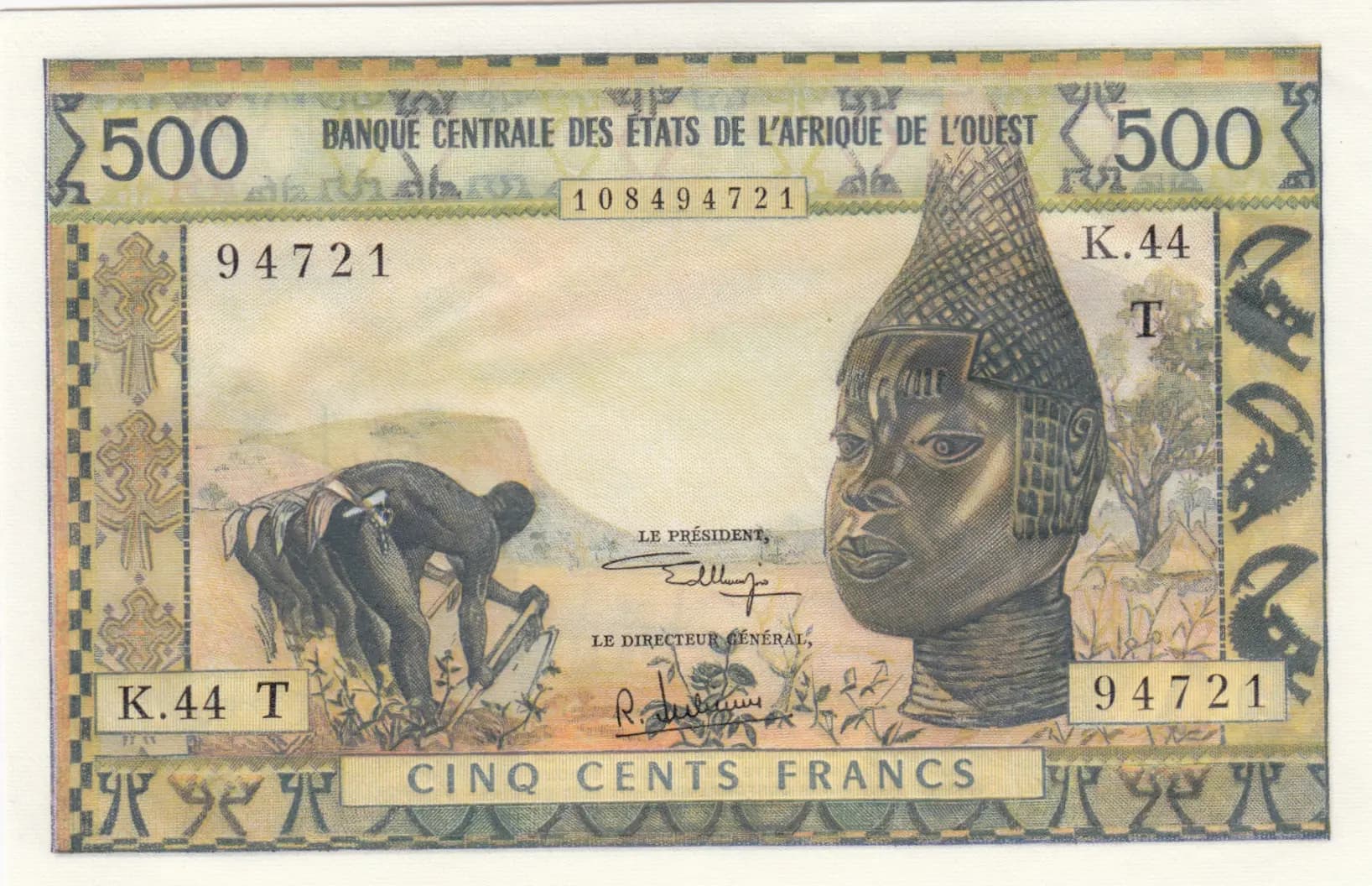
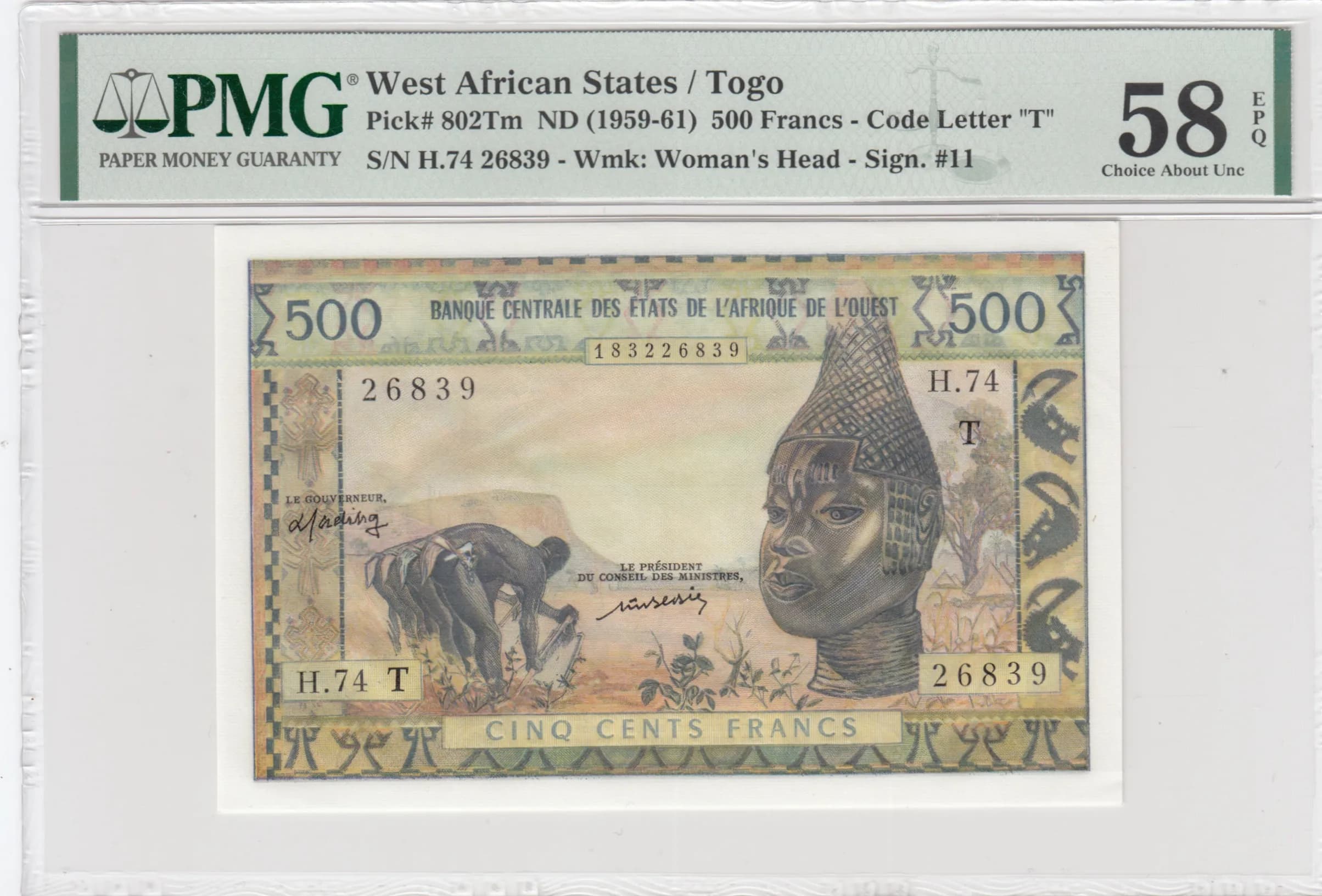
500 francs 1959
“Benin”
About This Note
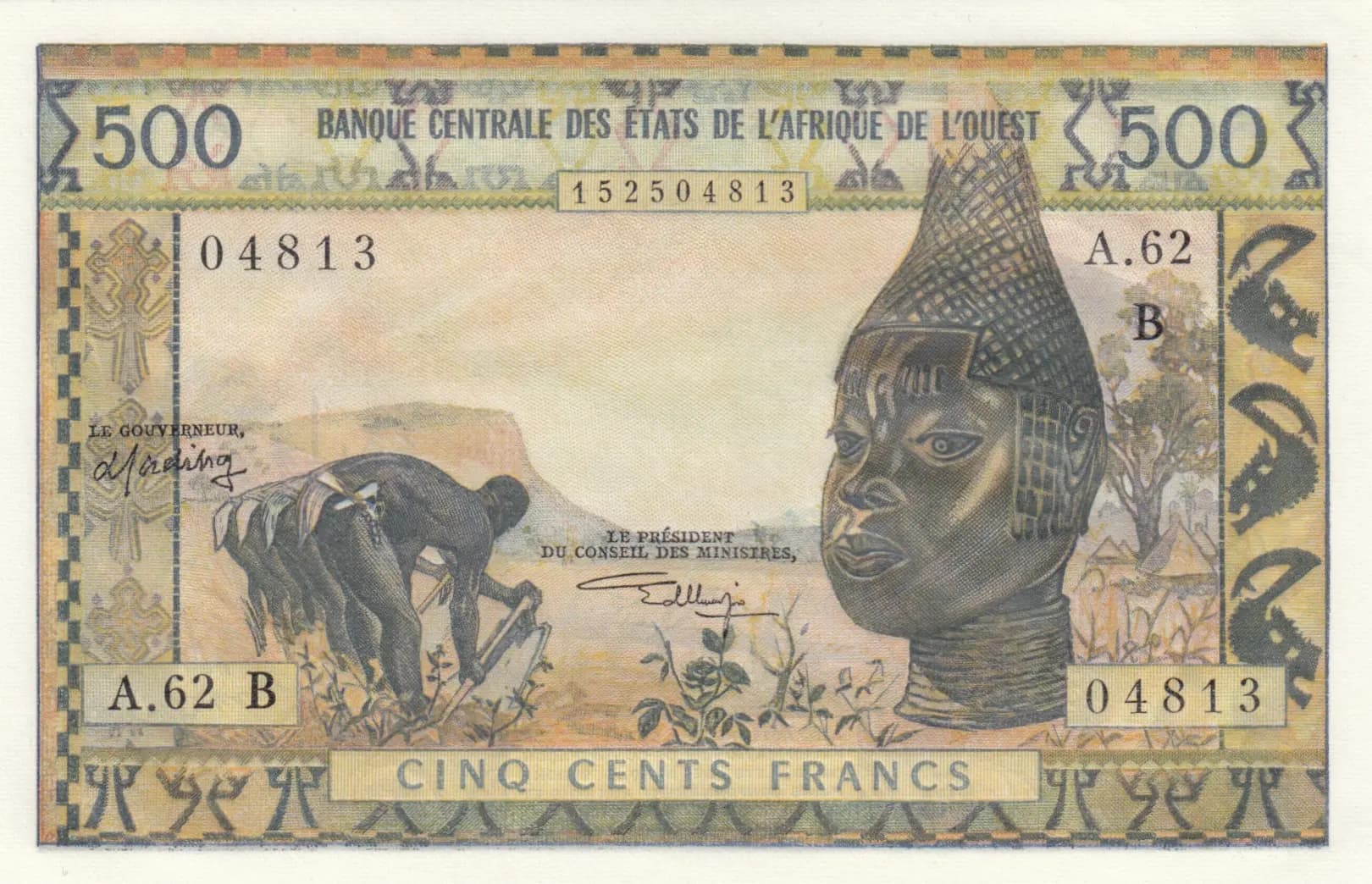
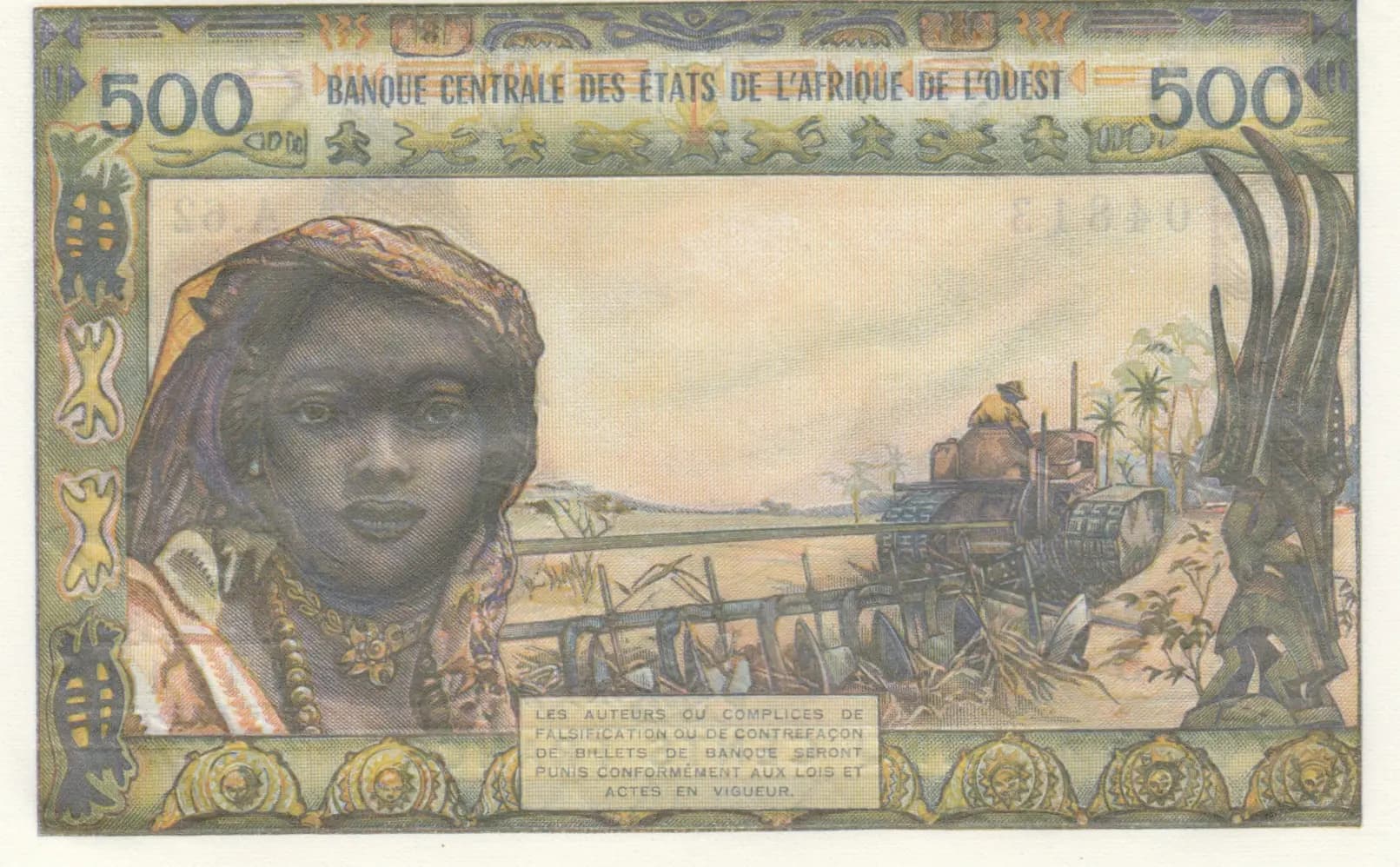
This 1959 West African States 500 francs note (Pick P-202Bk) presents a classically composed colonial-era banknote in circulated condition with visible foxing and age-related patina throughout. The obverse features an African sculptural mask and a laboring figure set against a savanna landscape, while the reverse depicts a woman in traditional dress alongside a steam locomotive and agricultural scene—imagery that captures the economic and cultural identity of post-independence West Africa. Despite moderate wear consistent with circulation, the note retains legible inscriptions and intact security features, making it a representative example of early BCEAO currency.
Common. The 500 francs denomination from the 1959 BCEAO issue represents a standard circulation note from a major West African monetary authority with substantial print runs. Code Letter 'B' examples are documented in PMG's population reports as standard variants, indicating regular production and survival rates. Circulated specimens in typical condition appear regularly in the numismatic market at modest valuations consistent with common 20th-century African banknotes. The note's age and moderate wear do not elevate rarity, as many examples from this era survive in similar condition.
Issued by the Banque Centrale des États de l'Afrique de l'Ouest (Central Bank of West African States) in 1959, this note marks the transitional period following French West African independence. The depicted imagery—featuring African artistic traditions via the sculptural mask, indigenous labor practices, and industrial progress symbolized by the locomotive and palm plantations—reflects the post-colonial narrative of modernization and cultural affirmation. The dual signature lines for Governor and President of the Council of Ministers reinforce the institutional authority of the newly independent monetary system.
The obverse showcases a sculptural African mask with elaborate headdress and distinctive carved facial features positioned on the right, symbolizing West African cultural heritage, paired with a bent-over laboring figure on the left representing manual agricultural work. The background depicts an earth-toned savanna landscape in warm browns and tans. The reverse features a woman rendered in profile wearing a traditional head wrap and beaded neck ornaments, exemplifying regional dress traditions. Dominating the center-right is a colonial-era industrial scene depicting a steam locomotive with billowing smoke, tropical palm trees, and field workers—imagery emphasizing the economic development narrative of the period. Ornamental borders composed of geometric patterns, floral designs, and cross-hatched elements frame both sides, with decorative circular medallions anchoring the lower portions. The color palette throughout consists of tans, beiges, browns, grays, yellows, and muted blues, creating a cohesive aesthetic appropriate to mid-20th-century African currency design.
FRONT SIDE: '500' and 'CINQ CENTS FRANCS' (Five Hundred Francs) — denomination markings; 'BANQUE CENTRALE DES ÉTATS DE L'AFRIQUE DE L'OUEST' (Central Bank of West African States) — issuer identification; 'LE GOUVERNEUR' (The Governor) and 'LE PRÉSIDENT DU CONSEIL DES MINISTRES' (The President of the Council of Ministers) — signature line identifications; 'A.62 B' — series and letter designation; '04813' and '15250481' — serial numbers. BACK SIDE: '500' and 'BANQUE CENTRALE DES ÉTATS DE L'AFRIQUE DE L'OUEST' (Central Bank of West African States) — denomination and issuer; 'LES AUTEURS OU COMPLICES DE FALSIFICATION OU DE CONTREFAÇON DE LA PRESENTE BANKNOTE SERONT PUNIS CONFORMEMENT AUX LOIS ET ACTES EN VIGUEUR' (The authors or accomplices of falsification or counterfeiting of this banknote shall be punished in accordance with the laws and acts in force) — legal warning; 'CD10' — printing designation.
This note was produced using traditional intaglio engraving and letterpress printing methods characteristic of 1950s banknote production. The fine line work visible in the border patterns, facial details of the portraits, and background scenes demonstrates skilled engraving. The multiple color variations and shading effects were achieved through multi-plate printing processes. The BCEAO notes of this period were typically produced by established European security printers; the 'CD10' designation on the reverse likely indicates the printing works or production batch code. The serial numbers appear in both standard black ink and yellow/orange band printing, representing separate print passes.
This specimen is catalogued as Pick P-202Bk, identified by the code letter 'B' visible on the obverse ('A.62 B'). PMG's population data indicates documented variants P-202Bh and P-202Bl, also bearing Code Letter 'B', suggesting multiple printings within the 'B' series. The serial number prefix 'A.62' combined with the 'B' letter designation establishes this note's specific variety within the 1959 issue. The specific serial number '15250481' and '04813' would further distinguish this individual note, though no signature varieties are apparent in the available visual data.