2 dollars 1963
About This Note
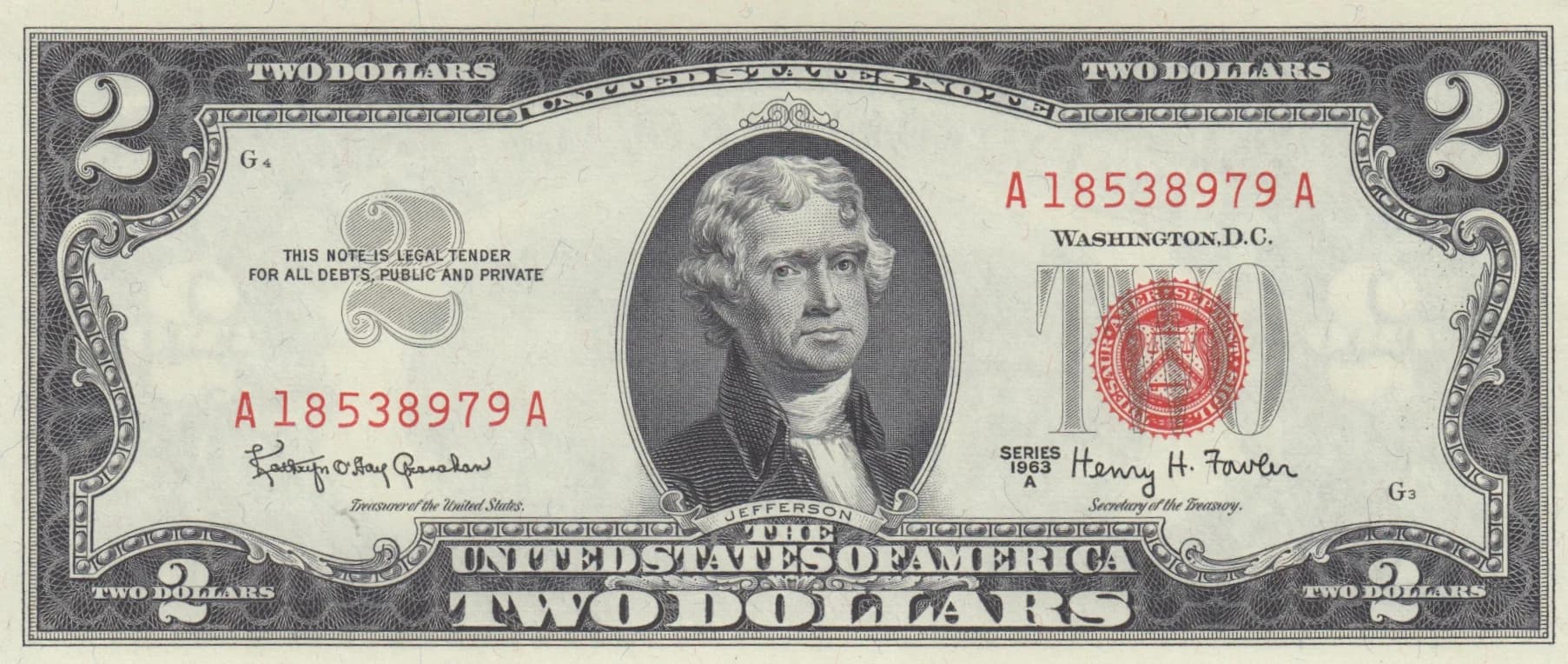
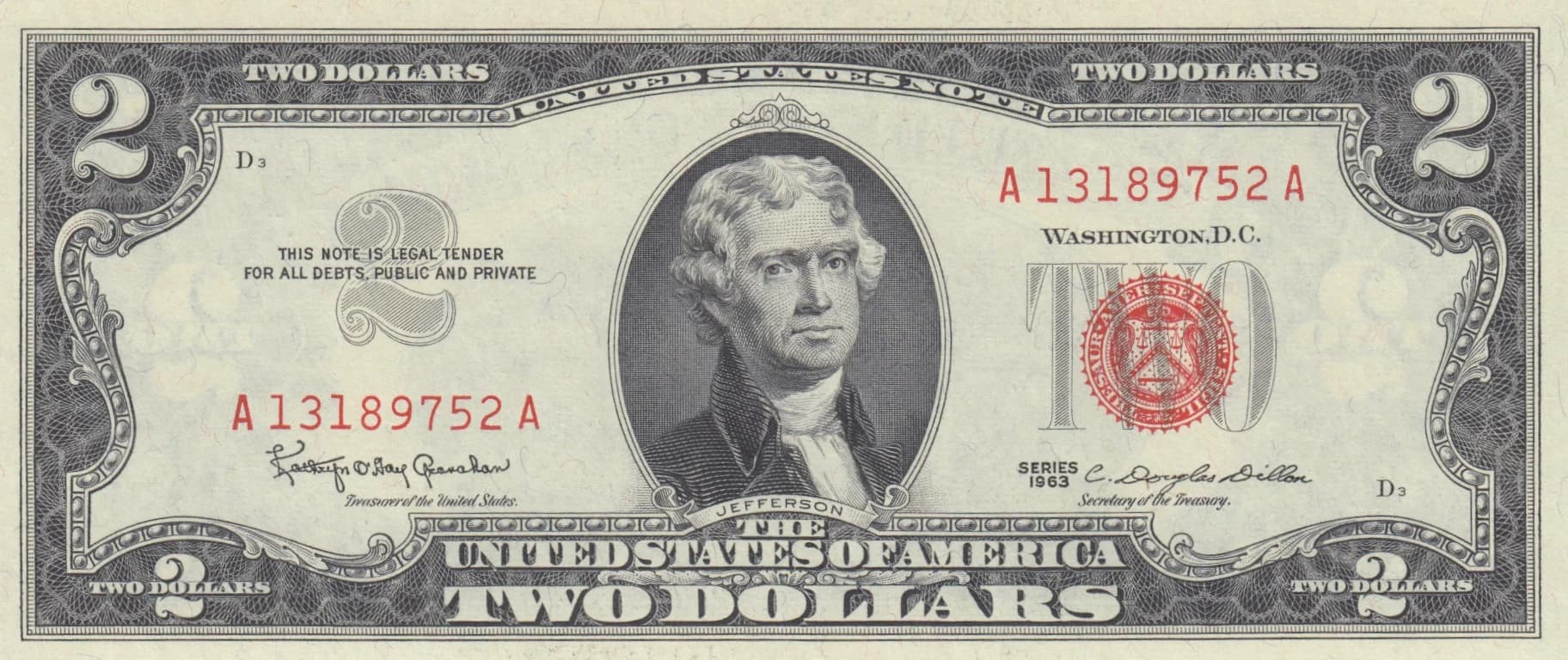
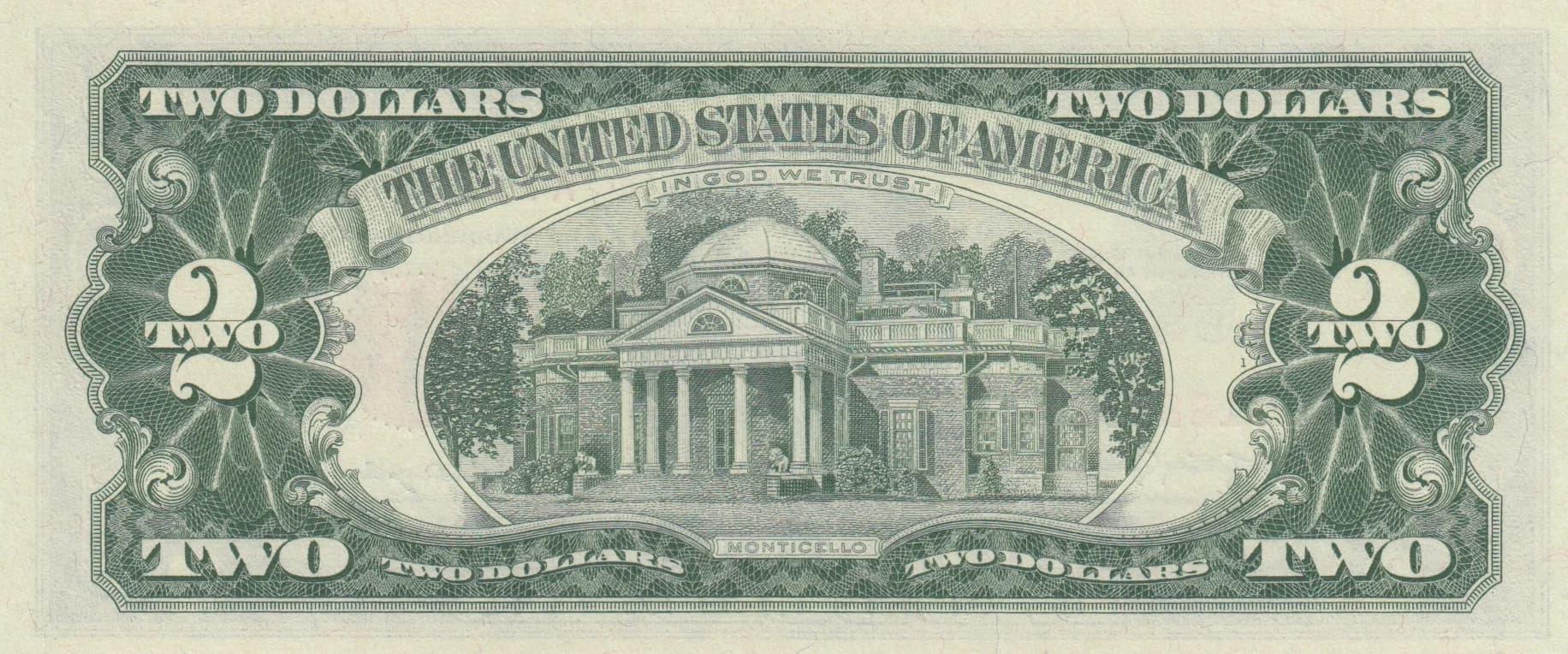
A well-preserved 1963 Series $2 bill featuring Thomas Jefferson on the obverse and Monticello on the reverse, both rendered in classic Bureau of Engraving and Printing style. The note exhibits excellent condition consistent with UNC grading, displaying crisp printing, sharp detail definition, and no visible wear, creasing, or tears. This denomination and series represents a historically significant period in American currency production, with the red Treasury Seal and period-appropriate signatures of Kathryn O'Hay Connally (Treasurer) and C. Douglas Dillon (Secretary of the Treasury) clearly visible.
Common. The 1963 Series $2 bill represents standard production by the U.S. Treasury with no known restricted print runs, special issues, or recall circumstances. While $2 bills are less frequently circulated than other denominations, the 1963 Series is not scarce or rare in numismatic terms. Large quantities remain in collectors' hands and institutional holdings. UNC condition examples are readily available in the secondary market at modest premiums above face value.
The 1963 Series $2 bill was issued during the Kennedy administration, a time when the U.S. Treasury continued producing this denomination despite its limited circulation. The signatures of Treasury officials Connally and Dillon reflect the fiscal leadership of this era, while the continued commemoration of Thomas Jefferson and his Monticello residence maintained the classical iconography established for this denomination. The red Treasury Seal visible on the obverse represents the standard security feature of notes from this period, preceding the later security enhancements implemented in subsequent decades.
The obverse features a formal portrait of Thomas Jefferson positioned in a centered oval frame, rendered in fine-line engraving with classical proportions and high collar formal attire. Jefferson faces slightly left in the traditional style established for this denomination. The reverse showcases an architectural rendering of Monticello, Jefferson's neoclassical residence in Charlottesville, Virginia, depicted with meticulous detail including the characteristic dome, classical columns, and surrounding landscape elements. Both sides are framed by ornate decorative scrollwork and botanical designs typical of mid-20th century U.S. currency production. The color palette consists of black and gray engraving on the obverse with a red Treasury Seal, while the reverse employs green and black printing on cream-colored paper stock.
Front Side: 'UNITED STATES OF AMERICA' - Country of issue; 'TWO DOLLARS' - Denomination; 'SERIES 1963' - Issue year and series designation; 'JEFFERSON' - Portrait identification; 'WASHINGTON, D.C.' - Location of issue; 'THIS NOTE IS LEGAL TENDER FOR ALL DEBTS, PUBLIC AND PRIVATE' - Legal tender statement; Serial number 'A13189752 A' - Individual note identifier; 'Kathryn O'Hay Connally' - Signature of Treasurer of the United States; 'C. Douglas Dillon' - Signature of Secretary of the Treasury. Back Side: 'THE UNITED STATES OF AMERICA' - Country identification; 'TWO DOLLARS' / 'TWO' - Denomination; 'IN GOD WE TRUST' - National motto; 'MONTICELLO' - Identification of the depicted landmark.
Intaglio engraving (line engraving) performed by the Bureau of Engraving and Printing, utilizing steel plates with fine-line detail work characteristic of American currency production in the 1960s. The intricate border designs, portrait rendering, and architectural detail of Monticello demonstrate the high-quality engraving standards maintained during this period. The note exhibits the sharp, crisp impressions and fine detail definition that distinguish authentic Bureau of Engraving and Printing production from this era.
Pick catalog number P-382a denotes the 1963 Series with red Treasury Seal. This note exhibits the standard signatures of Kathryn O'Hay Connally (Treasurer, 1961-1965) and C. Douglas Dillon (Secretary of the Treasury, 1961-1965), which are the characteristic signatures for this series. Serial number prefix 'A' indicates standard production from the primary issue sequence. No unusual overprints, experimental markings, or rare variety characteristics are evident from the visual inspection.