10 dollars 1901
About This Note
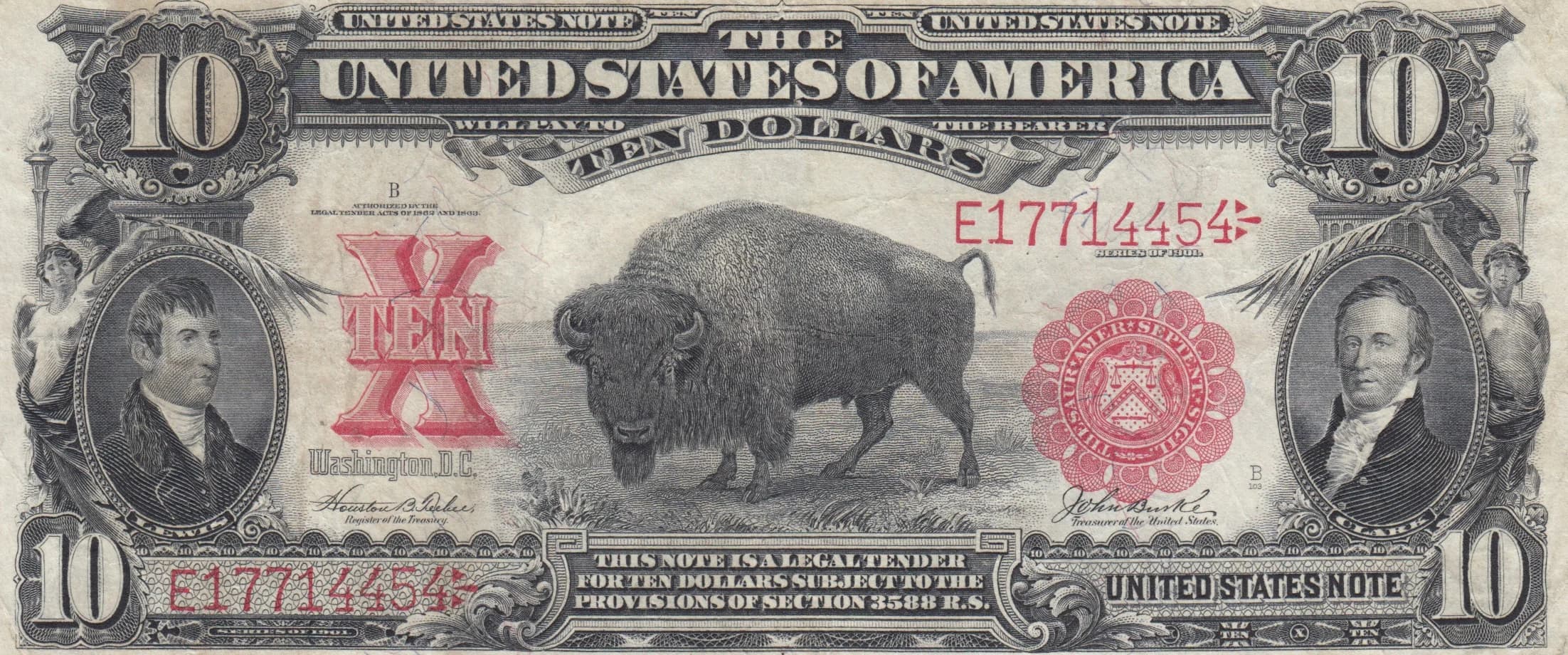
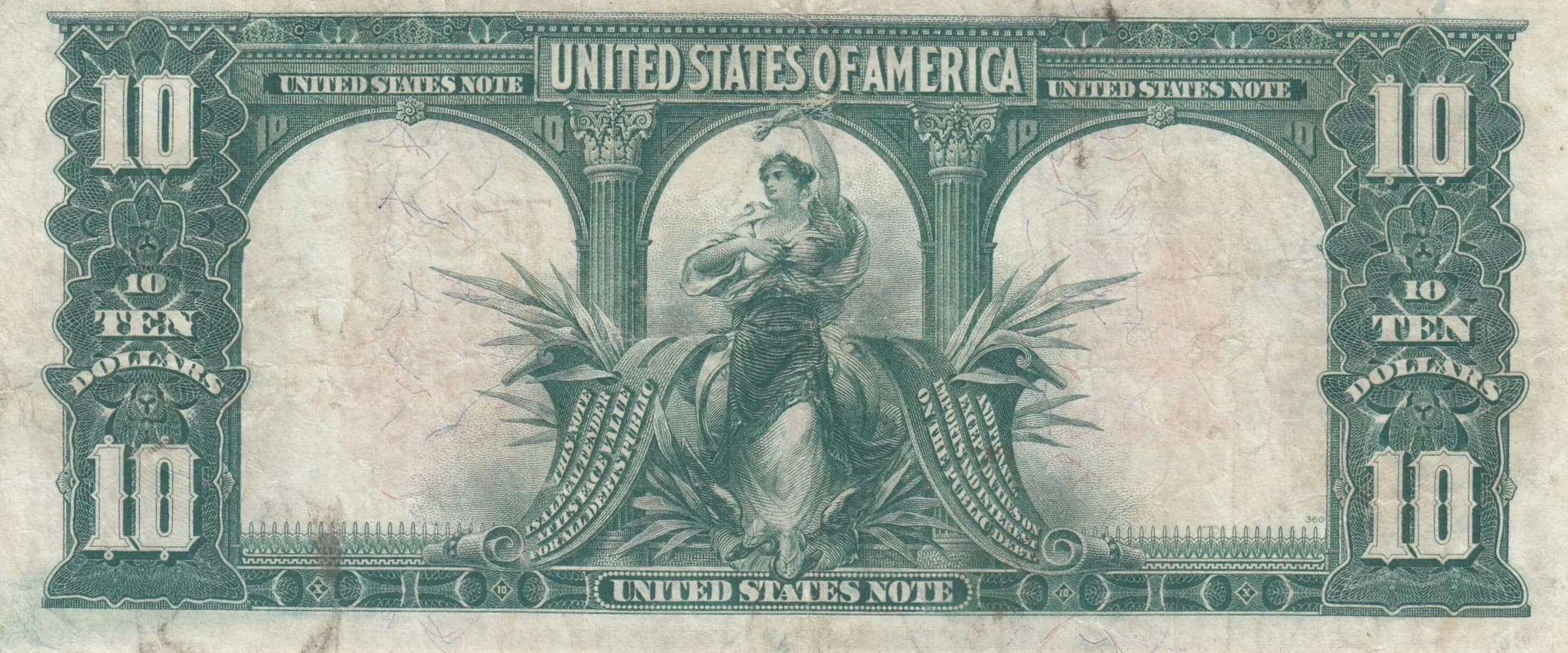
This is a 1901 United States $10 Note (Pick P-185) in VF condition, displaying the iconic bison design on the obverse and allegorical Liberty figure on the reverse. The note exhibits the characteristic red and black inks on the front with green on the back, typical of this issue, along with visible age-appropriate wear including creasing, foxing, and paper discoloration consistent with early 20th-century circulation. The serial number E17714454 is clearly visible in red ink, and the note remains a popular collector item representing the American bison series.
Common. The 1901 $10 United States Note is a widely available note in the collector market, with substantial print runs characteristic of this denomination and period. Notes in VF condition are regularly encountered in numismatic commerce at moderate prices reflecting their common status.
Issued in 1901 as a United States Note redeemable in gold, this $10 denomination exemplifies the monetary policy of the McKinley era when the gold standard was firmly established. The bison depicted on the obverse references American frontier heritage and westward expansion, while the reverse features a classical allegorical figure representing Liberty with shield and sword, symbolizing national strength and democratic values during the early Progressive Era. The note's inscription explicitly states redemption in gold on demand at the Treasury or Federal Reserve Banks, reflecting the pre-Federal Reserve monetary system and the legal tender status of United States Notes.
The obverse features a central American bison (buffalo) flanked by two portrait medallions containing male figures in formal period attire, with the denomination '10' displayed prominently in all four corners. Ornamental designs and a distinctive red X with decorative geometric center seal dominate the composition, rendered in red and black inks on a cream background. The reverse displays a classical allegorical figure representing Liberty or Minerva in the center, draped in classical garments and holding both a shield and sword, symbolizing national defense and protection. She is flanked by wheat or palm fronds and decorative architectural columns, with the numeral '10' repeated in all four corners, rendered primarily in green ink. Both sides feature intricate fine-line engraving and geometric border patterns characteristic of high-security currency production of the period.
FRONT SIDE: 'UNITED STATES OF AMERICA' / 'THE UNITED STATES NOTE' / 'TEN DOLLARS' / 'WILL PAY TO THE BEARER' / 'Washington D.C.' / Serial number 'E17714454' / 'THIS NOTE IS A LEGAL TENDER FOR TEN DOLLARS AND IS REDEEMABLE IN GOLD ON DEMAND AT THE TREASURY OF THE UNITED STATES IN WASHINGTON D.C. OR AT ANY FEDERAL RESERVE BANK NOTE ISSUED UNDER THE PROVISIONS OF SECTION 3588 R.S.' BACK SIDE: 'UNITED STATES OF AMERICA' / 'UNITED STATES NOTE' / 'TEN' / 'DOLLARS' (All inscriptions are in English as printed; the front contains the primary legal tender declaration while the back repeats the denomination and issuer identification with ornamental numerals in all four corners).
This note was produced using steel-plate intaglio engraving and letterpress printing, the standard security printing method for United States currency in 1901. The dual-color printing on the obverse (red and black) and the green printing on the reverse were accomplished through separate pass printing. The intricate fine-line patterns, geometric designs, and ornamental elements visible throughout the note demonstrate the sophisticated anti-counterfeiting techniques of the Bureau of Engraving and Printing, which produced all U.S. currency during this period.
Serial number E17714454 indicates this note was printed by the Bureau of Engraving and Printing. The prefix 'E' denotes a standard production batch from this era. No major varieties (such as significant overprints, signature variations, or printing errors) are evident from the visual analysis. This appears to be a standard issue example of the 1901 $10 United States Note without notable variety characteristics that would distinguish it from the typical print run.