2 dollars 1963A
About This Note
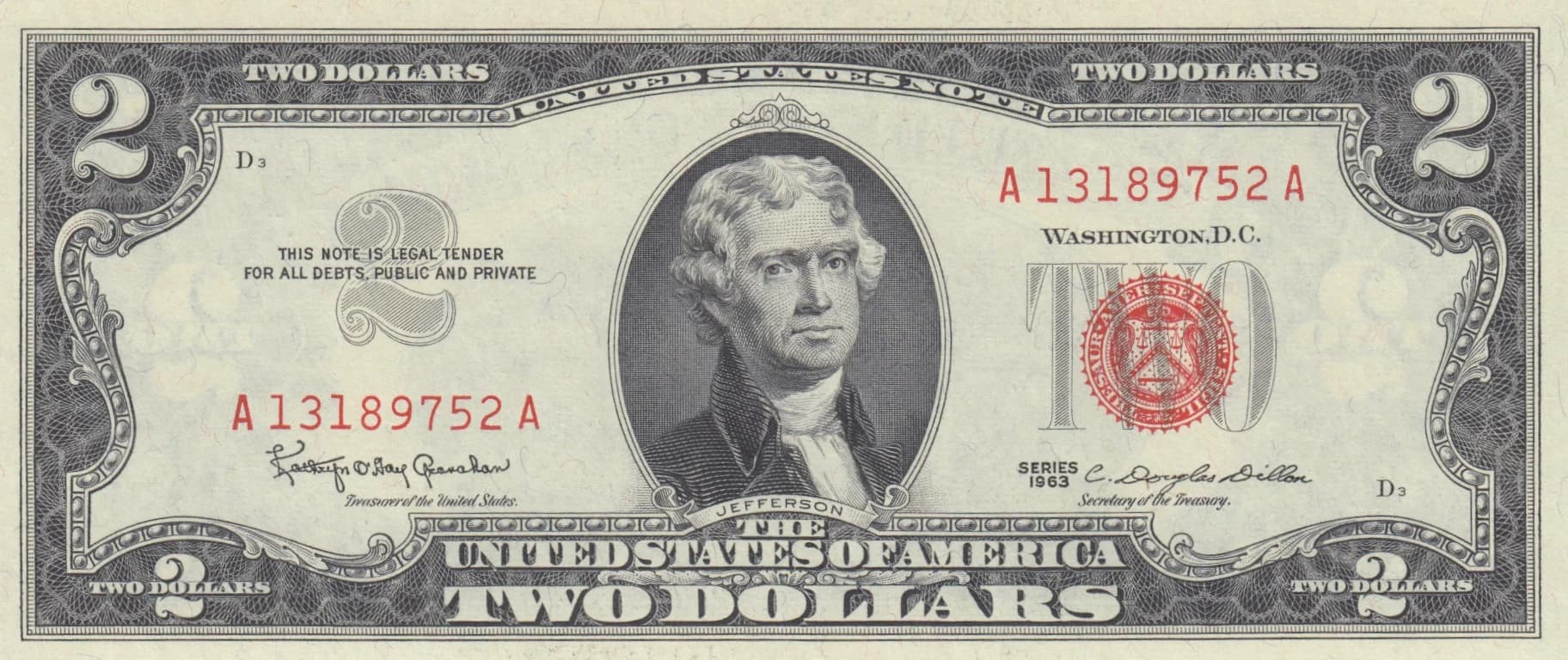
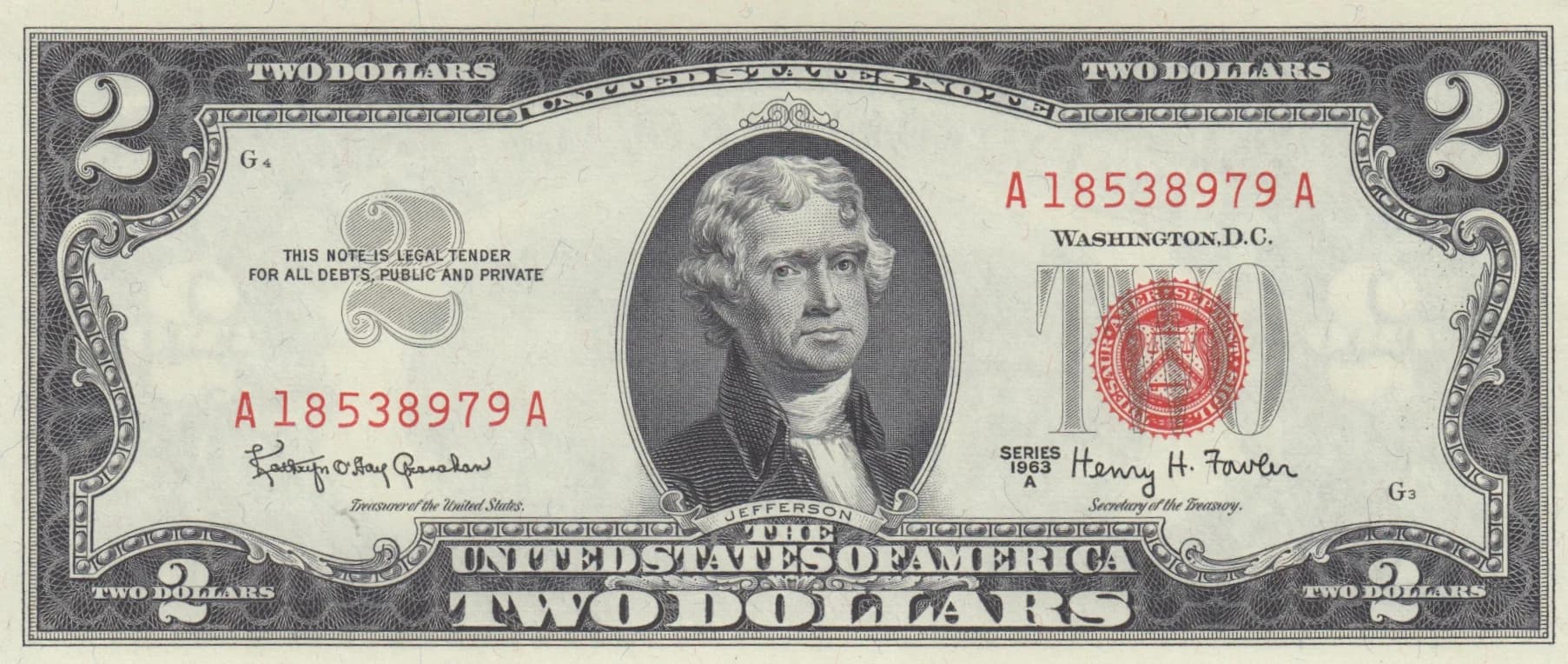
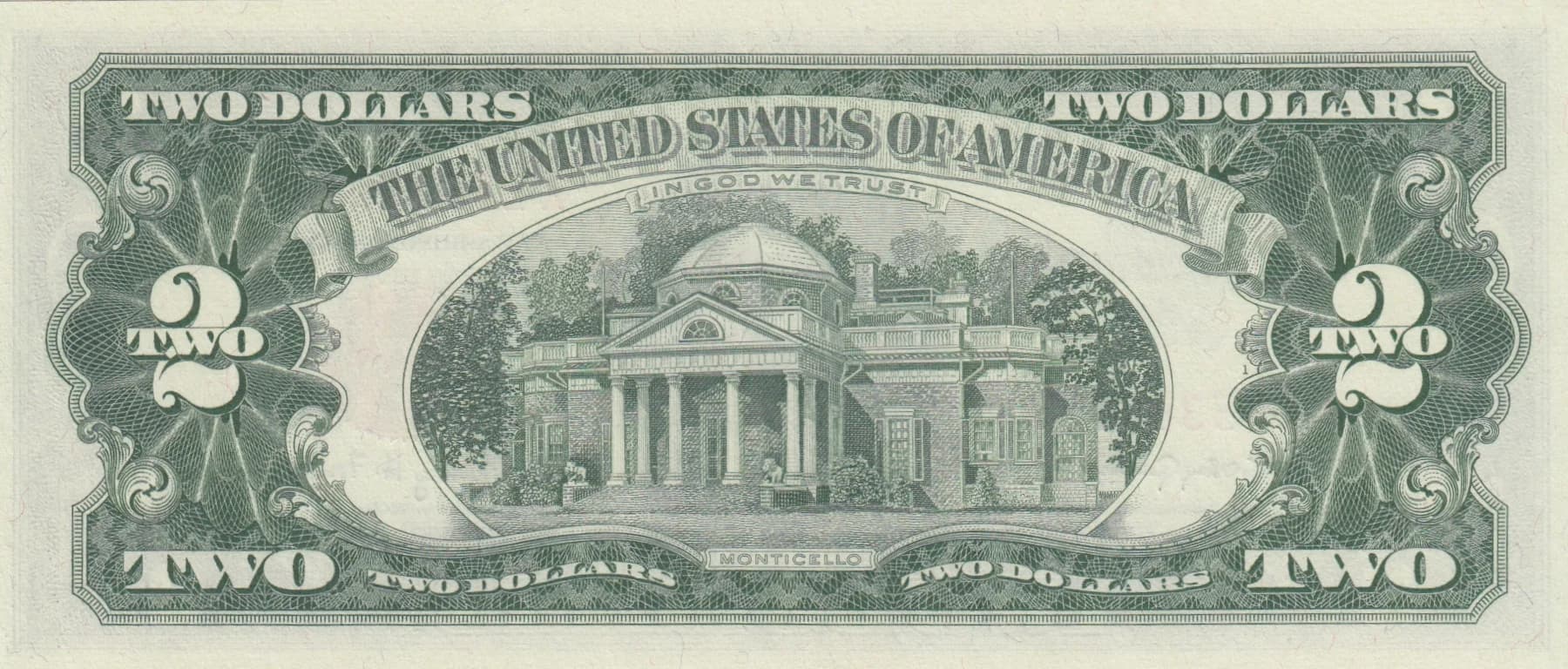
This is an uncirculated 1963A Series A $2 bill featuring Thomas Jefferson on the obverse and his residence Monticello on the reverse, both rendered in classic intaglio engraving. The note displays exceptional preservation with sharp, crisp details throughout, no visible wear or creasing, and excellent color rendering in red on the front and green on the back. As a $2 bill from the early post-1963 series with signatures of Treasurer Kathryn O'Hay Granahan and Secretary Henry H. Fowler, this represents an interesting intermediate issue between the original 1963 series and later printings.
common. The 1963A $2 bill is widely available in all grades. Print runs for $2 bills, while lower than higher denominations, were still substantial, and this series was not recalled or removed from circulation prematurely. Uncirculated examples are readily obtainable through numismatic channels, typically commanding modest premiums over face value rather than representing significant collector premiums. The signatures of Granahan-Fowler and Series A designation do not represent scarce varieties within the broader 1963A issue.
The 1963A $2 bill was issued during the Kennedy administration under Treasury Secretary Henry H. Fowler, featuring the signature of Treasurer Kathryn O'Hay Granahan, who served during a period of significant changes in U.S. currency design and security practices. The choice to feature Thomas Jefferson and his neoclassical masterpiece Monticello reflects America's reverence for Enlightenment ideals and architectural achievement during the height of Cold War-era American confidence. The 'Series A' designation indicates this was among the first printings following the original 1963 issue, making it part of the transitional currency designs of the early 1960s.
The obverse presents a formal portrait of Thomas Jefferson in left profile, rendered within an ornate oval frame and surrounded by elaborate scrollwork and geometric border designs. The portrait captures Jefferson in classical formal attire with distinctive collar, following the traditional presentation style for U.S. currency. The reverse features an architectural engraving of Monticello, Jefferson's neoclassical mansion, depicted with its characteristic central dome, columned portico, and surrounding landscape of trees, creating a balanced and aesthetically sophisticated composition. The design employs the red Treasury Department seal with eagle and shield on the obverse, along with ornamental corner numerals '2' on both sides. The fine-line engraving technique creates the characteristic texture and depth visible throughout both sides, with red ink domination on the front and green ink on the reverse, typical of $2 bills of this era.
FRONT SIDE: 'TWO DOLLARS' (denomination, appears multiple times); 'THIS NOTE IS LEGAL TENDER FOR ALL DEBTS, PUBLIC AND PRIVATE' (standard legal tender declaration); 'JEFFERSON' (portrait identification); 'UNITED STATES OF AMERICA' (national identification); 'WASHINGTON, D.C.' (issuing location); 'SERIES A' (series designation); 'DEPARTMENT OF THE TREASURY' (issuing authority); Signatures of Kathryn O'Hay Granahan (Treasurer of the United States) and Henry H. Fowler (Secretary of the Treasury); '1963' (issue year); Serial number 'A 18538979 A'; 'G4' and 'G3' (plate position markers). BACK SIDE: 'TWO DOLLARS' (denomination, appears multiple times); 'THE UNITED STATES OF AMERICA' (national identification); 'IN GOD WE TRUST' (national motto); 'MONTICELLO' (landmark identification).
Intaglio (engraved) printing on currency paper with security features including fine-line engraving precision, red Treasury seal in intaglio, and detailed architectural rendering. The note was produced by the Bureau of Engraving and Printing (BEP) using their standard multi-color intaglio process, with separate passes for red ink (obverse) and green ink (reverse), combined with black overprinting for text and portraits. The sharp registration and crisp detail observed in the UNC specimen indicates high-quality press work and proper paper stock, consistent with BEP's premium currency production standards of the early 1960s.
This note is identified as Series A with the signature combination of Kathryn O'Hay Granahan (Treasurer) and Henry H. Fowler (Secretary of the Treasury). The serial number format 'A 18538979 A' with the leading and trailing letter indicates standard BEP numbering for this period. The plate position markers 'G3' and 'G4' visible on the obverse indicate specific plates used during printing. Within the 1963A series, notes can vary by signature combination (Granahan-Fowler represents the earlier variety), series letter, and serial number ranges, but these variations are common within the issued population and do not create distinct rarity tiers.