20 kopeek
“Holodomor”
About This Note
This is a historically significant Ukrainian relief note from the early Soviet period, featuring a striking design of a golden wheat sheaf flanked by two purple hands symbolizing collective labor and humanitarian aid. The note bears the inscription 'Gift to the Hungry' (Подарок голодному) and references a Soviet relief organization (АРИМГУБКОМПОМГОЛ), indicating its connection to famine relief efforts. While the visual analysis notes aging and wear consistent with historical storage, the denomination and imagery make this an important artifact documenting Soviet response to the Holodomor crisis.
uncommon to scarce. While Soviet-era notes are generally available, this specific relief issue connected to the Holodomor is not commonly encountered. Relief notes from the famine period were issued in limited quantities for specific charitable purposes and many were not preserved. The 'P-unlisted' designation in Pick suggests it has not been comprehensively cataloged in major reference works, indicating limited collector awareness and circulation among numismatists. The historical significance combined with limited documentation makes this scarcer than standard Soviet fractional currency of the era.
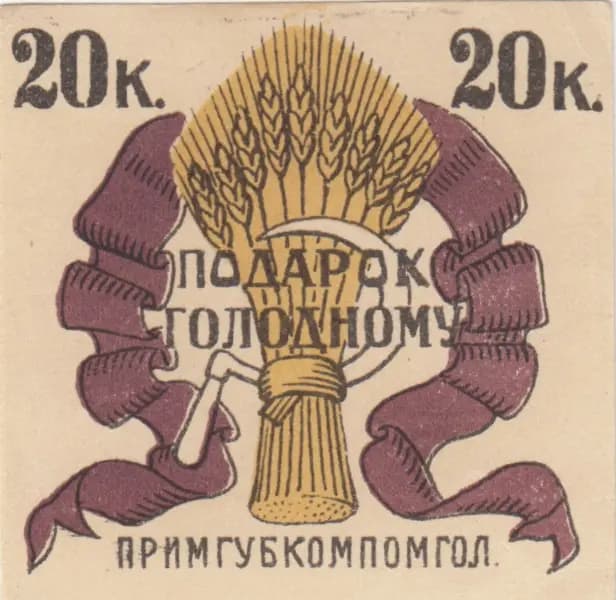
This 20 kopeek note was issued as part of Soviet relief efforts during the catastrophic Holodomor famine of 1932-1933 in Ukraine. The central wheat sheaf—rendered in gold tones—represents both the agricultural resources at the heart of the tragedy and the promise of sustenance, while the two cooperative hands symbolize the collective labor ideology promoted by the Soviet state. The organizational abbreviation and 'Gift to the Hungry' inscription directly reference Soviet famine relief campaigns, making this note a material record of the state's official response to one of the deadliest man-made famines in history.
The obverse features a centered composition dominated by a sheaf of wheat rendered in warm yellow and gold tones, symbolizing agricultural abundance and sustenance. Flanking the sheaf on either side are two purple or maroon-colored hands in gestures of offering or mutual support, representing both manual labor and collective solidarity—core Soviet ideological motifs. Decorative purple ribbons or fabric elements curve around the composition, framing the central design. The denomination '20k.' appears in dark text in both upper corners. The overall design emphasizes themes of agricultural wealth, human cooperation, and state-provided aid during crisis.
Front side: '20k.' (20 kopeks) appears in upper left and upper right corners. Additional inscriptions include 'ПОДАРОК ГОЛОДНОМУ' (Gift to the Hungry / A Gift for the Starving) and 'АРИМГУБКОМПОМГОЛ' (Russian abbreviation, likely standing for a regional Soviet relief committee or aid organization). Back side: Not described in visual analysis provided.
Based on the observed color separation, registration, and the relatively simple but effective color palette (cream background, yellow/gold wheat, purple hands and ribbons, dark text), this appears to be produced using offset lithography or early Soviet letterpress techniques common for charitable/relief notes of the 1932-1933 period. The precision of the wheat sheaf rendering and hand imagery suggests professional government printing facilities rather than emergency or temporary printing.
Marked as 'P-unlisted,' indicating this specific issue is not assigned a Pick catalog number, suggesting it represents either a regional/organizational issue, a supplementary relief note, or a specialized charitable emission not fully documented in major references. The organizational abbreviation 'АРИМГУБКОМПОМГОЛ' may identify a specific regional or provincial relief committee, potentially making this a localized variety. Without additional documentation or provenance, specific variety identification is limited, though the precise organizational marking could differentiate this from other contemporary relief emissions.