2 griven 1918
Market Prices
16 salesAbout This Note
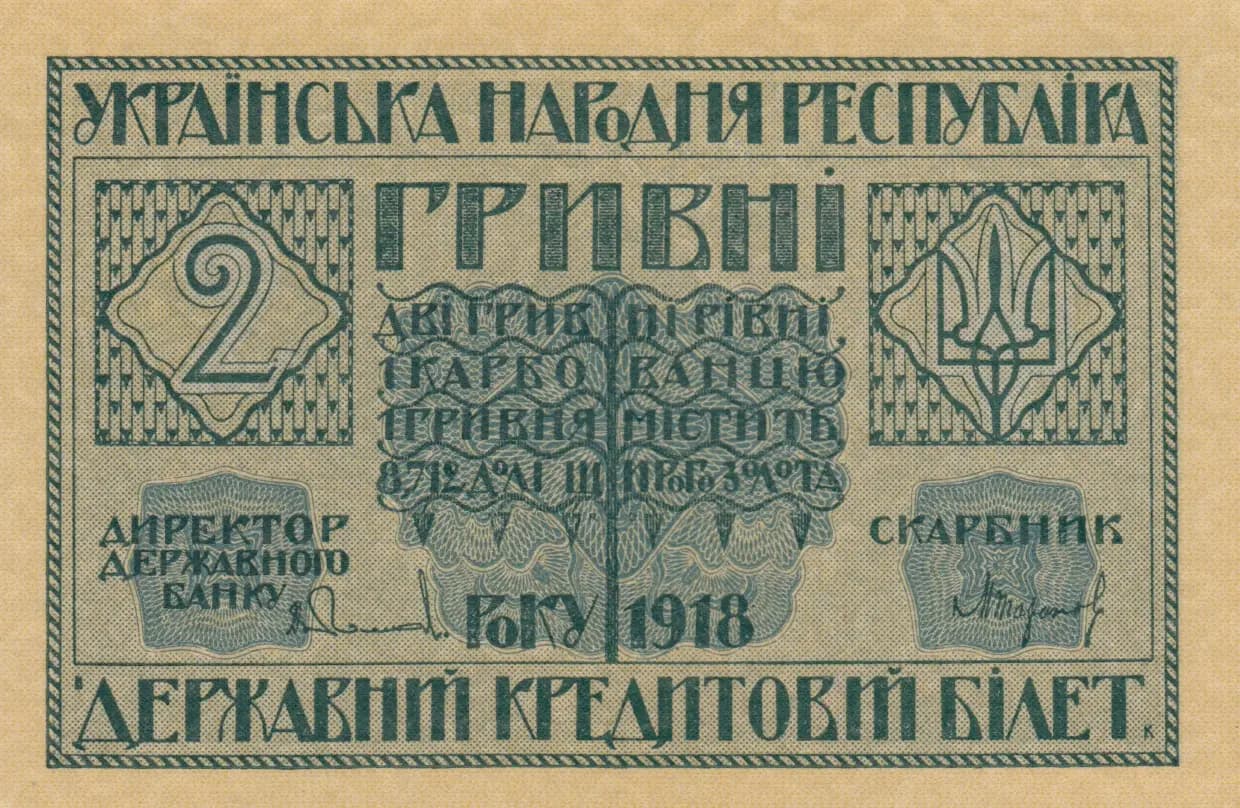
This Ukrainian 2 Hryven note from 1918 is an exceptional example of early Ukrainian monetary history, presented in uncirculated condition with crisp paper and vibrant teal-green engraving on a tan background. The note features intricate ornamental borders and geometric patterns typical of the period's security printing, with clear Cyrillic inscriptions identifying it as issued by the Ukrainian People's Republic. The exceptional preservation and detailed engraving work make this a desirable acquisition for collectors of Eastern European historical currency.
Common. eBay auction data spanning 2014-2022 consistently shows this note selling in the $3.25 to $22.50 range depending on condition, with the vast majority of sales clustered between $5-$15 for circulated to lightly circulated examples. Multiple sales per year indicate ready availability in the market. This 1918 Ukrainian issue was produced in sufficient quantities to satisfy the brief period of circulation during the short-lived Ukrainian People's Republic. No evidence of limited print runs or early recall exists.
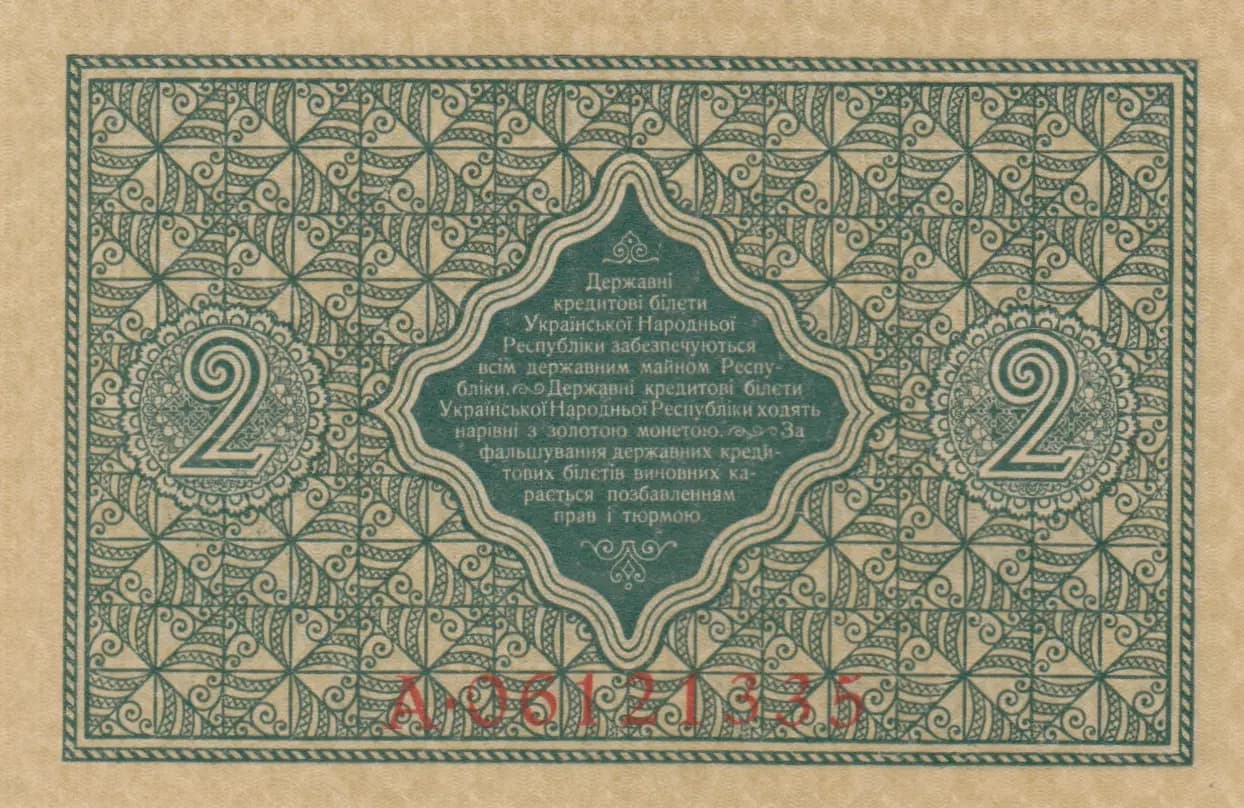
Issued during 1918 by the Ukrainian People's Republic (Українська Народна Республіка), this note represents the tumultuous period following the Russian Revolution when Ukraine briefly declared independence. The inscriptions on the reverse—guaranteeing the note's value against state property and equating it to gold currency—reflect the new nation's attempts to establish monetary credibility amid economic chaos. The severe penalties for counterfeiting noted on the reverse underscore the authorities' desperation to prevent currency fraud during this politically unstable era.
The note employs a classical security-print design eschewing portraiture in favor of elaborate geometric and ornamental elements. The obverse features a symmetrical layout with the denomination '2' in diamond-shaped frames at upper left and right corners. The central design contains a decorative block of Cyrillic text flanked by signature or official stamp areas. The reverse is dominated by an intricate all-over repeating pattern of interlocking spirals and quatrefoil motifs, with a central scallop-edged cartouche containing warranty text. The color scheme—teal-green intaglio printing on tan-beige paper stock—was standard for this series. No specific arms or heraldic symbols are prominently featured despite the catalog reference; the security design relies entirely on the complexity of the geometric engraving.
FRONT: 'УКРАЇНСЬКА НАРОДНА РЕСПУБЛІКА' (Ukrainian People's Republic); 'ГРИВНІ' (Hryvnias); 'РОКУ 1918' (Year 1918); 'ДИРЕКТОР ДЕПАРТАМЕНТУ БАНКО' (Director of the Banking Department); 'СКАРБНИК' (Treasurer); 'ДЕРЖ.КАЗНИ РЕДИЛАСЬ ДЕРЖ. КРЕДИТНОЙ БІЛЕТА' (State Treasury Credit Bill). BACK: 'Державні паперові цінні папери Української Народної Республіки забезпечуються всім державним майном Республіки, с Державної кредитної білетів Української Народної Республіки холять нарівні з золотою монетою. За фальшування державних кредитних білетів виновцівь позбавленням прав і тюрмою.' (State securities of the Ukrainian People's Republic are secured by all state property of the Republic. The state credit bills of the Ukrainian People's Republic are equivalent to gold currency. Counterfeiting of state credit bills results in deprivation of rights and imprisonment); 'ДЕРЖАВНА' (State).
Intaglio engraving (recess printing), the standard security printing method for banknotes of this period. The fine detail, precise line work, and multi-color capability evident in the teal-green on tan-beige printing are characteristic of master engraving typical of established European security printers. The specific printer for this Ukrainian State issue is not definitively documented in standard catalogs, though the quality suggests a professional security house, possibly operating under Ukrainian government contract in 1918.
This specimen is cataloged as Pick P-20a, identified by its yellowish/tan background (as opposed to P-20b, which features a brown background). The two variants represent different paper stock or printing batches rather than significant design changes. Based on visual analysis, this example exhibits the characteristic tan/beige coloring consistent with the P-20a designation. No visible serial numbers, control marks, or signature variations are clearly discernible from the images provided that would indicate further sub-varieties within P-20a.