10 rublei 1917
“Odessa”
About This Note
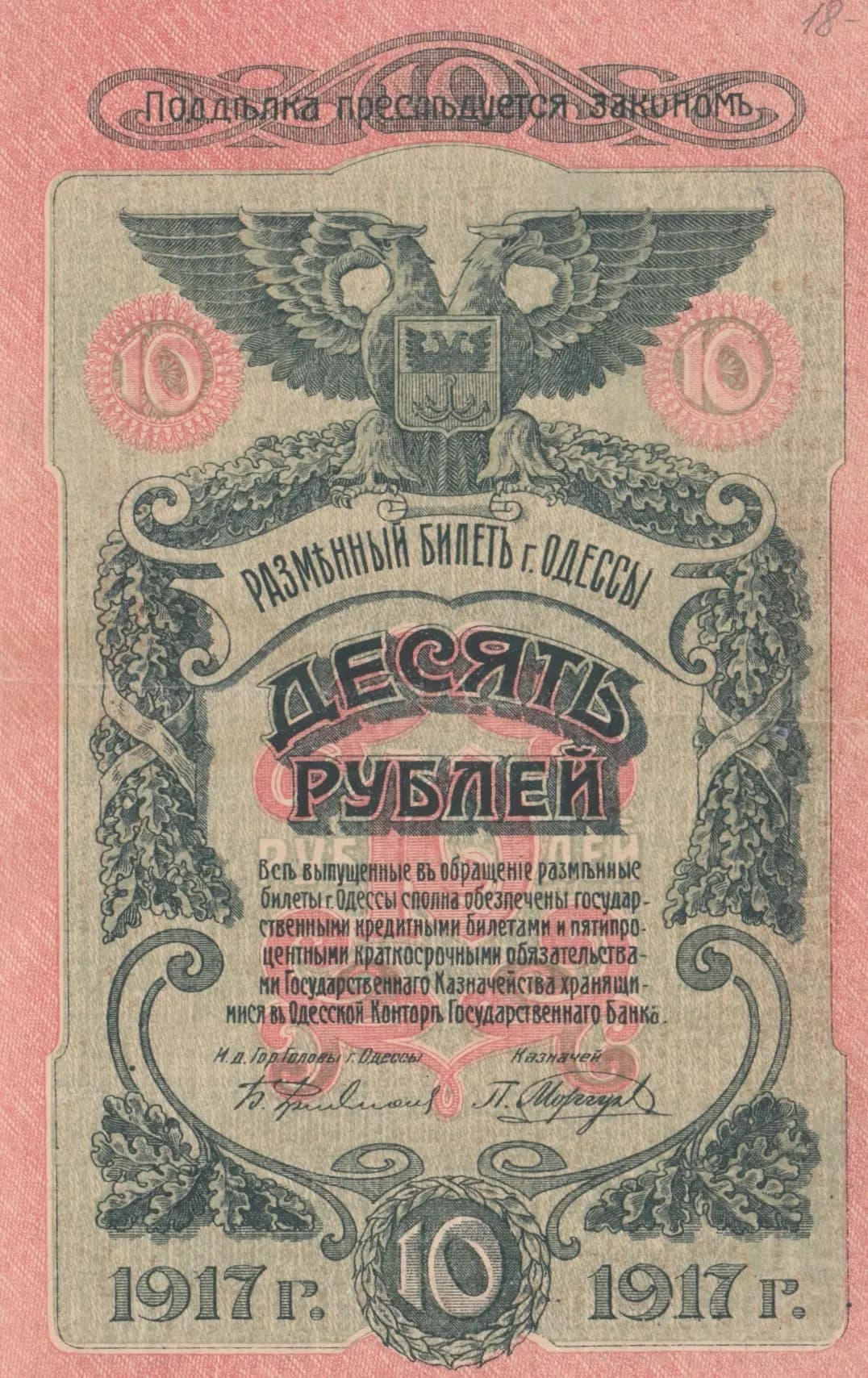
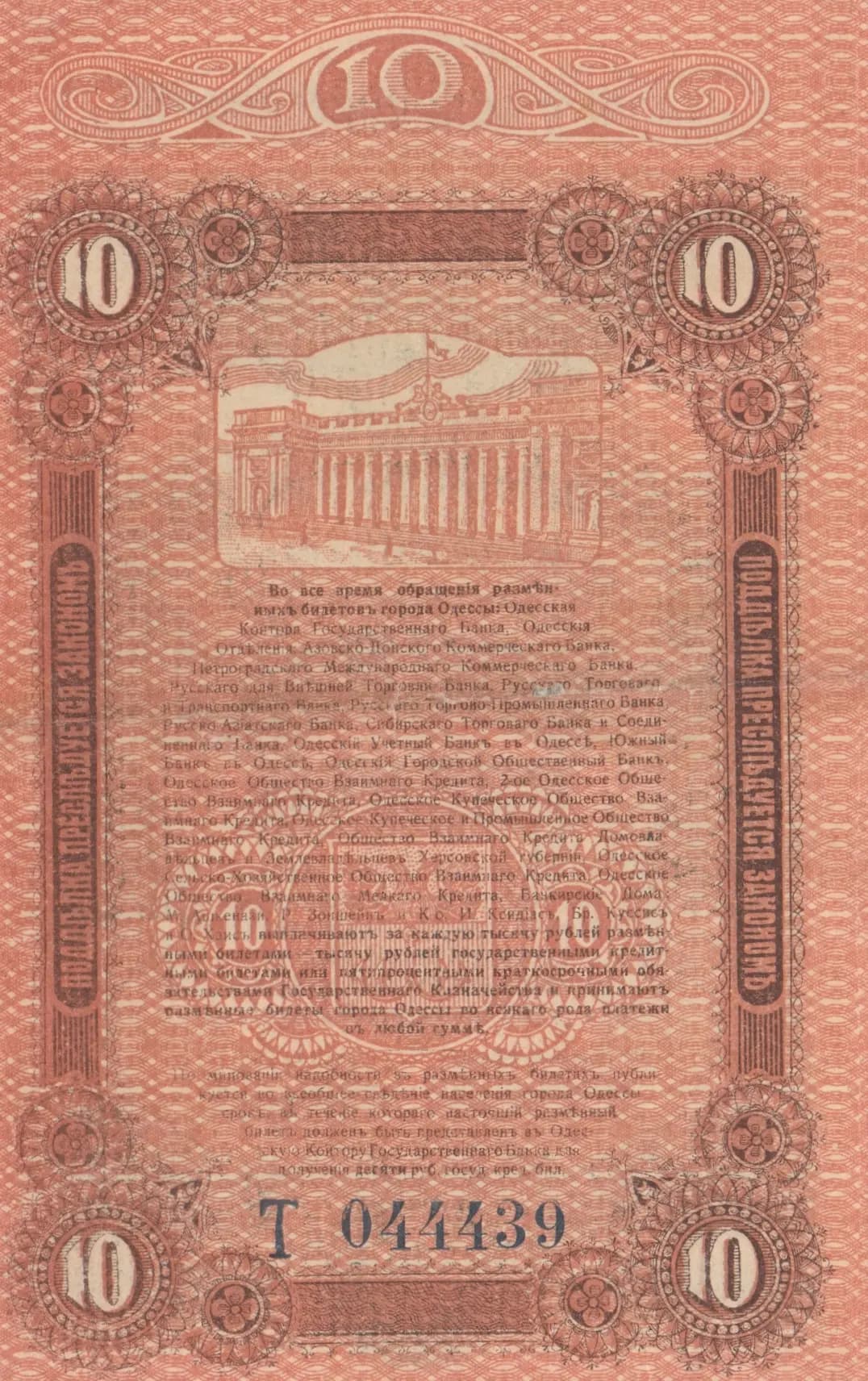
This is an Excellent Condition example of the 10 Rublei emergency currency issued by the Town of Odessa in 1917, featuring a striking pink/rose color scheme with ornate Art Nouveau-influenced engraving. The note displays the characteristic double-headed eagle and classical architecture central to Russian Imperial design, with the front dominated by heraldic imagery and the reverse showcasing an elegant columned building. Despite over a century of age, the note retains sharp design clarity and good color preservation, making it an appealing example of Russian Civil War-era municipal currency.
Common. Odessa's emergency currency was issued in substantial quantities during 1917 to meet local circulation needs during the supply crisis of the Revolution and Civil War period. Municipal notes from major trading centers like Odessa were printed in relatively large runs compared to provincial towns. The Pick catalog listing (P-S336(2)) indicates this is a known and cataloged variety, suggesting adequate surviving examples. No evidence of short print runs, early recall, or exceptional scarcity is apparent from standard philatelic references.
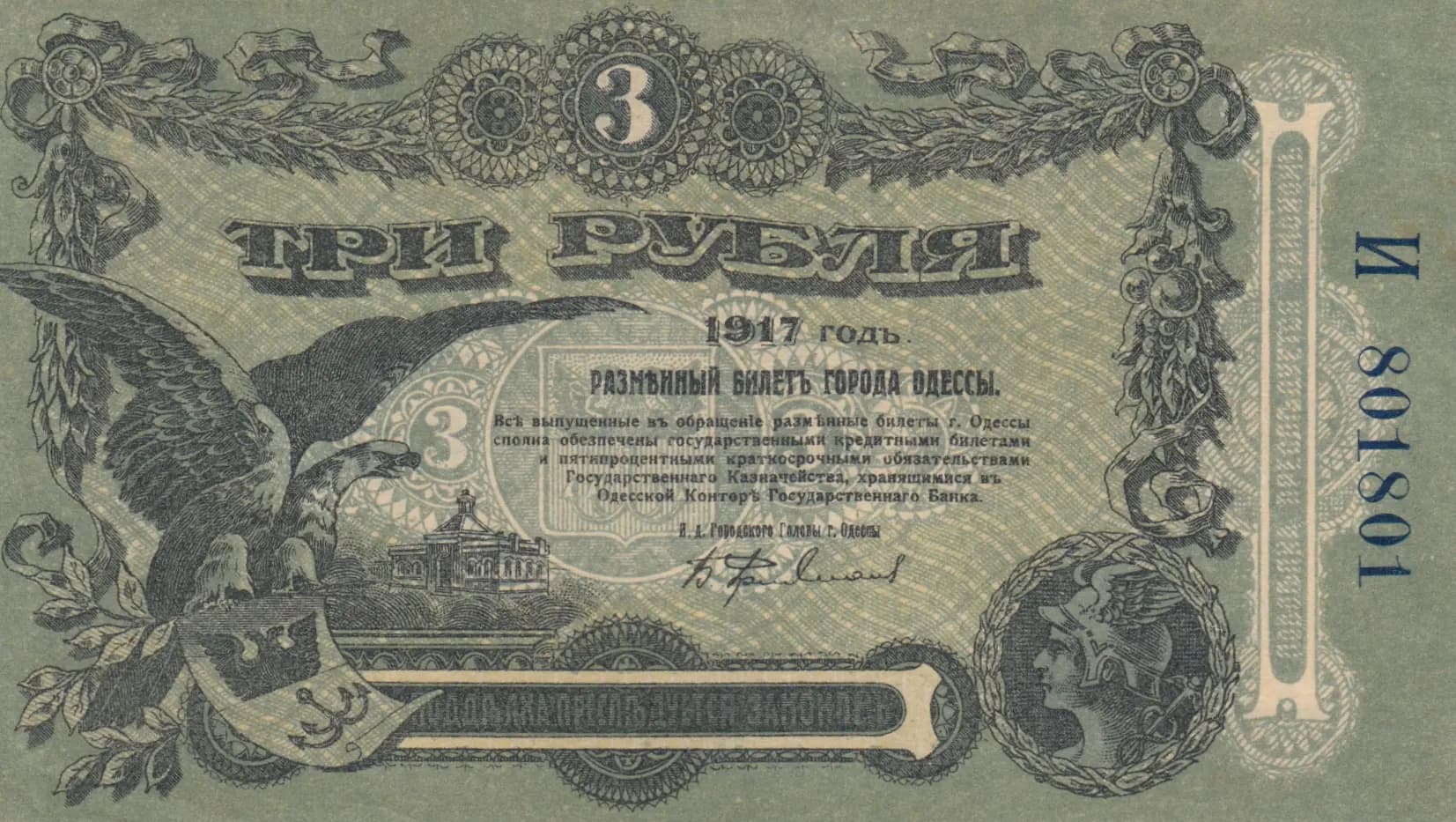
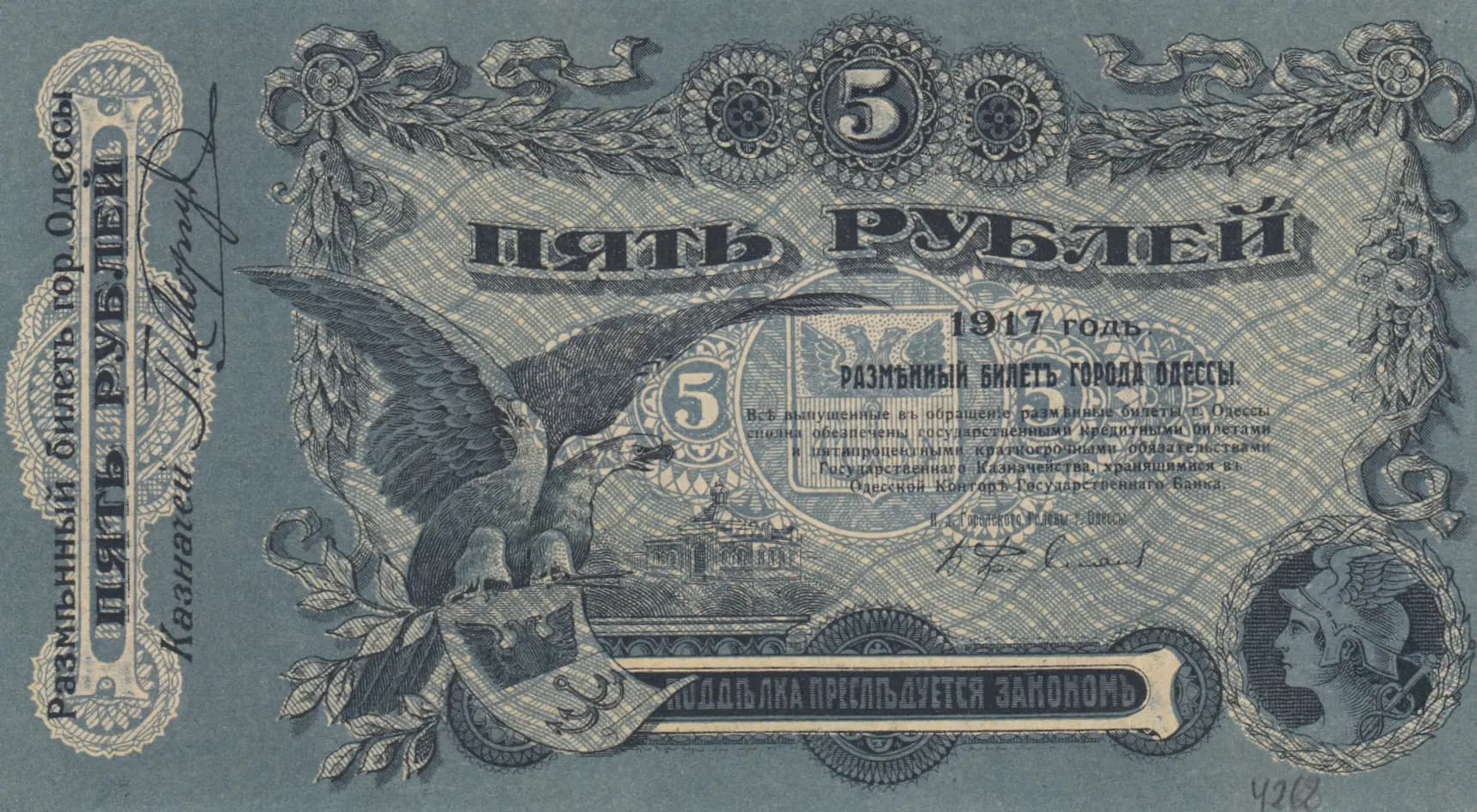
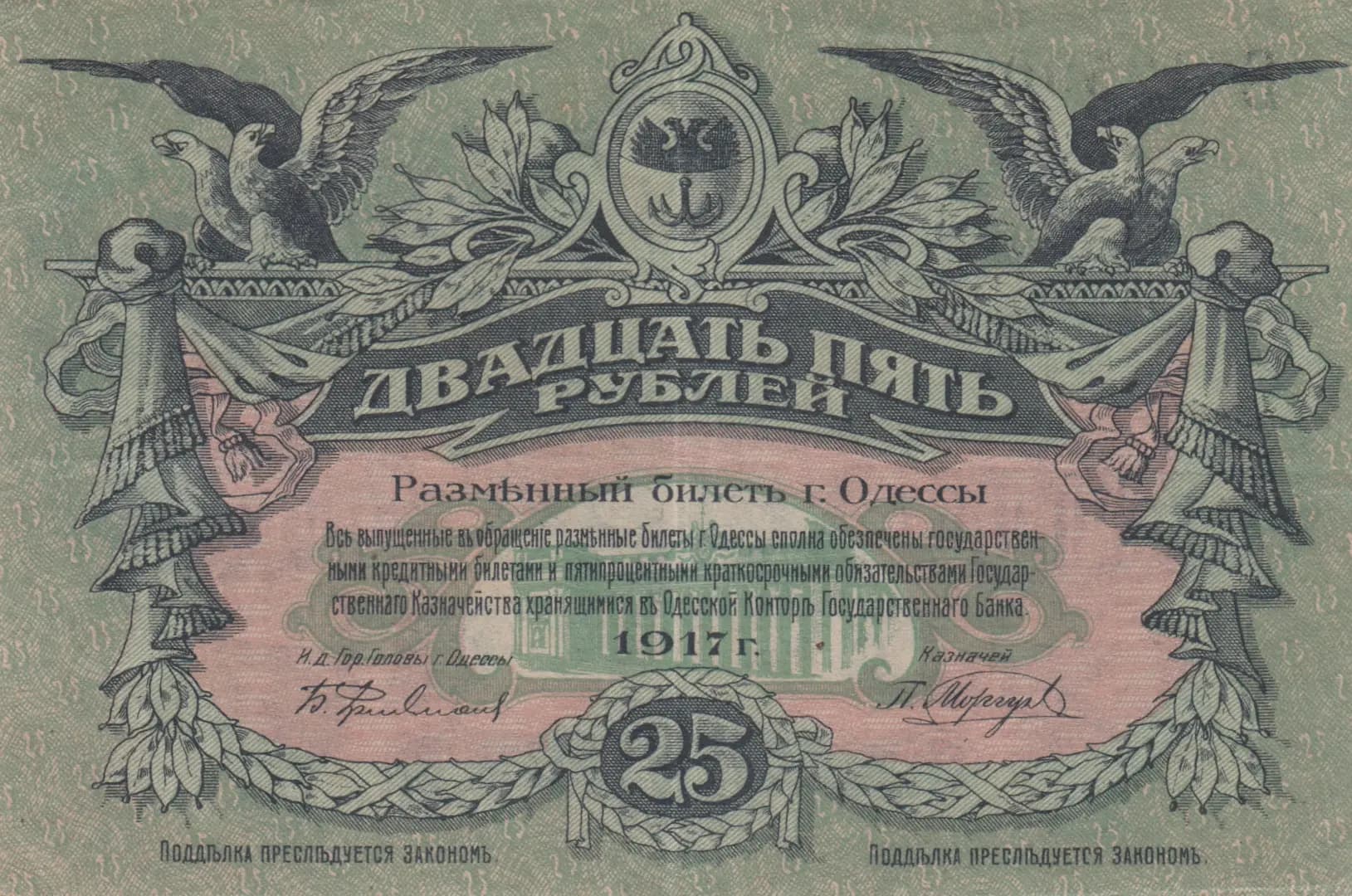
Issued during the chaotic period of the Russian Revolution and Civil War, Odessa's exchange notes (разменные билеты) served as local currency when state resources were depleted and trust in central government had collapsed. The note's backing by state credit bills and treasury bonds—as stated in the legal text—reflects attempts by local authorities to maintain monetary stability during this turbulent period. The classical building depicted on the reverse likely represents a civic or financial institution of significance to Odessa, symbolizing the town's authority and credibility to issue currency.
The 10 Rublei features a dual-sided design emphasizing imperial authority and civic stability. The obverse (front) is dominated by a large double-headed eagle with fully spread wings, a central symbol of Russian Imperial heraldry representing the autocratic state, positioned above an ornate shield containing heraldic design elements. The eagle is flanked by elaborate foliate scrollwork and surrounded by an intricate decorative border featuring rosettes containing the numeral '10' in pink circular frames at left and right. The reverse (back) displays a classical neoclassical building with multiple columns and a domed cupola, representing an important civic or financial institution of Odessa (possibly the State Bank branch or city treasury building). Four large ornamental rosettes bearing the numeral '10' anchor the corners of the reverse design. The overall composition uses fine-line engraving throughout to create security through design complexity.
FRONT SIDE: Header: [Partially legible decorative inscription in Old Church Slavonic/Ukrainian]; Main text: 'РАЗМЕННЫЙ БИЛЕТ г.ОДЕССЫ' (Exchange Note of Odessa); Denomination: 'ДЕСЯТЬ РУБЛЕЙ' (Ten Rubles); Legal text: 'All exchange notes issued into circulation by the town of Odessa are secured by state credit bills and short-term treasury obligations of the State Treasury held in the Odessa branch of the State Bank'; Date: '1917г.' (1917); Signatures present but not fully legible. BACK SIDE: Decorative header band [ornamental design element]; Body text: Extensive legal and institutional information in small print [specific content not fully legible in analysis]; Serial number: 'Т 044439'
Intaglio engraving (copperplate printing), the standard security printing method for Russian Imperial and Soviet currency of this period. The fine-line detail work visible throughout both sides—particularly in the eagle's feathers, architectural elements, border patterns, and foliate designs—is characteristic of high-quality intaglio production. The sharp contrast between ink and paper, the dimensional quality of the engraved lines, and the subtle tonal variations in the image all indicate professional intaglio printing. The printer is not specified in the available catalog data, though such municipal notes were typically produced by established Russian security printers.
This note is identified as Pick S336(2), indicating it is the second known variety of Odessa's 10 Rublei issue. The serial number 'Т 044439' with Cyrillic 'T' prefix is consistent with the documented series. No overprints, date variations, or signature variants are evident in this example that would constitute a distinct sub-variety. The note represents the standard circulation issue without special markings.