10 kopeek
“Holodomor”
About This Note
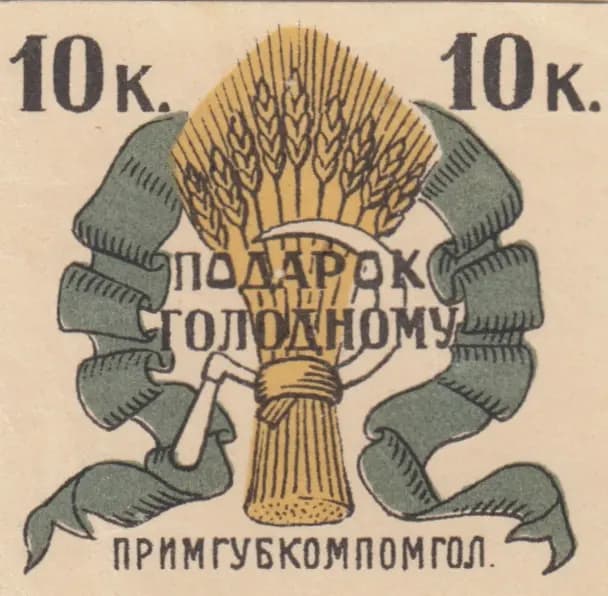
A striking Ukrainian famine relief note from the early Soviet period, featuring a powerful composition of two hands protecting a golden wheat sheaf—symbolizing sustenance and hope during the Holodomor. The note is rendered in uncirculated condition with crisp, clean surfaces and fine engraving throughout. This is a significant historical piece documenting one of the 20th century's most tragic humanitarian crises, with its emotional imagery and explicit dedication to feeding the hungry making it a poignant collector's item.
Rare. This is an unlisted Pick number, indicating it does not appear in standard international banknote catalogs (Pick being the primary reference work). Soviet regional famine relief notes from 1921-1923 had very limited print runs and were often recalled or destroyed after the immediate crisis. The explicit Holodomor connection and its status as an unlisted, regionally-issued emergency currency make genuine examples scarce in the collector market. The uncirculated condition further enhances its rarity and desirability.
This 10 kopeks note was issued by the Prim Gubernia Committee to Combat Hunger during the Soviet famine crisis of 1921-1923, when widespread starvation affected millions across the former Russian Empire, particularly in Ukraine. The central wheat sheaf imagery, flanked by protective hands, directly references the region's agricultural devastation and the urgent need for relief aid. The explicit Cyrillic inscription 'Gift to the Hungry' reveals this was a charitable or emergency fundraising instrument, documenting Soviet attempts to address the catastrophic food shortage that preceded the larger Holodomor of 1932-1933.
The obverse features a symmetrical, allegorical composition centered on a golden-yellow wheat sheaf bound at its base with wrapped cordage, symbolizing the agricultural wealth and sustenance needed to address famine. Two grayish-green hands emerge from either side, depicted in a protective or presenting gesture that conveys both vulnerability and hope. Below the wheat is a decorative grayish-green ribbon or banner in classical presentation style. The overall design employs fine line engraving with detailed hatching throughout, creating depth and texture. The color palette—cream background, golden wheat, and muted grayish-green tones—reinforces the humanitarian and agricultural themes without gaiety or celebration.
Front side inscriptions: '10 k.' (10 kopeks) appears twice in large black text at top; 'ПОДАРОК' (Podarok - Gift/Present); 'ГОЛОДНОМУ' (Golodnomu - To the Hungry); 'ПРИМГУБКОМПОМГОЛ' (Prim Gubernia Committee to Combat Hunger). Complete readable translation of main text: 'A Gift to the Hungry' from the 'Prim [Primary/First] Gubernia Committee to Combat Hunger.'
Intaglio engraving (recess printing), evidenced by the fine line hatching, detailed modeling of the hands and wheat sheaf, and the crisp definition of text and decorative elements. The uniform pressure and quality of impression visible across the note suggest professional security printing. Specific printer information for this Prim Gubernia Committee issue is not definitively documented in standard catalogs, but Soviet famine relief notes of this period were typically produced by regional government printing facilities.
As a Pick-unlisted note, this represents a distinct variety not yet formally cataloged in major references. The specific issuer designation 'ПРИМГУБКОМПОМГОЛ' (Prim Gubernia Committee to Combat Hunger) identifies this as a particular regional emission, likely from the Prim Gubernia administrative district. No variants in signatures, dates, or serial prefixes are visible in the provided imagery. The note may exist in other denominations under the same issuing authority, and catalog researchers should cross-reference regional Soviet emergency currency issues of 1921-1923.