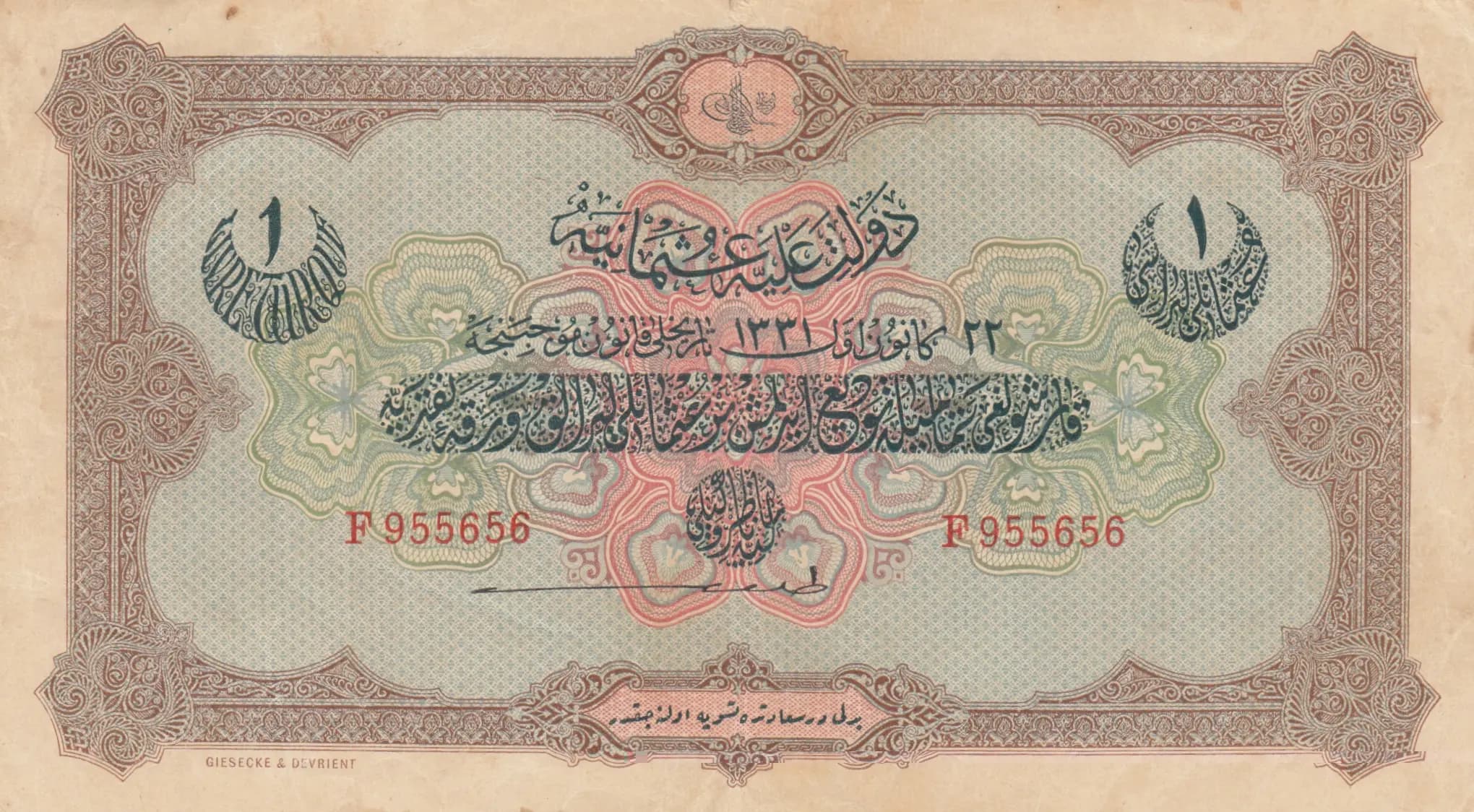
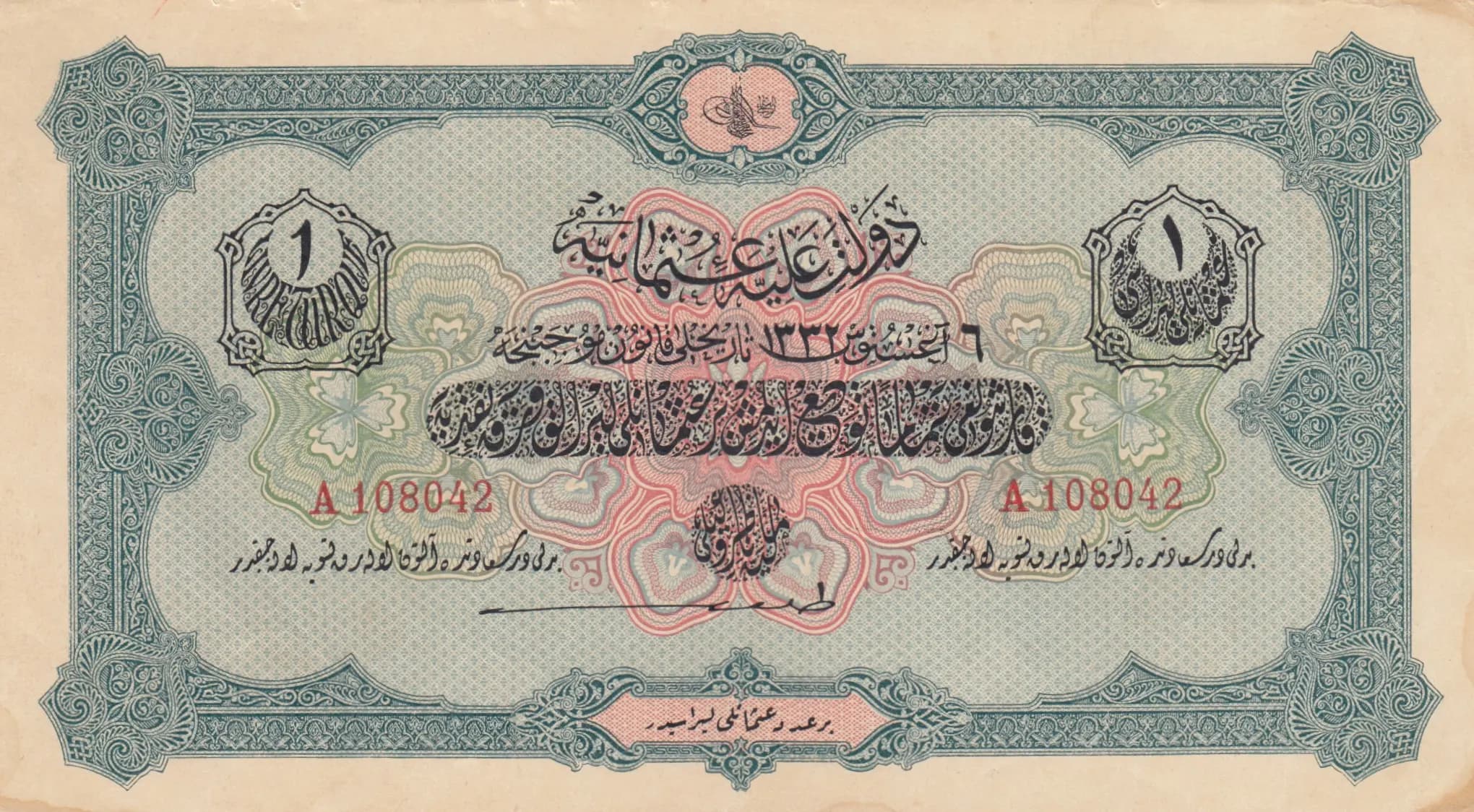
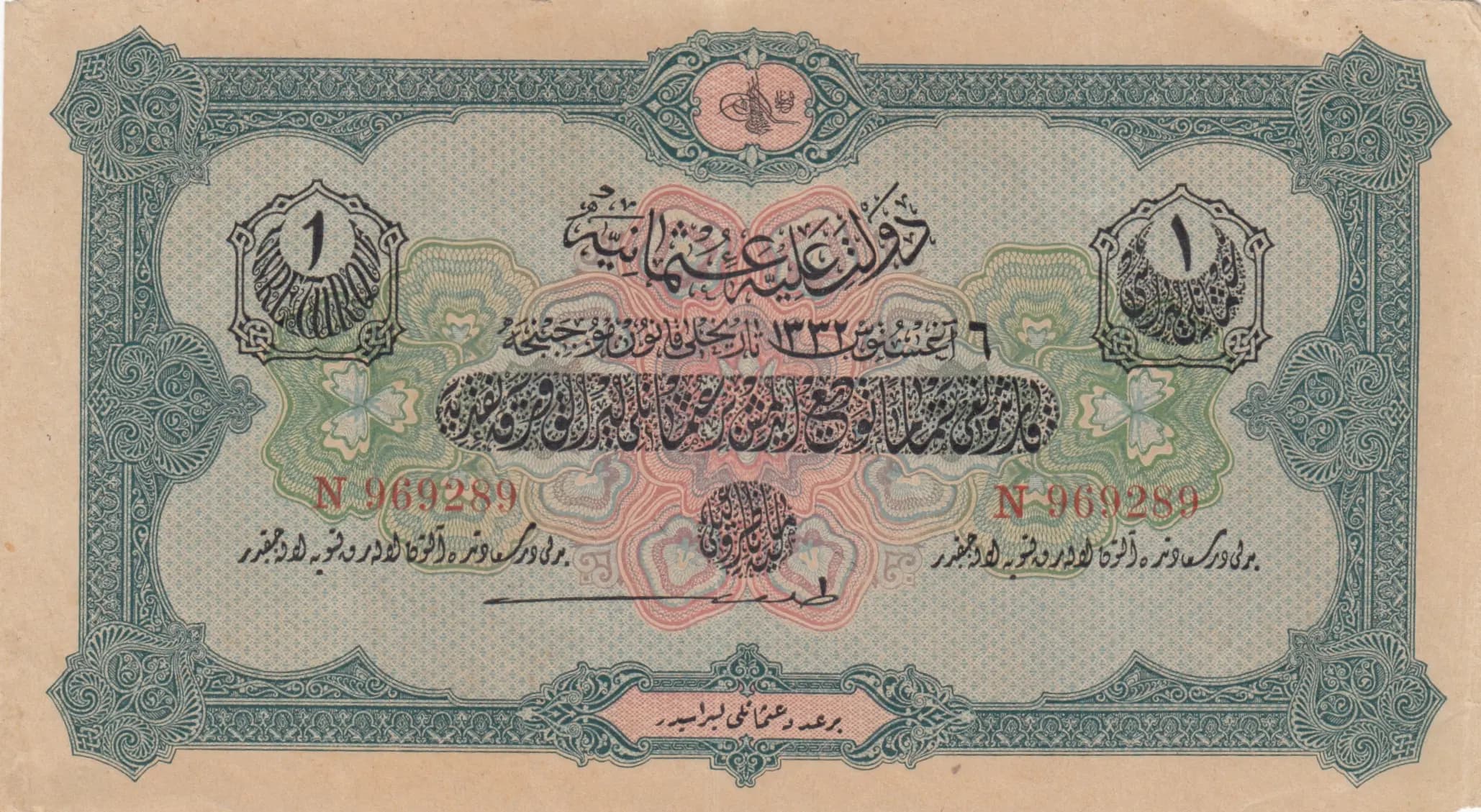
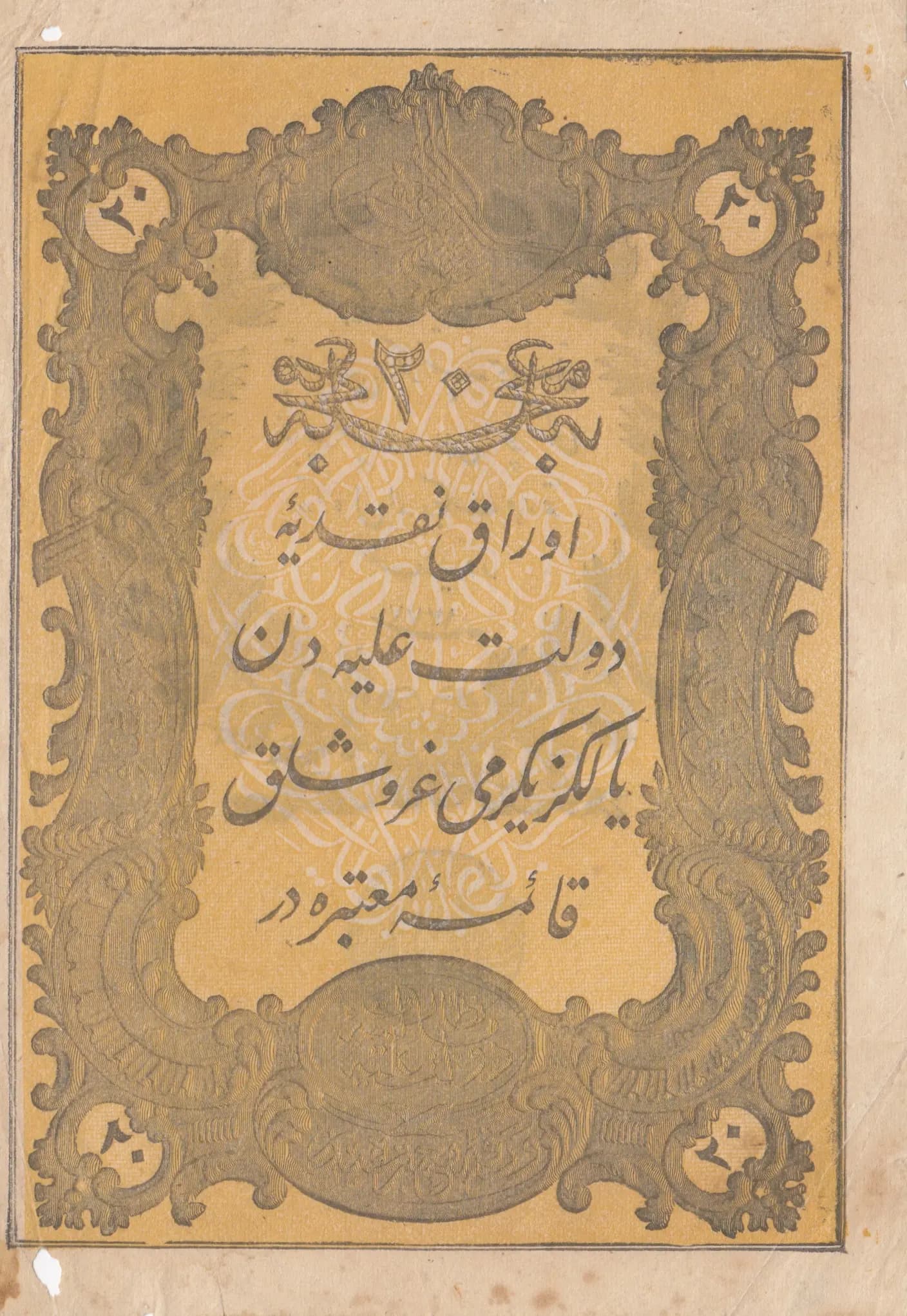
1 lire 1916
Market Prices
11 salesAbout This Note
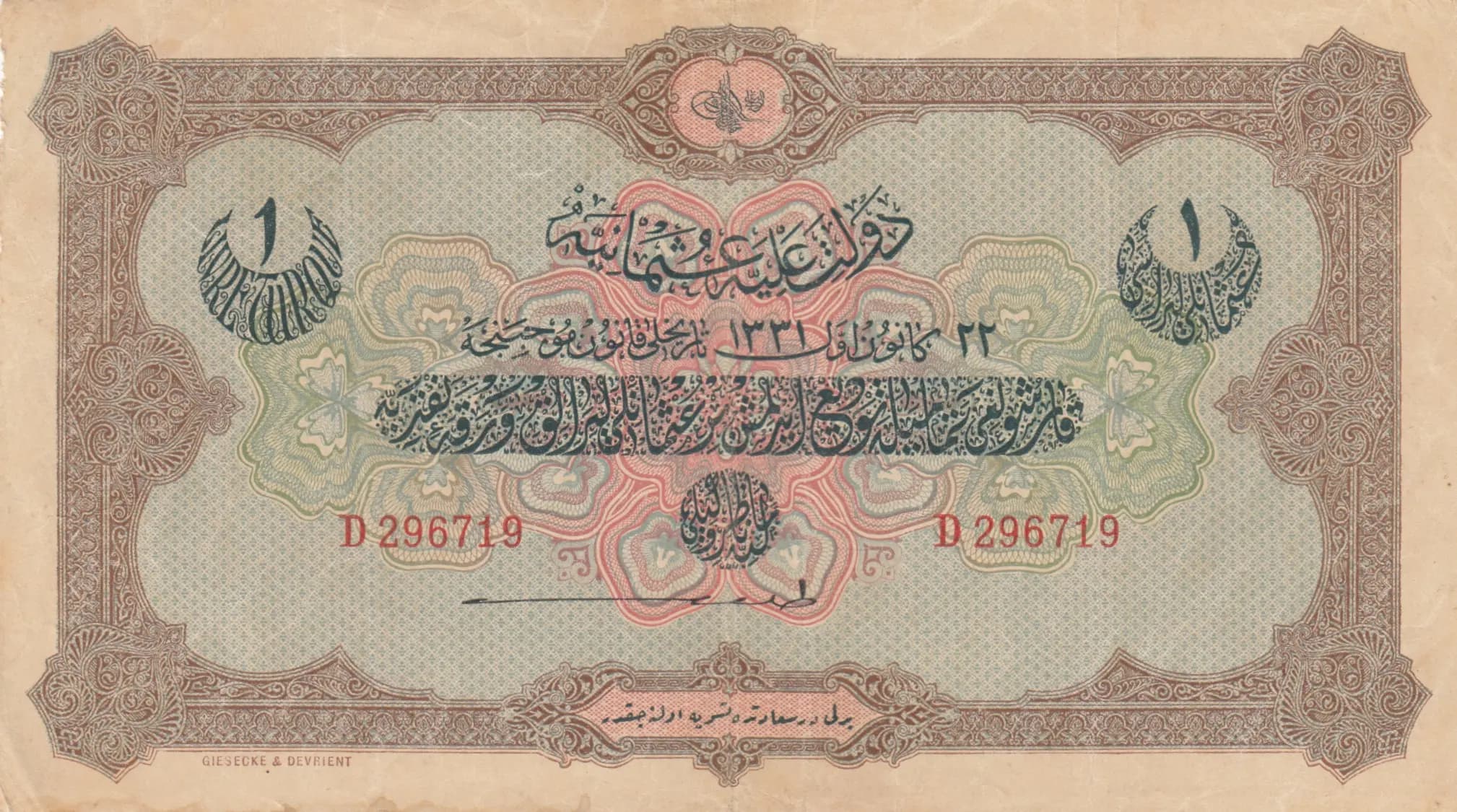
This is an attractive VF example of a 1 Livre Turque issued by the Dette Publique Ottomane in 1916, printed by the renowned security printer Giesecke & Devrient. The note displays the characteristic ornate Islamic geometric and floral border designs in brown, red, and green tones typical of late Ottoman currency, with well-preserved paper showing only minor age-related foxing and discoloration consistent with a century-old note that saw modest circulation.
Common. eBay market data shows consistent sales in the $30-56 range for VF examples with multiple transactions over recent years (most recently $45.35 in November 2025), indicating steady collector demand but no scarcity premium. The 2016 catalog value of $22.50 for VF, combined with regular appearance in the marketplace and documented print runs by a major security printer, confirms this as a standard issue within the Ottoman banking system. While historically significant as a late-period Ottoman note, no evidence suggests restricted production, early recall, or survival challenges that would elevate rarity status.
Issued during the final years of the Ottoman Empire (1916), this note represents the fiscal modernization period when the Ottoman government adopted the RC (Rumi Takvim/Roman Calendar) for official dating instead of the Islamic lunar calendar. The prominent calligraphic inscriptions referencing 'خزانهٔ عثمانیہ شریفہ' (Ottoman Imperial Treasury) and the elaborate official decree on the reverse underscore the government's attempt to maintain financial credibility during a period of military strain and currency instability. The commission to Giesecke & Devrient, Europe's leading security printer, reflects the Ottoman state's commitment to anti-counterfeiting measures despite diminishing resources.
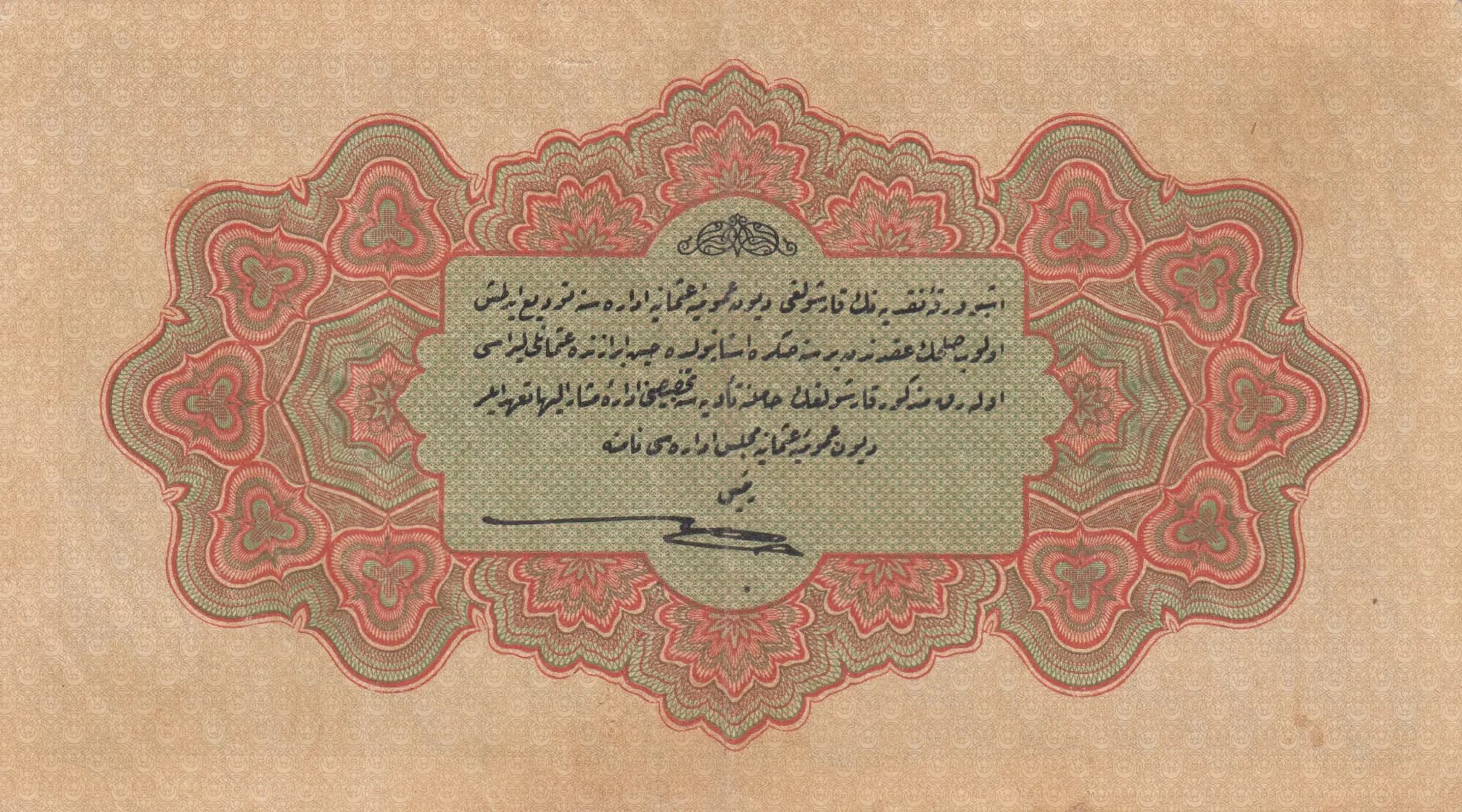
This note exemplifies the aesthetic sophistication of late Ottoman currency design. The obverse features a symmetrical composition dominated by an ornate brown and tan frame with red and green underprinting, creating visual depth and complexity. Twin crescent moon symbols with the numeral '1' occupy the upper left and right corners—a traditional Ottoman emblem signifying Islamic authority and the monetary unit. The center displays an elaborate cartouche containing the Treasury name and denomination in Persian/Ottoman script, surrounded by fine geometric microprinting and delicate scrollwork in the classical Islamic architectural tradition. The reverse employs a contrasting color scheme of red and green with cream-colored central panel, again framing an ornamental cartouche. The entire design reflects the Ottoman administrative aesthetic blending Persian-Islamic calligraphy with European security printing standards, with no portraits depicted—consistent with Islamic monetary conventions of the era that discouraged figural representation on currency.
FRONT: The upper cartouche contains 'خزانهٔ عثمانیہ شریفہ' (Ottoman Imperial Treasury). The denomination is marked as 'یک لیرہ' (One Lira). The date appears as '۲۲ جمادی الثانی ۱۳۲۱' in the Islamic calendar, corresponding to the RC date of 22 Jumada al-Thani 1321 AH / 1912-1913 in the solar calendar, though catalog sources indicate the actual issue/decree date as 04.01.1916 (4 January 1916 in the RC system, equivalent to L. 1331). Serial numbers appear as 'F955656' and 'R955656'. The printer credit reads 'GIESECKE & DEVRIENT'. BACK: The reverse begins with 'بسم الله الرحمن الرحيم' (In the Name of God, the Most Merciful, the Most Compassionate), followed by an extensive official decree in Ottoman Turkish calligraphic script authorizing the issuance and legal validity of the banknote, with an official signature at the bottom right of the central green panel.
This note employs sophisticated multicolor letterpress and intaglio printing, characteristic of Giesecke & Devrient's security printing standards in the early 20th century. The fine guilloche borders, intricate geometric microprint patterns, and precise color registration visible in the visual analysis indicate a combination of engraved dies and high-quality paper stock. The complex layering of red, green, brown, and black inks with subtle underprinting demonstrates the security measures employed to deter counterfeiting. Printer: Giesecke & Devrient (Leipzig/Berlin), the leading European security printer of the period.
The observed variety is catalogued as Pick-83, with the inscription showing RC date L. 1331 (corresponding to 1912-1913 in the lunar calendar) but actual decree/issue date of 04.01.1916 per banknote.ws. The serial numbers visible (F955656 and R955656) appear to represent a standard numbering system, though detailed variety information (such as signature varieties, specific serial number prefixes, or printing location variants) would require comparison with PMG population reports and comprehensive Ottoman banknote references. The base Pick-83 number reportedly has 1 catalogued variant, but specific distinguishing characteristics are not detailed in available sources. No overprints or significant printing variations are apparent from the visual analysis.