50 francs 1940
Market Prices
16 salesAbout This Note
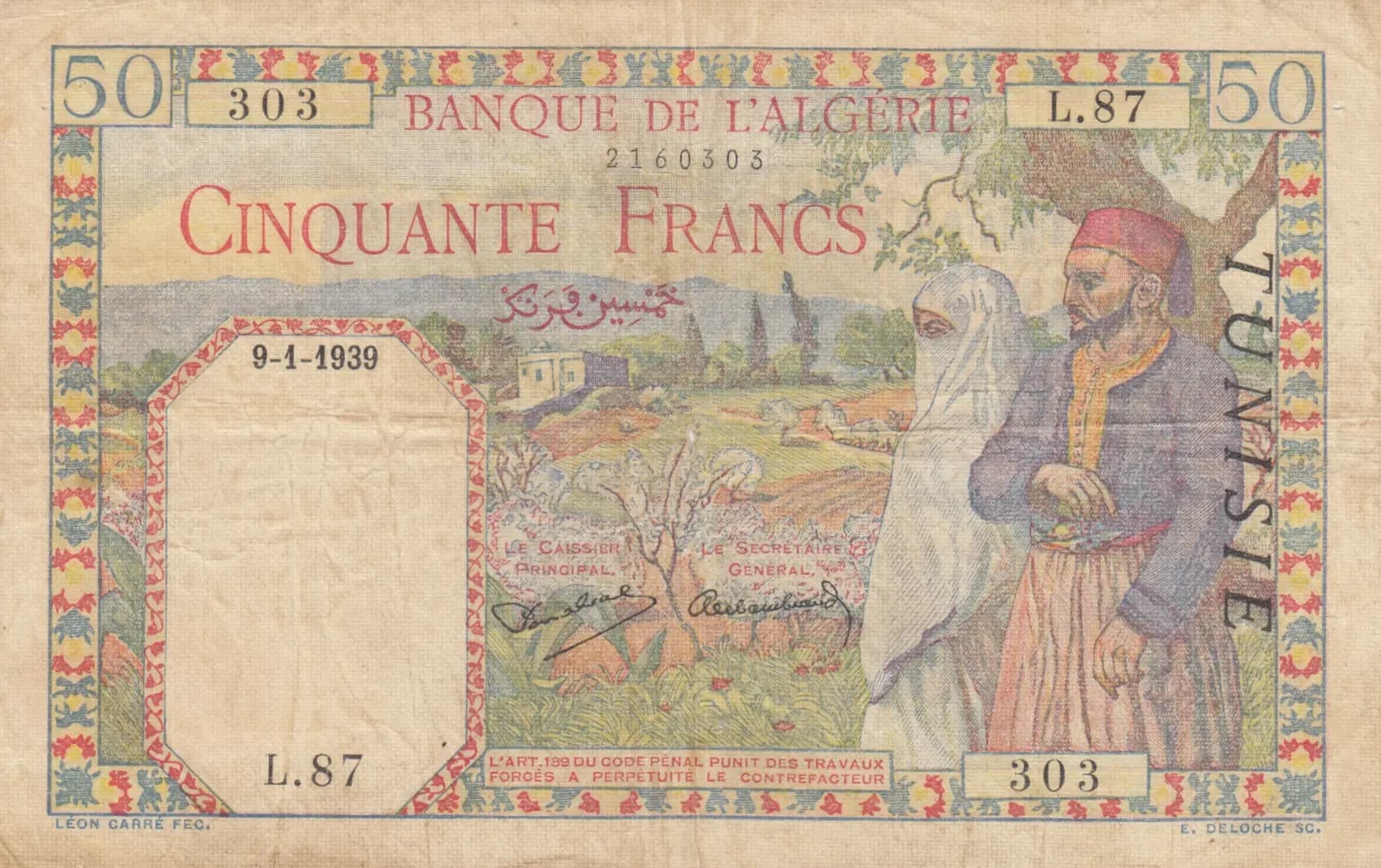
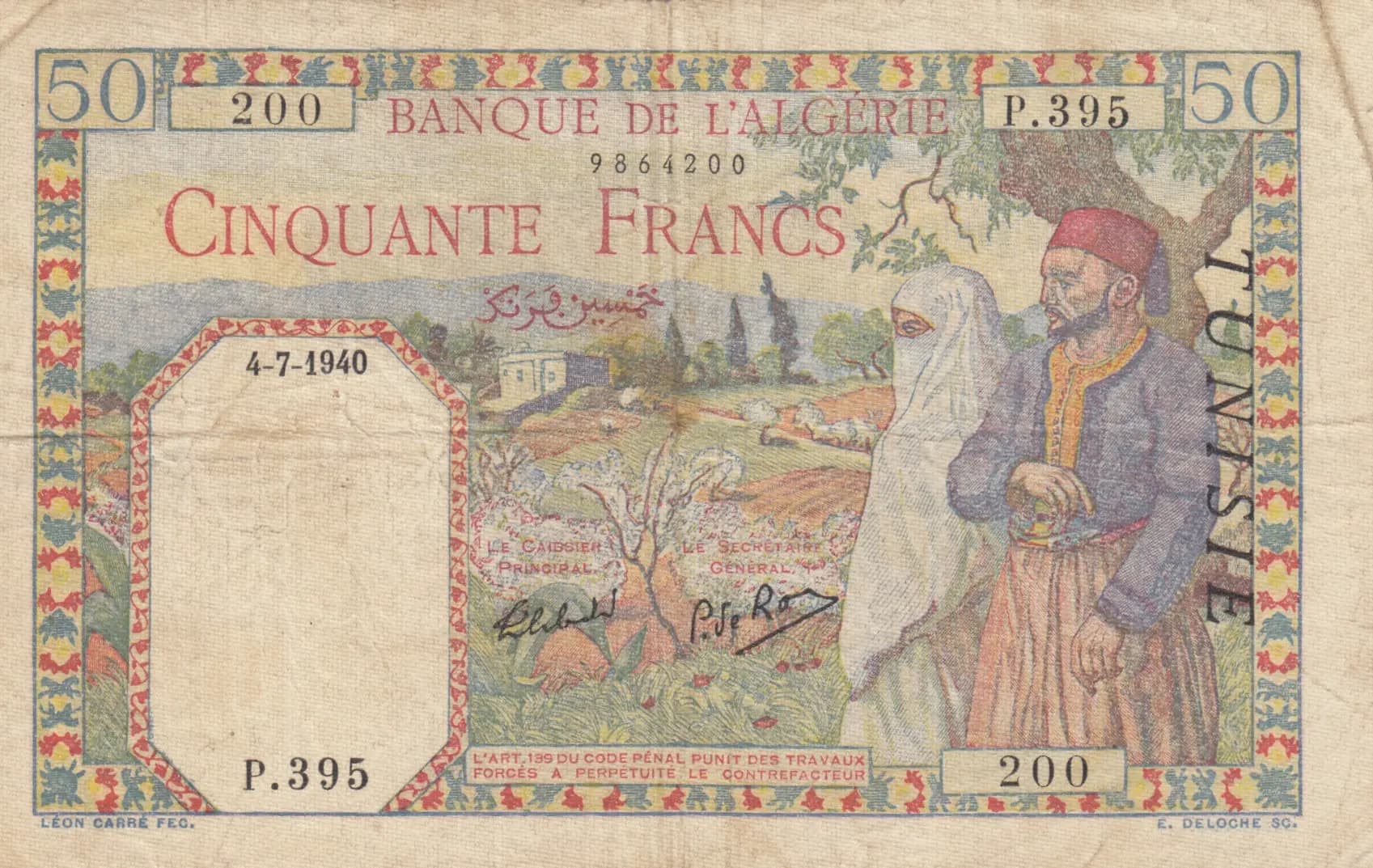
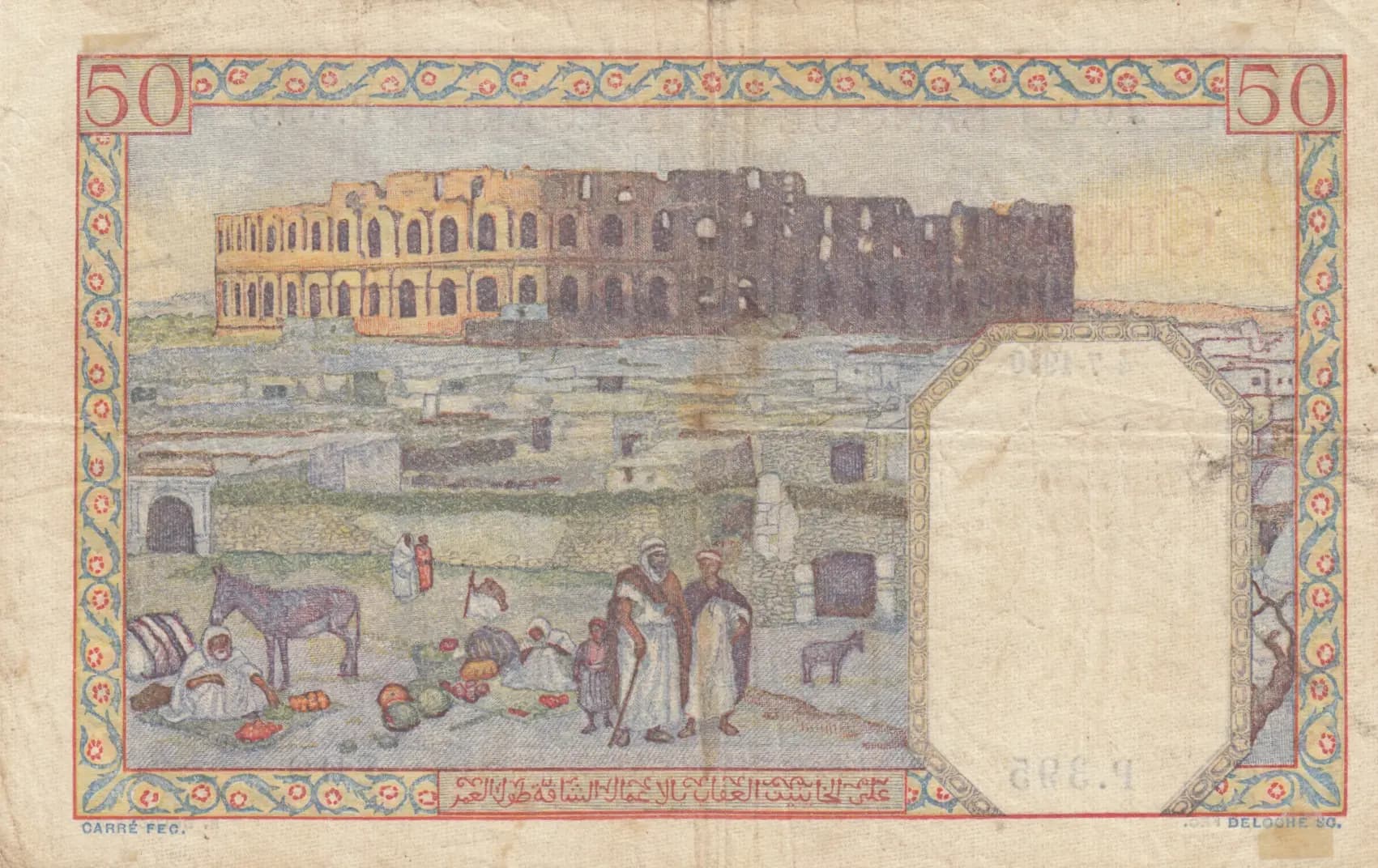
This is a 50 Francs banknote issued by the Banque de l'Algérie for Tunisia, dated July 4, 1940, in Fine condition. The note features vibrant multicolored ornamental borders with a couple in traditional North African dress on the obverse and the spectacular El-Djem Roman amphitheater ruins with marketplace scene on the reverse. Despite significant age-related wear including creases, foxing, and discoloration typical of an 80+ year old note, the detailed engraving and historical imagery remain visible, making this an interesting example of colonial-era North African currency.
Common. The eBay price history for this Pick number (P-12a) shows consistent market availability with numerous sales spanning from 2011 to 2023. Notes in Fine condition have regularly sold for $12-$20 in recent years (2023-2021 transactions), and even VF examples command only $17-$38. The catalog value for Fine grade (2016) lists $15. The broad sales activity across multiple years and consistent pricing indicate healthy supply, and the note was clearly issued in substantial quantities by the Banque de l'Algérie. The presence of three cataloged varieties (P-12a, P-12b, P-12s) also suggests significant production volumes.
This banknote was issued during the tumultuous year of 1940, as Tunisia remained under French colonial administration (the Banque de l'Algérie's Tunisian branch). The imagery reflects the colonial perspective of the era, depicting traditional Tunisian life and celebrated Roman heritage through the El-Djem amphitheater, one of North Africa's most impressive classical structures. The note's French inscriptions and Algerian issuer reflect Tunisia's administrative status as part of French North Africa during this period, ending with independence in 1956.
The obverse depicts a couple in traditional Tunisian dress standing in a romanticized landscape with cypress trees and architectural structures in the background. The woman wears traditional white head coverings and light robes characteristic of 1940s Tunisian dress, while the man on the right wears a red fez and purple-blue garment. The design is framed by an intricate ornamental border featuring repeating floral and geometric patterns in red, blue, yellow, and green. The reverse showcases the El-Djem amphitheater, an exceptionally well-preserved Roman structure in central Tunisia dating to the 3rd century AD, depicted with its characteristic multi-tiered arched architecture. Below the ruins is a marketplace scene with multiple figures in traditional dress, animals (donkey or horse), and settlement structures, presenting a romanticized view of daily life and commerce. Large blank octagonal cartouches (watermark areas) frame each side, emphasizing the security design.
OBVERSE: 'Banque de l'Algérie' (Bank of Algeria); 'Cinquante Francs' (Fifty Francs); '4-7-1940' (July 4, 1940); 'Le Caissier Principal' (The Principal Cashier); 'Le Secrétaire Général' (The General Secretary); 'L'Art.139 du Code Pénal punit des travaux forcés à perpétuité le contrefacteur' (Article 139 of the Penal Code punishes counterfeiting with perpetual forced labor); 'Léon Carré Fé.' and 'E. Deloche Sc.' (engraver signatures); Serial number '9864200'; Denomination '50' and '200' (likely referring to exchange or plate numbers). REVERSE: '50' (denomination, appears twice); 'Carré Fé.' and 'Deloche Sc.' (engraver signatures); Arabic script present but not clearly legible in the images.
This note was produced using engraved intaglio (line engraving) printing, evident from the fine line work, detailed cross-hatching, and precise geometric patterns visible throughout. The signatures 'Léon Carré Fé.' (fait/made) and 'E. Deloche Sc.' (sculpsit/engraved) indicate the engraver(s) responsible. The multicolor printing was achieved through separate color plates characteristic of high-security banknote production of the 1940s period. The Banque de l'Algérie's notes were typically produced by the Banque de France's printing facilities or associated security printers, using the most advanced anti-counterfeiting techniques available at the time.
This example is Pick catalog number P-12a, specifically distinguished by the watermark type: a Woman's Head (as opposed to P-12b with Bank Title watermark). The note is dated 4-7-1940 and shows serial number 9864200. The visual analysis confirms the 'TUNISIE' overprint in black ink characteristic of notes issued for the Tunisian market. The note bears an 'ANNULÉ' (cancelled) stamp, suggesting it may have been removed from circulation at some point. The engravers Léon Carré and E. Deloche are consistent with the documented production specifications for this issue. No additional visible plate varieties, signature varieties, or date varieties beyond the documented 1938-1945 issue period are apparent from this specimen.