50 francs 1939
Market Prices
16 salesAbout This Note
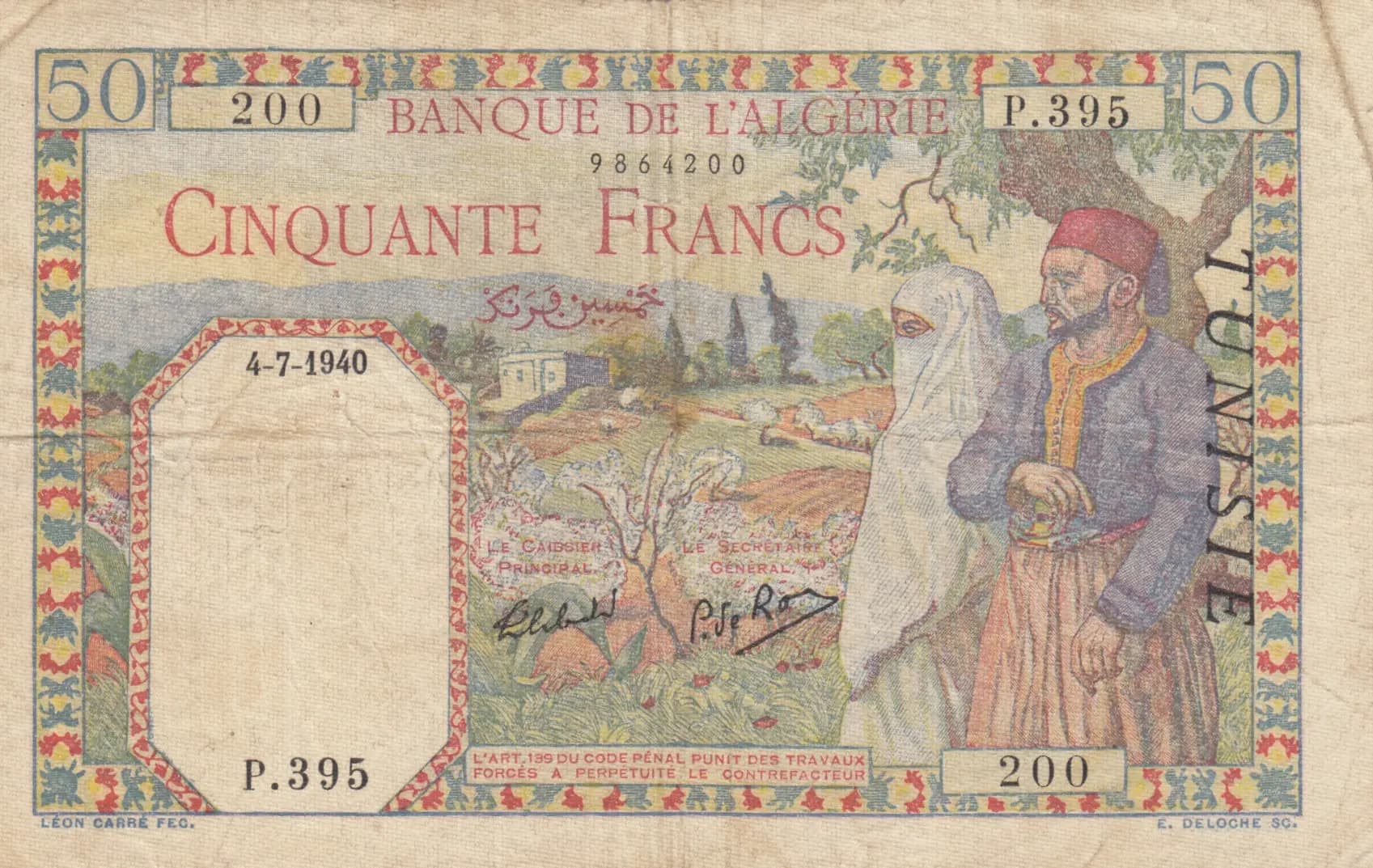
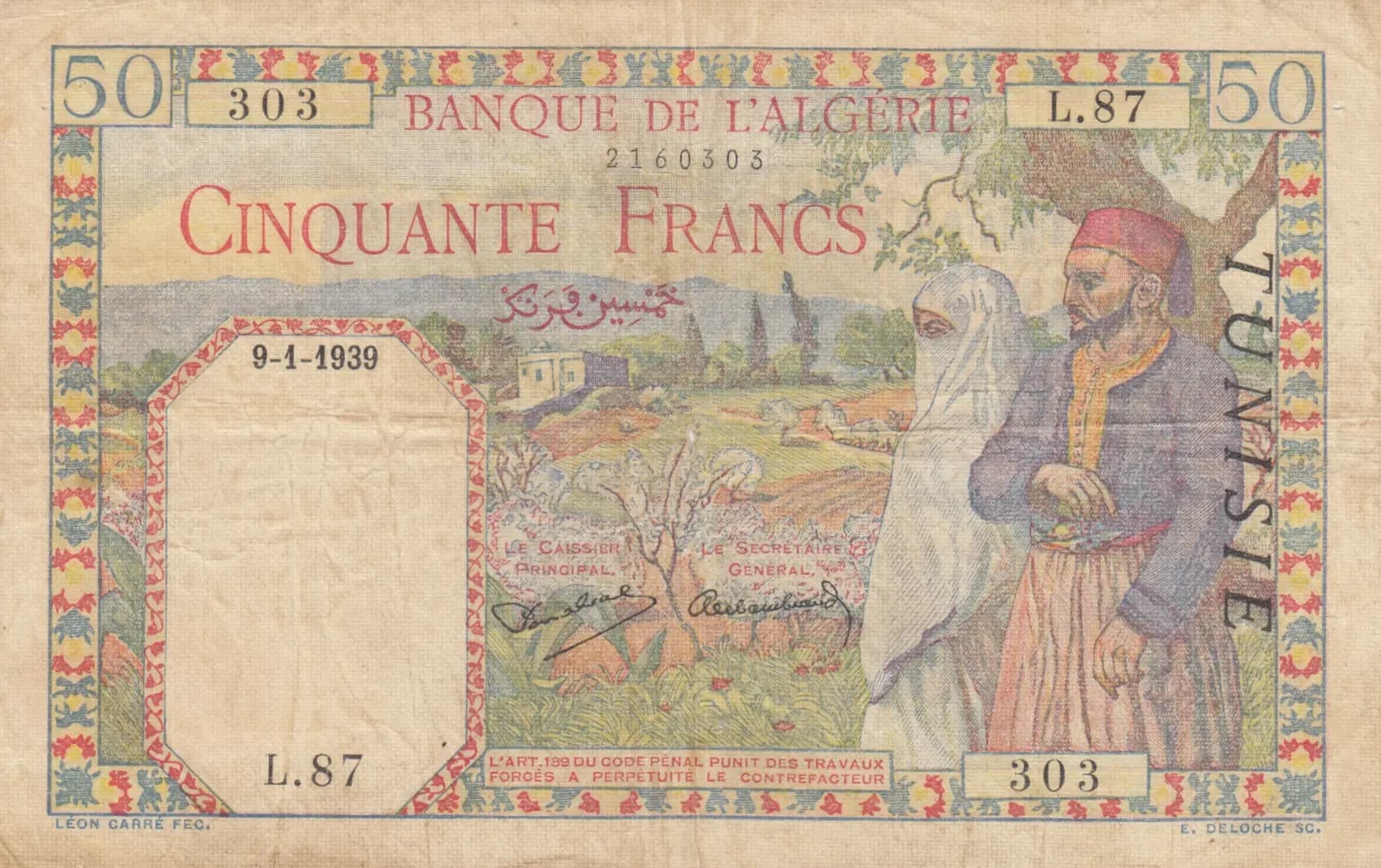
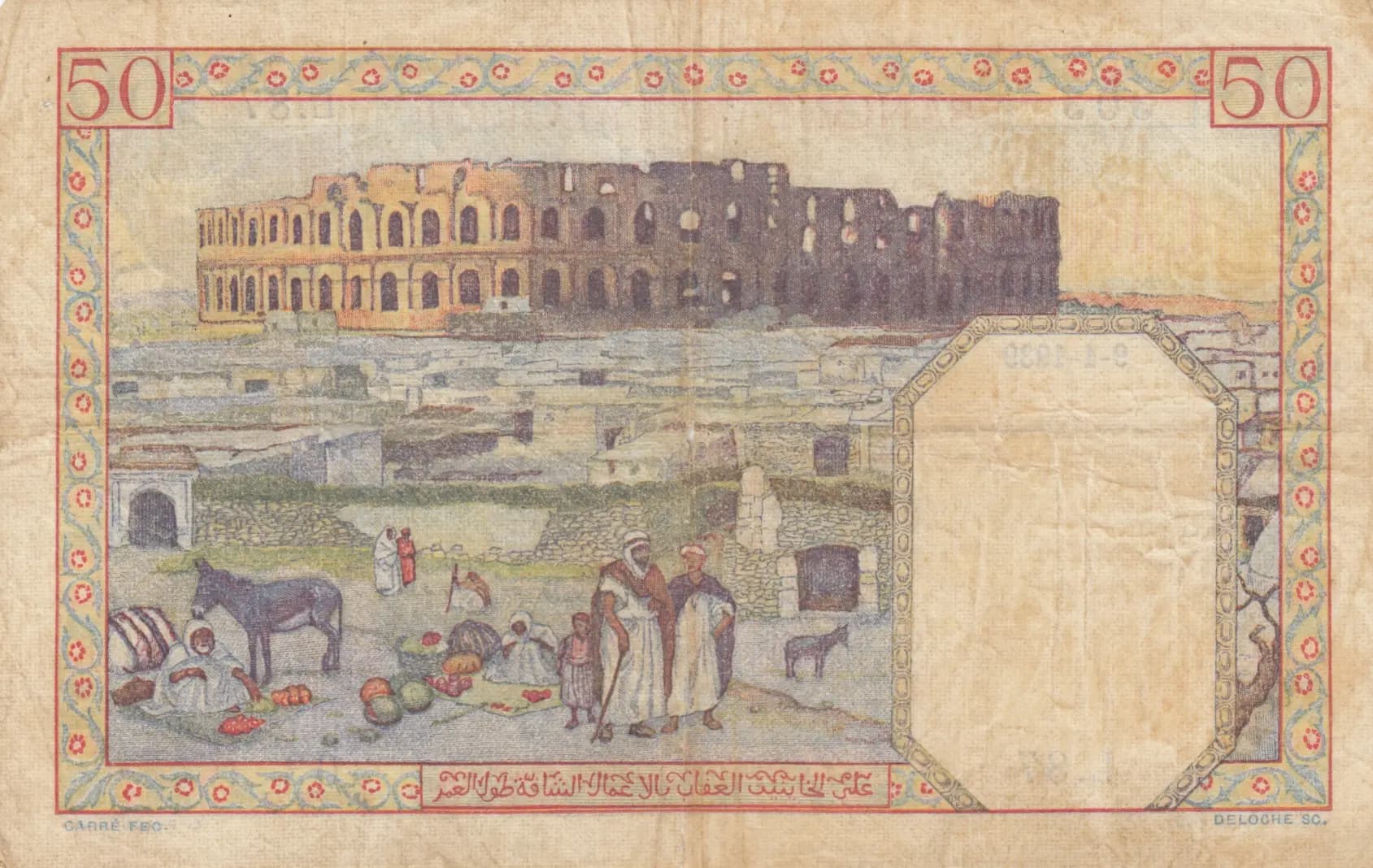
This is a 50 Francs banknote from the Banque de l'Algérie dated January 9, 1939, issued specifically for circulation in Tunisia (evidenced by the regional designation). The note features a beautifully engraved design by Léon Carré depicting a veiled woman and man in traditional North African dress on the obverse, with the iconic El-Djem Roman amphitheater and marketplace scene on the reverse. In Fair condition, the note exhibits moderate circulation wear with visible creases, foxing, and age-related discoloration consistent with an 85-year-old note, yet the multicolor printing and fine engraved details remain legible.
Common. The eBay market data shows consistent sales in the $12-$20 range for Fine condition examples across a 12-year period (2011-2023), with notable volume (multiple sales per year in some years). Catalog values from 2016 list Fine at $15, consistent with observed market prices. The 1938-1945 issue period was lengthy with substantial print run for colonial circulation in Tunisia. While these notes are no longer common in high grades (UNC brought $400 in 2014), Fair to Fine condition examples remain readily available in the collector market. No evidence of rarity in this grade.
This note was issued during the French colonial period in North Africa, specifically for Tunisia under the authority of the Banque de l'Algérie. The imagery reflects the colonial narrative of the era—the couple in traditional dress on the obverse romanticizes North African life, while the El-Djem amphitheater on the reverse references Tunisia's Roman heritage, symbolizing European civilization and cultural dominance. The 1938-1945 issue period spans from before World War II through the post-war decolonization movements that would reshape North Africa.
The obverse features a central allegorical couple rendered in fine line engraving: a woman on the left wearing a white haik (traditional veil and outer garment) and a man on the right in purple-blue robes trimmed with gold, wearing a distinctive red fez. Both figures are positioned against a romanticized rural North African landscape with agricultural fields, traditional buildings, and vegetation, reflecting the colonial-era idealization of the region. The note is framed by an ornate decorative border in red with blue and yellow floral and geometric patterns typical of Art Deco-influenced colonial banknote design. The reverse depicts the El-Djem amphitheater (ancient Roman site in Tunisia) in the upper portion, one of the largest surviving Roman structures in North Africa, symbolizing historical European presence. Below is a marketplace or settlement scene with multiple figures in traditional dress, animals including a horse, and arched colonial-era architecture. The same decorative border treatment appears on the reverse. Denomination numerals '50' appear on both sides. The note employs fine line engraving with multicolor lithographic printing.
FRONT SIDE: 'BANQUE DE L'ALGERIE' (Bank of Algeria); 'CINQUANTE FRANCS' (Fifty Francs); 'L.87' (likely sheet or series identifier); '9-1-1939' (date: January 9, 1939); '2160303' (serial number); '303' (batch number); 'LE CAISSIER PRINCIPAL' (The Principal Cashier); 'LE SECRETAIRE GENERAL' (The General Secretary); 'L'ART.199 DU CODE PENAL PUNIT DES TRAVAUX FORCES A PERPETUITE LE CONTREFACTEUR' (Article 199 of the Penal Code punishes counterfeiting with forced labor for life); 'LÉON CARRÉ FEC.' (Engraved by Léon Carré); 'E. DELOCHE SC.' (E. Deloche, sculptor); '50' (denomination numeral). BACK SIDE: '50' (denomination); 'CARRÉ FEC.' (Engraved by Carré); 'DELOCHE SC.' (Deloche, sculptor); Arabic script inscriptions (exact text unclear from provided image quality).
The note was produced using combination intaglio/engraving and color lithography, standard for high-security banknotes of the 1930s-1940s era. The fine line engraved work (evidenced by the crisp detail in the portraits, border patterns, and architectural elements) was executed by Léon Carré, with sculptural/design work by E. Deloche. The multicolor printing visible in the dominant colors (red borders, blue ornamental elements, cream background, green accents) indicates separate lithographic color passes. The security features include blank rectangular spaces (likely for overprinting, watermarks indicated by the head design), and complex decorative patterns designed to deter counterfeiting.
This is identified as Pick P-12a (watermark: Woman's Head). The note shows the standard design for the P-12a variety with the characteristic head watermark. Known varieties for this base Pick number include P-12b (watermark: Bank Title) and P-12s (specimen note). The visual analysis confirms the typical multicolor design, engraver attributions (Carré/Deloche), and the regional 'TUNISIE' designation for North African colonial circulation. The specific date observed (9-1-1939) falls within the standard 1938-1945 issue range for this variety.