5 dinars 1972 specimen
Market Prices
1 saleAbout This Note
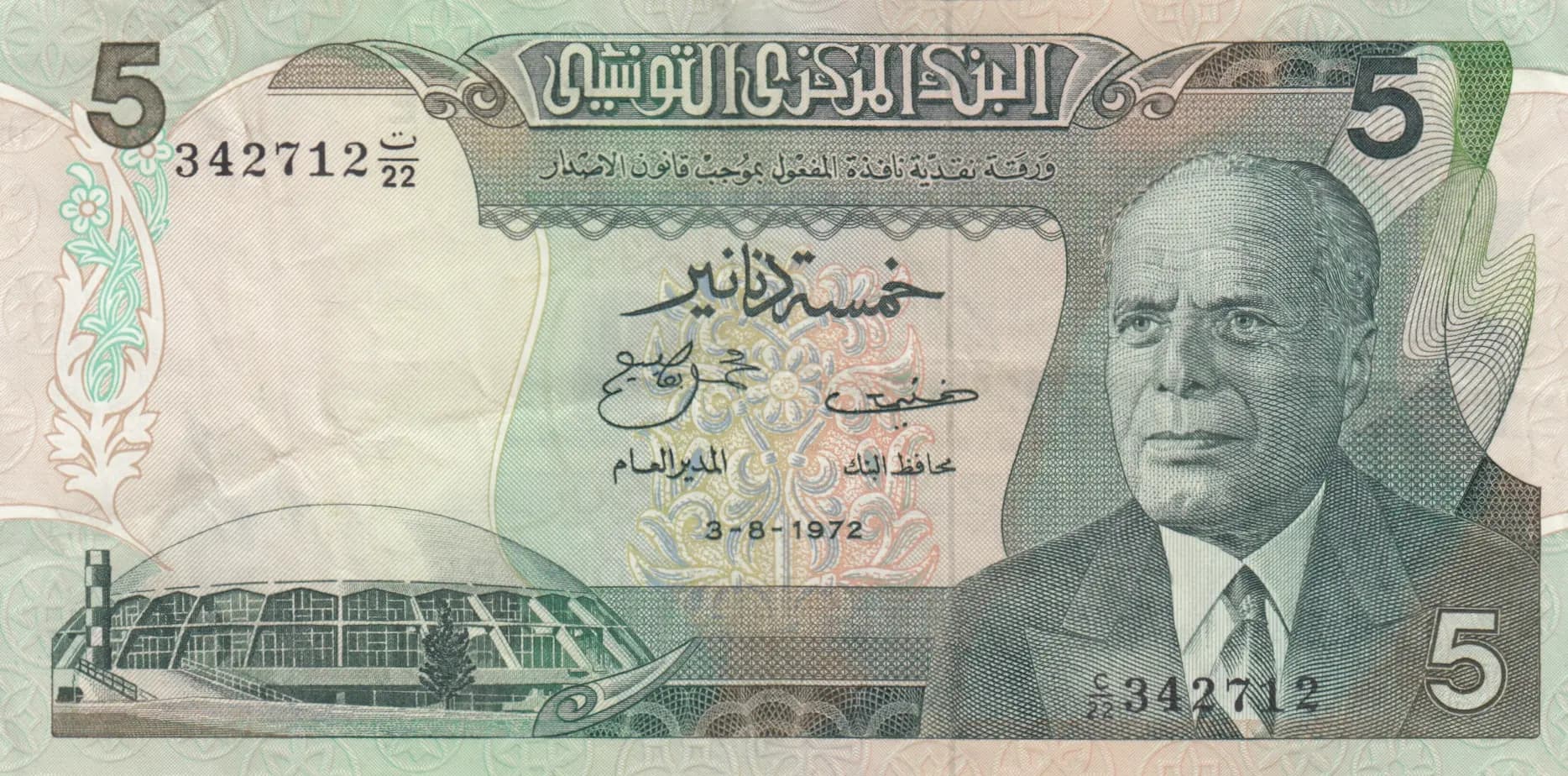
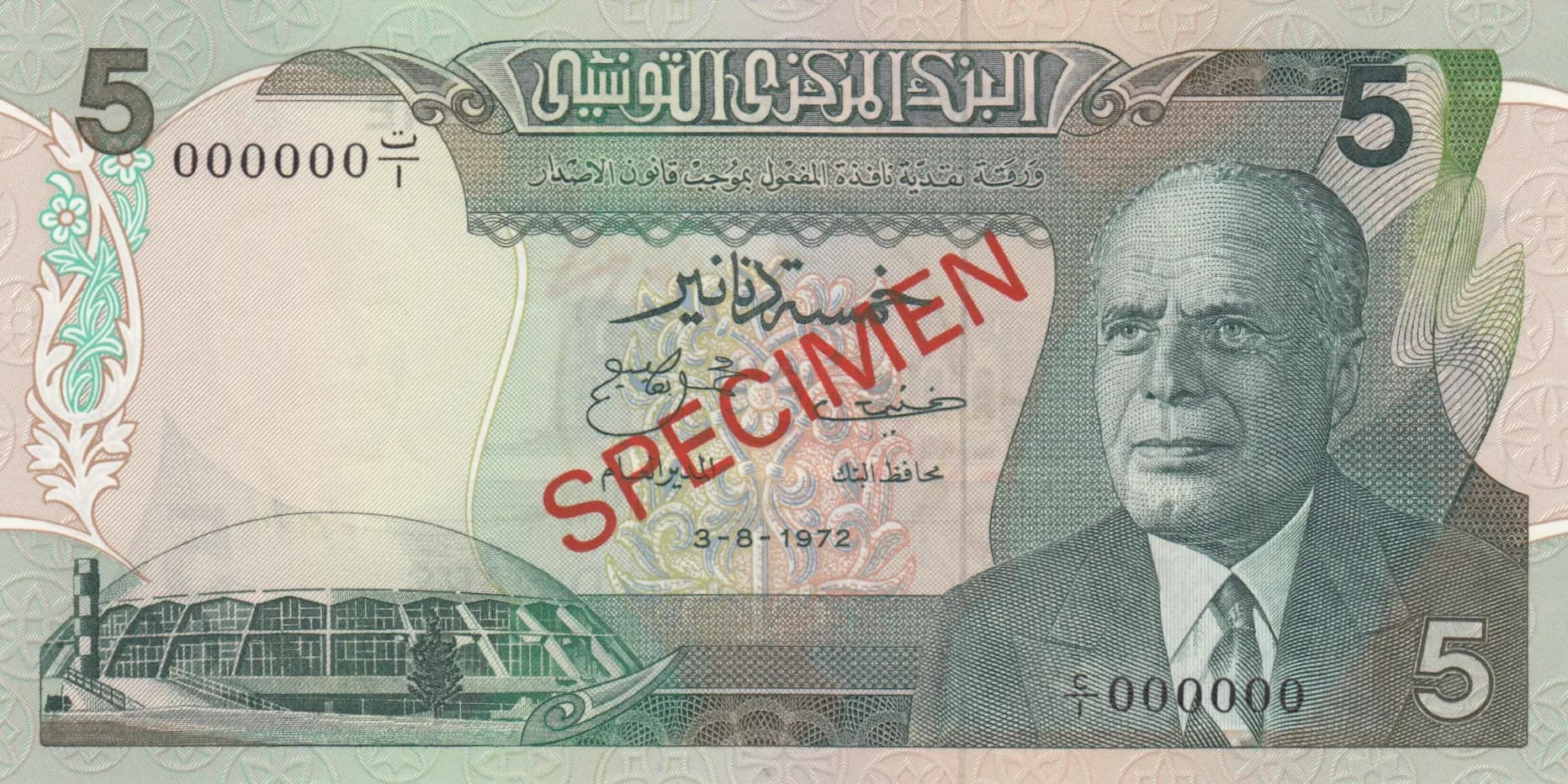
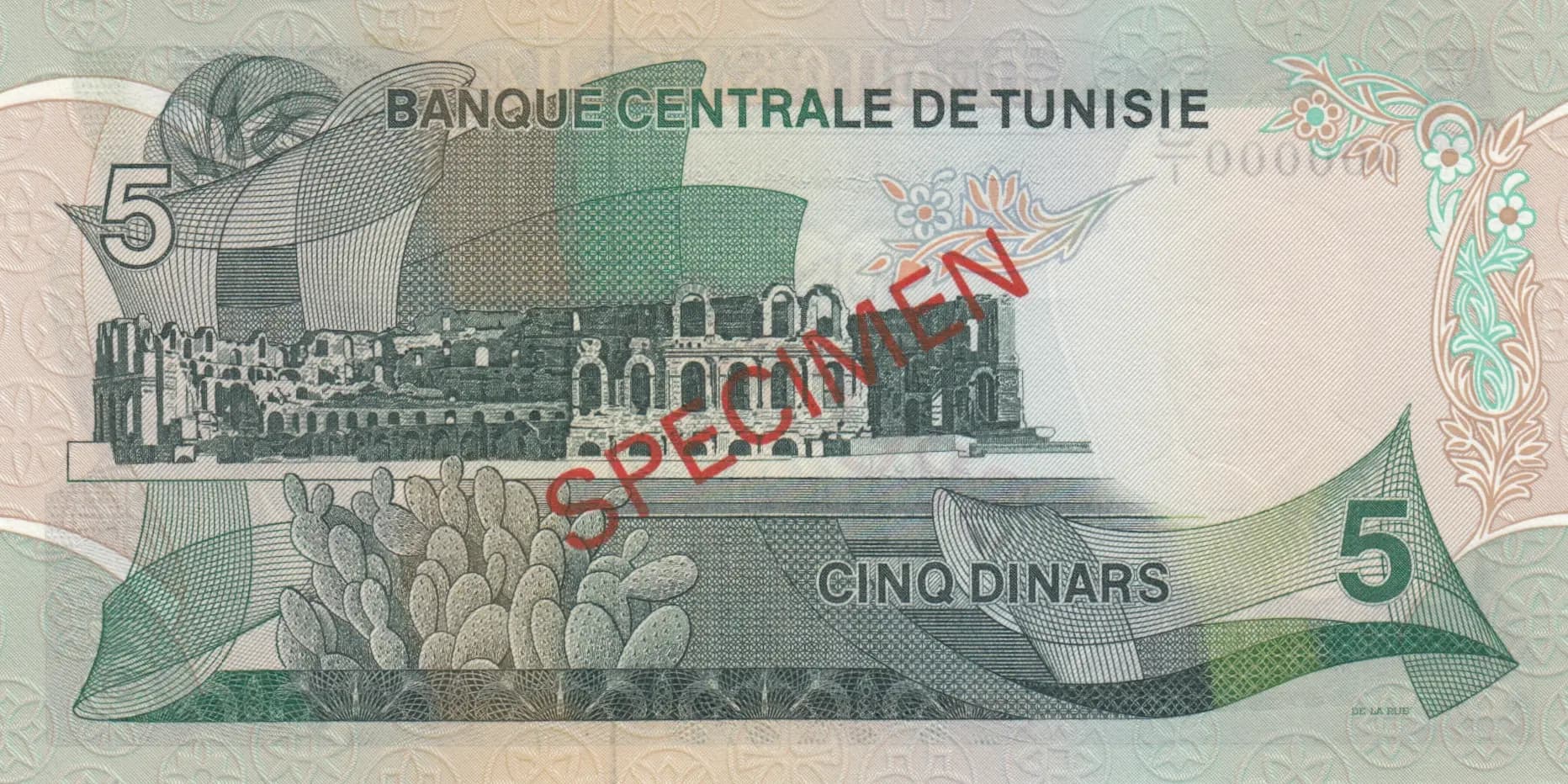
This is a 1972 Tunisian 5 dinars specimen note from the Banque Centrale de Tunisie, printed by De la Rue in London. The note features a portrait of President Habib Bourguiba on the obverse and the magnificent El-Djem amphitheatre on the reverse, both rendered in fine engraved detail with a pleasing palette of greens, pinks, and beige tones. As an uncirculated specimen with the characteristic red SPECIMEN overprint, this note exhibits sharp printing, clean surfaces, and no signs of circulation or wear, making it an attractive example for collectors of North African currency.
Common. Specimen notes from this era, while not circulating in commerce, were produced in sufficient quantities for distribution to banks, collectors, and institutions. The eBay market data showing a PMG 53-graded circulated example selling for $385 is notable, but UNC specimens typically catalog at $40 (per 2019 values), and specimen notes are generally more available than their circulated counterparts due to their preservation in institutional holdings. The absence of rarity designations in PMG population records and the modest catalog values indicate this is a standard specimen issue without scarcity.
This note was issued during the early 1970s under President Habib Bourguiba's rule, a period of nation-building and modernization in post-independence Tunisia. The choice to feature Bourguiba—Tunisia's first president and architect of independence—on the obverse underscores his central importance to the nation's identity. The reverse's depiction of the El-Djem amphitheatre, one of North Africa's most impressive Roman-era structures, reflects Tunisia's rich classical heritage and cultural pride during this era of economic development and institutional consolidation.
The obverse features a formal three-quarter profile portrait of President Habib Bourguiba positioned at right, depicted in engraved style wearing a business suit and tie. To the left is a modern industrial or agricultural facility with distinctive architectural features, representing Tunisia's modernization efforts. The reverse showcases the El-Djem amphitheatre (Thysdrus), a second-century Roman structure featuring multiple tiers of arches—one of the best-preserved amphitheatres from the Roman world. A prickly pear cactus plant is depicted in the lower left of the reverse. Both sides feature ornamental floral corner motifs in turquoise and green, decorative guilloche patterns, and fine geometric security patterns throughout the background, typical of high-quality security printing.
FRONT: 'البنك المركزي التونسي' (Banque Centrale de Tunisie / Central Bank of Tunisia) in Arabic script at top; denomination '5' in numeric form; date '3-8-1972' (3 August 1972); serial numbers in top left and bottom right corners (specimen examples show '000000'); 'SPECIMEN' in large red overprint across center. BACK: 'BANQUE CENTRALE DE TUNISIE' (Central Bank of Tunisia) in French at top; 'CINQ DINARS' (Five Dinars) in French; denomination '5' appears in multiple locations; 'SPECIMEN' in large red overprint across center.
Intaglio engraving (recess printing), characteristic of security banknote production. The note was printed by De la Rue, London (marked as TDLR), one of the world's premier security printers. The detailed fine-line work visible on the portrait, architectural elements, decorative borders, and background patterns are hallmarks of intaglio engraving, which produces the tactile raised impressions and sharp detail security banknotes require.
This is cataloged as Pick P-68s, the specimen variety of the 5 dinars 1972 note. The 's' designation indicates this is a specimen note, distinguished by the red SPECIMEN overprint visible across both sides and the use of placeholder serial numbers (000000). The printer marking shows (T)DLR (De la Rue, London). PMG has recorded variants P-68a and P-68a* (likely indicating different printer markings or serial number characteristics), though the specimen variety (P-68s) represents a distinct issue type from the standard circulation notes. The date 3.08.1972 (3 August 1972) is consistent across examples.