5 dinars 1972
Market Prices
16 salesAbout This Note
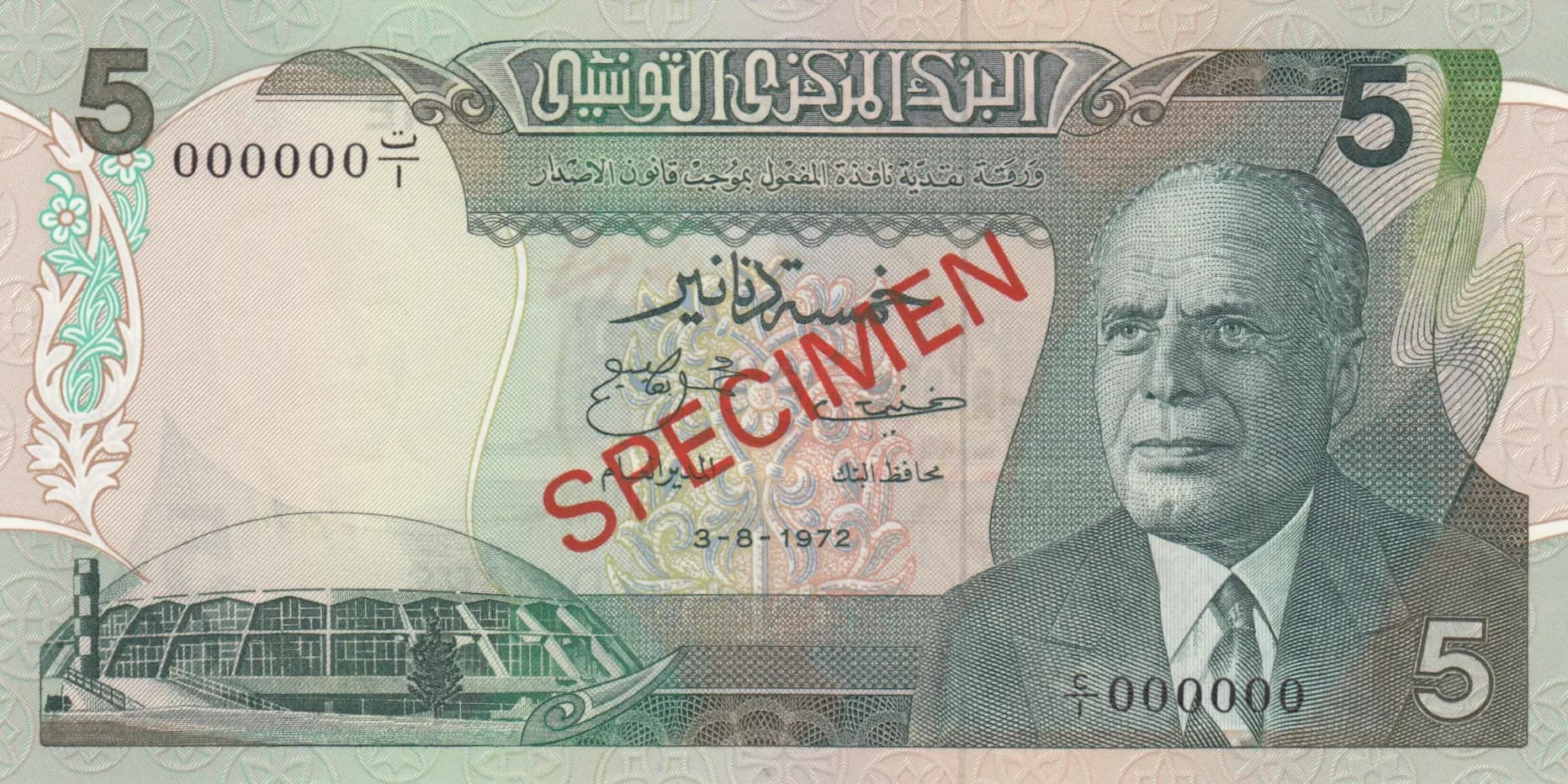
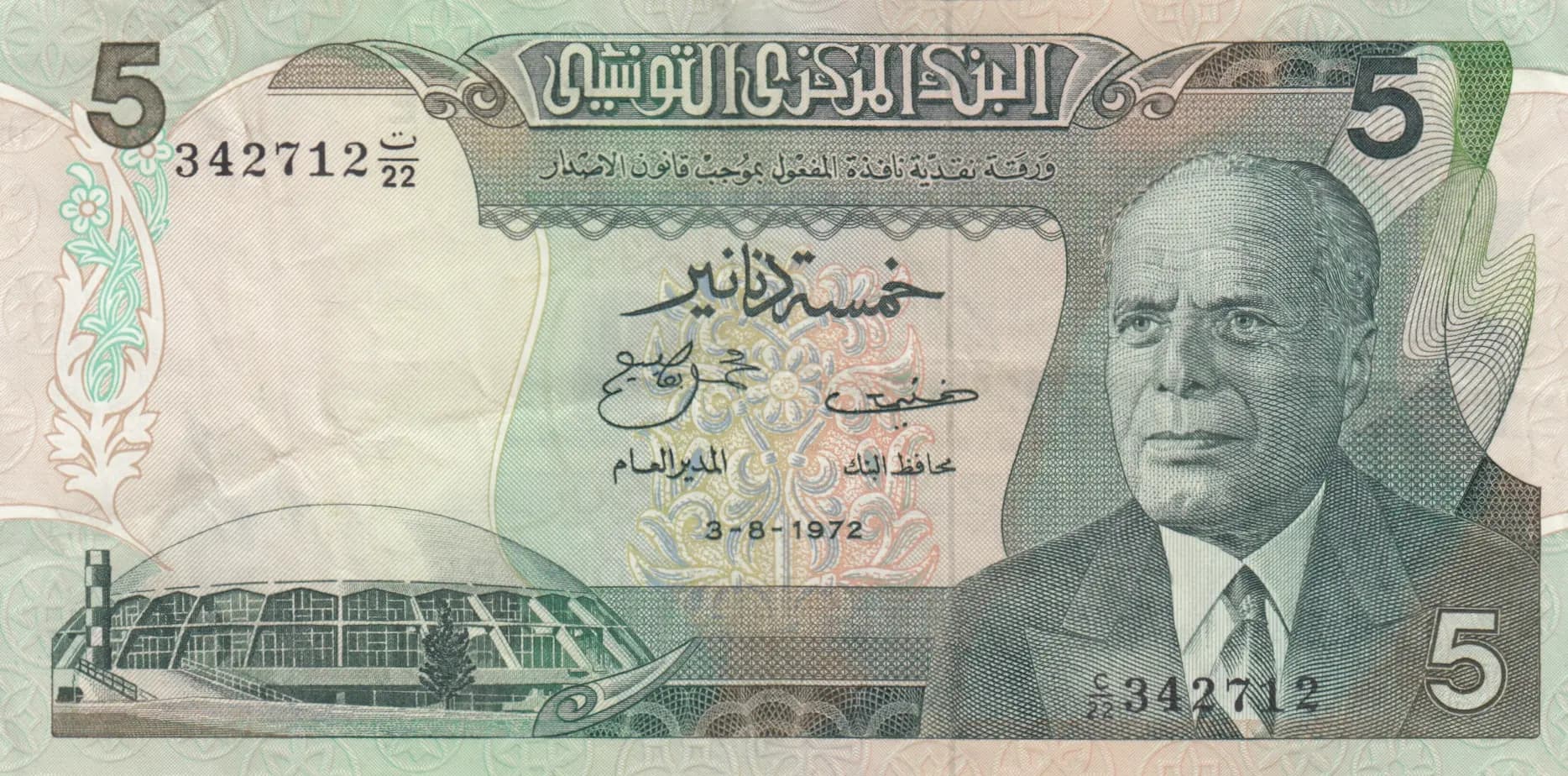
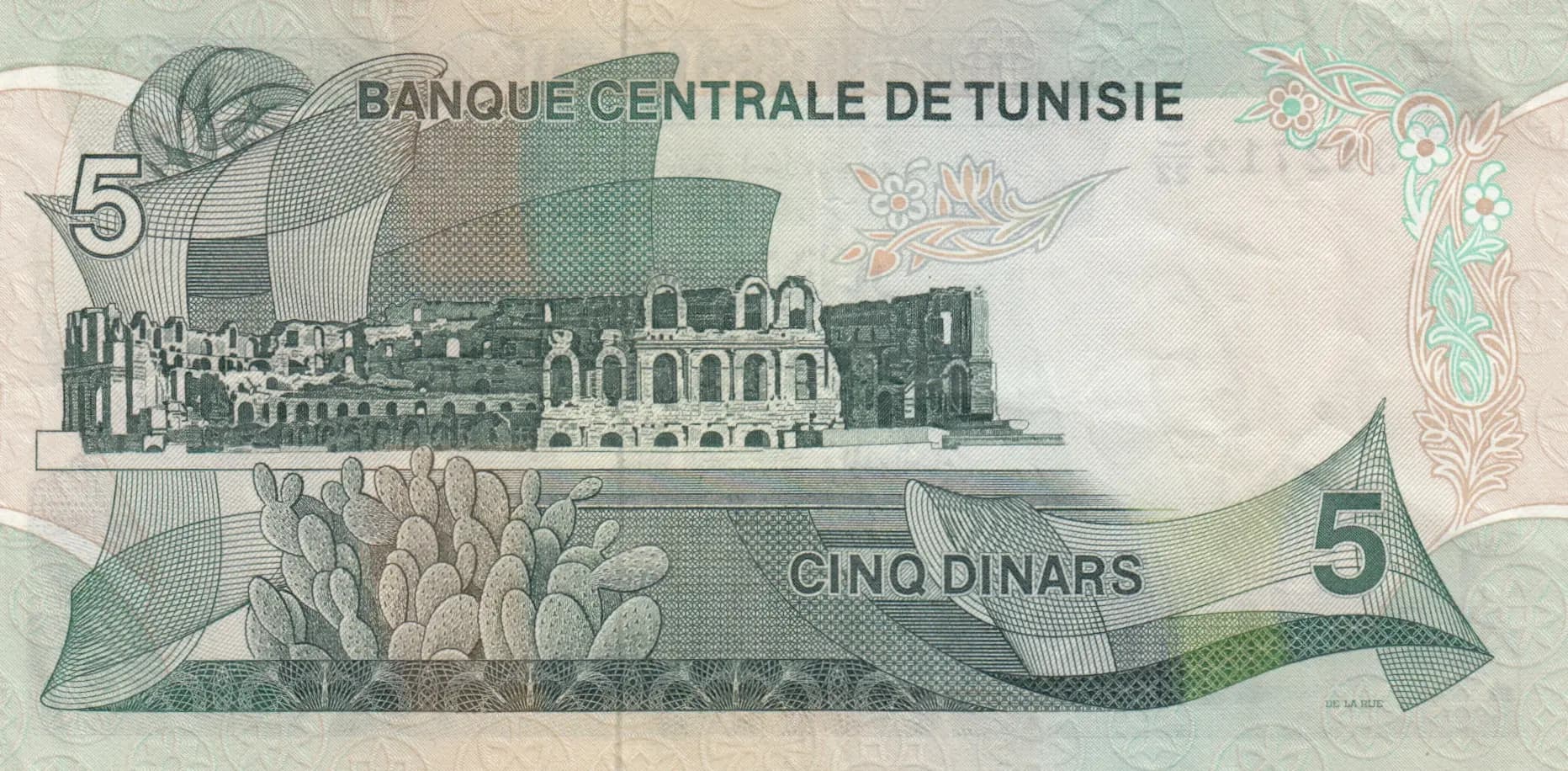
This is a crisp, well-preserved example of the 1972 Tunisian 5 Dinars (P-68a) issued by the Banque Centrale de Tunisie and printed by De la Rue in London. The note features a striking green and multicolor design with a formal portrait of President Habib Bourguiba on the obverse and the iconic El-Djem amphitheatre on the reverse, complemented by period-appropriate ornamental engraving and security features. In VF condition, this note represents a solid mid-range collector piece, with market data suggesting values around $6-$15 depending on eye appeal and exact condition nuances.
Common. This note is a regular issue from a major African central bank with a substantial print run typical of standard circulation denominations in 1972. eBay market data over the past decade shows consistent sales activity across multiple condition grades (VG to UNC), with VF examples selling regularly in the $6-$15 range. The 2019 catalogue value for VF is $15, further confirming widespread availability. There is no historical evidence of recalls, short print runs, or scarcity factors that would elevate this to uncommon or rare status.
The 1972 issue marks a significant period in post-independence Tunisia under President Habib Bourguiba's leadership, with the president's portrait prominently featured as a symbol of national identity and stability. The reverse depicts El-Djem (ancient Thysdrus), one of North Africa's most important Roman amphitheatres and a UNESCO World Heritage site, reflecting Tunisia's pride in its Greco-Roman heritage. The bilingual inscriptions (Arabic and French) underscore Tunisia's dual linguistic and cultural identity during this transitional period in the early 1970s.
The obverse features a formal three-quarter profile portrait of President Habib Bourguiba positioned on the right side, dressed in a business suit and tie, rendered with fine engraving detail. To the left is a modern architectural structure with a distinctive sloped/pitched roof, representative of contemporary Tunisian institutional or administrative buildings. Ornamental floral patterns frame the left margin, and the composition is anchored by the denomination '5' in the top corners, all set against a green-dominant multicolor underprint with intricate guilloche patterning. The reverse presents the El-Djem amphitheatre, a monumental Roman structure characterized by multiple levels of arched windows and crenellated fortification walls, rendered in detailed architectural illustration. A stylized eagle or bird figure appears in the upper left corner, while a prickly pear cactus (Opuntia) plant—a symbol of Tunisia and North Africa—is depicted in the lower left, accompanied by decorative floral borders on the right margin.
Front Side: 'البنك المركزي التونسي' (Banque Centrale de Tunisie / Central Bank of Tunisia); 'خمسة دنانير' (Five dinars); 'محافظ البنك المركزي' (Governor of the Central Bank); Date: '23-8-1972' (23 August 1972); Serial number: '342712' with suffix '22'. Back Side: 'BANQUE CENTRALE DE TUNISIE' (Central Bank of Tunisia); 'CINQ DINARS' (Five dinars). Denomination numeral '5' appears in multiple corners on both sides.
Intaglio engraving (copperplate), a hallmark of De la Rue's security printing. The visual analysis confirms the presence of fine line engraving work, intricate guilloche patterns, and detailed architectural and botanical illustrations typical of high-security banknote production. The printer mark 'TDLR' (Thomas De la Rue, London) appears on the note as indicated in the watermark and security documentation.
This is catalogued as P-68a (printer mark TDLR). The PMG population report indicates two variants for the base Pick number P-68: the standard P-68a and P-68a* (likely a replacement note or starred variety). The observed serial number format and date of 23 August 1972 are consistent with the standard P-68a variety. No overprints or unusual serial number prefixes indicating replacement currency are visible in the visual analysis, confirming this as a standard P-68a issue rather than a starred replacement variant (P-68a*).