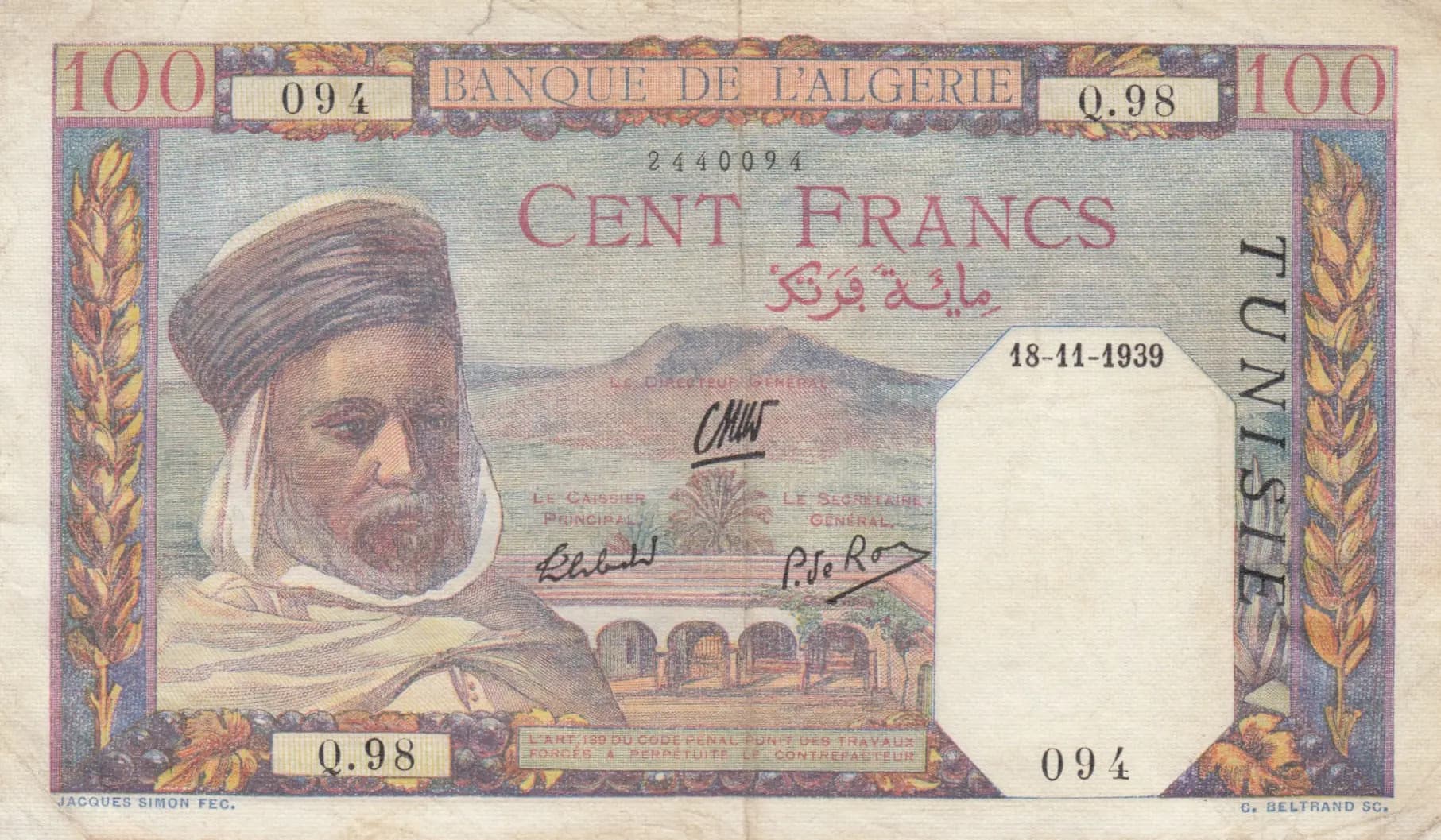
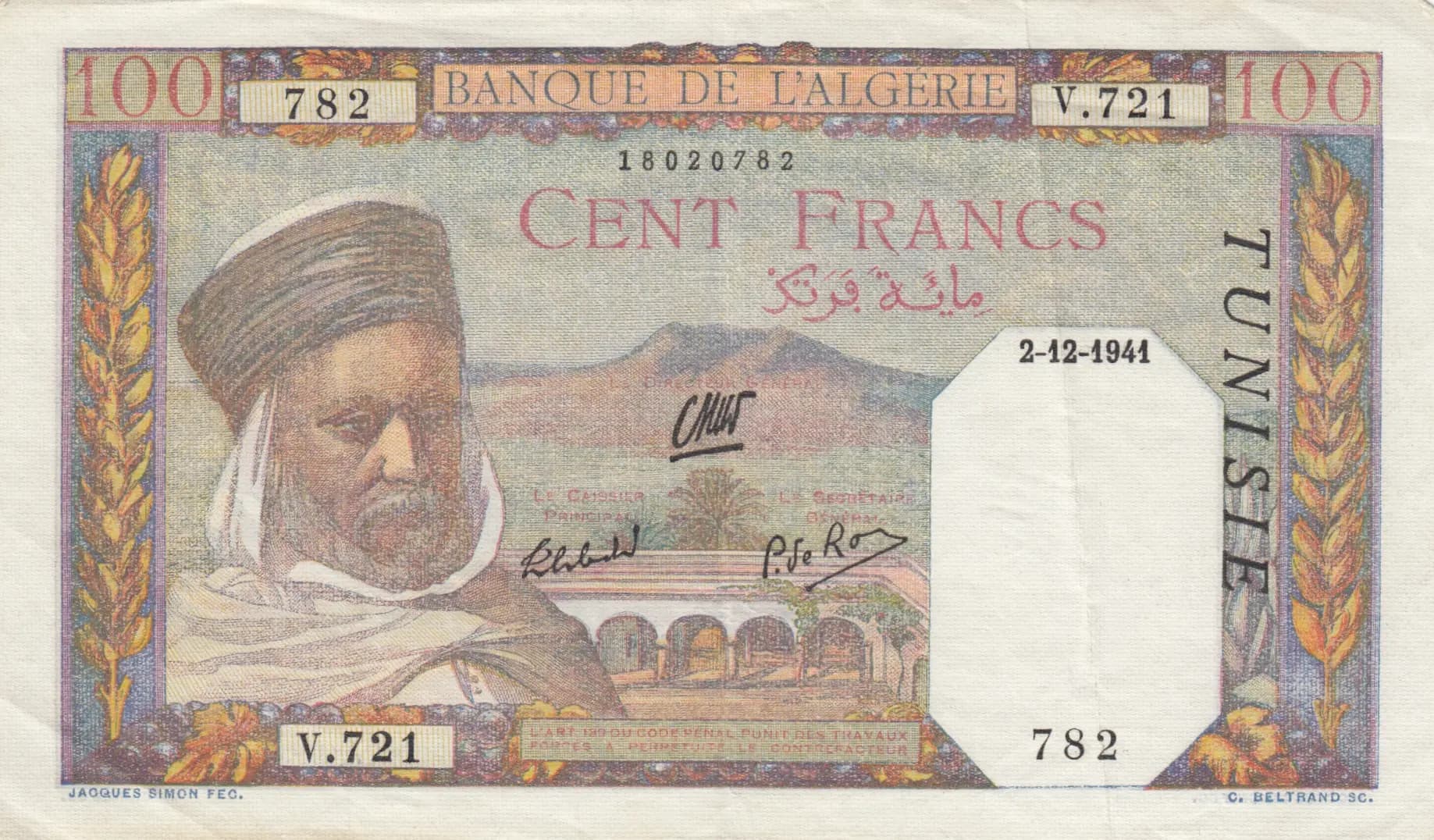
100 francs 1941
“31.03.41”
Market Prices
11 salesAbout This Note
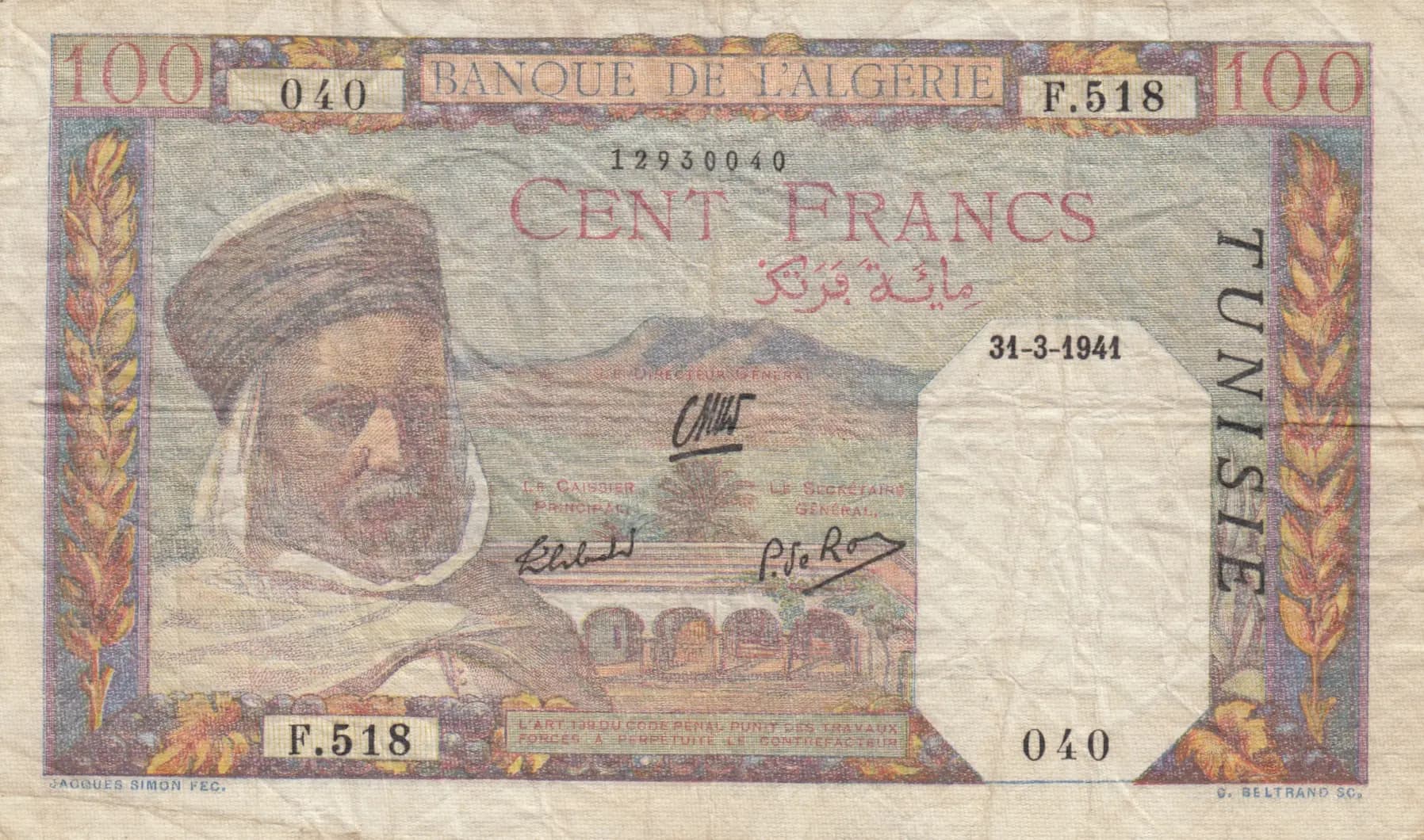
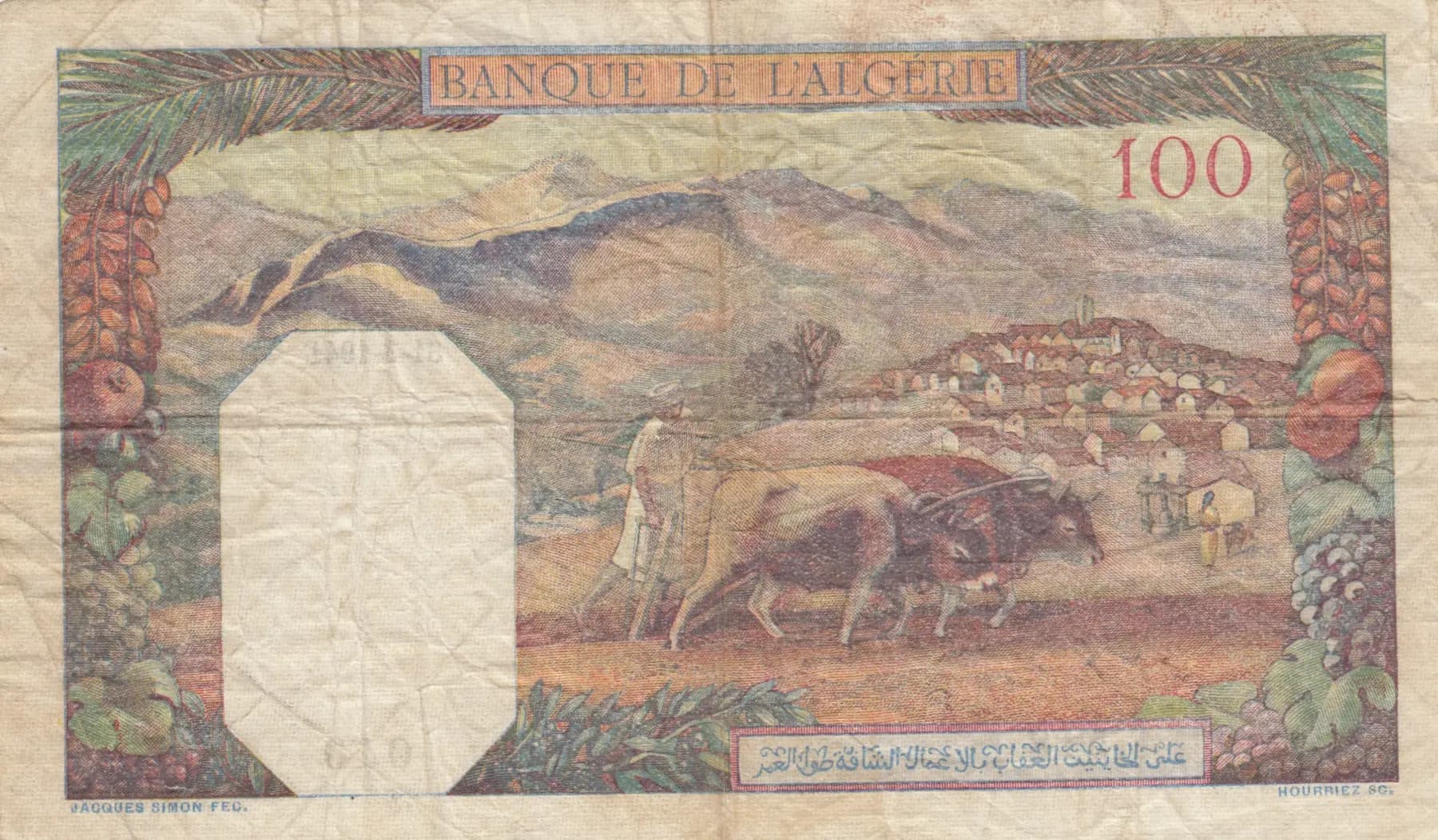
This is a 100 Francs banknote issued by the Banque de l'Algérie on March 31, 1944, representing the Tunisian overprint variant (Pick P-13a). The note displays the characteristic multicolor intaglio design with a portrait of a man in traditional North African dress on the obverse and an agricultural scene on the reverse featuring oxen plowing with mountainous landscape. In Fair condition, the note exhibits significant wear, creasing, and foxing consistent with circulation history, with notable white rectangular obscured areas on both sides, adding to its aged appearance and collector interest as a mid-war French colonial issue.
Common. Despite its age and the Fair condition of this specific example, the 100 Francs 1941 Tunisian issue (Pick P-13a) is fundamentally common in the broader numismatic market. eBay market data shows consistent sales across a range of conditions from 2009 to 2024, with Fair-condition notes typically selling for $14–$25 and VF notes ranging from $11–$46, indicating ready availability and steady but modest collector demand. The catalog 2016 valuation of $10 for Fine grade further confirms this is a collector-grade note without scarcity premium. Most French colonial banknotes from this period were issued in substantial quantities for circulation, and many survive today.
This banknote was issued during World War II when Tunisia, under French administration, experienced the tumultuous North African campaign. The agricultural imagery on the reverse—depicting oxen and field labor with palm fronds and settlement backdrop—reflects the economic importance of farming to the colonial Tunisian economy. The 1944 date and Banque de l'Algérie issuer mark a period when French colonial monetary authority was reasserting control in North Africa following the liberation campaigns, making this note a tangible artifact of the waning French colonial monetary system in the region.
The obverse features a left-facing portrait of a North African man wearing a traditional white turban or headwrap, representing the indigenous population of Tunisia. The design is framed by decorative wheat or laurel wreaths in gold/tan on vertical borders, with ornamental corner elements. The reverse depicts an allegorical scene of agricultural prosperity: a farmer or worker with oxen plowing a field in the foreground, set against a mountainous landscape with a hillside settlement visible in the background. Palm fronds border both sides of the reverse, symbolizing North African identity and tropical/Mediterranean climate. The palette of tan, purple, green, brown, red, and gold creates a visually rich multicolor composition characteristic of high-quality banknote intaglio work of this era.
FRONT: 'BANQUE DE L'ALGERIE' (Bank of Algeria), 'CENT FRANCS' (One Hundred Francs), '100' (Arabic numerals), 'مائة فرنك' (One Hundred Francs in Arabic), Serial: '12930040', Reference: 'F.518', Date: '31-3-1944' (March 31, 1944), 'CAISSIER PRINCIPAL' (Principal Cashier), 'SECRETAIRE GENERAL' (Secretary General), Artist: 'JACQUES SIMON FEC.' (Jacques Simon made/engraved), Engraver: 'BELTRAND SC' (Beltrand engraved). BACK: 'BANQUE DE L'ALGERIE' (Bank of Algeria), '100' (denomination), Arabic inscription relating to livestock/animal husbandry wealth, Artist: 'JACQUES SIMON FEC.' (Jacques Simon made/engraved), Engraver: 'HOURRIEZ SC' (Hourriez engraved).
This note was produced using intaglio engraving, evidenced by the intricate line work, fine detail reproduction, and the deep color saturation observed throughout both sides. The multicolor intaglio printing technique allowed for precise registration of multiple colors—tan, purple, green, brown, red, and gold—creating the complex design. The engravers Jacques Simon (designer/maker) and either Beltrand or Hourriez (sculptors) are credited on the note. As a Banque de l'Algérie issue, production was likely by the Banque de France's printing facilities or authorized French security printers of the era.
This note is specifically Pick P-13a, characterized by a watermark of a woman's head (as distinct from Pick P-13b, which features a bank title watermark). The visual analysis confirms this is a Tunisian overprint variant of the Algerian 100 Francs design (base Algeria P-85), as referenced in the catalog data. The serial number '12930040' with prefix 'F' and the specific date of March 31, 1944 (rather than the 1941 nominal date) suggests this note was from a later printing run during the wartime circulation period. PMG has graded variants of both P-13a and P-13b for this denomination; this specimen falls within the P-13a category.