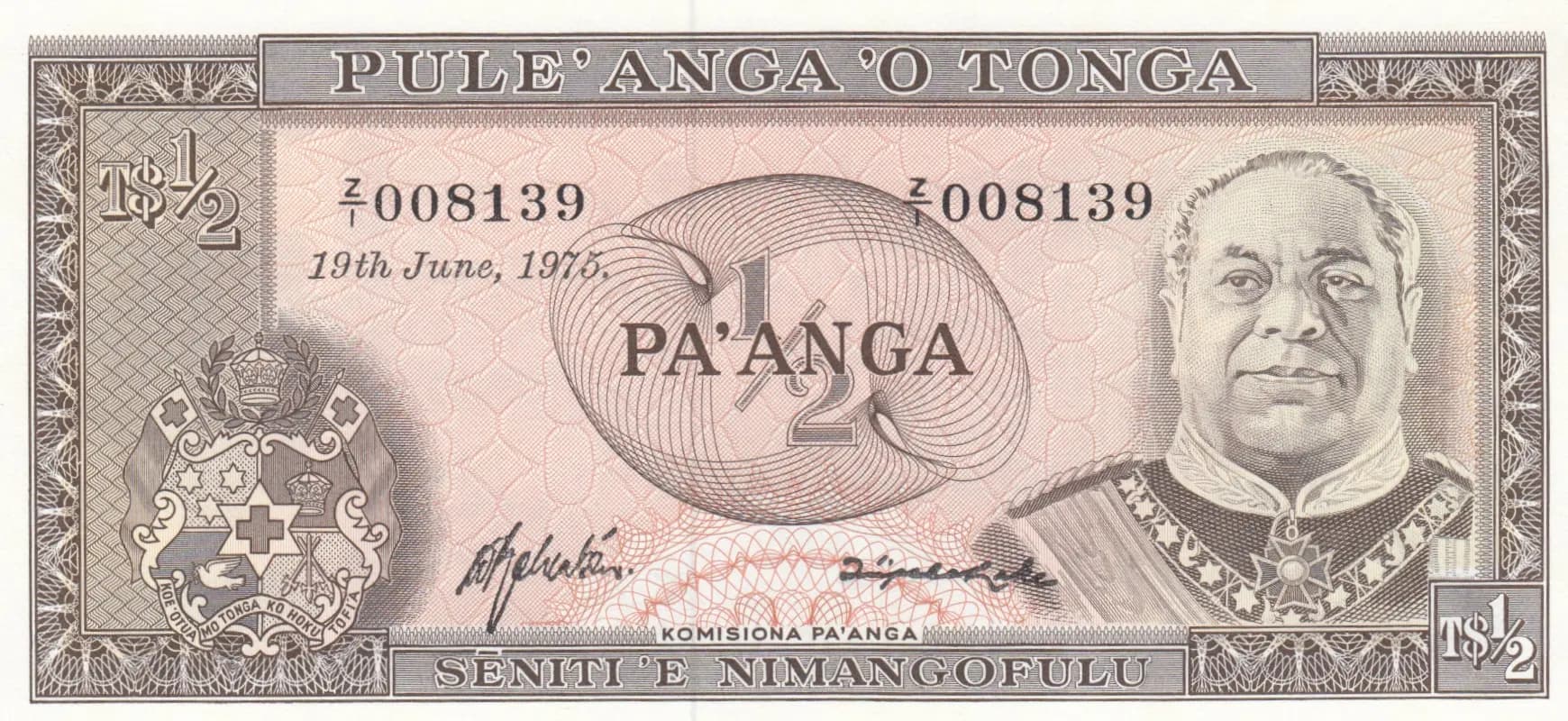
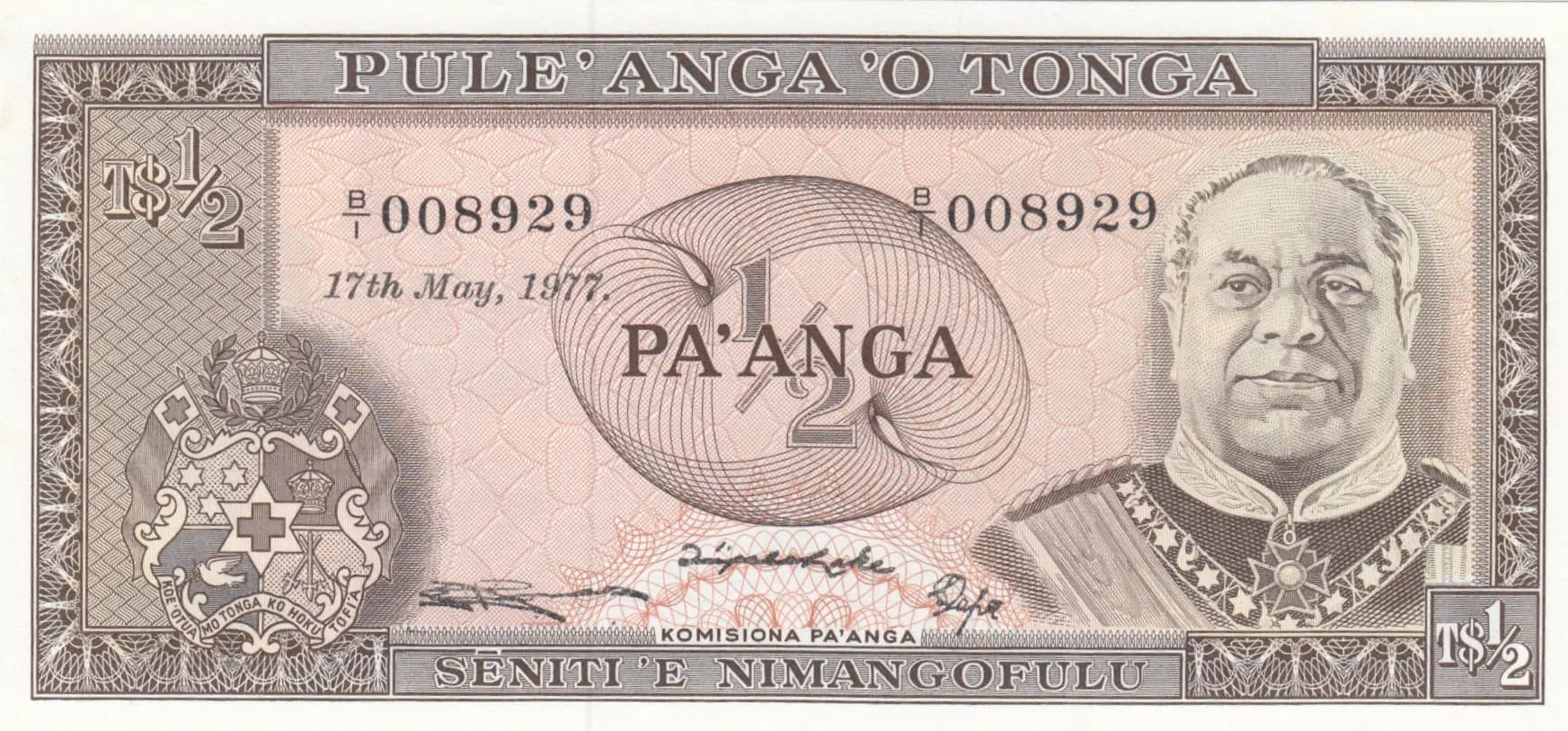
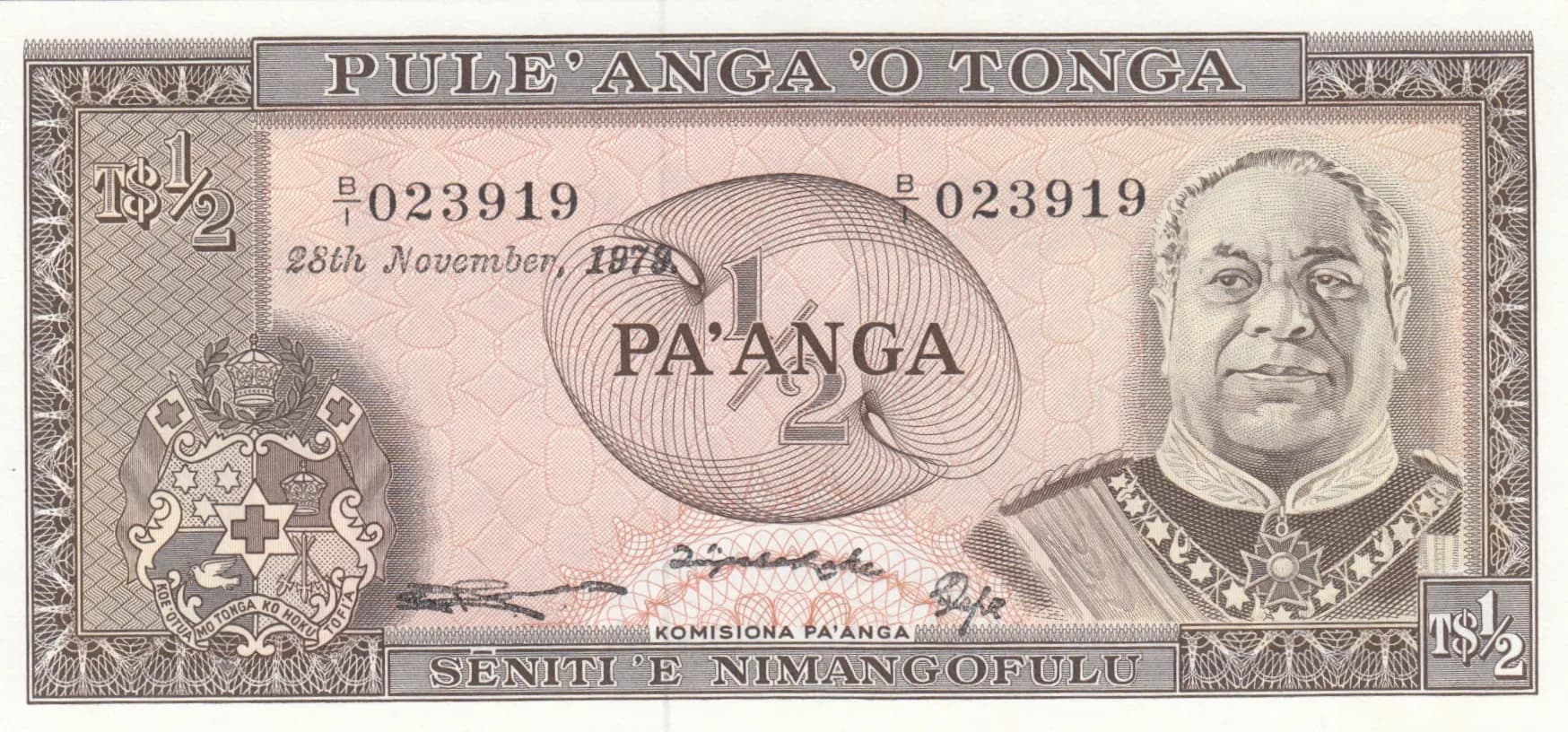
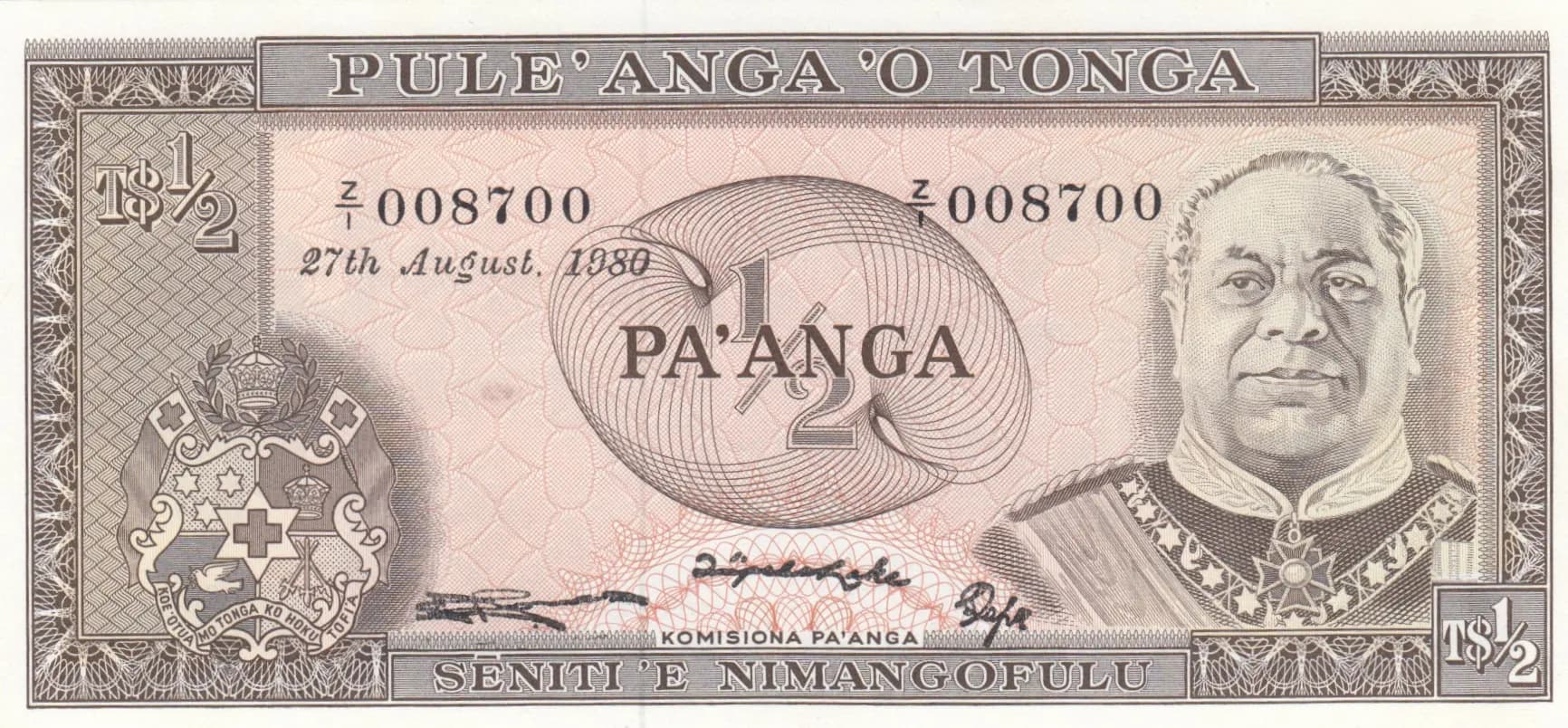
1/2 pa'anga 1980
Market Prices
9 salesAbout This Note
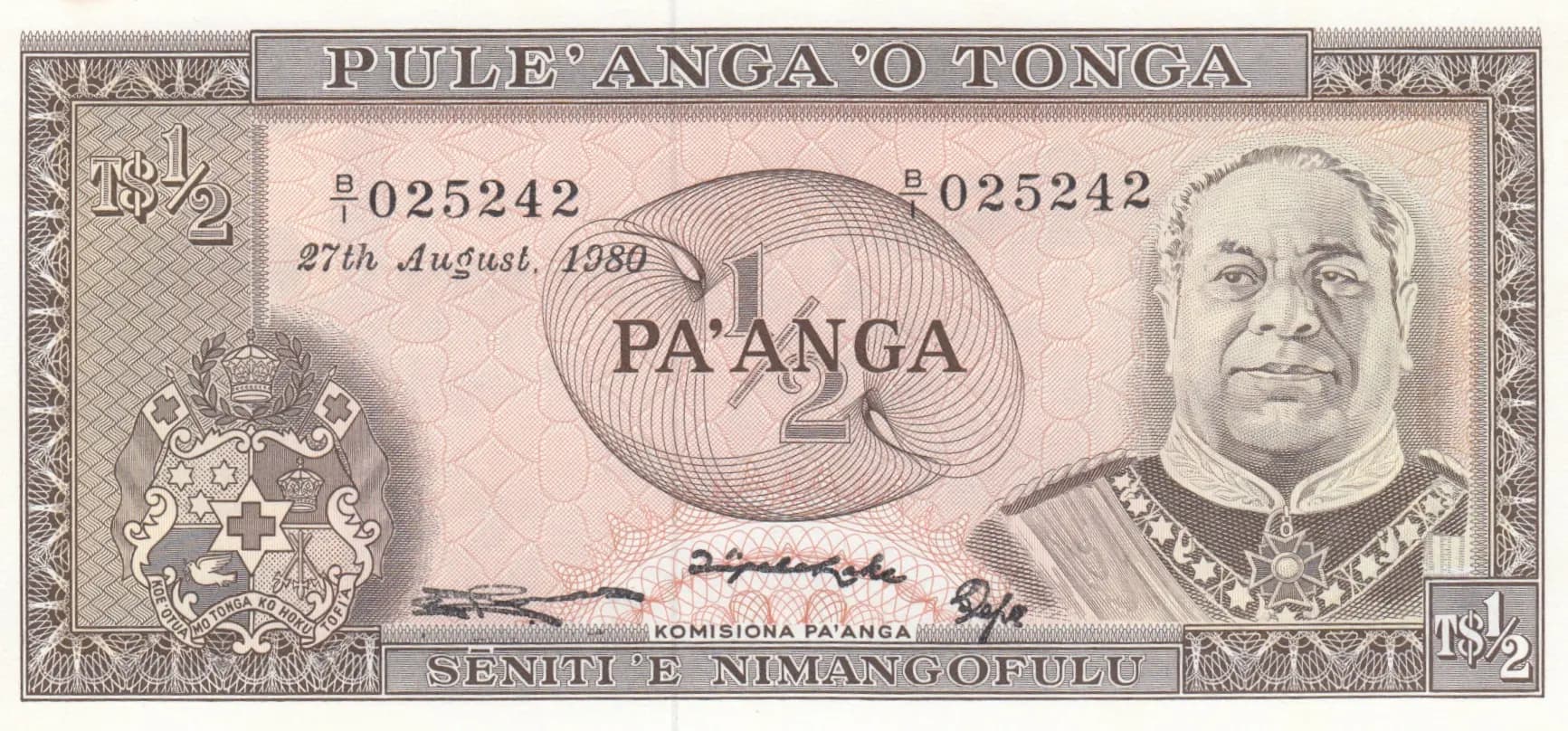
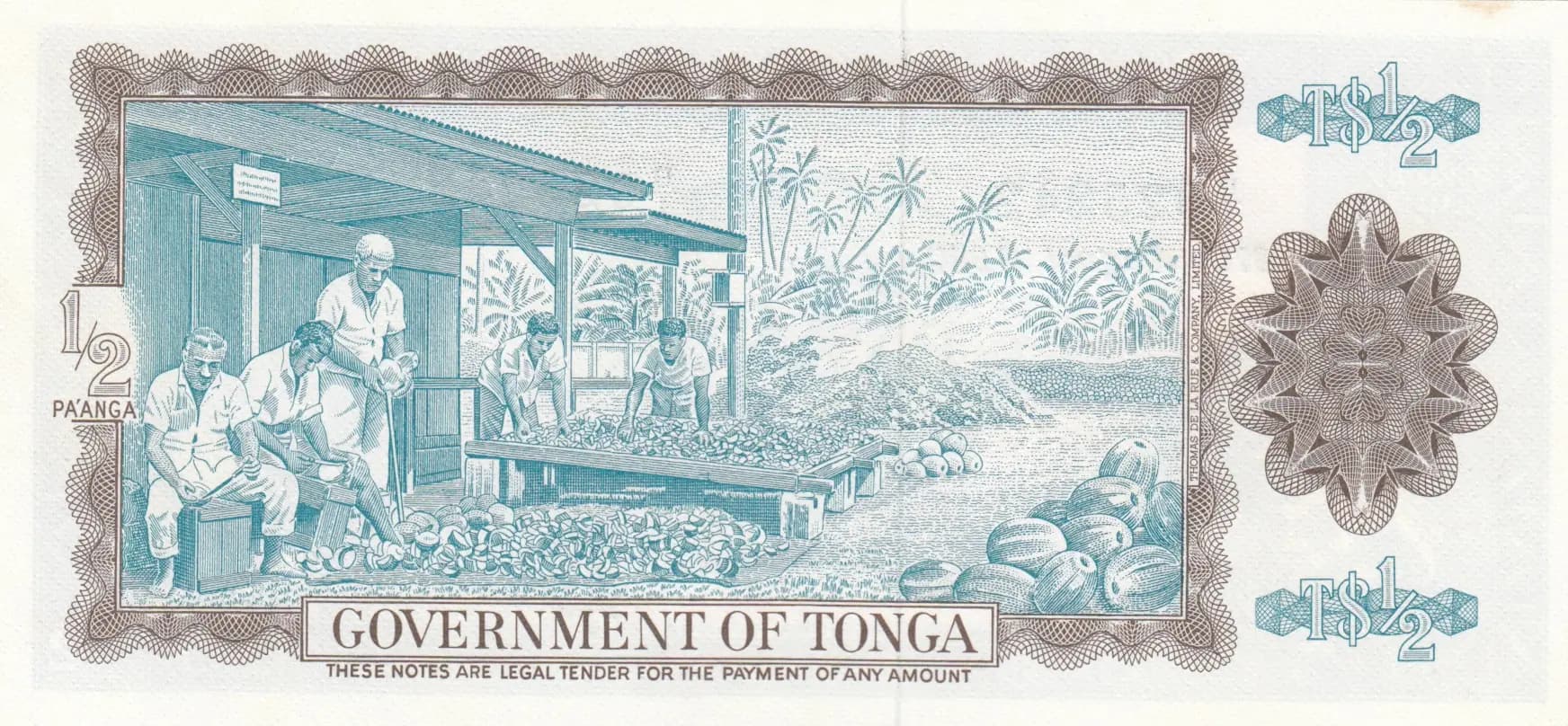
This is an uncirculated 1980 half pa'anga note from Tonga, featuring King Siaosi (George) Taufa'ahau IV Tupou on the obverse and a detailed vignette of coconut workers on the reverse. The note displays pristine condition with sharp, crisp printing throughout, no wear or creases, and exhibits the characteristic pale pink underprint with intricate geometric security patterns typical of Thomas de la Rue's production quality.
Common. Despite the specific 1980 date shown on this example, the 1/2 pa'anga note P-18c was issued across a multi-year span (1977-1983) with substantial print runs. eBay market data shows consistent sales of UNC examples in the $5-$12 range, with recent 2025 sales around $10.99, indicating robust supply and steady but modest demand typical of common Pacific island currency notes.
Issued during the reign of King Taufa'ahau IV (1965-2006), this 1980 note reflects Tonga's economic reliance on agricultural production, particularly coconut processing, which was central to the kingdom's export economy during this period. The imagery of workers processing coconuts on the reverse commemorates the labor-intensive agricultural heritage that sustained Tonga's economy in the late 20th century, while the king's portrait on the front reinforced the monarchy's central role in the nation's identity and governance.
The obverse features a formal portrait of King Siaosi (George) Taufa'ahau IV Tupou positioned on the right side, rendered in brown ink on a pale pink underprint. His image shows him in formal attire with decorative insignia befitting his royal status. On the left side is an elaborate heraldic coat of arms representing the Kingdom of Tonga, featuring a shield with crown and cross motifs typical of Tongan royal symbolism. A large ornate oval frame containing the numeral '2' (representing the half denomination) dominates the center. The reverse depicts a detailed scene of coconut workers in white clothing engaged in processing coconuts within a wooden structure, with tropical palm trees in the background, rendered in brown and teal/blue inks. Two ornamental rosette designs in teal appear on the right side of the reverse. Multiple serial numbers are positioned throughout the note for verification purposes.
Front side: 'PULE'ANGA 'O TONGA' (Kingdom of Tonga), 'T$1/2' (denomination), 'PA'ANGA' (currency unit), 'KOMISIONA PA'ANGA' (Currency Commission), 'SENITI 'E NIMANGOFULU' (Fifty cents), '27th August, 1980' (issue date), and serial number 'B 025242'. Back side: 'T$1/2' (denomination), 'PA'ANGA' (currency unit), 'GOVERNMENT OF TONGA', and 'THESE NOTES ARE LEGAL TENDER FOR THE PAYMENT OF ANY AMOUNT'.
This note was produced by Thomas de la Rue, London, using intaglio engraving (line engraving/recess printing), evidenced by the fine detailed line work, intricate geometric background patterns, and sharp reproduction of portraiture and architectural elements visible throughout both sides. The multi-color printing with precise registration between the pink underprint and brown/teal overprintings demonstrates de la Rue's advanced security printing capabilities of the period.
This specimen is dated 27 August 1980, representing one of several date varieties known for Pick-18c (other documented dates include 12 January 1977, 17 May 1977, 10 September 1979, 31 July 1981, 17 August 1982, and 29 July 1983). The serial number prefix 'B' indicates this is a regular issue note (replacement notes carry 'Z/1' prefix). Signature varieties are noted for this issue. The PMG population report confirms four cataloged variants exist for this base Pick number (P-18b, P-18b*, P-18c, P-18c*), with the asterisk variants typically indicating replacement notes.