50 escudos 1967 specimen
“violet colour”
About This Note
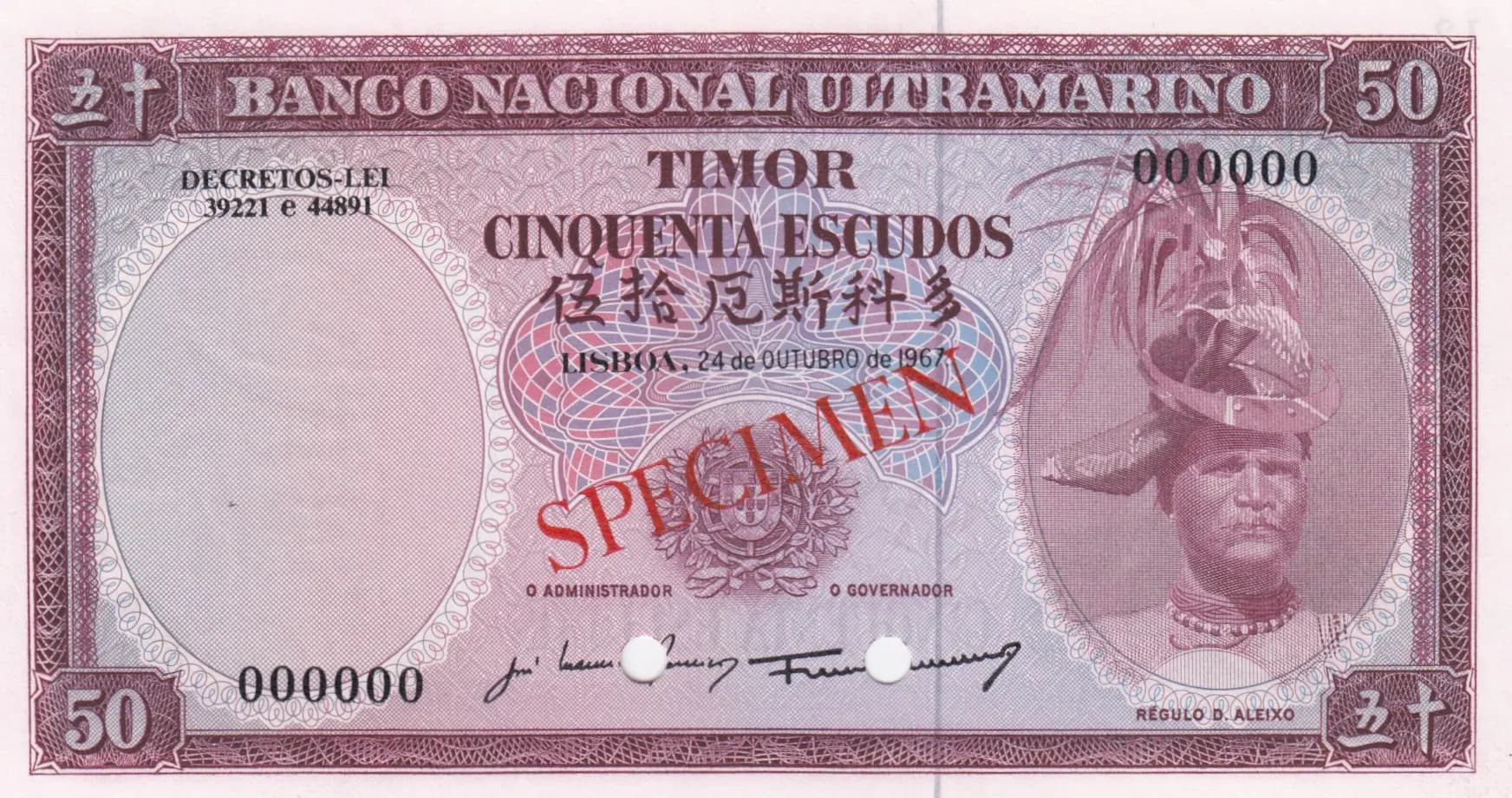
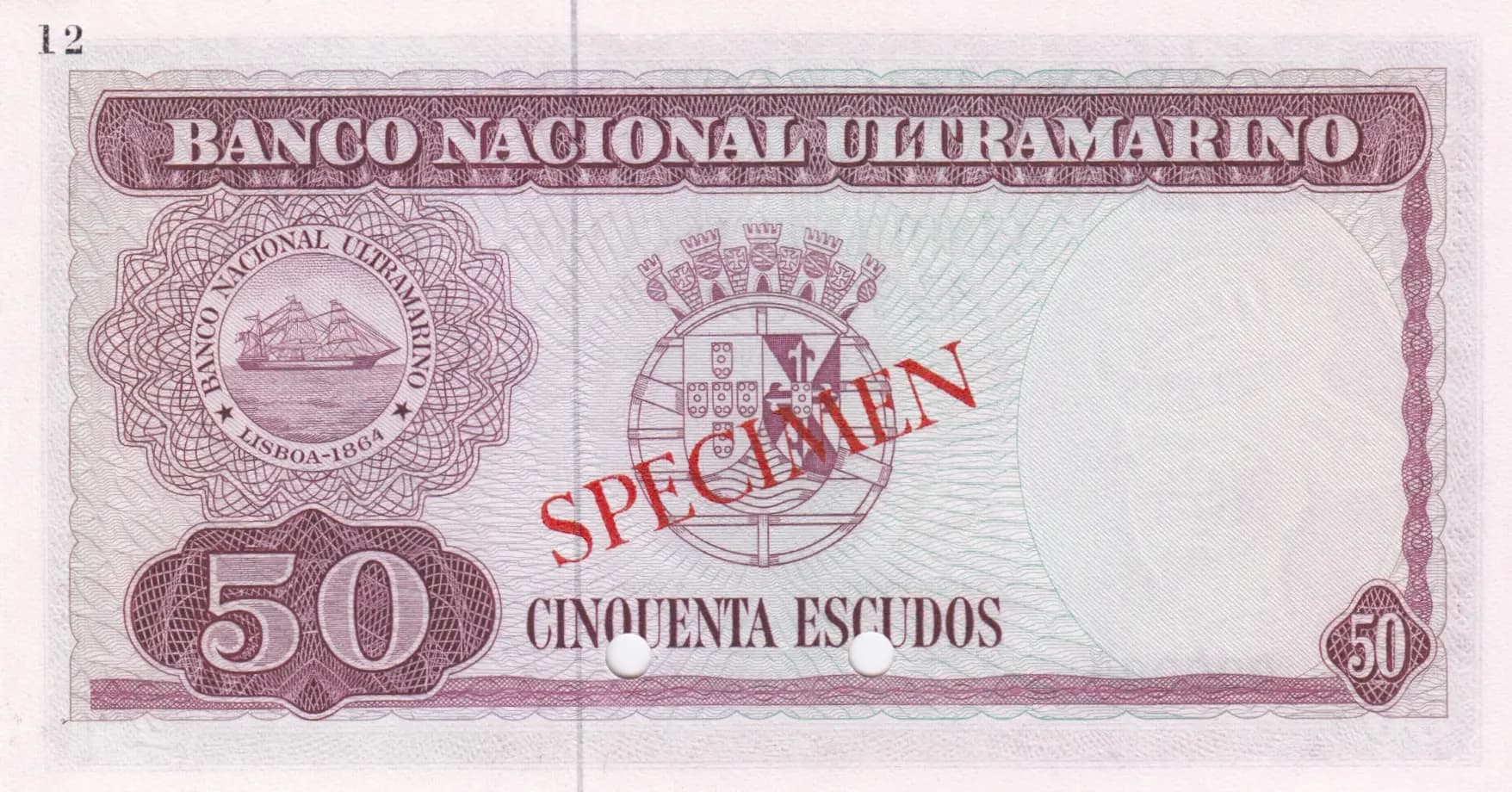
This is an exceptional uncirculated specimen note of the 50 Escudos from Timor issued in 1967 by the Banco Nacional Ultramarino. The note features striking mauve and burgundy coloring with intricate guilloche security patterns throughout, displaying a formal portrait on the obverse and a historically significant sailing ship (dated Lisboa-1864) on the reverse, symbolizing Portuguese maritime heritage in the colonial period. As an unlisted Pick number specimen with diagonal red 'SPECIMEN' overprint and characteristic punch holes, this represents an important variant from Timor's brief independent monetary history before its 1975 integration.
Scarce. While the 1967 Timor 50 escudos in standard circulation form would be common, this specific unlisted Pick number specimen variant with the diagonal red 'SPECIMEN' overprint and cancellation punch holes represents a much smaller subset of the original printing. Specimen notes by definition were produced in limited quantities for distribution to banks and government institutions, never entering circulation. The fact that this variety is not assigned a Pick catalog number despite being from a major issuer indicates it was either a trial/non-standard printing or remains under-documented in standard numismatic references, adding to its scarcity among serious collectors.
Timor's 1967 escudo series was issued during the final decade of Portuguese colonial rule, reflecting Portugal's "Estado Novo" regime's continued control of overseas territories. The inclusion of a sailing ship dated 1864 and prominent coat of arms on the reverse emphasizes the Banco Nacional Ultramarino's role in colonial commerce and Portugal's maritime dominance, while the globe design underscores the bank's position as the financial institution of Portugal's dispersed overseas empire. This note predates Timor's independence by eight years and represents the last standard circulating currency issued under Portuguese administration for the territory.
The obverse features a right-profile portrait of a dignitary wearing formal military headwear with plumage, likely representing a colonial administrator or Timorese régulo (traditional chief) of significance. The center displays an ornate globe or world map design overlaid with decorative medallions and stars, symbolizing the global reach of the Banco Nacional Ultramarino. The reverse showcases a detailed circular medallion on the left containing an engraved sailing ship (likely a Portuguese merchant or naval vessel from the colonial era), dated 'Lisboa-1864,' flanked by a globe design and Portuguese coat of arms featuring castles, spheres (armillary symbols), and a crown on the right side. Both sides are dominated by extensive guilloche engraving with geometric border patterns, creating sophisticated anti-counterfeiting visual security. The specimen status is marked with diagonal red 'SPECIMEN' overprint and two circular cancellation punch holes.
FRONT: 'BANCO NACIONAL ULTRAMARINO' (National Overseas Bank), 'TIMOR' (Timor), 'CINQUENTA ESCUDOS' (Fifty Escudos), 'DECRETOS-LEI 39221 e 44891' (Decree-Laws 39221 and 44891), 'LISBOA, 24 de OUTUBRO de 1967' (Lisbon, 24 October 1967), 'SPECIMEN' (Specimen), 'O ADMINISTRADOR' (The Administrator), 'O GOVERNADOR' (The Governor), 'RÉGULO D. ALEIXO' (Régulo D. Aleixo), '50' (denomination), '000000' (specimen serial number). BACK: 'BANCO NACIONAL ULTRAMARINO' (National Overseas Bank), 'CINQUENTA ESCUDOS' (Fifty Escudos), 'LISBOA-1864' (Lisbon-1864, marking the historical sailing vessel), 'SPECIMEN' (Specimen), '50' (denomination).
Intaglio engraving (recess printing), evidenced by the fine, intricate guilloche patterns, detailed line work visible throughout, and the characteristic depth and precision of the security printing. The multi-layered security design with complex geometric patterns and the detailed circular medallion engraving with the sailing ship are hallmarks of high-security intaglio production. The note was almost certainly produced by Banco Nacional Ultramarino's contracted security printer, likely Portuguese Casa da Moeda or a European security printing house contracted by the Portuguese central bank.
This is a SPECIMEN variety, identifiable by: (1) diagonal red 'SPECIMEN' overprint across both obverse and reverse, (2) two circular punch holes near the center (standard cancellation marking for specimens), and (3) all-zero serial number '000000' typical of specimen production. The note is dated 24 October 1967 (Lisbon) per the decree authorizing issuance. The signature line references 'RÉGULO D. ALEIXO' as The Governor and 'O ADMINISTRADOR' (The Administrator), suggesting this may represent a variant with specific official signatures. The unlisted Pick catalog status suggests this specimen variety may not be fully documented in the standard Pick catalog and could represent a trial printing or transitional issue during the final years of Portuguese colonial currency production for Timor.