10 avos 1940
Market Prices
About This Note
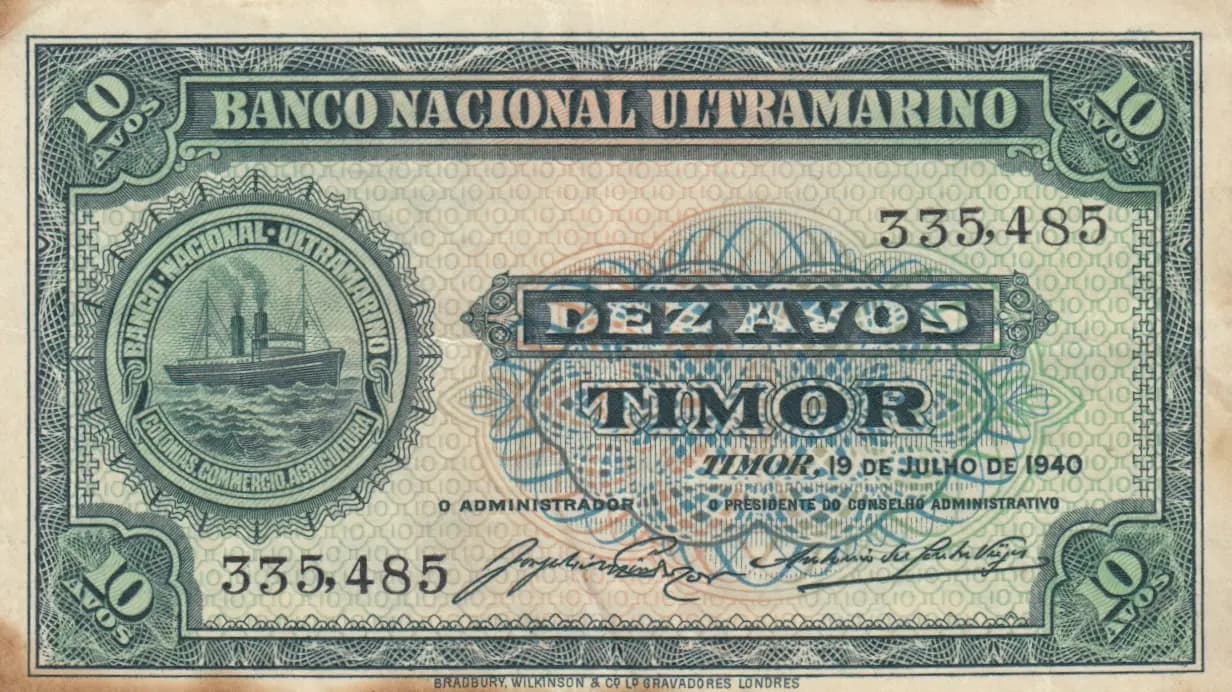
This is a Fine-grade example of the scarce 1940 Banco Nacional Ultramarino 10 avos from Timor, featuring the iconic steamship medallion on the obverse and ornate green typography on both sides. The note displays age-appropriate patina with visible foxing and cream discoloration, but retains clear, well-defined printing throughout. As a Portuguese colonial currency from Portuguese Timor issued during World War II, this denomination represents an important piece of numismatic history from a territory with a complex colonial legacy.
Scarce. While not extremely rare, the 10 avos denomination from the 1940 Timor issue appears less frequently in the market than higher denominations. The eBay price tracking data shows VG examples around $130, VF examples ranging $129-$325, and XF examples at $190-$330, with catalog values (2016) placing VF at $85 and UNC at $225. The Fine-grade condition of this note positions it within the mid-range of market pricing. Portuguese colonial currency from Timor has limited collector demand compared to other colonial currencies, and surviving examples in circulated grades are moderately available but not common.
The Banco Nacional Ultramarino issued this note in 1940 during Portugal's Estado Novo period under Salazar, when Portugal maintained tight control over its overseas territories. The steamship depicted in the circular medallion symbolizes Portugal's maritime heritage and colonial commercial networks, reflecting the bank's role in facilitating trade within the Portuguese Empire. The note's Portuguese-language inscriptions and formal administrative references underscore Timor's status as Portuguese Timor during this era, before the territory's eventual independence in 2002.
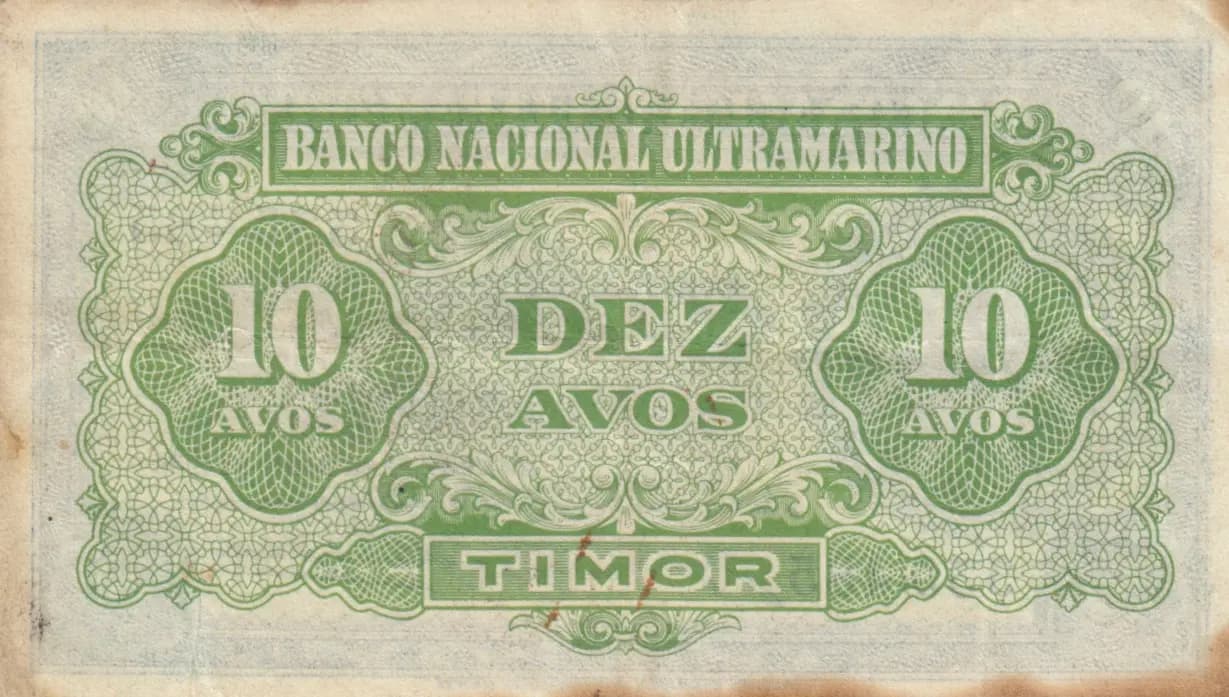
The obverse features a dominant circular medallion on the left containing a detailed engraving of a multi-masted steamship sailing on water, symbolizing Portugal's maritime and commercial dominance. This medallion is surrounded by ornate decorative borders featuring fine geometric and floral guilloche patterns in green. The denomination appears in corner ornaments, and the center displays administrative text with signature lines for official authorization. The reverse presents a symmetrical, text-centric design with 'BANCO NACIONAL ULTRAMARINO' and the denomination 'DEZ AVOS' / '10 AVOS' prominently displayed within elaborate scrollwork and cartouches. The entire note employs intricate line engraving with geometric borders typical of high-security currency production of the 1940s era.
FRONT SIDE: 'BANCO NACIONAL ULTRAMARINO' (National Overseas Bank); 'DEZA VOS' / 'DEZ AVOS' (Ten Avos); 'TIMOR' (Timor); 'TIMOR - 19 DE JULHO DE 1940' (Timor - 19th of July 1940); 'O ADMINISTRADOR' (The Administrator); 'PRESIDENTE DO CONSELHO ADMINISTRATIVO' (President of the Administrative Council); Serial number '335485'; 'BRADBURY, WILKINSON & CO LDS GRAVADORES LONDRES' (Bradbury, Wilkinson & Co Ltd Engravers London). BACK SIDE: 'BANCO NACIONAL ULTRAMARINO' (National Overseas Bank); '10 AVOS' / 'DEZ AVOS' (Ten Avos); 'TIMOR' (Timor).
Intaglio (line engraving) printing executed by Bradbury, Wilkinson & Co Ltd of London, a renowned British security printer. The note exhibits fine line engraving throughout, with complex guilloche patterns, geometric designs, and detailed scrollwork characteristic of intaglio production. The multi-color appearance results from the combination of green ink with the cream/beige paper stock and the intricate engraved line work, creating depth and anti-counterfeiting visual complexity.
This note carries serial number 335485. The Pick catalog lists P-13 as a single variant with no recorded sub-varieties in the PMG population report. The date of issue is fixed at 19 July 1940. Serial number ranges and signature varieties (if present) would require comparison with other examples to establish specific variety classifications, but based on available documentation, this represents the standard 1940 issue variety.