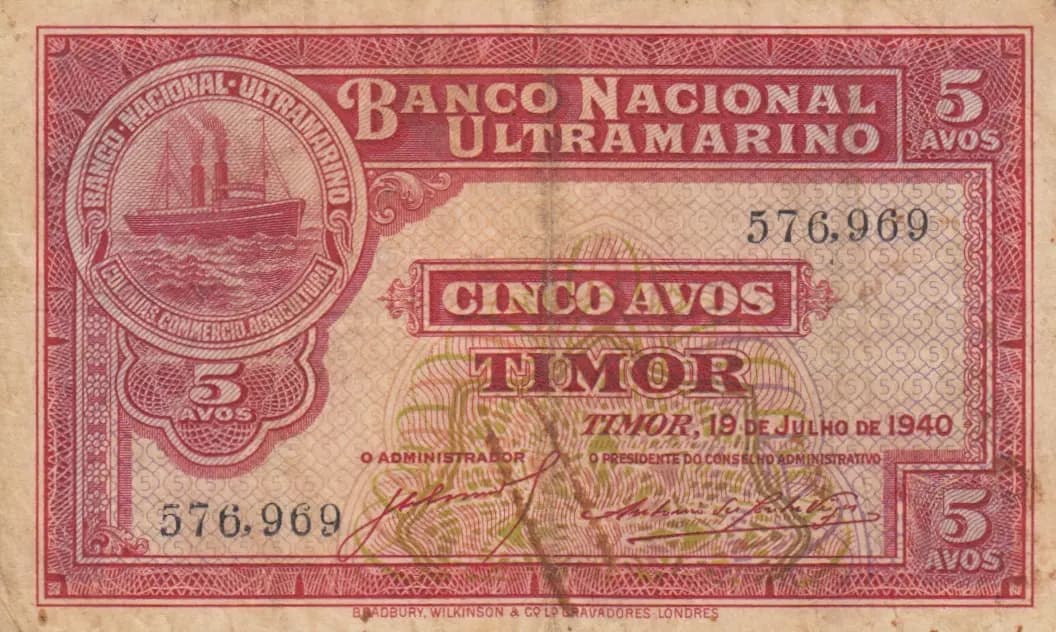
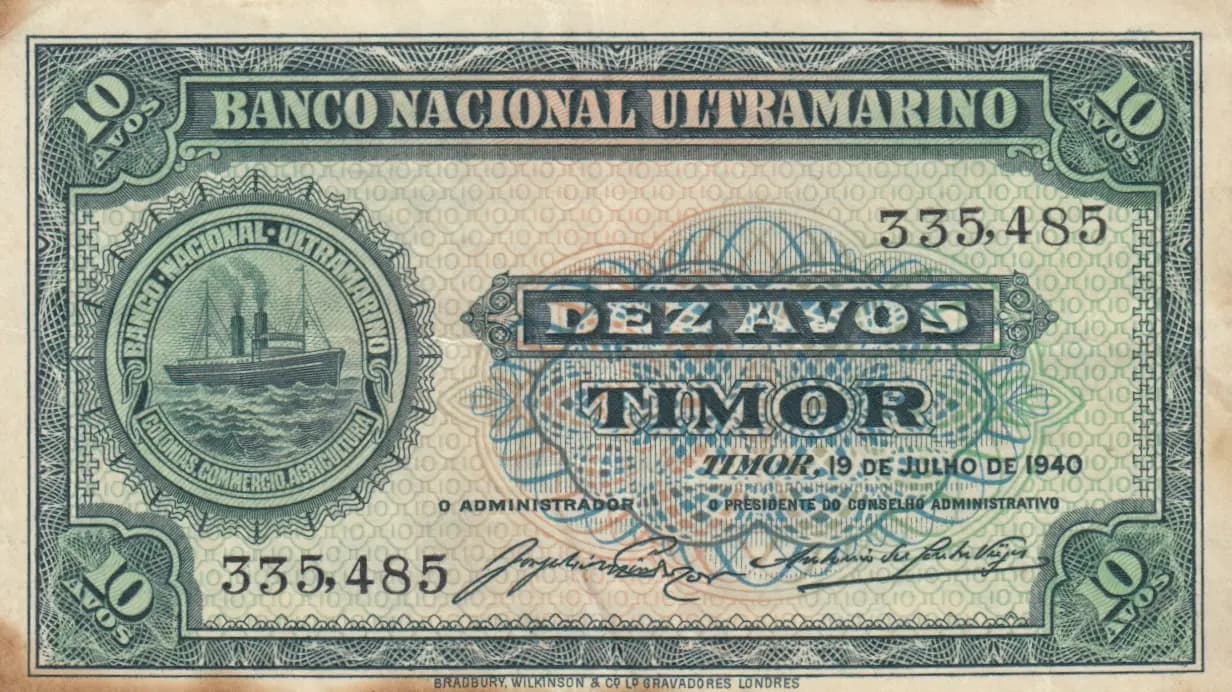
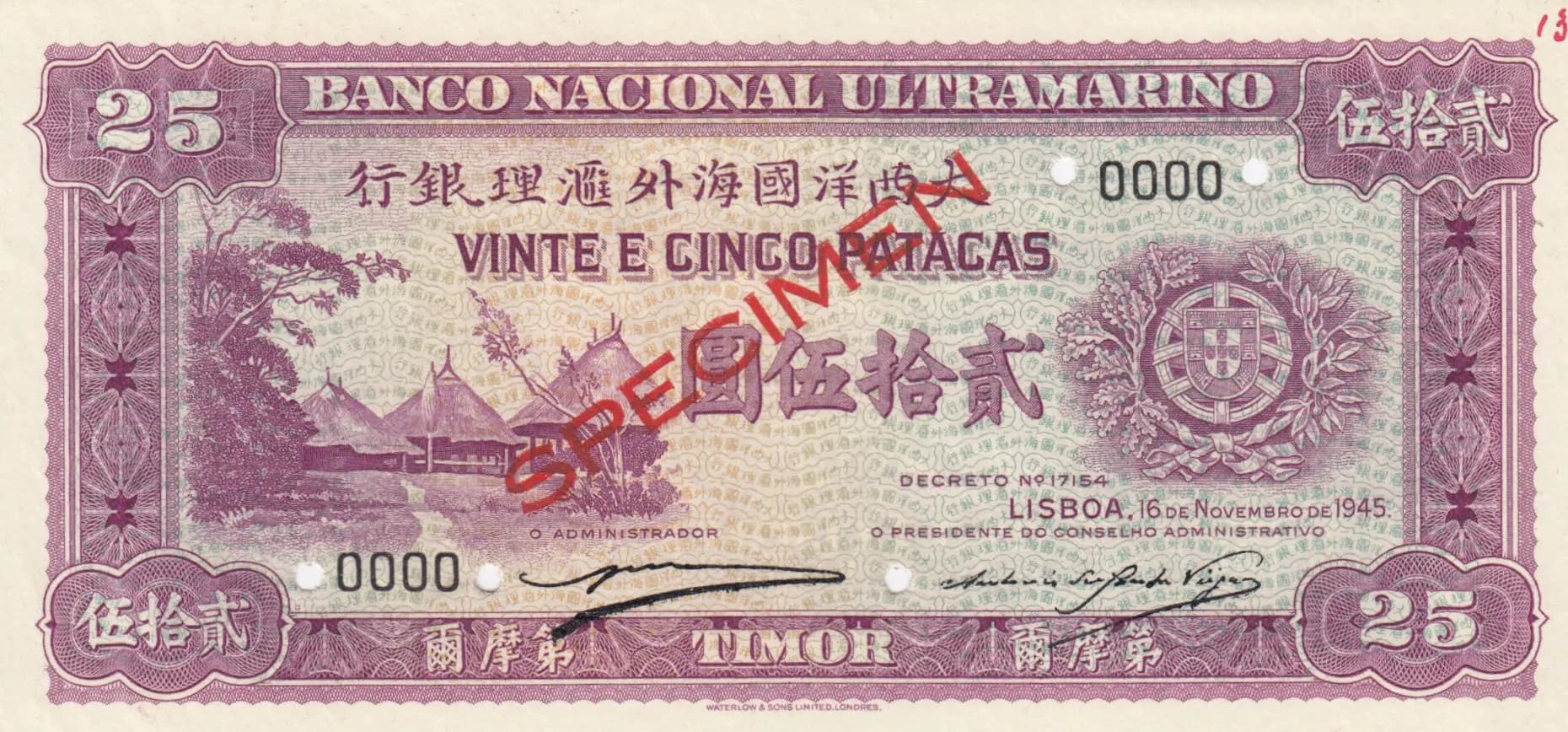
20 avos 1948
Market Prices
2 salesAbout This Note
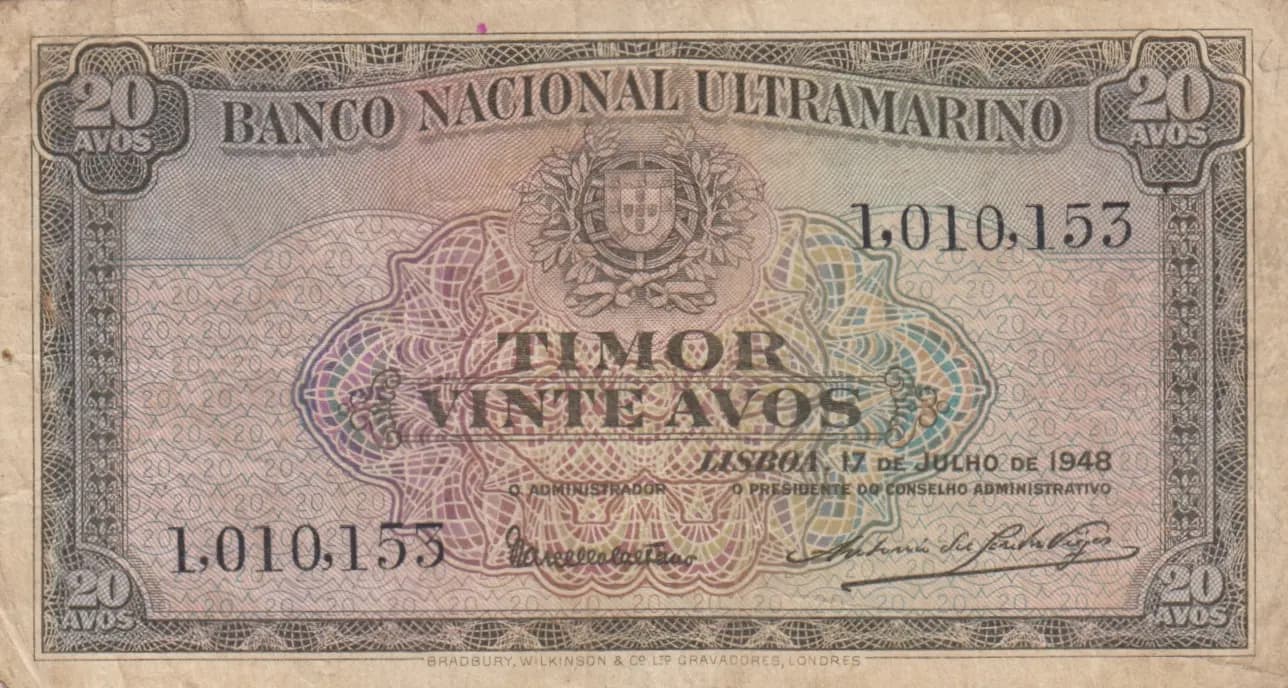
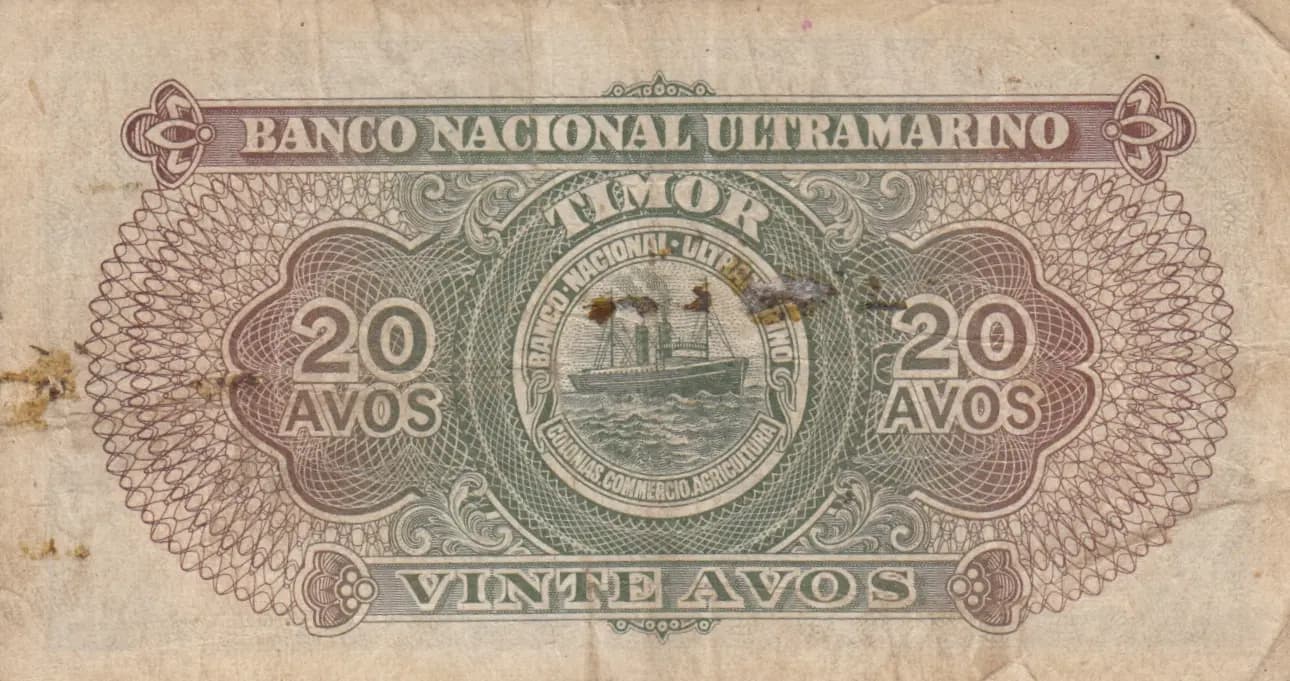
This 20 avos note from Banco Nacional Ultramarino (1948) exemplifies the ornate Portuguese colonial currency design of mid-20th century Timor. The obverse features a Portuguese coat of arms in an elaborate decorative frame with corner denominations, while the reverse displays a prominent circular maritime seal depicting a multi-masted sailing ship, reflecting Timor's strategic importance in Portuguese overseas trade networks. In Fine condition, the note exhibits expected foxing, browning, and creasing consistent with 75 years of age and circulation, with brown spotting particularly evident on the reverse.
Common. Recent eBay sales data shows specimens in Fine condition selling for $13.50–$15.83 (2021–2024), well below the 2016 catalog value of $15 for VG. This pricing trajectory and transaction frequency indicate steady collector interest in an accessible price range, typical of common-grade colonial issues. The 1948 Timor 20 avos was part of regular currency circulation and does not exhibit the characteristics of a scarce or rare note.
Issued on July 17, 1948, this note represents the Banco Nacional Ultramarino's continued management of currency in Portuguese Timor during the late colonial period. The Portuguese coat of arms and Lisbon-dated issuance stamp underscore metropolitan control over the colony's monetary system. The maritime ship imagery on the reverse symbolizes Portugal's historical dominance of oceanic trade routes and its colonial administration of distant overseas territories like Timor.
The obverse features the Portuguese national coat of arms—a shield with a laurel wreath surround—positioned at the upper center, framed within ornate geometric and floral borders. Denominations appear in all four corners within decorative frames. Two serial numbers flank the central design. The reverse centers on a circular maritime medallion containing an engraved sailing ship with multiple masts and flags, surrounded by concentric decorative bands and ornamental text. The dominant color palette is olive-brown with multicolored underprinting in rose/pink, gray, and cream tones on the obverse; olive, red-brown, green, and gray on the reverse. Both sides employ elaborate cross-hatching and fine-line geometric patterns as background security elements.
FRONT: 'BANCO NACIONAL ULTRAMARINO' (National Overseas Bank) / '20 AVOS' (Twenty avos) / 'TIMOR' / 'VINTE AVOS' (Twenty avos in words) / 'LISBOA, 17 DE JULHO DE 1948' (Lisbon, July 17, 1948) / 'O ADMINISTRADOR' (The Administrator) / 'O PRESIDENTE DO CONSELHO ADMINISTRATIVO' (The President of the Administrative Council) / Serial number '1.010.153'. BACK: 'BANCO NACIONAL ULTRAMARINO' (National Overseas Bank) / 'TIMOR' / '20 AVOS' (appears left and right) / 'VINTE AVOS' (Twenty avos in words).
Intaglio engraving (line engraving) executed by Bradbury Wilkinson & Company (BWC), a renowned security printer. The intricate geometric cross-hatching, fine decorative borders, detailed maritime imagery, and complex floral patterns visible throughout are characteristic of high-quality intaglio work. The multicolor underprinting was applied prior to engraved overprinting, a standard practice for colonial banknotes of this era.
This specimen appears to be the standard P-21 variety (Banco Nacional Ultramarino, 1948, printer BWC). The PMG population report indicates three cataloged variants exist (P-21, P-21pp, P-21s), suggesting the presence of proof and specimen overprints. The observed serial number 1.010.153 and standard issuance markings ('LISBOA, 17 DE JULHO DE 1948') confirm this is a regular-issue note, not a proof or specimen variety. No overprints or anomalies indicative of variant status are evident in the visual analysis.