20 escudos 1967 specimen
“red colour”
About This Note
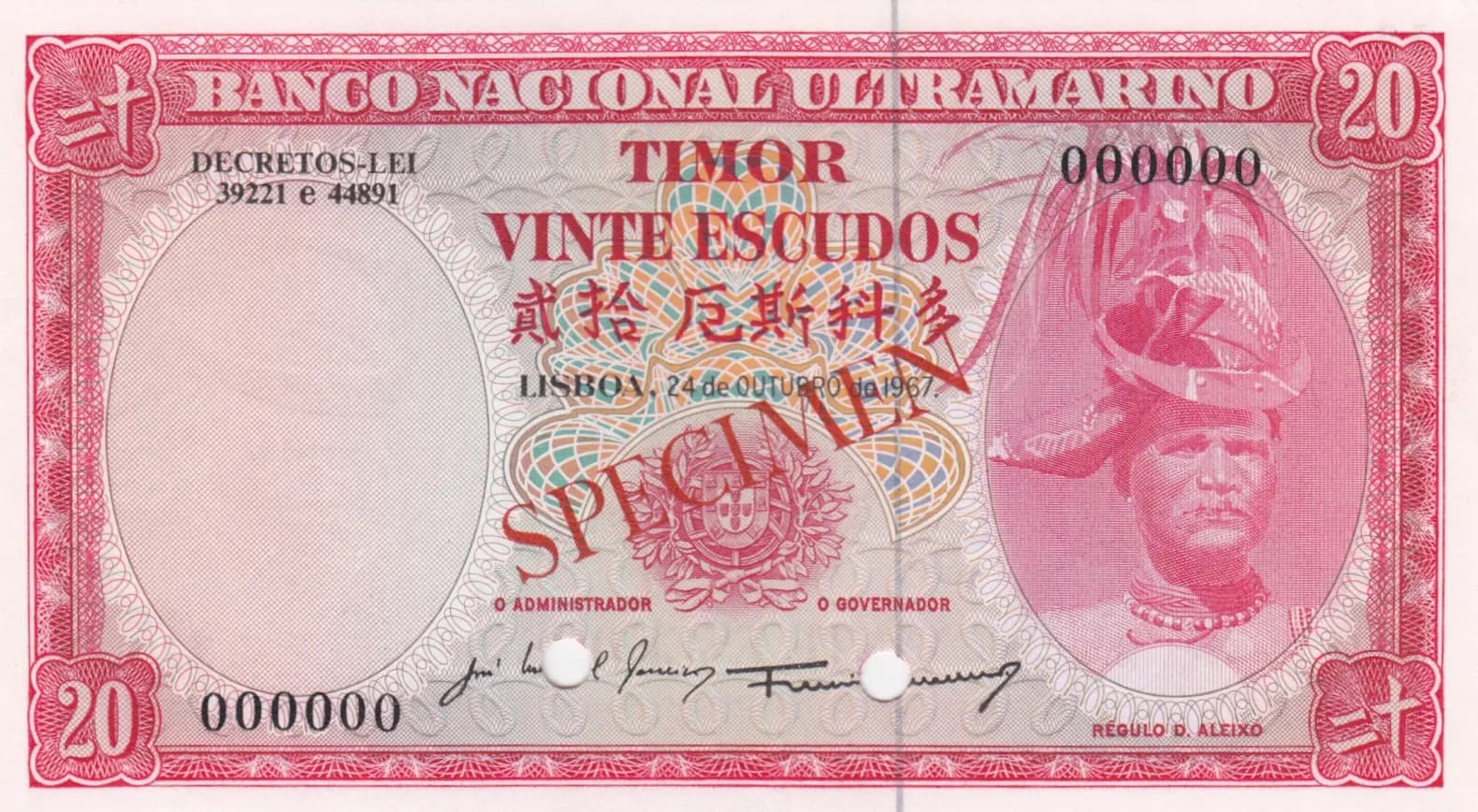
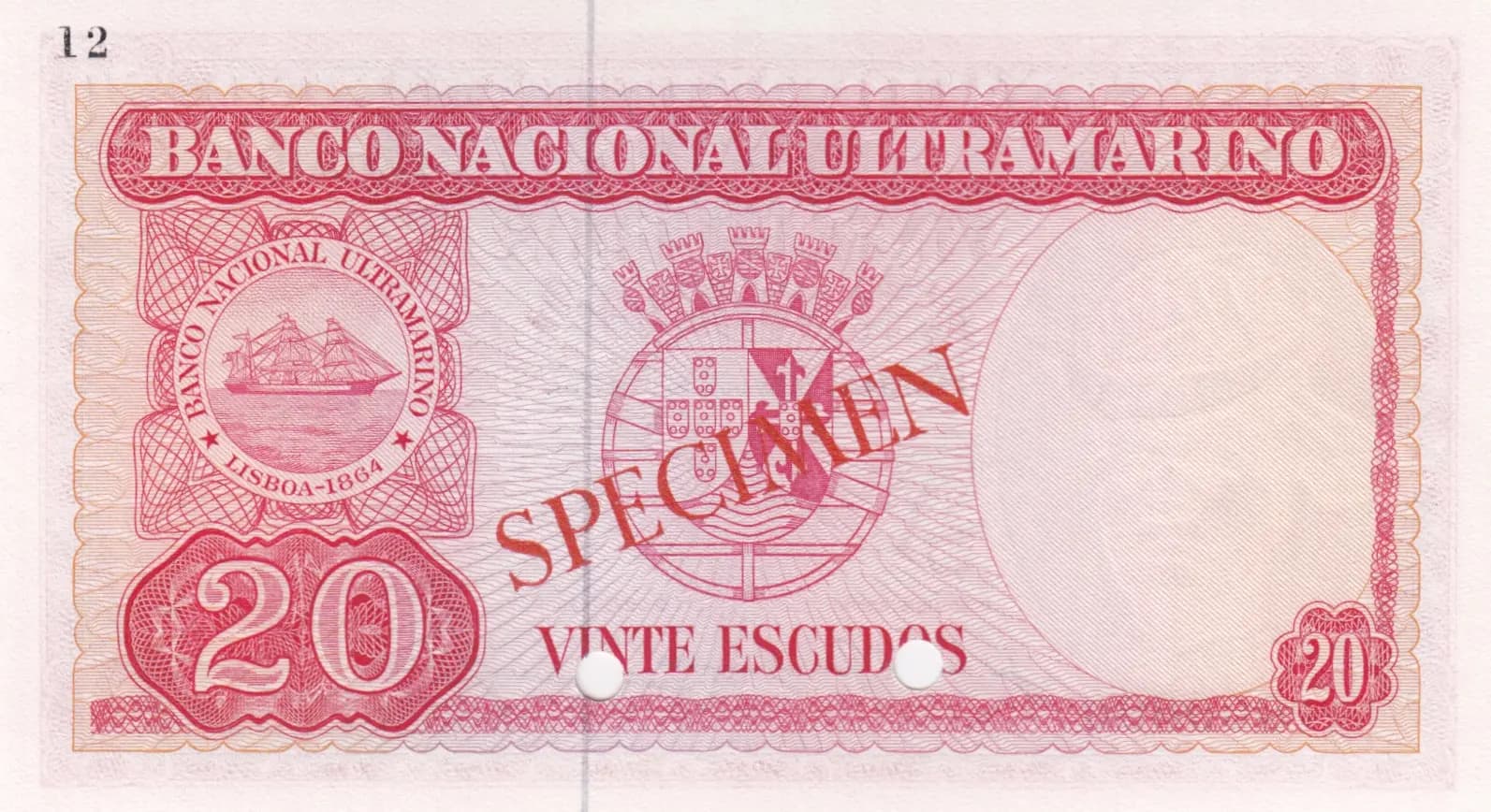
This is a specimen banknote of the 20 escudos denomination issued by Banco Nacional Ultramarino for Timor in 1967, presented in exceptional uncirculated condition with vibrant pink/magenta coloring. The note is distinguished by its bilingual design incorporating Portuguese and Chinese characters, ornate corner rosettes, and characteristic specimen perforations through the center. As an unlisted Pick specimen variety, this note represents an important documentary example of Timor's monetary history during the Portuguese colonial period.
Uncommon. While Timor banknotes from the colonial period are not frequently encountered in international numismatic markets, this specific specimen variety remains unlisted in standard catalogs, suggesting limited surviving examples. Specimen notes typically had restricted distribution compared to circulation issues, and the 1967 date places this within the final decade of Portuguese rule, before the political upheaval of 1975. The condition (UNC) and bilingual design add modest collector interest, but market demand for Portuguese colonial Timor notes remains relatively specialized.
This 1967 note was issued during the final decades of Portuguese colonial rule in Timor, when the Banco Nacional Ultramarino maintained monetary authority across Portugal's overseas territories. The inclusion of Chinese characters alongside Portuguese reflects Timor's significant Chinese merchant community and regional commercial ties. The heraldic imagery on the reverse, featuring the bank's founding seal dated 1864 and Portuguese coat of arms, emphasizes the continuity of Portuguese financial administration in the territory, which would continue until Indonesia's invasion in 1975.
The front features a distinguished portrait on the right side of an unidentified colonial administrator in formal attire with military-style headpiece. The left side contains an empty oval watermark area. The denomination '20' and 'Vinte Escudos' appear centrally with bilingual text incorporating Portuguese and Chinese characters arranged in circular patterns, reflecting Timor's multicultural composition. Ornate corner rosettes with cross and geometric patterns frame all four corners. Central heraldic emblems display governmental seals marked 'O Administrador' and 'O Governador'. The reverse displays the Banco Nacional Ultramarino's founding seal from 1864 containing a symbolic sailing ship, representing the bank's maritime commercial heritage. Above this is a crowned heraldic coat of arms featuring the Portuguese shield design, flanked by decorative guilloche borders. The prominent 'SPECIMEN' overprint with characteristic perforations appears on both sides.
FRONT: 'Banco Nacional Ultramarino' (National Overseas Bank), 'Timor' (Timor), 'Vinte Escudos' (Twenty Escudos), '20' (denomination), 'Decretos-Lei 39221 e 44891' (Decrees-Law 39221 and 44891 - authorizing legislation), '000000' (specimen serial number), 'Lisboa, 24 de Outubro 1967' (Lisbon, October 24, 1967), 'Specimen' (specimen designation), 'O Administrador' (The Administrator), 'O Governador' (The Governor), 'Regulo D. Aleixo' (Regulo D. Aleixo - official title holder), '貨幣及銀行' (Chinese: Currency and Banking). BACK: 'Banco Nacional Ultramarino' (National Overseas Bank), 'Lisboa - 1864' (Lisbon - 1864, bank founding date), 'Vinte Escudos' (Twenty Escudos), '20' (denomination), 'Specimen' (specimen designation), '12' (sheet or press number).
Intaglio (copperplate) engraving, evidenced by the fine line work, detailed guilloche patterns throughout borders and backgrounds, and the intricate rendering of heraldic elements and portraiture. The specimen perforations indicate printing by a security printer equipped for note production and specimen preparation. The crisp impression quality and ornate decorative elements are consistent with European security printing standards of the 1960s, likely executed by a Portuguese-based security printer serving Banco Nacional Ultramarino.
This is identified as a specimen note through the printed 'SPECIMEN' overprint and characteristic center perforations on both obverse and reverse. The note is dated 'Lisboa, 24 de Outubro 1967' and authorized under 'Decretos-Lei 39221 e 44891'. The serial number appears as '000000', confirming specimen status. No signature varieties are visible on this specimen example. The unlisted Pick status suggests this variety may not have been formally catalogued in major references, possibly due to its specimen designation or limited surviving examples.