100 escudos 1967 specimen
Market Prices
32 salesAbout This Note
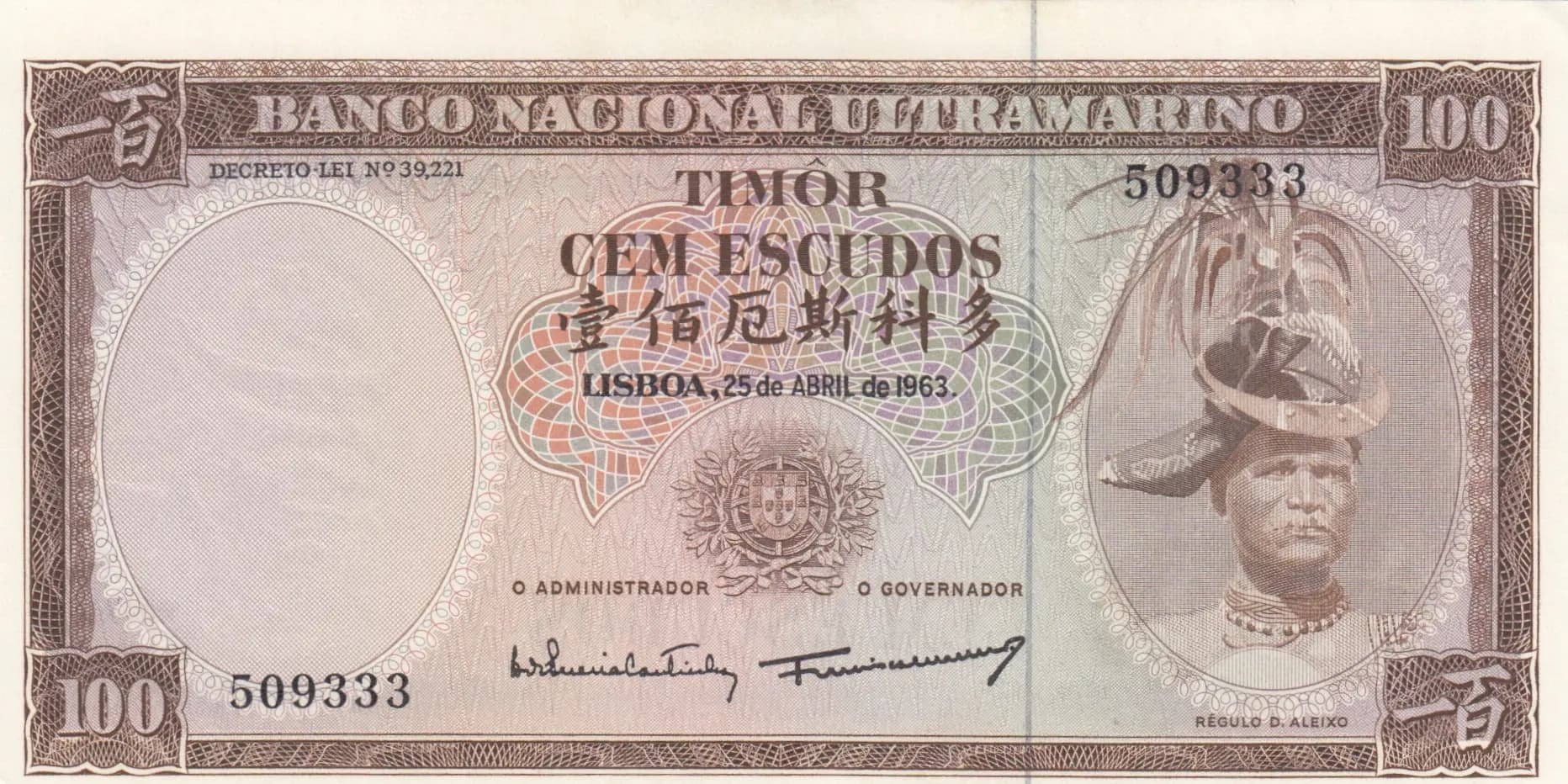
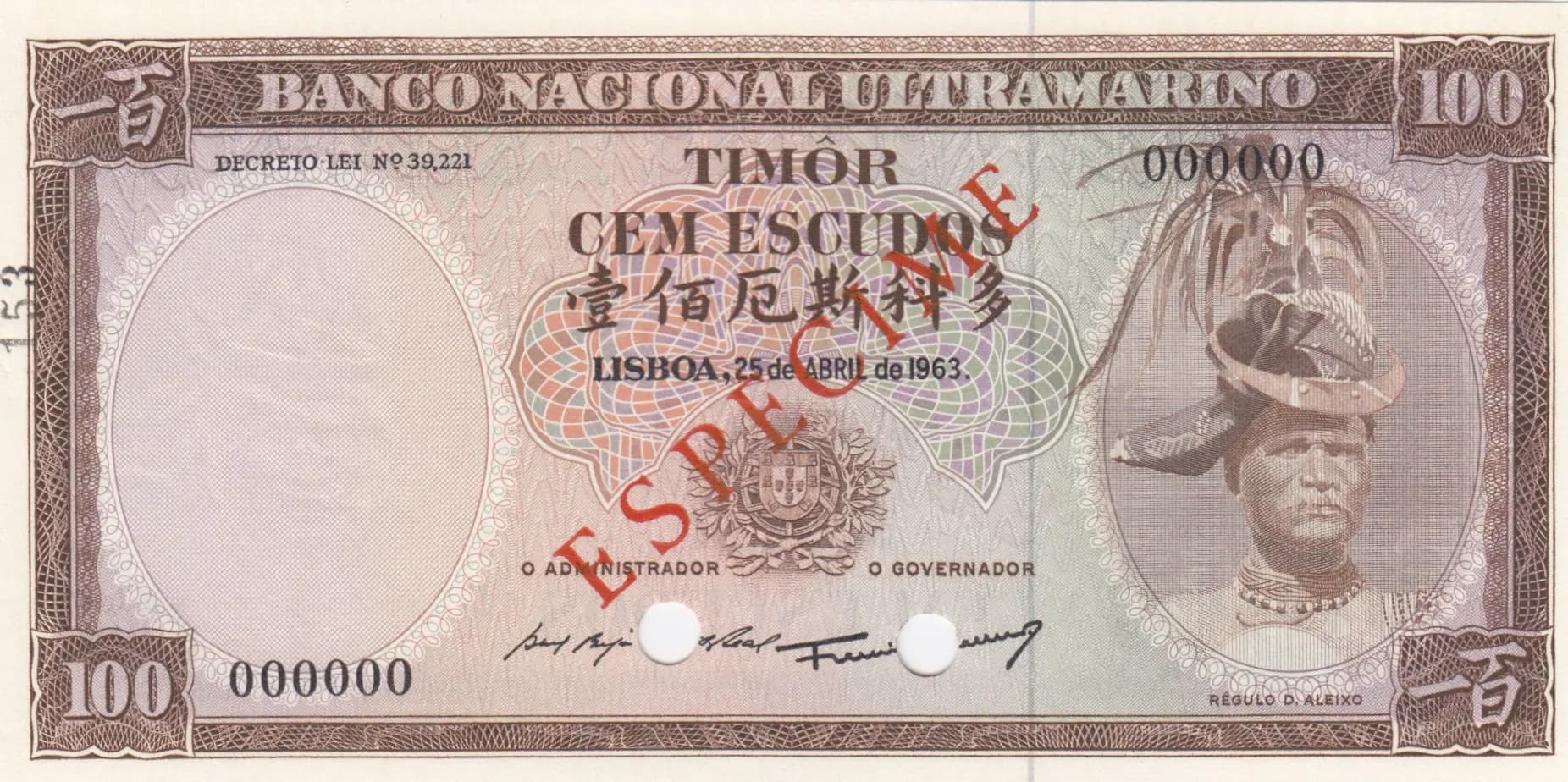
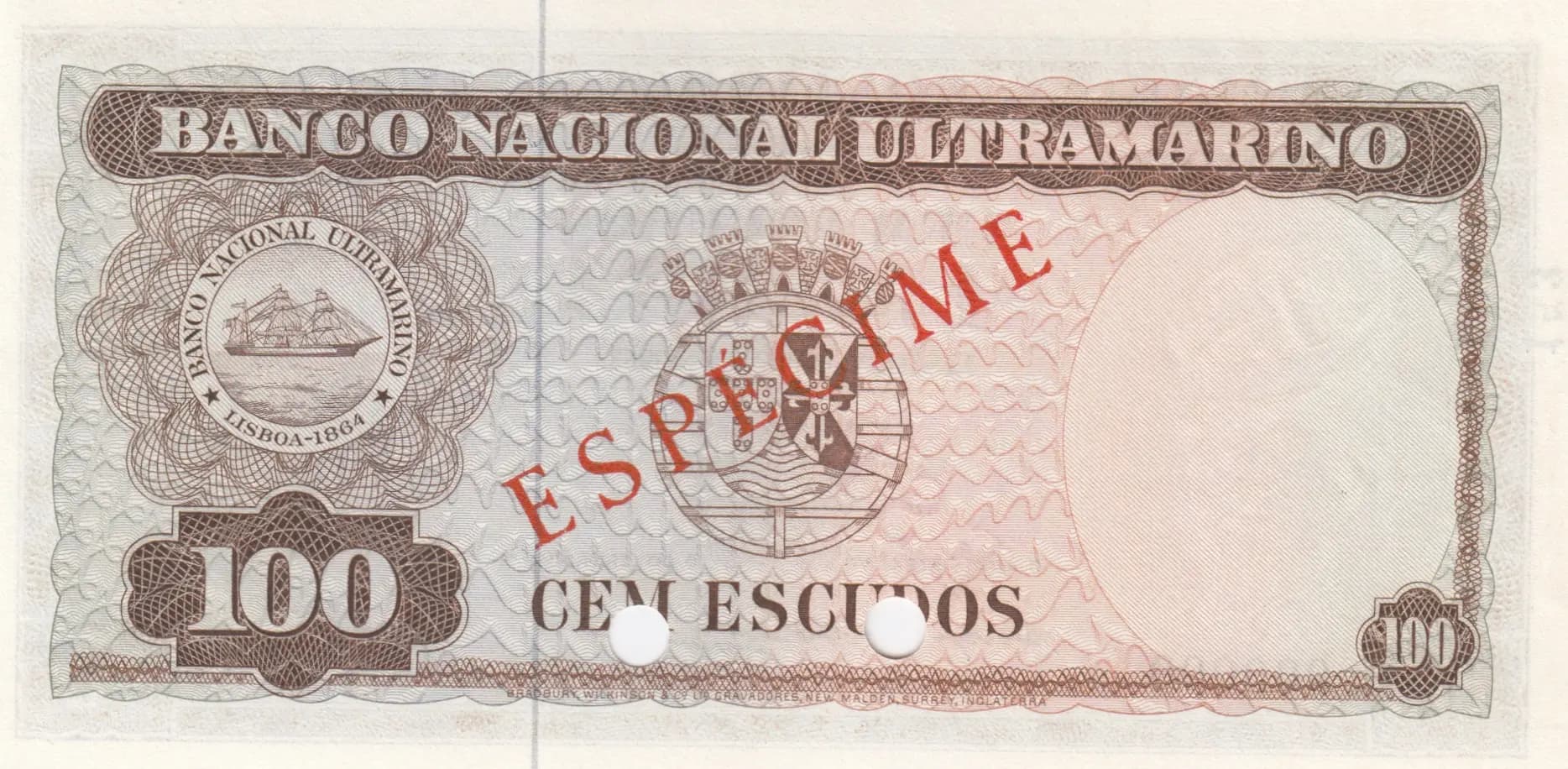
This is a 1967 specimen note of 100 escudos from Timor issued by Banco Nacional Ultramarino, graded UNC. The note features a portrait of Régulo D. Aleixo in profile wearing a decorative feathered hat on the obverse, with the bank's seal and Portuguese coat of arms prominently displayed on the reverse. As a specimen example, it bears the characteristic red 'ESPÉCIME' diagonal overprint and two circular punch-hole cancellations, which are typical security features preventing its circulation while preserving it as a reference example.
Common. Specimen notes from this series are standard reference examples rather than rare collectibles. eBay market data shows consistent sales of this denomination in various conditions ranging from $3 to $31 USD, with most UNC examples selling in the $6-$15 range. The 2019 catalogue value of $15 for UNC specimens is modest and reflects common availability. The note was part of the regular issue for Timor during the final colonial period, and specimen examples were produced in reasonable quantities as reference standards for banks and collectors. No evidence of short print runs, recalls, or extreme scarcity exists for the P-28s variety.
This banknote was issued under Decree-Law No. 39,221 dated April 25, 1963, during the final years of Portuguese colonial rule in Timor, which lasted until 1975. The Banco Nacional Ultramarino, established in Lisbon in 1864 and visible in the seal on the reverse, served as the central issuing authority for Portuguese overseas territories including Timor. The portrait of Régulo D. Aleixo represents indigenous Timorese leadership, reflecting the colonial administrative structure of the period.
The obverse features a sophisticated colonial-era banknote design centered on a portrait of Régulo D. Aleixo, positioned on the right side and rendered in profile facing right, wearing a distinctive feathered ceremonial hat representing traditional Timorese leadership regalia. The center of the obverse displays an ornate coat of arms with heraldic shield and multiple crowns within elaborate decorative frames. The reverse showcases the Banco Nacional Ultramarino's institutional seal—a circular emblem dated 'LISBOA-1864' featuring a ship, symbolizing the maritime colonial enterprise—positioned on the left within a decorative circular frame. The center of the reverse contains the Portuguese national coat of arms with heraldic shield and cross within an oval frame. Both sides exhibit extensive guilloche security printing, fine-line engraving details, and geometric decorative patterns characteristic of high-security 1960s-era banknote production. The denomination '100' appears in corner positions on both sides. Two blank oval spaces (watermark areas) are visible, and the specimen status is marked by red diagonal 'ESPÉCIME' text and two circular punch holes through the center.
FRONT SIDE: 'BANCO NACIONAL ULTRAMARINO' (National Overseas Bank) / 'DECRETO-LEI Nº 39.221' (Decree-Law No. 39,221) / 'TIMÔR' (Timor) / 'CEM ESCUDO' (One Hundred Escudo) / 'LISBOA, 25 de ABRIL de 1963' (Lisbon, April 25, 1963) / 'O ADMINISTRADOR' (The Administrator) / 'O GOVERNADOR' (The Governor) / 'ESPÉCIME' (Specimen) / 'RÉGULO D. ALEIXO' (Régulo D. Aleixo - portrait subject) / Serial number '000000'. REVERSE SIDE: 'BANCO NACIONAL ULTRAMARINO' (National Overseas Bank) / 'BANCO NACIONAL ULTRAMARINO LISBOA-1864' (National Overseas Bank Lisbon-1864) / 'CEM ESCUDOS' (One Hundred Escudos) / 'ESPÉCIME' (Specimen) / Denomination '100'.
This banknote was produced using intaglio engraving (fine-line copper plate engraving) combined with multicolor letterpress printing. The primary printer was BWC (Bradbury Wilkinson & Company), a renowned British security printer. The sophisticated guilloche patterns, fine-line security details, and multicolor underprinting (visible as brown primary color with green, purple, red, and tan secondary colors) are characteristic of high-security banknote production standards of the 1960s. The specimen overprint and punch-hole cancellations were applied as post-printing security measures to prevent unintended circulation.
This note is catalogued as Pick P-28s, the specimen variety of the 100 escudos issued in 1967 (though dated 1963 on the note itself, reflecting the decree date). The PMG population report indicates four variants exist for this base Pick number: P-28a (regular issue), P-28cts (possibly a curtailed or special printing), P-28r (possibly a replacement or rare variant), and P-28s (specimen, as presented here). The specimen variety is distinguished by the red diagonal 'ESPÉCIME' overprint and the two circular punch holes through the center. Serial number 000000 is typical for specimen notes. The visual analysis confirms this is the P-28s specimen variant with no circulation-related wear or damage consistent with specimen preservation standards.