100 escudos 1967
Market Prices
32 salesAbout This Note
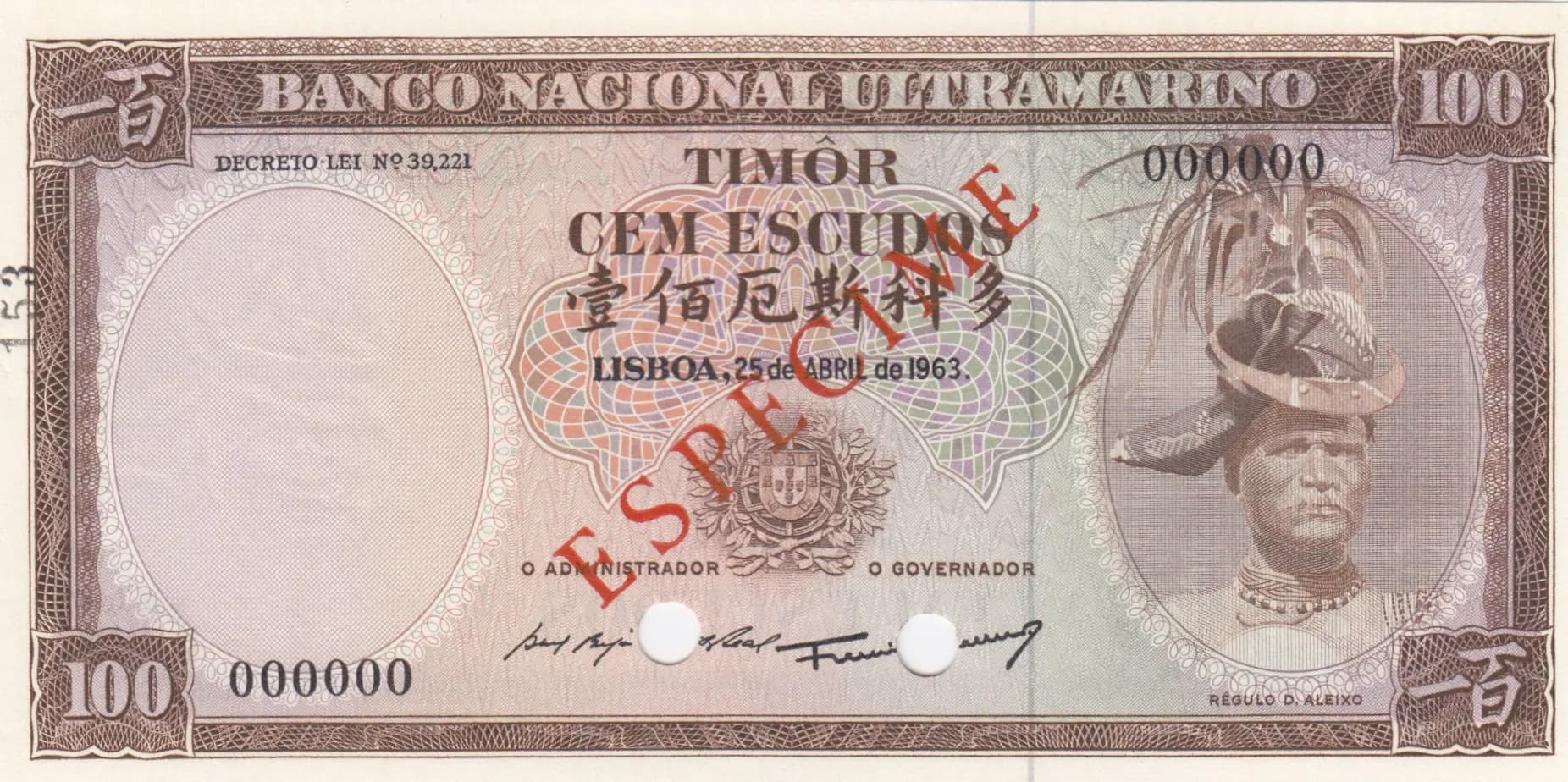
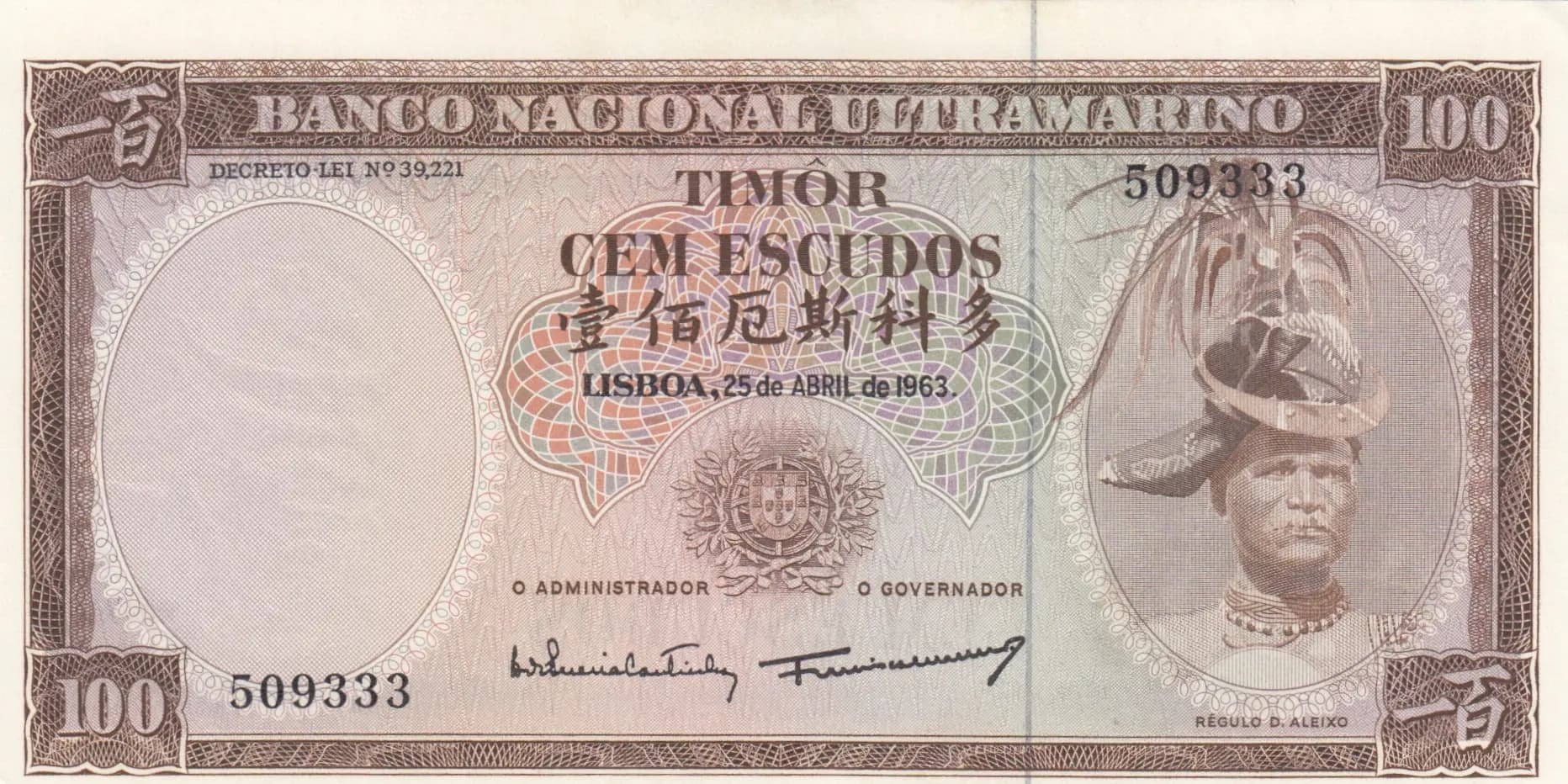
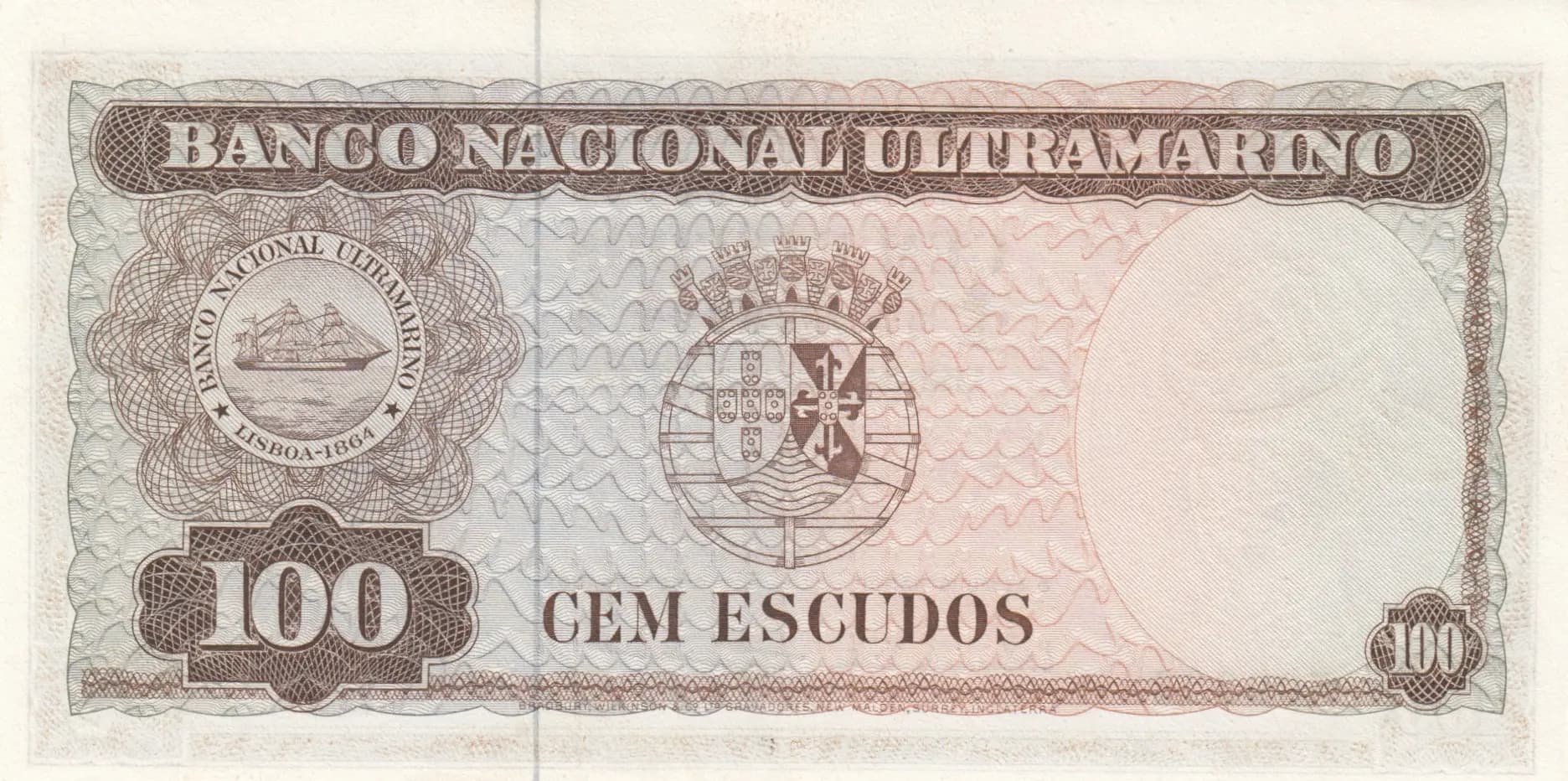
This is a 1963-dated 100 Escudos banknote from the Banco Nacional Ultramarino, the Portuguese colonial-era issuer for Timor. The note displays excellent preservation in uncirculated condition with sharp printing detail, featuring a portrait of Régulo D. Aleixo on the obverse and the characteristic ship seal and Portuguese crowned arms on the reverse. A notable feature is the center chop mark overlay bearing Chinese characters (Hong Kong and Shanghai Banking Corporation), indicating this note circulated through Hong Kong banking channels, which is a historically interesting artifact of colonial-era trade networks.
Common. This note exhibits strong secondary market activity with consistent eBay sales data spanning from 2012 to 2025, showing typical pricing in the $3-$31 range depending on grade, with UNC examples generally bringing $6.50-$15. The 2019 catalog value for UNC is $15. The extensive sales history and moderate pricing indicate this was produced in substantial quantities. While the center chop mark from Hong Kong banking may be of historical interest to specialists, it does not significantly enhance rarity. The note remains a common-grade Portuguese colonial emission.
This banknote was issued under Decreto-Lei Nº 39,121 and dated April 25, 1963—a significant date in Portuguese history (the Carnation Revolution would occur exactly 11 years later). The note represents the monetary authority of the Portuguese Overseas Bank during the final decade of Portugal's colonial presence in Timor, before Indonesian occupation in 1975. The ship seal on the reverse symbolizes Portugal's maritime colonial heritage, while the portrait of Régulo D. Aleixo reflects the administrative structure of Portuguese Timor's governance.
The obverse features a formal portrait of Régulo D. Aleixo, positioned at the right side wearing traditional Portuguese colonial-era administrative headwear, representing the colonial governor or high administrator of the period. The composition includes an empty oval frame on the left (conventional design space), ornamental rosette designs in red and green at center, and the Portuguese coat of arms with heraldic shield. Two signature lines appear below the arms for the Administrator and Governor. The reverse displays two prominent circular emblems: the left seal contains a historical Portuguese caravel or ship (symbolizing the Banco Nacional Ultramarino and maritime commerce), while the right seal features the Portuguese coat of arms with a crown above. Both are surrounded by decorative rosette borders in tan and brown tones. The entire note employs a sophisticated color palette of brown, sepia, red, green, and beige, with extensive geometric patterning throughout.
FRONT SIDE: 'BANCO NACIONAL ULTRAMARINO' (National Overseas Bank) / 'TIMOR' / 'CEM ESCUDOS' (One Hundred Escudos) / 'DECRETO-LEI Nº 39,121' (Decree-Law No. 39,121) / 'LISBOA, 25 de ABRIL de 1963' (Lisbon, April 25, 1963) / 'O ADMINISTRADOR' (The Administrator) / 'O GOVERNADOR' (The Governor) / Serial number '509333' / BACK SIDE: 'BANCO NACIONAL ULTRAMARINO' (National Overseas Bank) / 'CEM ESCUDOS' (One Hundred Escudos) / '* BANCO NACIONAL ULTRAMARINO *' (circular text around left seal) / 'LISBOA-LISBOA' (Lisbon-Lisbon) / Denomination '100' in corners.
Intaglio engraving, the standard security printing method for banknotes of this era. The note was printed by BWC (Bradbury Wilkinson and Company), a renowned British security printer of the period. The visual analysis confirms the characteristic fine line engraving with intricate geometric crosshatch patterns, detailed wave-like designs, and multiple decorative borders typical of high-security banknote production. The sharp clarity of the portrait, coat of arms, ship emblem, and border work all indicate professional intaglio engraving rather than lithography.
This note corresponds to Pick P-28a (printer: BWC). The visual analysis confirms the distinctive Decreto-Lei Nº 39,121 and the April 25, 1963 date stamp from Lisbon. The serial number observed is 509333. PMG records indicate four cataloged variants for this base Pick number (P-28a, P-28cts, P-28r, P-28s), all with BWC printing. The specific variety cannot be definitively determined from visible characteristics alone, though the standard obverse and reverse designs with ship seal and crowned arms confirm alignment with the standard P-28a issue. The Hong Kong chop mark is a post-issuance banking validation, not a printing variety.