20 baht 1943
Market Prices
5 salesAbout This Note
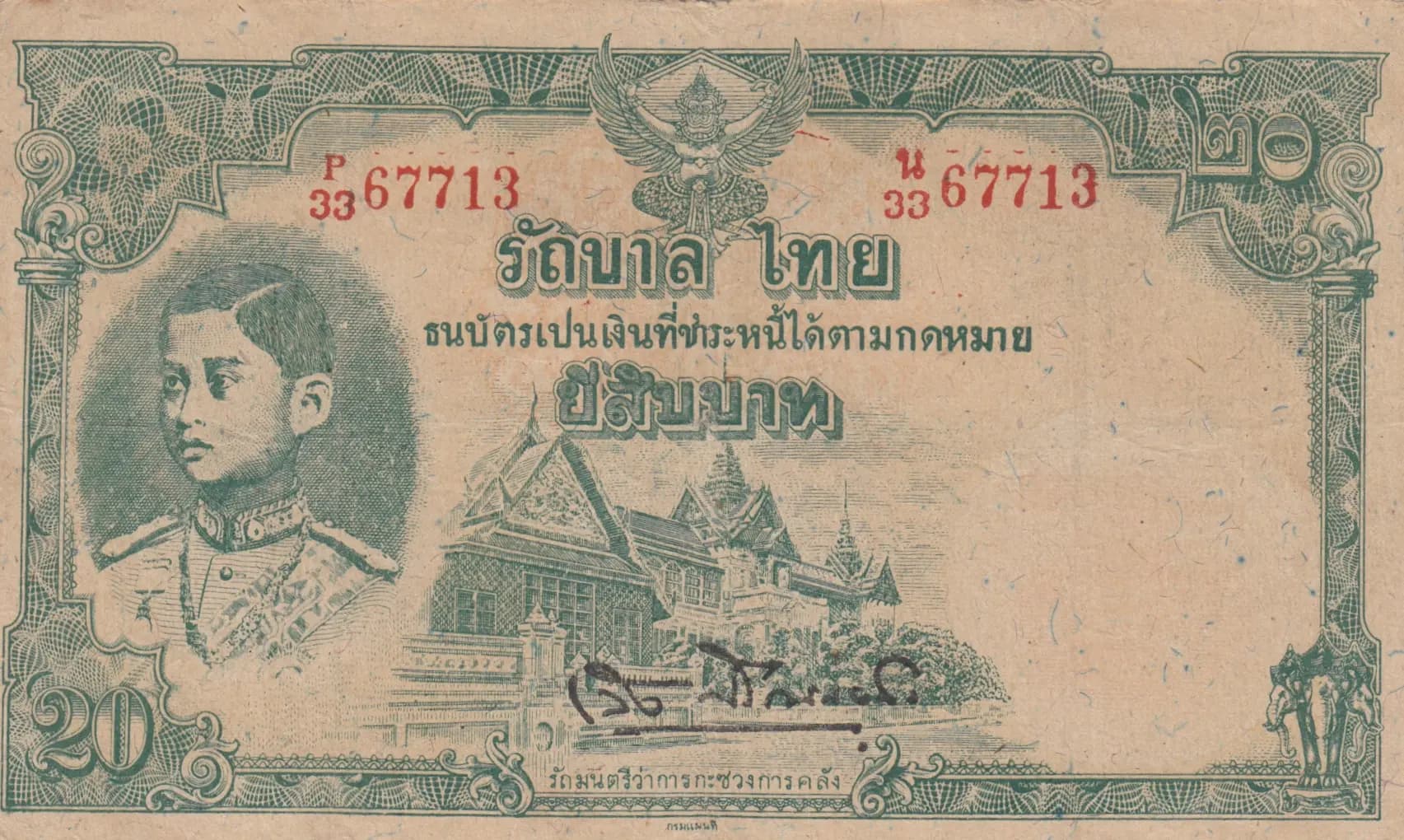
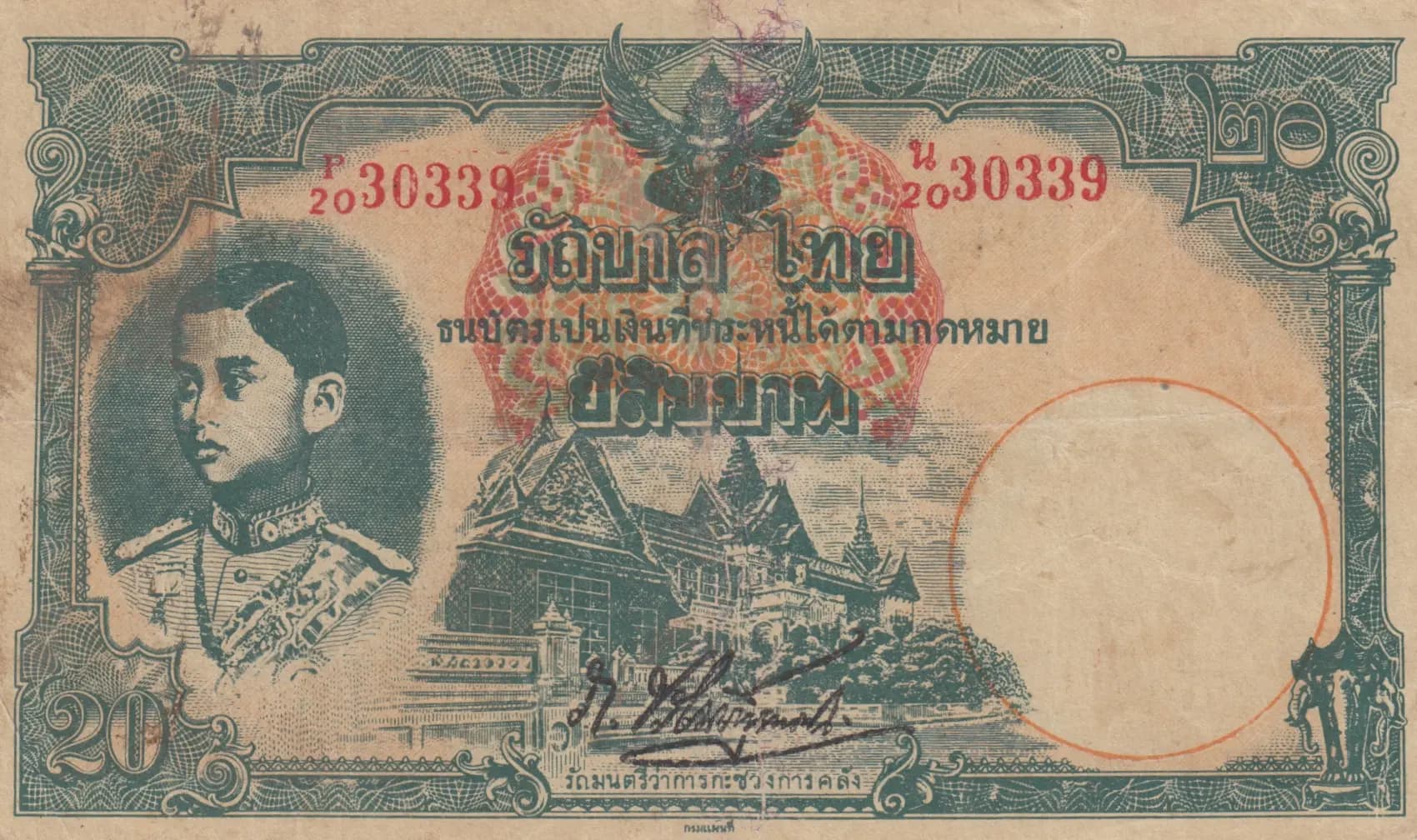
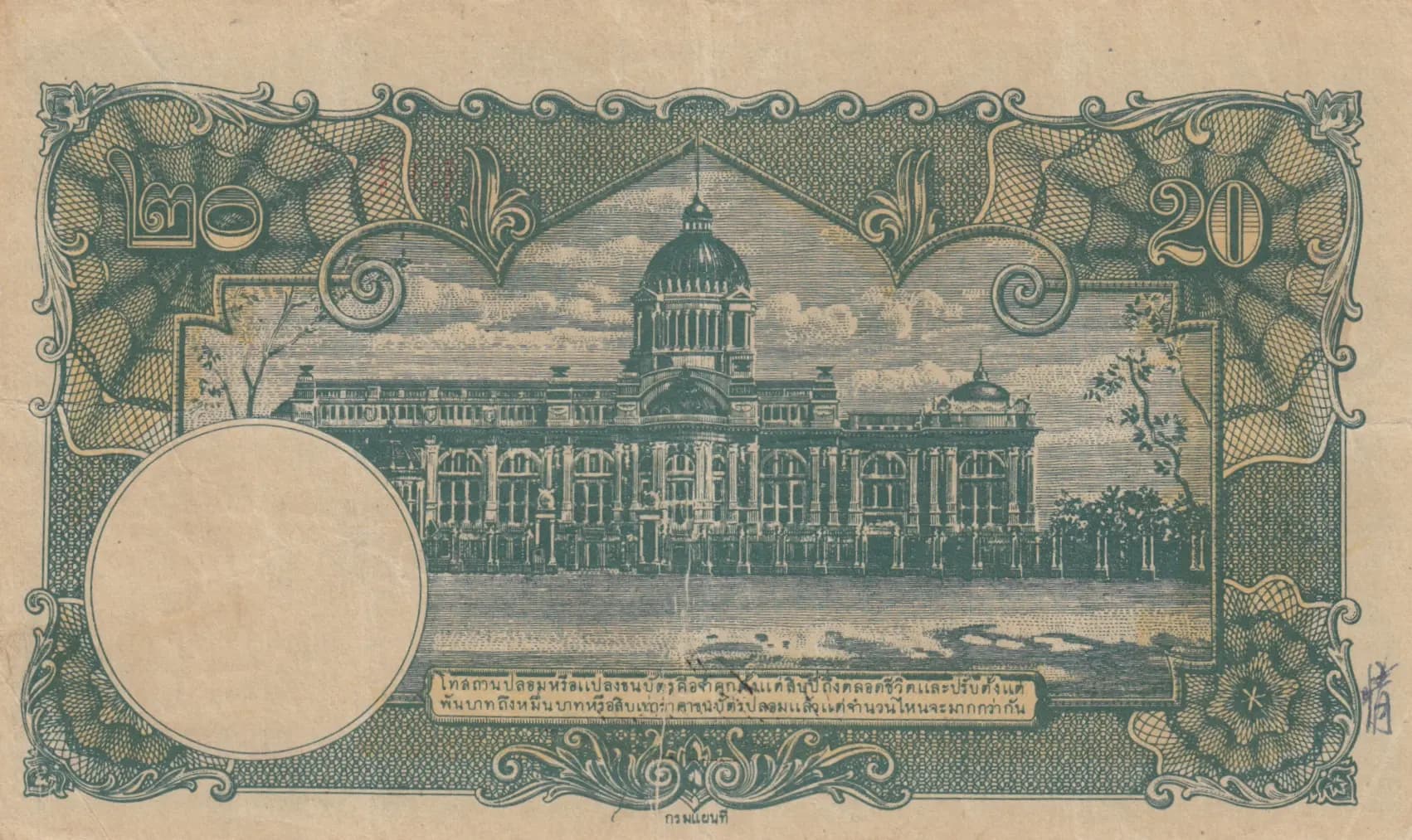
This Thai 20 Baht note from 1943 represents a wartime-era banknote issued by the Government of Thailand during King Rama VIII's reign. The note displays the characteristic green and orange color scheme with a striking central red seal featuring the Garuda emblem, accompanied by a portrait of the young king in military dress on the obverse and a neoclassical throne hall on the reverse. In VF condition, the note shows expected aging with foxing and tan discoloration throughout, but retains good detail and legibility—recent eBay sales data confirms VF examples command approximately $100-140, making this a modestly valued historical piece for collectors of Southeast Asian currency.
Common. This note is regularly encountered on the secondary market, with eBay transaction data showing consistent sales across multiple condition grades (VG examples at $6-10, VF examples at $100-140, AUNC/UNC examples at $170-270). The catalog values from 2016 ($3 VG, $35 VF, $150 UNC) and the frequency of sales with 9-22 bidders per lot indicate substantial circulation among collectors. The Royal Thai Army Map Department printing and the 1943-1945 date range suggest a reasonable print run, and no evidence of recall or rarity is documented in major catalog references.
This banknote was issued during Thailand's World War II period under the reign of King Rama VIII (Ananda Mahidol), who became king as a child in 1935. The military dress uniform portrait and the prominence of the Garuda (Thai national symbol) reflect the militaristic and nationalist themes of 1940s Thailand, while the neoclassical throne hall depicted on the reverse emphasizes royal authority and continuity during a tumultuous international period. This particular note was printed by the Royal Thai Army Map Department rather than the more refined Thomas de la Rue printing house, reflecting wartime resource constraints.
The obverse features a three-quarter facing portrait of King Rama VIII as a young male in ornate military dress uniform with elaborate shoulder decorations and medals positioned on the left side. The central motif is a large red circular seal containing Thai script with the Garuda (mythical eagle) displayed prominently with spread wings at the top—a longstanding symbol of Thai sovereignty. A large orange/red circle occupies the right side, likely representing a watermark area or decorative element. An elaborate border of geometric and scrollwork patterns in green/teal frames the entire design on a beige/tan background. The reverse depicts a neoclassical government building (the Royal Throne Hall) with a prominent dome and columned facade, positioned centrally with water features in the foreground, surrounded by similar ornamental borders in green/teal with floral and geometric motifs. The architectural rendering employs detailed engraving technique throughout.
Front side: Serial number '2030339' appears twice (in numerals); Thai text includes 'ธนบัญชีไทย' (Bank of Thailand); denomination marking '20' in numerals; additional Thai text relating to banknote authorization and denomination specification. Back side: Denomination '20' appears in opposite corners; Thai text at bottom center (fine print, specific content difficult to confirm from image resolution); text 'ธรรมชาติ' appears to reference printer attribution or similar official marking.
This note was produced using intaglio engraving and letterpress printing methods, as confirmed by the catalog designation and the Royal Thai Army Map Department attribution. The fine line work visible in the ornamental borders, the detailed architectural rendering on the reverse, and the complex geometric patterns are characteristic of traditional intaglio processes. The two-color printing (green and red/orange) was applied in separate passes, which is evident from the color registration and the unfilled circular watermark areas visible on both sides. This production method represents a step down from the refined Thomas de la Rue security printing used for earlier Thai issues (P-36), reflecting wartime manufacturing constraints.
This note is catalogued as Pick P-41 and represents the Royal Thai Army Map Department printing of the 20 Baht from 1943-1945. The catalog notes reference similarity to P-36 (superior quality Thomas de la Rue printing of similar design) and P-53A (notes with different signatures). The observed serial number '2030339' is a standard sequential issue number. No specific signature varieties, date variants, or documented overprints are noted for this Pick number. The watermark is listed as 'Constitution' in the reference data, though the visual analysis describes unfilled circular areas rather than clearly visible watermark patterns—consistent with the note's age and condition.