1 baht 1948
Market Prices
26 salesAbout This Note
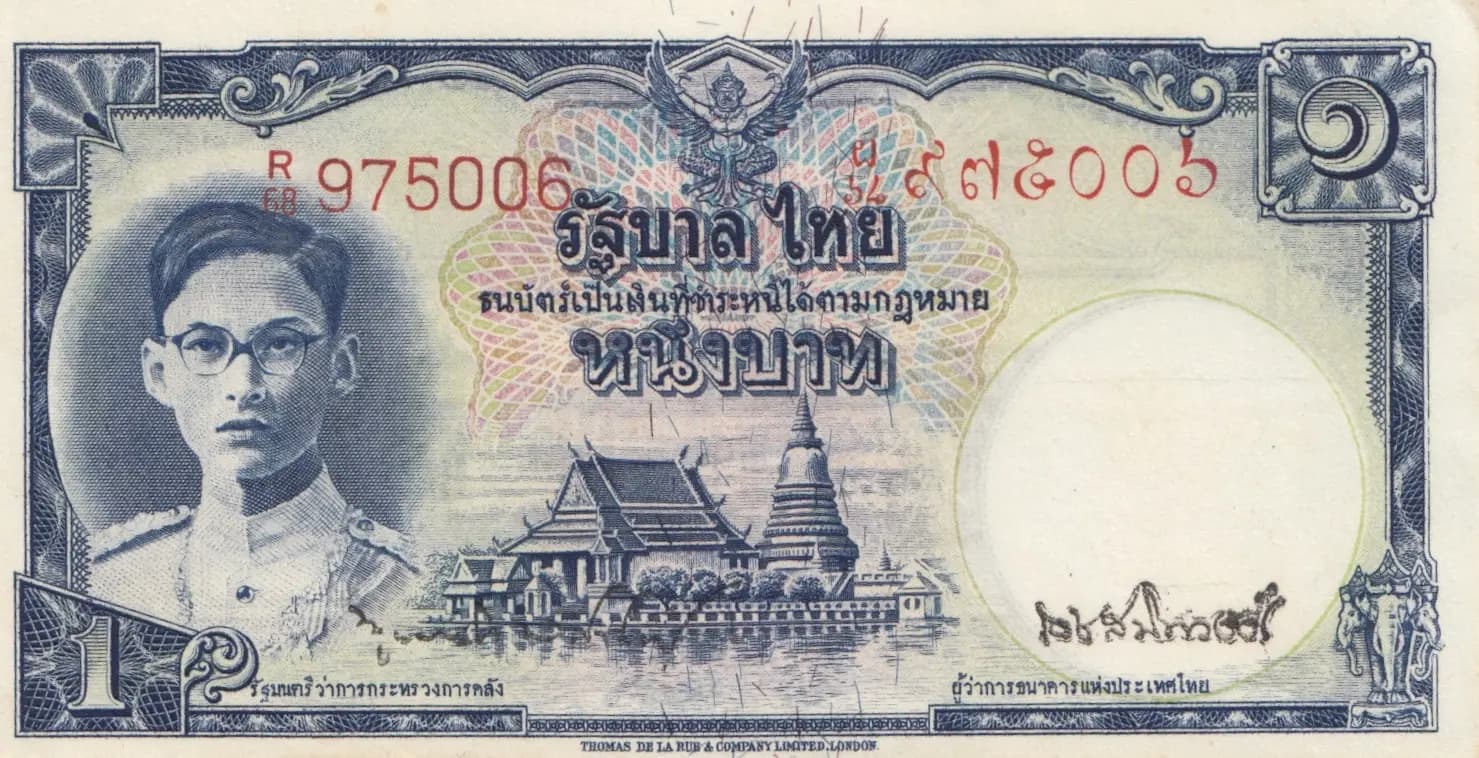
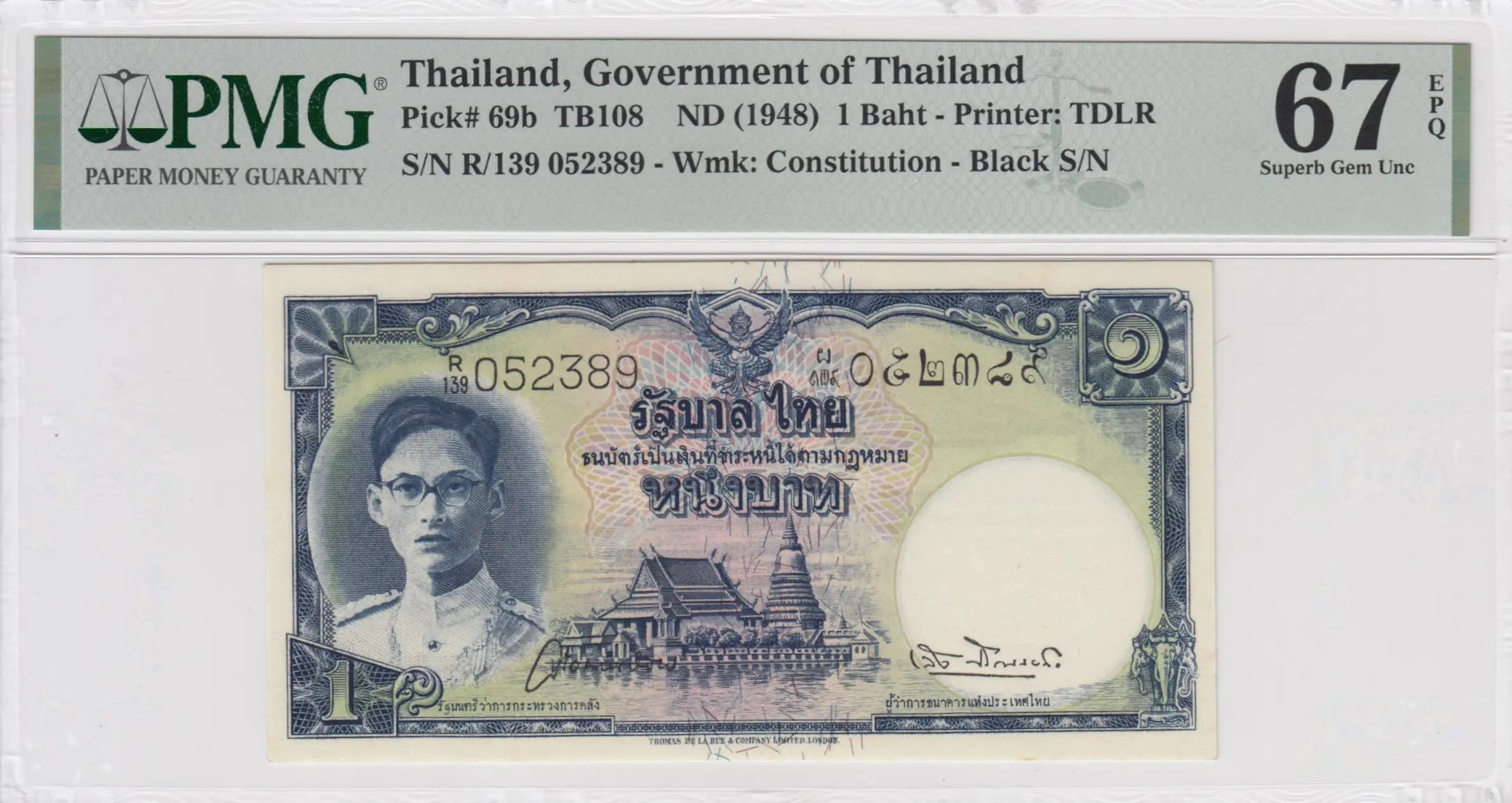
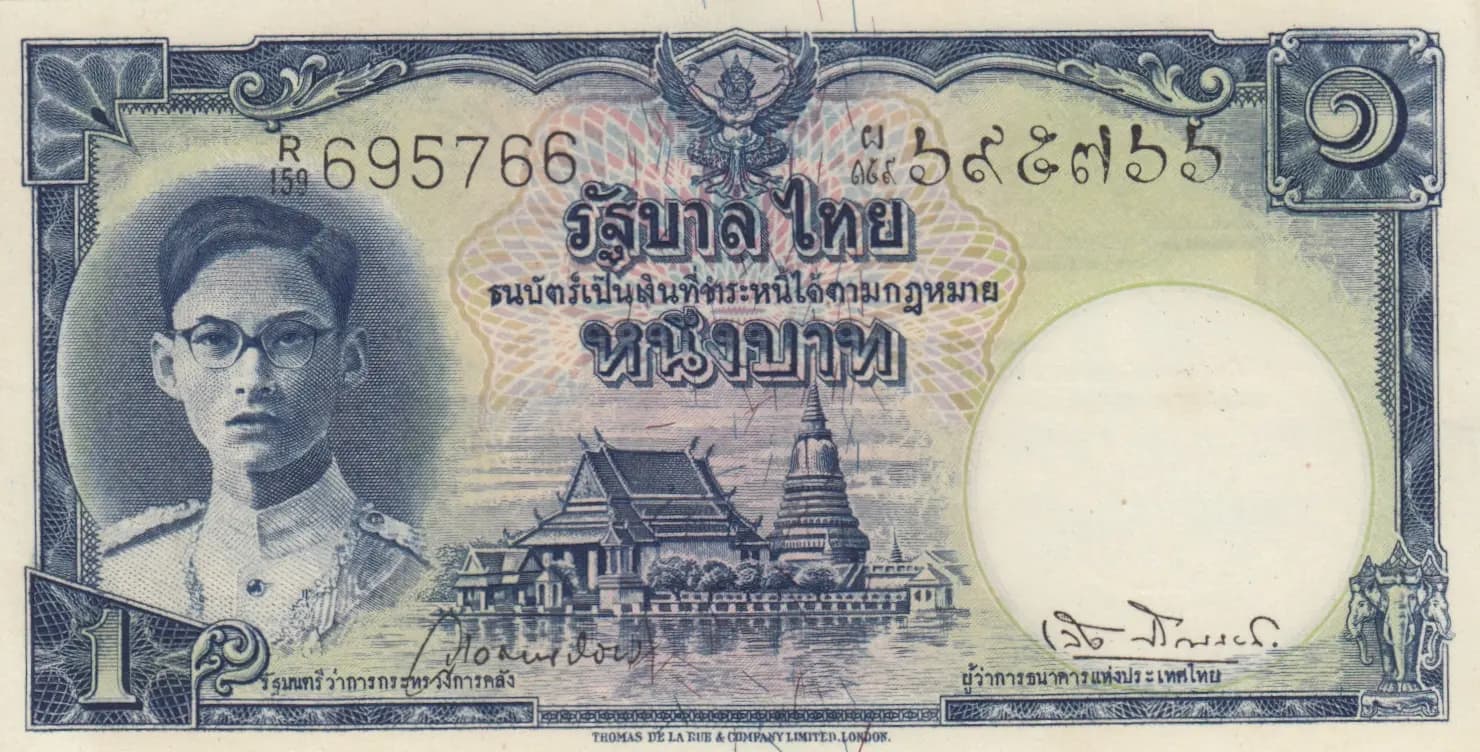
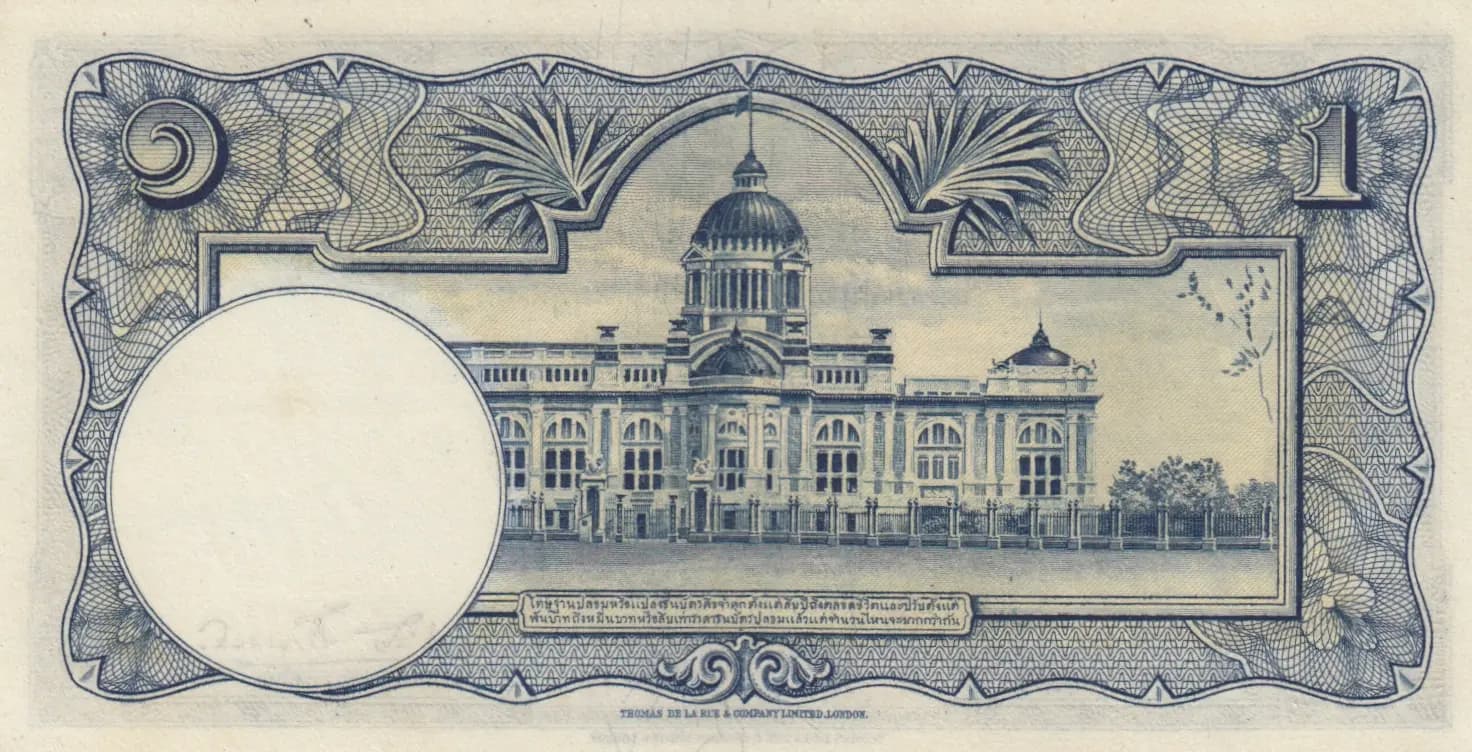
This is a 1948 Thai 1 Baht note (Pick P-69b) in AU condition, printed by Thomas de la Rue in London. The note features a portrait of King Rama IX Bhumibol Adulyadej in military dress on the obverse, with the reverse depicting a neoclassical government building with a prominent dome. The note exhibits natural aging with light yellowing and toning consistent with its age, but remains well-preserved with no significant damage, making it an attractive example of early Thai currency under King Bhumibol's reign.
Common. This note regularly appears on the secondary market with modest pricing typical of common early Thai banknotes. eBay sales data shows consistent sales in the $8-$16 range for circulated examples in AUNC condition, with even PMG-certified examples (PMG 63-64) selling for $37-$68 in 2018-2019. Current market values have stabilized lower at approximately $12-$13 for raw UNC examples. The combination of a straightforward regular issue from a major government with no documented scarcity, substantial print runs from a major security printer, and consistent low-to-moderate market prices all indicate this is a common date and denomination.
This 1 Baht note was issued in 1948, the first year of King Rama IX Bhumibol Adulyadej's reign following his accession to the throne. The portrait of the young king in military dress symbolized the authority and modernization of post-World War II Thailand. The reverse depicts a significant government building, likely the Royal Palace or government administrative building, reinforcing the nation's institutional stability during this foundational period of the current Thai monarchy.
The obverse features a formal portrait of King Bhumibol Adulyadej positioned on the left, depicted wearing eyeglasses and formal military dress with shoulder insignia. Above the portrait is an ornate emblem with a winged deity figure (likely representing Thai royal or celestial iconography) with a radiating crown or halo. The center contains the denomination and bank name in Thai script. A large circular space on the right side indicates the watermark area showing a Constitution on a tray/pedestal. The reverse displays a substantial neoclassical architectural structure with a central dome, multiple arched windows, columns, and formal façade elements, representative of a significant Thai government building. Both sides are framed by elaborate decorative scrollwork and guillochéd border patterns in blue and cream tones.
Front side: 'ธนาคารไทย' (Bank of Thailand); 'หนึ่งบาท' (One Baht); 'THOMAS DE LA RUE & COMPANY LIMITED, LONDON' (Printer attribution); Serial number 'R 695766'. Back side: 'THOMAS DE LA RUE & COMPANY LIMITED, LONDON' (Printer attribution); Additional Thai text present but not fully legible in provided image. The note includes legal and accounting disclaimers in Thai regarding asset accounting requirements.
This note was produced using intaglio (engraved) printing by Thomas de la Rue & Company Limited, London, as indicated on the note itself. The fine line engraving visible throughout, the detailed guillochéd pattern work in the background, and the precision of the security features (blue and red security threads noted in source material) are characteristic of De La Rue's high-security banknote production methods of the 1940s. The multiple color printing combines blue, green, and cream inks applied through successive engraved plate passes.
This note is cataloged as Pick P-69b, indicating it is a known variety of the 1948 1 Baht issue. The 'b' suffix typically denotes a secondary variety, possibly representing a different printer's state, signature variety, or security feature variant. The serial number observed (R 695766) with its 'R' prefix may indicate a specific printing series. The note matches the standard P-69b specifications: blue on multicolor underprint, portrait without collar insignia, blue and red security threads, and the characteristic watermark of a Constitution on a tray on pedestal. No additional major varieties or overprints are evident on the observed specimen.