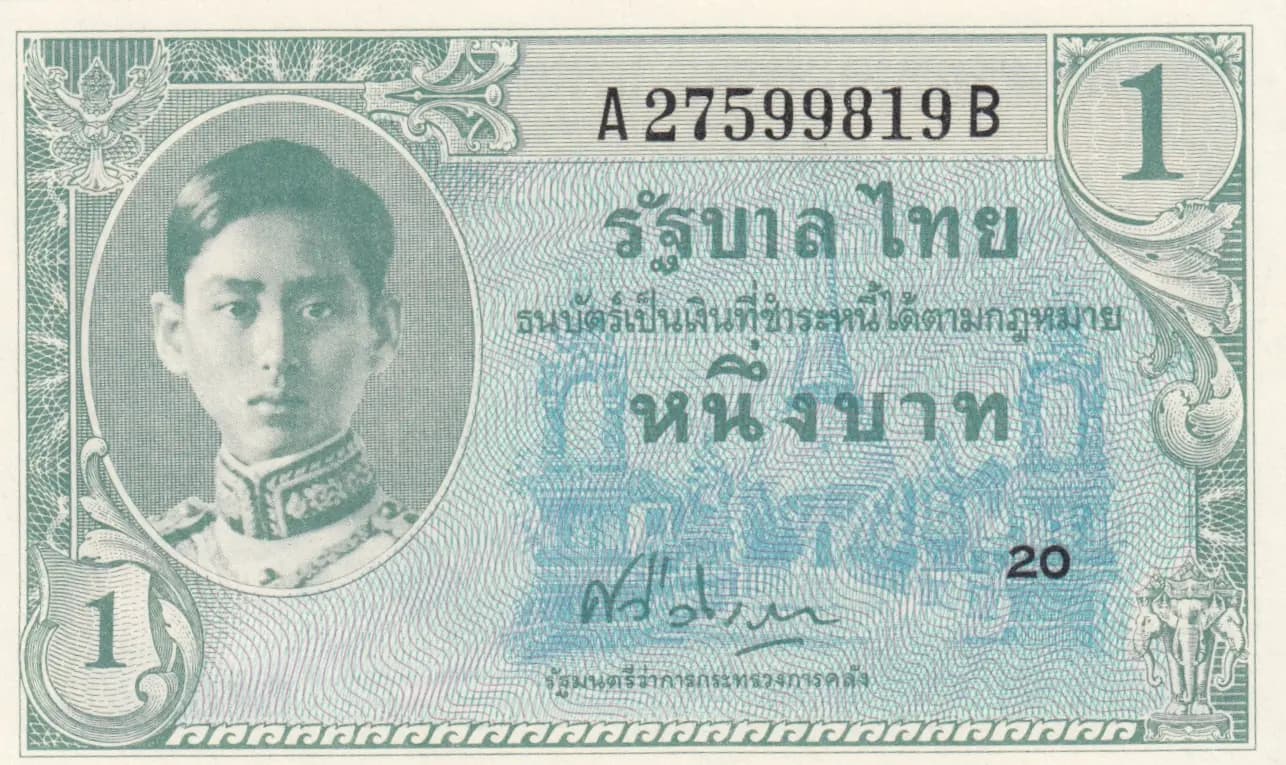
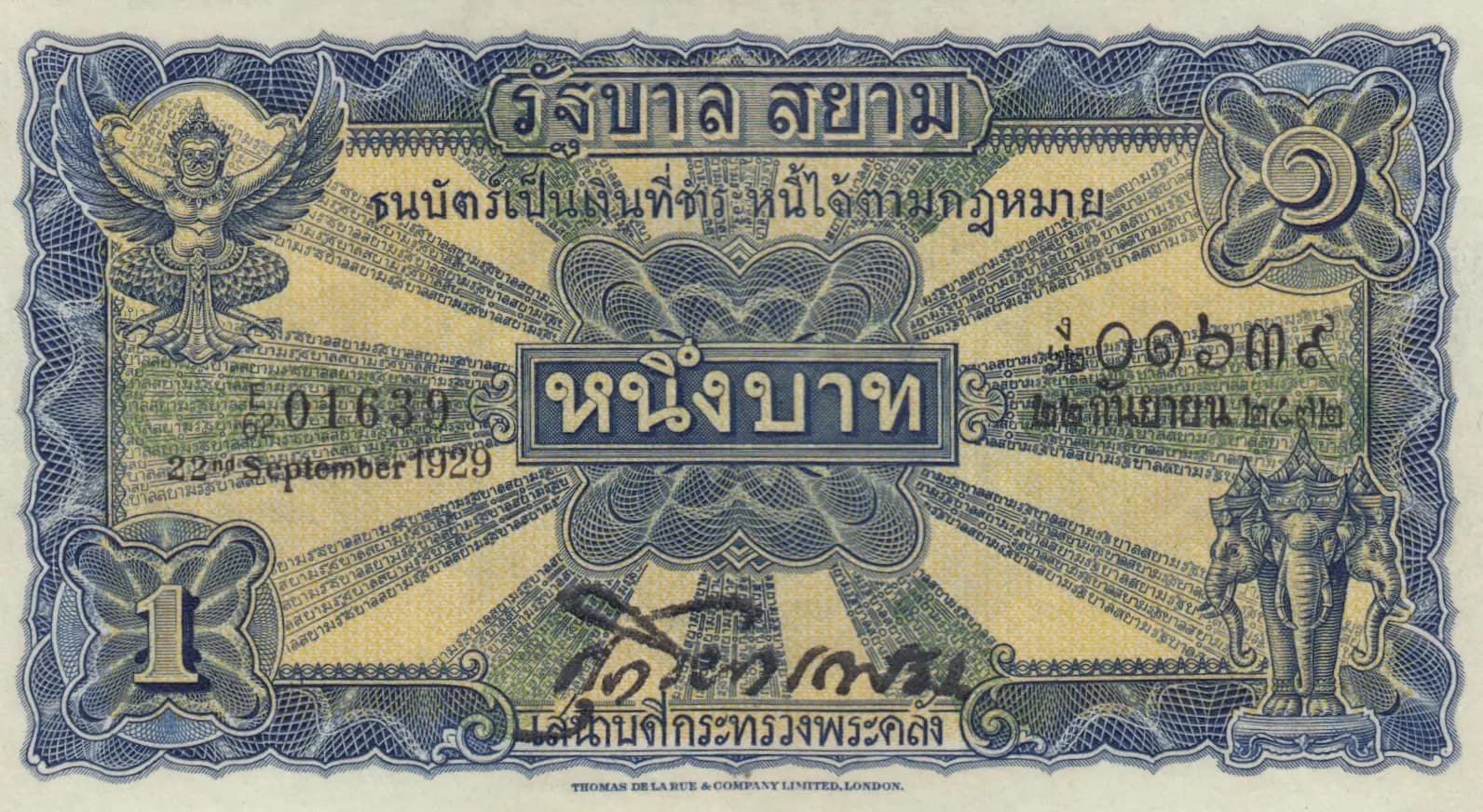
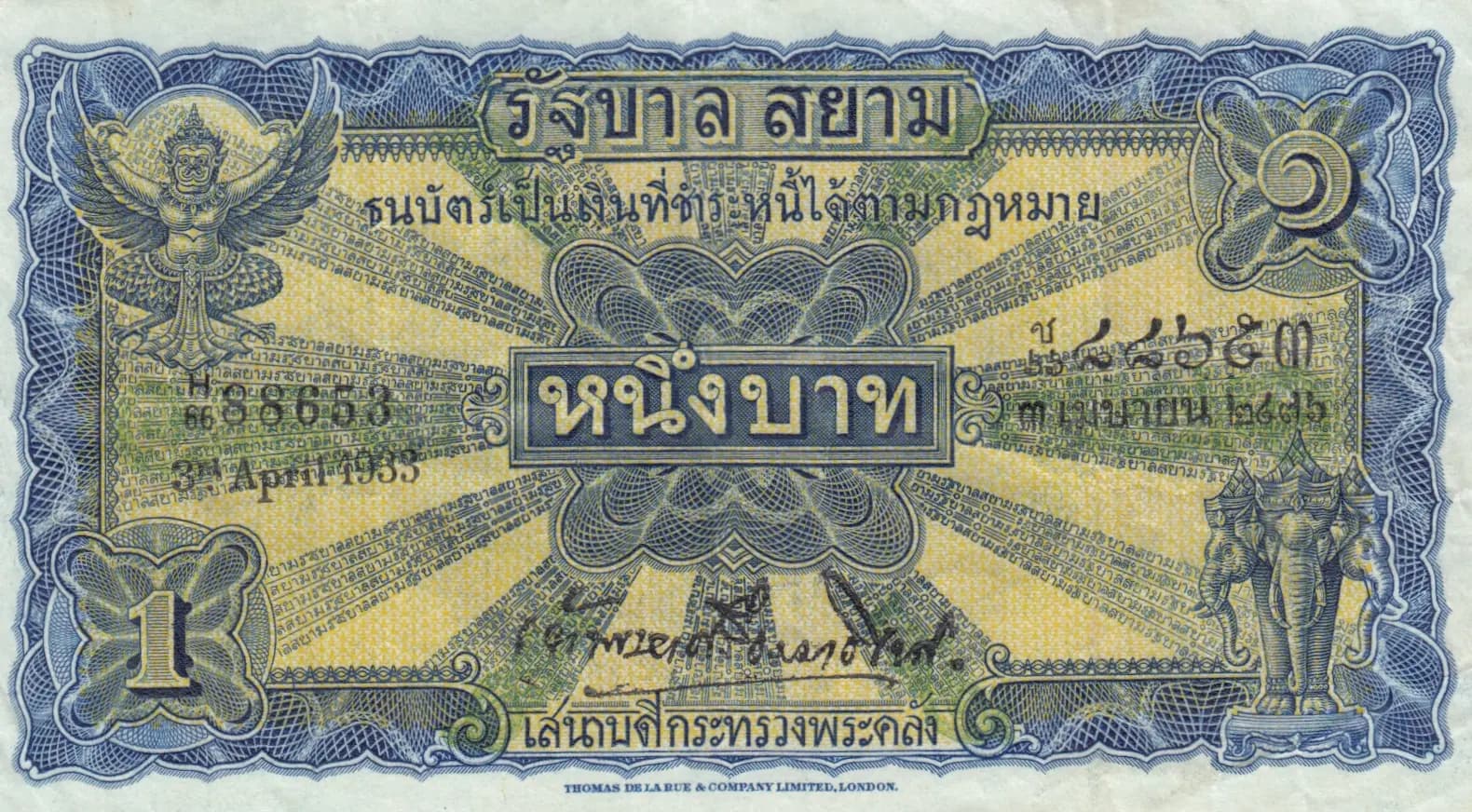
1 baht 1946
Market Prices
4 salesAbout This Note
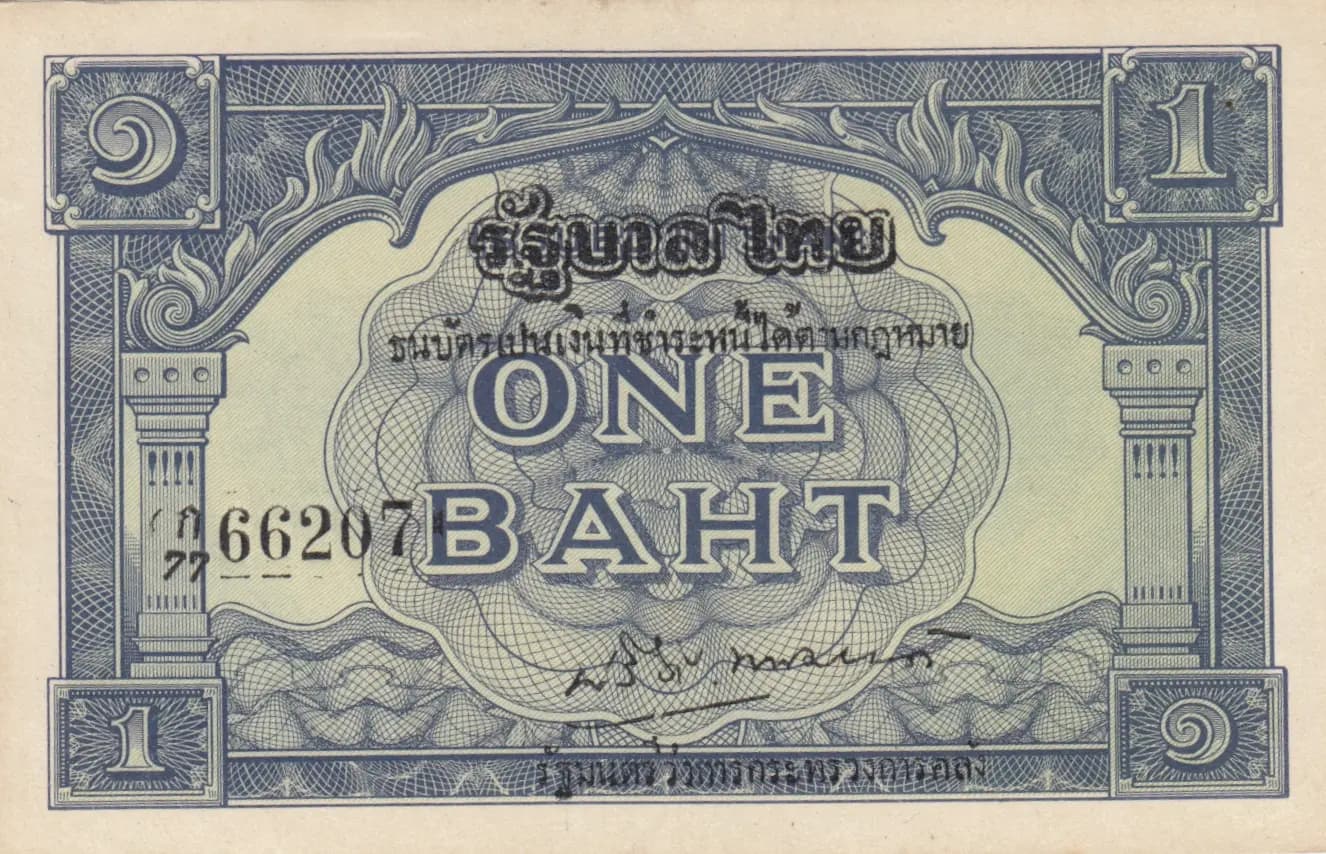
This is a 1 Baht banknote from 1946, issued by the Government of Thailand during the post-World War II period. The note exhibits the characteristic blue ink on pale olive underprint with ornate decorative borders, corner numerals, and a prominent 'ONE BAHT' overprint in English across the center of the front. In EF condition, the note shows expected age-related foxing and yellowing consistent with notes from this era, but retains sharp detail and good contrast throughout the intricate geometric cross-hatching and engraved designs.
Common. The eBay market data provided shows this note type regularly trading in the $50–$128 range for higher grades (PMG 58–64), with catalogue values of $2–$8 for lower grades. These moderate, predictable prices and consistent market activity indicate regular availability. The 1946 1 Baht was part of a standard regular issue with reasonable print runs typical of post-war currency production. No evidence of short print runs, recalls, or scarcity factors is apparent from the catalog or market data.
This 1946 issue represents Thailand's currency during the reign of King Rama VIII Ananda Mahidol, a significant period of post-war stabilization for the kingdom. The bilingual design with both Thai script and English inscriptions reflects Thailand's modernization efforts and international engagement following World War II. The ornate, traditional artistic style incorporating rosette patterns and classical border designs demonstrates the continuity of Thai cultural aesthetics in the nation's monetary system during this transitional period.
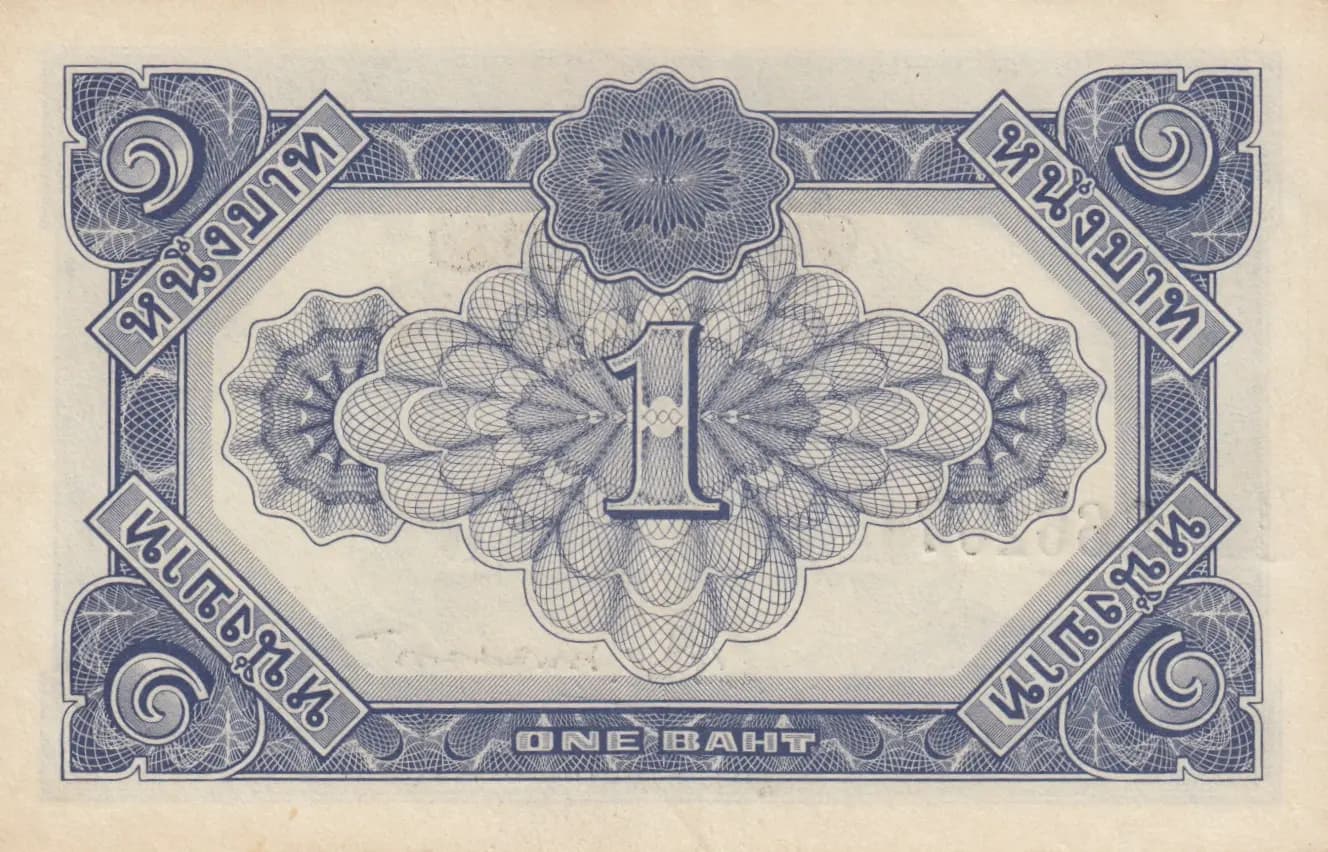
This 1946 Thai 1 Baht note features a sophisticated classical design centered on denomination display and decorative engraving rather than portraiture. The front presents a large cartouche frame with ornate scrollwork and floral designs housing Thai script above bilingual 'ONE BAHT' text in English. Denomination numerals '1' appear in circles at upper right and lower left corners, anchoring the design. The reverse showcases a dominant central numeral '1' surrounded by an elaborate symmetrical rosette or flower motif with fine petal detailing, framed by decorative borders. All four corners contain circular spiral ornamental designs. Throughout both sides, intricate geometric cross-hatching and fine line work create visual security and aesthetic complexity characteristic of high-quality banknote engraving.
Front: Thai script text appears above and below the central English denomination 'ONE BAHT' (representing the numeral and word form of the denomination). Serial number '66207' visible on left side. Back: 'ONE BAHT' printed in English at bottom center. Thai script appears in diagonal rectangular banners in all four corners, though specific translations cannot be reliably provided due to image quality and angled presentation. The Thai text likely contains issuer information, authority designations, or regulatory inscriptions typical of Thai currency of this period.
Intaglio (engraved) printing, the standard security printing method for currency of this period. The detailed cross-hatching patterns, fine line work, and complex rosette designs visible throughout both sides are characteristic of traditional hand-engraved banknote production. The crisp registration between the blue ink and pale olive underprint, along with the precision of the geometric patterns, indicates professional security printer work, likely from the British American Bank Note Company or a similar established note printer of the era who produced Thai currency during this period.
This specimen is catalogued as Pick P-62Ab (1 Baht variant). The catalog indicates two variants exist under base Pick number P-62: the 50 Satang on 10 Baht (P-62) and the 1 Baht (P-62Aa/P-62Ab). The visual analysis notes that this is an English printing with the characteristic '3-line black overprint' of 'ONE BAHT' at center on the face. The specific serial number '66207' observed on this specimen would distinguish it as an individual note, though without additional documentation on signature varieties or printing batches, the exact P-62Ab designation likely refers to specific printing characteristics or overprint placement that distinguishes it from the P-62Aa variant.