1 baht 1942
Market Prices
11 salesAbout This Note
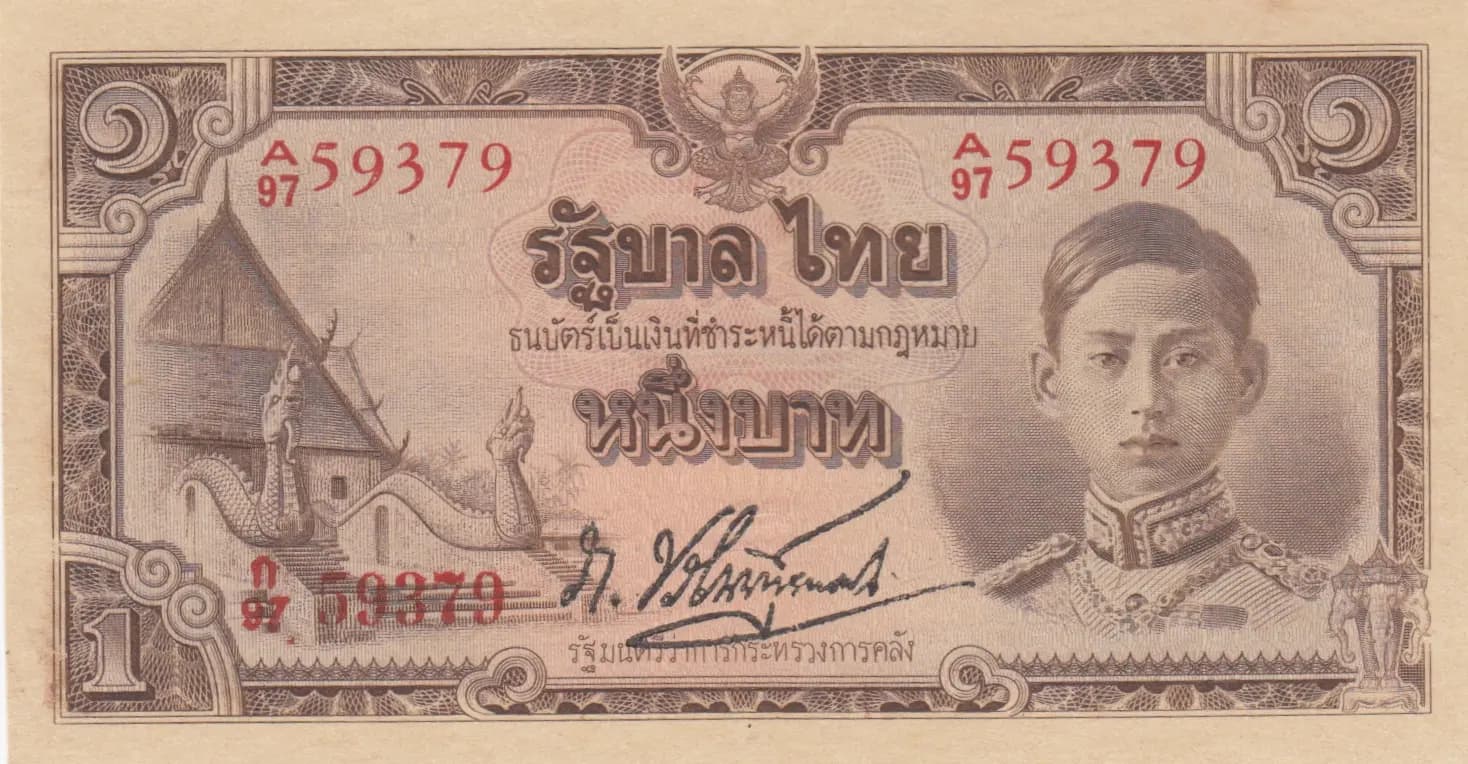
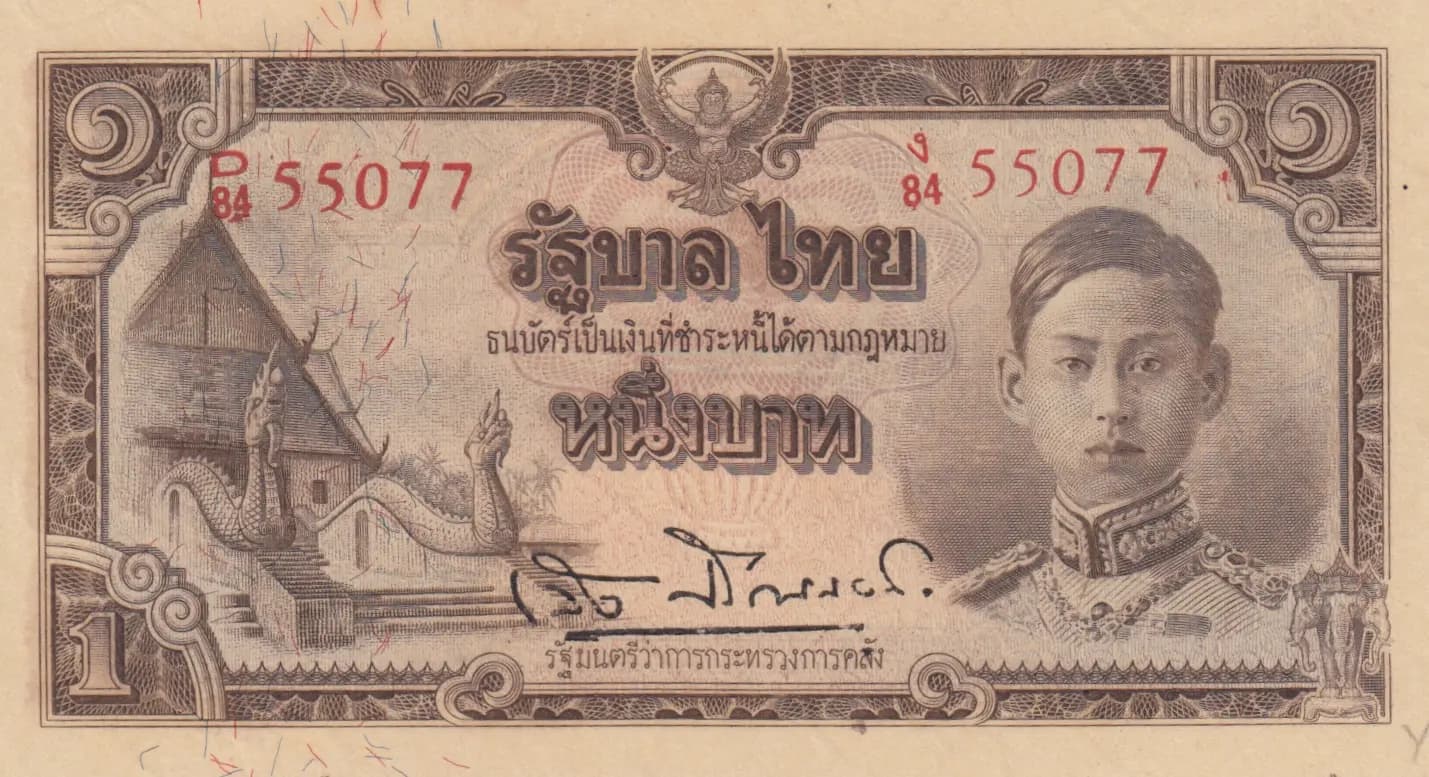
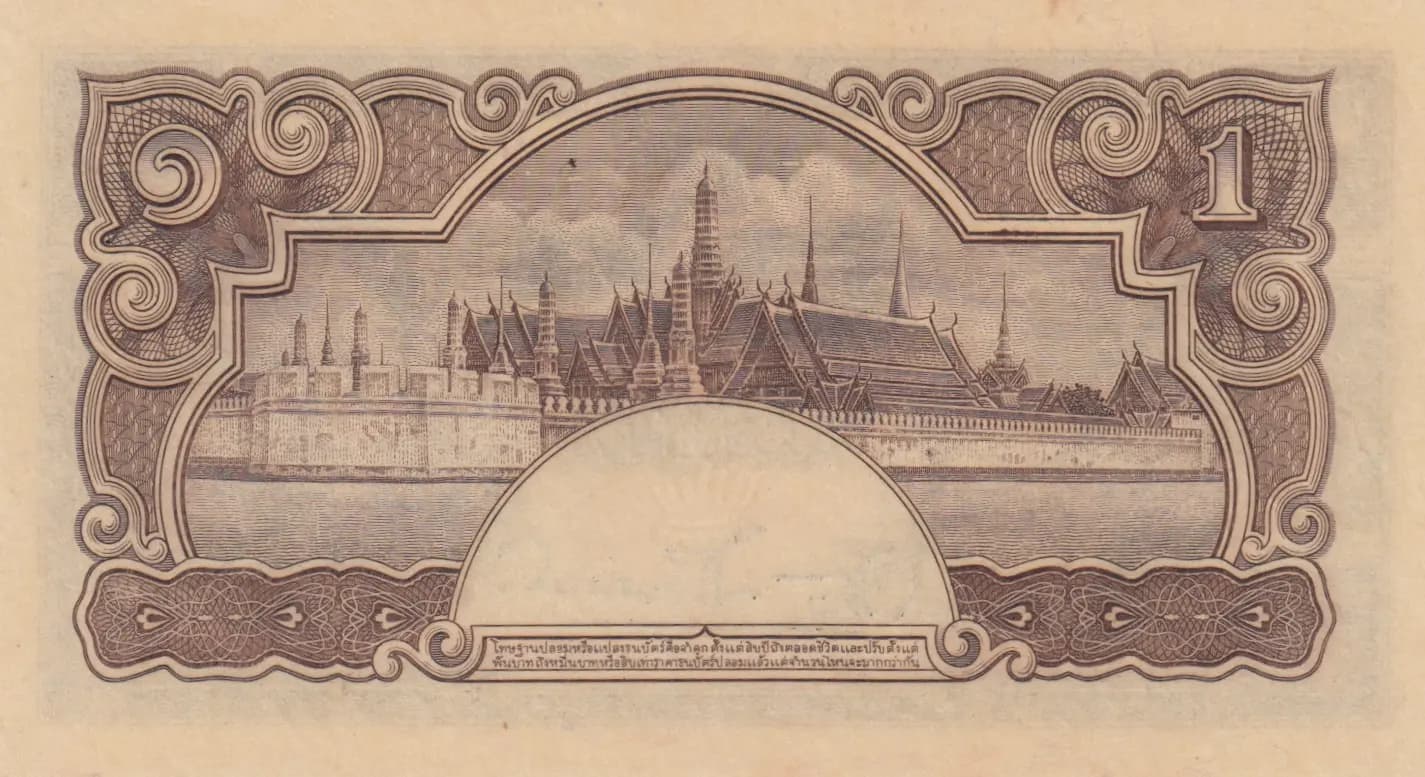
This is a Thai 1 Baht note from 1942 (Pick-44c, Type III) issued by the Government of Thailand, graded in UNC condition. The note displays the characteristic brown on pink underprint of this issue, featuring a portrait of King Rama VIII Ananda Mahidol on the obverse and an intricate engraving of the Royal Palace, Bangkok on the reverse. The visual analysis confirms excellent preservation with only light age-related yellowing and no major damage, making this an attractive example of early 1940s Thai currency.
Common. Historical eBay price data shows consistent circulation of this note type across a wide range of grades (VG through UNC), with sales regularly occurring at modest prices. UNC examples have historically sold for $40-255 depending on exact grade and market timing, with 2016 catalog values listing UNC at $40. The regular issue designation and evidence of multiple variants (P-44a through P-44s1) suggest a substantial print run. The appearance of numerous examples in the market across nearly a decade of recorded sales data (2014-2026) indicates this is a readily available issue for collectors.
This 1 Baht note was issued during 1942-1944, a period coinciding with Thailand's complex political position during World War II under King Rama VIII's reign (Ananda Mahidol, 1935-1946). The choice to feature the entrance to Wat Phumintr temple on the obverse and the Royal Palace complex on the reverse reflects the Thai government's emphasis on national pride and Buddhist religious institutions during this turbulent historical period. The ornate, traditional Thai artistic style of the engraving demonstrates the government's commitment to preserving Thai cultural identity through its currency design.
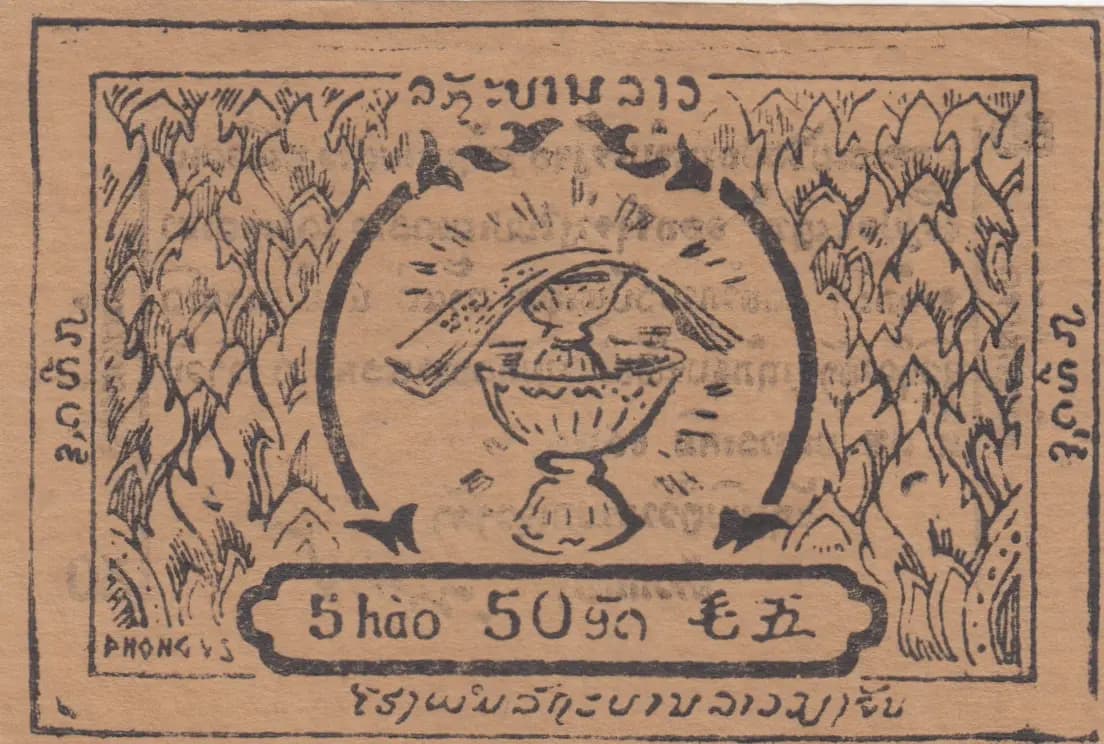
The obverse features a formal three-quarter portrait of King Rama VIII Ananda Mahidol positioned on the right side, depicted in military or diplomatic dress with an ornate collar, facing right. To the left is an architectural rendering of the entrance to Wat Phumintr temple, depicted with distinctive Thai peaked roofs and ornamental details, flanked by ornamental mythological snakes characteristic of Thai temple guardian imagery. A winged royal emblem appears at the top center, serving as the national symbol. The reverse presents an elaborate engraved landscape depicting the Grand Palace (Royal Palace, Bangkok) complex with multiple spires, peaked roofs, and fortification walls, with the architectural forms reflected in water below, all contained within an ornamental frame with spiral scrollwork corner flourishes. Both sides employ fine-line engraving with complex decorative background patterns throughout.
Front side: Central Thai text reads 'ธีราษฎร ไทย' (Thai People's currency); legal guarantee text 'ธนบัตรโปแลนมี่ที่จำระหนักได้จากกฎหมาย' (Banknote guaranteed by law); denomination designation 'ผลิตญาณทรม'; serial number visible as '84 55077' printed in red ink in upper corners. Additional official Thai text and signature appear on the note. Back side: Denomination numeral '1' indicating 1 Baht; Thai text along bottom border providing legal and official information regarding the banknote. All inscriptions employ fine engraved lettering consistent with official currency production standards.
This note was produced using traditional intaglio engraving (line engraving) by the Mitsui Trading Company, a Japanese security printer. The fine detail visible in the architectural renderings, portrait work, and intricate background patterns are characteristic of high-quality intaglio printing. The red serial numbers were applied as a secondary printing operation. The watermark features a Constitution symbol on a tray/pedestal, a sophisticated security feature typical of professional security printing of this era.
This note is cataloged as Pick-44c, specifically identified as Type III. According to PMG population reports, this base Pick number includes five cataloged variants: P-44a (with Constitution watermark), P-44b, P-44c (Type III), P-44r, and P-44s1. The visual analysis confirms no visible overprints, and the serial number format (84 55077) is consistent with the standard issue. No signature variations or unusual markings that would indicate a distinct sub-variety are apparent in the provided images.